
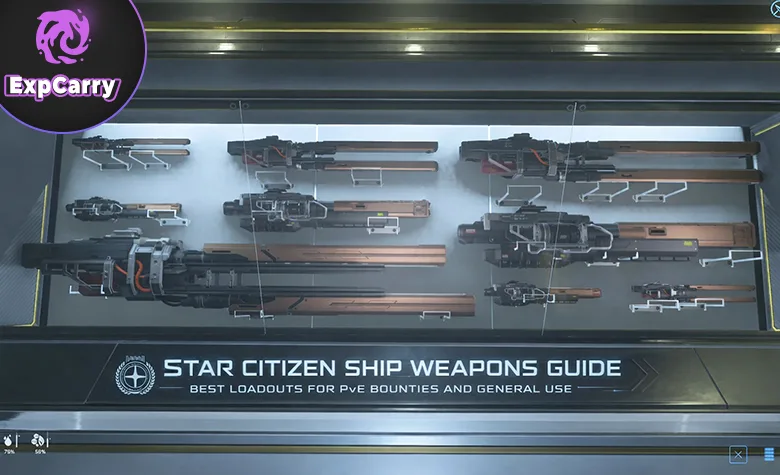
Star Citizen ship weapons fall into several overlapping categories: Cannons, Repeaters, Gatlings, Scatterguns and specialist weapons such as Distortion guns and Mass Drivers. Each family has different firing behavior, range, projectile velocity and ammunition requirements. Damage type matters just as much as weapon class, while the size of a ship's hardpoints determines which guns can actually be installed. For most mixed PvE encounters, laser repeaters are a dependable starting point, while cannons, ballistic gatlings and scatterguns reward more specialized target selection and flying styles.
Updated October 11, 2026. This guide covers ship weapon families, energy and physical damage, distortion effects, gun sizes, fixed and gimbaled mounts, capacitor use, projectile speed and practical loadout selection in Star Citizen Alpha 4.10.2 LIVE. It also explains the important weapon balance changes introduced in Alpha 4.10.0. The separate TTK/TTD Tech Preview tested during the 4.10.2 PTU cycle was not part of the October 9 LIVE release, so its experimental damage and shield values are not treated as current weapon statistics.
Quick answer: choose laser repeaters for flexible combat against agile ships, laser cannons for deliberate shots against larger targets, ballistic cannons and gatlings when penetration and concentrated damage justify limited ammunition, and scatterguns for very close-range engagements. Distortion weapons serve disable-oriented builds rather than replacing ordinary hull-damage weapons. Before purchasing anything, check the hardpoint size, available power, weapon grouping, projectile velocity and whether the mount can accept a replacement gun.
Star Citizen Ship Weapons at a Glance
Weapon behavior and damage type are separate choices. A cannon may fire an energy projectile or a physical ballistic round. A repeater may be laser-based, ballistic or distortion-based. Scatterguns also exist in both energy and ballistic versions, while not every gatling uses conventional ballistic ammunition.
| Weapon Family | Main Strength | Main Weakness | Best Use |
|---|---|---|---|
| Laser Repeaters | Frequent shots, consistent tracking and no physical ammunition restocking | Dependent on weapon capacitor, effective hit rate and shield or armor interactions | Mixed PvE, light fighters and general bounty hunting |
| Laser Cannons | Strong damage per hit and sustained use without ballistic ammunition | Missed shots waste larger firing opportunities | Medium and large targets, precision-focused bounty runs |
| Ballistic Cannons | Concentrated physical damage and penetration potential | Limited ammunition and potentially slower firing rhythm | Heavy targets, armor pressure and component-focused damage |
| Ballistic Gatlings | High-volume fire and strong concentrated pressure | Rapid ammunition consumption and hit-spread losses | Shorter aggressive fights and suitable armored targets |
| Scatterguns | Multiple projectiles with high potential damage at close range | Spread, falloff and inconsistent results at distance | Close-range combat against larger target profiles |
| Distortion Weapons | Disruption of ship systems and components | Not a universal replacement for lethal hull damage | Disable-oriented combat and coordinated hybrid loadouts |
| Mass Drivers and Specialist Cannons | Heavy individual shots or specialized damage behavior | Lower firing frequency and more demanding accuracy | Controlled engagements and specific target classes |
The most useful comparison is not theoretical DPS alone. A weapon that lands only a fraction of its shots may produce less effective damage than a weaker gun with better projectile speed and tracking. Likewise, an impressive short burst can be less valuable across a long bounty session if it requires repeated rearming.
For a broader explanation of shield resistance, armor, penetration and subsystem damage, see the Star Citizen Ship Weapons and Armor Guide. This article focuses on choosing and fitting the guns themselves.
Best Ship Weapons for General Use
Laser repeaters remain a practical default for mixed PvE because they combine frequent firing opportunities with the convenience of energy ammunition. They are especially useful when targets change direction often and the pilot needs to keep adjusting the firing solution.
That recommendation is not a claim that every repeater has the same projectile speed or is automatically stronger than every cannon. Individual weapon models have different range, rate of fire, damage, capacitor draw and handling characteristics. A well-matched cannon can outperform a repeater when the pilot has a consistent firing window.
Why Laser Repeaters Stay Reliable
Repeaters fire relatively frequent individual shots. Against a maneuvering target, that provides repeated opportunities to connect instead of relying on a small number of heavy hits. It is particularly useful when a target changes direction or passes across the aiming reticle.
Laser repeaters also draw ammunition from the ship's weapon capacitor rather than consuming finite physical rounds. They do not require landing at a station simply to purchase replacement ammunition, although their sustained output still depends on capacitor regeneration and power allocation.
Popular examples include the CF-series laser repeaters, Attrition-series repeaters and selected ship-specific laser repeaters. These are examples of weapon families rather than a guarantee that every variant is interchangeable or available at the same dealer.
When buying a replacement, prioritize the exact weapon size and the gun's current statistics. A Size 2 repeater cannot simply replace a Size 4 weapon unless the mount and any relevant adapter explicitly support that configuration.
Best General-Use Loadout Logic
For a solo fighter facing mixed PvE contracts, start by checking whether all compatible pilot guns can use laser repeaters with similar projectile velocities. Matching shot behavior generally makes it easier to use a consistent lead indicator and maintain effective fire.
Next, test capacitor endurance. A fighter with several energy weapons may have shorter firing bursts than expected because those weapons share a limited energy budget. Weapon count alone does not determine how long the ship can keep firing.
Finally, compare actual hits against small and medium targets. If a heavier weapon delivers better damage only when the enemy flies directly toward you, it may not be the strongest choice for your typical missions.
For replacement guns and components sold through in-game stores, aUEC is the relevant currency. ExpCarry's Star Citizen aUEC product can be used for the credits needed to purchase available equipment; it is not a direct listing for a specific ship-mounted weapon.
Star Citizen Ship Weapon Types: Cannons, Repeaters, Gatlings and Scatterguns
Each weapon family uses a different method of delivering damage. Understanding these differences is more useful than selecting one gun only because it has the largest number on a component website.
Cannons: Heavy Shots and Precision Damage
Cannons generally emphasize individual shot impact over sheer firing volume. They are suited to engagements where the pilot can maintain a stable attack line or exploit short opportunities to land decisive hits.
Laser cannons offer this behavior without requiring physical ammunition restocking. Examples include the Behring M3A, M4A, M5A, M6A and M7A families and various Omnisky cannons, with each model occupying its own weapon size.
Ballistic cannons trade ammunition independence for physical projectiles and penetration-oriented damage. The Deadbolt family and Tarantula GT-870 models are familiar examples. Heavy ballistic cannons can be useful when their impact is sufficient to overcome the target's protective layers and damage vulnerable sections or internal components.
Mass Drivers are another cannon-style option. Weapons such as the Sledge and Strife emphasize relatively heavy shots and reward accuracy. They are less forgiving when the target makes an unexpected maneuver during the firing window.
Specialist cannons also include Neutron, Distortion and Tachyon designs. Their behavior is not identical simply because they use the word Cannon. Check the specific damage classification, velocity, effective range and availability of each model.
When to choose cannons: prioritize them against larger targets, slower ships and situations where you can reliably control the firing angle. Against small fighters, the higher impact per shot can be wasted if the weapon's handling makes consistent hits difficult.
Repeaters: Tracking, Sustained Pressure and Flexibility
Repeaters prioritize frequent firing opportunities. Laser repeaters are common in general-purpose combat builds, but the family also includes ballistic repeaters, neutron repeaters and distortion repeaters.
Examples of laser repeaters include the CF-227 Badger, CF-337 Panther, CF-447 Rhino and Attrition models. Individual versions vary in size and their actual performance depends on the current balance data.
Ballistic repeaters consume physical ammunition and can provide a different damage profile. They should not automatically be treated as having the same ammunition capacity, penetration behavior or sustained fire characteristics as laser repeaters.
Distortion repeaters sacrifice conventional destructive pressure to apply system-disruption effects. They become more relevant when the goal is to disable a ship or support another weapon group rather than simply destroy the target as quickly as possible.
When to choose repeaters: use them when the main challenge is maintaining consistent contact with agile enemies. Repeated hit opportunities are particularly valuable against fighters that frequently change direction.
Gatlings: High-Volume Fire and Ammunition Management
Gatlings deliver many rounds in rapid succession. Their main advantage is the ability to maintain concentrated projectile pressure when the target stays inside a useful firing lane.
Common ballistic examples include the YellowJacket GT-210, Scorpion GT-215, Mantis GT-220, Revenant and selected AD-series or other heavy ballistic gatlings.
Ballistic gatlings are not the same as ballistic cannons. Cannons concentrate damage into heavier individual shots, while gatlings distribute damage across a faster stream of comparatively smaller hits. Armor deflection and penetration rules can therefore affect these weapons differently even when a DPS display suggests comparable output.
High rate of fire also increases the cost of missing. A gatling can expend a significant portion of its ammunition during a long attempt to track a small evasive target.
Not every gatling uses ballistic ammunition. The Thlilye Laser Gatling fitted to the Mirai Pulse, for example, uses an energy-based design. However, it is a bespoke weapon rather than a general-purpose interchangeable ship gun. Always verify the actual damage type, ammunition system and mounting restrictions rather than treating Gatling as a synonym for Ballistic.
When to choose gatlings: they are most useful when you can maintain contact with a target and intend to prioritize aggressive damage over long periods without resupply.
Scatterguns: Close-Range Damage and Pellet Spread
Scatterguns fire multiple projectiles in a spread rather than one tightly grouped shot. They can deliver substantial damage when enough projectiles connect, but their effectiveness falls sharply when the target is distant or small enough that many pellets miss.
Star Citizen has both energy and ballistic scatterguns. The Dominance family is an example of laser scatterguns, while the Havoc, Hellion and Predator families provide ballistic examples.
The important number is not simply the total damage of a complete spread. You also need to consider how many projectiles actually hit the target at the distance where you normally fight.
Against a large ship at close range, the target's profile may allow many pellets to connect. Against a small fighter moving across the reticle, the same attack can lose a significant share of its potential damage.
Scatterguns are therefore specialist weapons. They reward aggressive approach control, reliable positioning and the ability to remain close enough for the spread to matter.
When to choose scatterguns: consider them for close-range fighting against targets you can approach and keep within a narrow engagement distance. Avoid treating their full-spread damage as guaranteed output at longer ranges.
Explore services related to this guide, selected from our Star Citizen catalog.
View All Star Citizen Services

Star Citizen Ship Weapon Damage Types Explained
A weapon's firing pattern does not determine the type of damage it deals. Cannons can be energy-based or ballistic. Repeaters can be laser, ballistic or distortion. Scatterguns can use laser or physical ammunition. This distinction matters because shields, armor and components do not respond identically to every damage category.
| Damage Type | Typical Sources | Combat Role | Important Limitation |
|---|---|---|---|
| Energy | Laser cannons, laser repeaters, laser scatterguns and some specialist guns | Shield pressure and repeatable damage without physical ammunition restocking | Capacitor demand, shield resistance and armor effects still apply |
| Physical / Ballistic | Ballistic cannons, gatlings, mass drivers and ballistic scatterguns | Physical damage, armor interaction and potential penetration | Limited ammunition; shield absorption and armor deflection can reduce effectiveness |
| Distortion | Distortion cannons and repeaters | Interference with ship systems and component operation | Does not replace a conventional destructive weapon in every encounter |
| Explosive | Missiles, torpedoes and selected explosive weapons | Burst damage, external damage and forcing defensive responses | Requires appropriate ordnance, targeting and countermeasure management |
| Specialist energy or projectile designs | Neutron, plasma and tachyon weapon families | Different projectile or firing characteristics depending on the specific weapon | The weapon's name does not by itself establish a universal armor or shield multiplier |
Energy Damage and Shields
Energy weapons provide sustained offensive potential without finite ballistic ammunition. They are useful for maintaining shield pressure and repeatedly attacking a target during a long encounter.
However, energy weapons are not exempt from the game's defensive mechanics. Shield resistance, armor values, weapon size and the target's current condition all influence the actual result of each shot.
When evaluating a laser cannon or repeater, compare not only burst damage but also capacitor recovery, effective range and how reliably its projectiles connect.
Physical Damage, Armor and Penetration
Ballistic weapons apply physical damage. Their interactions with shields and armor are more complicated than the idea that every ballistic shot simply ignores shields and directly damages the hull.
Actual damage depends on shield absorption or resistance, armor deflection, weapon impact strength and the target's physical protection. Smaller ballistic projectiles may struggle against armor that stronger individual shots can overcome.
That is why two ballistic weapons with similar theoretical DPS may perform differently against the same armored target. A heavy cannon may create fewer but more significant impacts, while a gatling applies many smaller hits.
Do not assume that every ballistic gun is automatically the fastest way to destroy a capital ship. The target's protective layers and the size of the selected weapon still matter.
Distortion Damage and Disabling Ships
Distortion weapons are designed around disruption rather than ordinary hull destruction. Their effects are most valuable when players are attempting to interfere with power, shielding or other systems instead of immediately destroying the target.
Distortion can contribute to disable-focused combat, particularly when the attacking ship or group can capitalize on weakened systems. It does not automatically shut down every target and should not be presented as a guaranteed bypass of modern armor or component protection.
For mixed builds, dedicate distortion weapons to an intentional purpose. If your main objective is a fast destructive PvE kill, carrying too much distortion may reduce the direct damage available for finishing the target.
Explosive, Neutron, Plasma and Tachyon Weapons
Missiles and torpedoes use explosive ordnance and follow different targeting, countermeasure and ammunition rules from ordinary ship guns. They should be evaluated separately from fixed energy or ballistic weapon groups.
Neutron, plasma and tachyon are also names associated with specialist weapon technology. Do not assume they form three completely separate universal defense categories simply because their descriptions differ from ordinary laser weapons.
For these weapons, the current damage classification and individual projectile behavior are more useful than a general rule that all plasma, neutron or tachyon guns behave identically.
The Ship Weapons and Armor Guide goes deeper into the interaction between weapon damage, armor, penetration and physical components.
Star Citizen Weapon Sizes and Hardpoints
Ship weapons are fitted through hardpoints with specific size limits. The size of a gun determines its compatibility with a mount, but it does not independently prove how much damage the weapon can deliver against every target.
Size 1 through Size 5 guns are common points of comparison for fighters and smaller combat ships. Larger vessels may have Size 6, Size 7, Size 8 or even bigger weapons, some of which are built for specific hulls or turrets and cannot simply be exchanged for every other gun of the same nominal size.
| Weapon Size | Typical Use | Examples | What to Check |
|---|---|---|---|
| Size 1 (S1) | Starter ships, light weapon mounts, smaller combat platforms | M3A Cannon, Deadbolt I, Attrition-1 | Hardpoint compatibility and limited damage against heavy armor |
| Size 2 (S2) | Small fighters and secondary gun mounts | M4A Cannon, Deadbolt II, selected laser and distortion repeaters | Projectile behavior and the ship's available capacitor or ammo capacity |
| Size 3 (S3) | Fighters, medium gun mounts and larger secondary weapons | M5A Cannon, CF-337 Panther, Mantis GT-220, Dominance-3 | Tracking, sustained output and protection of intended targets |
| Size 4 (S4) | Heavy fighters, larger pilot weapons and some turrets | M6A Cannon, Deadbolt IV, selected Size 4 Gatlings | Gun placement, firing arcs and ability to overcome relevant armor |
| Size 5 (S5) | Heavy fighters, large-ship guns and specialized combat platforms | M7A Cannon, Deadbolt V, AD5B and other heavy guns | Hardpoint restrictions, power, ammunition and target class |
| Size 6 and above | Large multicrew ships, anti-ship turrets and capital-class weapons | Heavy turrets, specialist cannons, spinal weapons and bespoke systems | Whether the weapon is replaceable, turret-locked or exclusive to the hull |
The table describes common applications, not a universal permission list. Some ships have bespoke mounts, restricted weapon families or integrated guns that cannot be replaced freely.
Example: the Mirai Guardian MX [LTI] is an actual ExpCarry heavy-fighter product with four Size 4 guns. It is a useful example of a ship designed around multiple heavy pilot-controlled weapons. The product is a ship pledge, not a listing for four separately delivered cannons.
Fixed Weapons vs. Gimbaled Weapons
Fixed weapons follow the ship's main firing direction and reward precise positioning. Gimbaled weapons allow the aiming mechanism to move within the mount's limits, helping pilots track targets without keeping the entire ship aligned perfectly.
One outdated rule still appears in many Star Citizen guides: that fitting a gimbal always requires a weapon one size smaller than the hardpoint. That rule applied to older implementations, but the Alpha 3.23 gunnery overhaul changed the system so compatible gimbals can carry weapons of the same size.
For example, a compatible Size 3 gimbal does not automatically force a Size 2 gun. The actual restriction depends on the ship's hardpoint, the mount and any bespoke equipment rules.
Gimbaled operation is also not free performance. CIG's updated gunnery system uses different firing modes, with fixed mode providing the highest rate of fire and corresponding maximum output under the relevant weapon settings.
Auto-gimbal behavior is not universally available to pilot weapons. Following the Alpha 3.23 changes, automatic gimbal operation was reserved for appropriate turrets rather than the former general pilot auto-gimbal implementation.
For the original system explanation, see the official Alpha 3.23 gunnery notes. Always check the current LIVE ship configuration because individual hardpoints can receive later fixes.
Turrets, Bespoke Guns and Multicrew Ships
Turret hardpoints have their own aiming arcs, control arrangements and weapon restrictions. A weapon mounted in a turret does not necessarily have the same tracking opportunities as an identical gun mounted directly on the pilot-controlled hull.
Large ships can also carry bespoke weapons that are part of their design rather than freely interchangeable component slots. In these cases, a high nominal weapon size does not guarantee that the player can substitute another gun of the same size.
Multicrew ships benefit from independent firing positions because turret operators can maintain target pressure while the pilot handles movement and positioning.
The RSI Perseus [LTI] is a relevant ExpCarry ship product for players interested in heavy ship-mounted guns and crew-operated turrets. Its product page describes a heavy patrol gunship pledge with dedicated combat positions; it is not a standalone heavy-cannon purchase.
For smaller platforms, a well-handled fighter with several compatible pilot guns may be more efficient than a large multicrew ship operated without the crew needed to use its turrets properly.
Missile Racks Are Separate From Gun Hardpoints
Missile and torpedo mounts are not interchangeable with ordinary cannon, repeater or gatling hardpoints. Each ship has its own ordnance capacity, rack arrangement and compatibility limits.
A Size 4 gun hardpoint does not automatically accept a Size 4 missile rack, and fitting missiles is not simply another way of using spare gun slots.
When planning a complete combat build, check pilot guns, turret weapons, missile racks, countermeasures and power systems as separate categories.
Best Ship Weapons for PvE Bounties
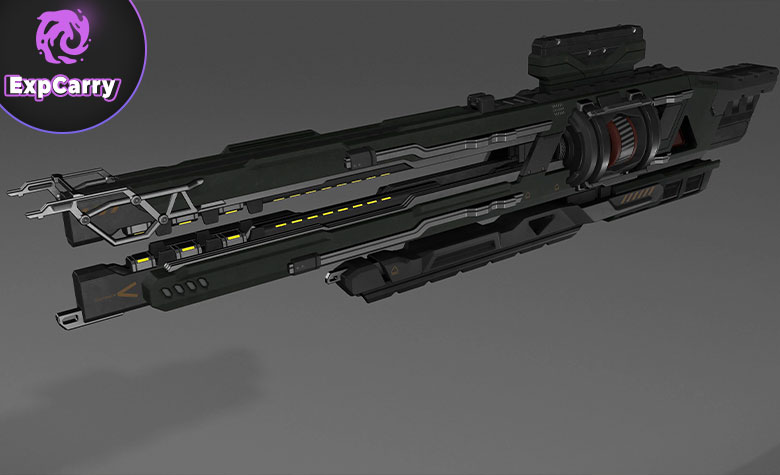
PvE bounty contracts involve very different enemy profiles. Small fighters reward accuracy and rapid target reacquisition, while larger ships offer more predictable firing windows but may have stronger shields, armor and internal components.
That is why a single weapon configuration rarely provides optimal results for every bounty level. The best setup depends on the target and whether your priority is killing one ship quickly or completing many contracts without rearming.
Laser Cannons for Heavy PvE Targets
Laser cannons are useful when a bounty target remains within a reliable firing lane. Each accurate hit carries more weight than a light stream of repeater fire, and the absence of physical ammunition allows continued operations without ballistic restocking.
Medium and heavy ships can provide the larger target profile needed to use these weapons effectively. Their exact armor and shield interaction still depends on the current combat model, so stronger individual hits do not guarantee a favorable result against every large hull.
Before investing in several large energy cannons, check the weapon capacitor and power requirements. A loadout that exhausts its energy budget immediately may be less convenient than its burst figures suggest.
When Cannons Beat Repeaters
Choose cannons when you regularly fight larger targets and can land deliberate shots. Choose repeaters when the enemy is difficult to track and the main challenge is keeping shots on target.
Projectile velocity matters in that decision. If your cannon shots travel substantially more slowly than your repeater shots, maintaining a good firing solution against a maneuvering target becomes harder.
Against a slow or large ship, that difference may be less important because the target presents a broad profile and changes direction less aggressively.
There is no reason to choose cannons merely because they have a larger damage-per-shot value. Compare the actual hit rate, sustained output and target response.
Ballistic Cannons for Armor and Component Pressure
Ballistic cannons become attractive when the target's defense can be overcome by concentrated physical impacts and penetration into vulnerable areas is relevant.
Heavy weapons such as the Deadbolt series are better evaluated against the armor class and physical resistance of the intended target rather than against a universal DPS ranking.
Limited ammunition is the main economic drawback. Even a powerful setup can lose efficiency if completing several bounty contracts requires repeated trips to a rearming location.
Players planning multiple loadouts can calculate their required aUEC with the Star Citizen aUEC Calculator and, if needed, compare the available aUEC product for purchasing compatible components in-game.
Ballistic Weapons for Fast Kills
Ballistic weapons are useful when the goal is concentrated physical damage, penetration and aggressive combat. They are not automatically superior to energy weapons merely because they can interact with shields and armor differently.
Current ship combat makes impact strength and armor interaction important. A weapon delivering many weak hits may struggle against a target that resists those impacts, even if the weapon's theoretical DPS is high.
Why Ballistic Weapons Hit Hard
Ballistic cannons, repeaters and gatlings can create strong pressure when their physical damage interacts favorably with a target's defensive layers. Their advantages are particularly noticeable when the attacking ship can maintain good accuracy and capitalize on weakened protection.
However, weapon family alone is not enough to predict armor performance. A large ballistic cannon and a small gatling may have radically different results against the same target.
Alpha 4.10.0 specifically addressed the weakness of certain Size 4 ballistic gatlings. CIG increased their per-round damage by approximately 68% because they had inherited the balancing category and ammunition behavior of smaller Size 3 weapons. The change was intended to let the larger weapons perform appropriately against armor.
The same patch removed the unusually broad splash component from the Size 4 C-788 Combine Cannon and reduced its direct damage by approximately 10%. These are confirmed changes from the original 4.10 LIVE release, not speculative 4.10.2 Tech Preview adjustments.
When Ballistics Stop Being Worth It
Ballistic loadouts become less convenient when ammunition limits interrupt a long series of contracts. High-rate-of-fire weapons can empty their reserves quickly if the pilot misses too often or spends too much time firing outside effective range.
Another problem is poor weapon-target matching. Ballistics do not provide guaranteed penetration against every armor value, so choosing a smaller ballistic gun solely for its listed DPS can produce disappointing results against heavily protected ships.
For long solo PvE sessions, the convenience of laser weapons may outweigh the short-fight advantages of a ballistic setup. For shorter combat objectives or specific heavy targets, physical damage can still be worth the additional logistics.
Gatlings and Scatterguns: Close-Range Combat Choices
Gatlings and scatterguns both reward pilots who can control engagement distance, but they behave differently. Gatlings deliver rapid repeated impacts, while scatterguns distribute one attack across multiple projectiles.
Ballistic Gatlings Against Moving Targets
A gatling can maintain pressure during a sustained firing window, but its fast ammunition consumption makes accuracy particularly important. When many rounds miss, both effective damage and available ammunition decline quickly.
Heavy gatlings may be appropriate against larger ships whose profiles allow more reliable hits. Against fast fighters, the same setup can become wasteful if the pilot cannot maintain the target within the firing lane.
Some gatlings also have weapon-specific firing behavior or spool characteristics. Check the actual model rather than assuming every gatling reaches the same firing rate immediately.
Scatterguns Against Large Targets at Short Range
Scatterguns are strongest when a target fills enough of the firing area for multiple pellets to connect. At short range against a relatively large ship, this can produce substantial damage.
At longer distances, spread reduces the chance that every projectile lands on the target. Smaller ships are particularly difficult because much of the shot pattern can pass around their hull.
Do not compare a scattergun's complete close-range spread to a cannon's single shot without accounting for actual hit count. Their listed output represents different firing behaviors.
The most important questions are whether your ship can safely maintain a close approach, whether the target is large enough to absorb the shot pattern and whether the chosen scattergun uses finite ammunition or the weapon capacitor.
Distortion Weapons and Hybrid Loadouts
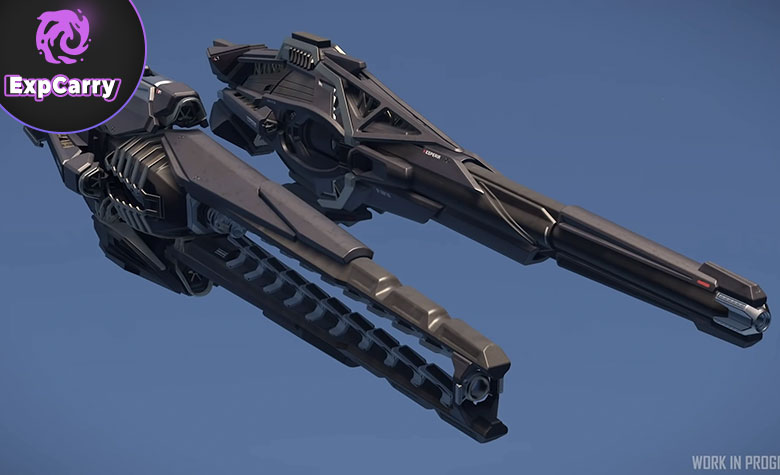
Distortion weapons are specialized tools for disrupting ship systems. They can support combat strategies focused on disabling a target, interfering with its operations or creating an advantage for another weapon group.
Hybrid loadouts combine different weapon behaviors to cover more than one combat requirement. This can be useful when the ship has enough hardpoints, capacitor capacity and ammunition reserves to support the mixture.
When Distortion Makes Sense
Distortion is relevant when disabling a ship serves a real mission objective or creates an opportunity for your crew. It may be useful in coordinated engagements where other weapons provide the necessary direct damage.
For ordinary solo PvE kills, replacing too much conventional firepower with distortion can reduce the loadout's ability to destroy targets efficiently.
Because system effects depend on the target's current protections and component condition, distortion should not be described as a guaranteed method for shutting down any ship instantly.
Best Hybrid Loadout Logic
A practical hybrid build starts with a reliable primary weapon group, then adds a second weapon type to solve a specific problem.
- Laser repeaters plus ballistic cannons: combine consistent energy fire with physical impacts when the target presents a suitable penetration opportunity.
- Laser cannons plus ballistic gatlings: balance deliberate energy shots with aggressive sustained physical pressure against appropriate targets.
- Laser repeaters plus distortion: maintain conventional offensive capability while including a disable-oriented option.
- Energy weapons plus missiles: retain long-session gun endurance while using separate ordnance for selected burst opportunities.
The most common hybrid mistake is mixing guns with substantially different projectile velocities and expecting every weapon to land against a moving target using the same aiming point.
Star Citizen calculates lead indicators according to weapon projectile behavior. Different speed groups may require different firing solutions, especially against small ships.
If your ship supports several weapon groups, organize guns so that different firing behaviors can be controlled deliberately rather than firing everything together regardless of range or lead.
How to Choose Ship Weapons for Your Loadout
There is no universal best weapon family without knowing the ship, the pilot, the target and the intended activity. A practical loadout should be assembled in a consistent order so incompatible parts and unrealistic damage comparisons do not waste aUEC.
- Identify the ship's exact weapon hardpoints. Confirm how many guns are pilot-controlled, which belong to turrets and whether the mounts have bespoke restrictions.
- Check weapon size. Match the replacement gun to the supported hardpoint and gimbal configuration. Do not apply the outdated universal one-size gimbal reduction rule.
- Choose the intended target. Small fighters, medium combat ships and heavy armored targets do not present the same accuracy or penetration requirements.
- Select the primary weapon family. Repeaters prioritize frequent hits, cannons prioritize stronger shots, gatlings emphasize volume and scatterguns favor close-range contact.
- Choose damage types. Consider energy endurance, ballistic ammunition and penetration, distortion utility or separate ordnance.
- Compare projectile velocities. Avoid combining weapons that require incompatible aiming solutions unless you can manage separate fire groups effectively.
- Check power and capacitor capacity. Several large energy guns can reduce available firing time even when each weapon is individually compatible.
- Verify ammunition and rearming costs. Ballistic ammunition may shorten the time you can remain outside a station.
- Test against real targets. Compare landed hits, time to disable or kill, remaining ammunition and ship condition across similar encounters.
- Adjust the loadout. Replace the weakest-performing part rather than assuming the entire ship needs a more expensive weapon family.
Weapon comparisons should also reflect the active build. Community databases can be useful for comparing models, but a table extracted from Alpha 4.10.1 does not automatically include every balance or equipment change in 4.10.2.
For individual weapons, sizes and current game-data references, consult the VerseToolkit ship weapons database or the SC DataHub weapon comparison tool. Check each site's stated data version before relying on exact values.
Best Weapons by Target Type
The easiest way to build a practical setup is to select weapons according to the target profile. Smaller ships place greater demands on tracking accuracy, while large ships make strong individual impacts and sustained pressure more relevant.
| Target or Activity | Useful Weapon Choices | Main Priority |
|---|---|---|
| Small and agile fighters | Laser repeaters and other high-consistency weapons | Projectile speed, frequent hits and tracking |
| Medium combat ships | Laser repeaters, laser cannons or compatible mixed builds | Reliable damage without sacrificing target tracking |
| Heavy fighters and gunships | Laser cannons, sufficiently powerful ballistic cannons or selected heavy gatlings | Impact strength, armor interaction and sustained offensive windows |
| Large armored ships | Appropriately sized heavy guns, supported turret fire and selected ordnance | Ability to overcome protection and maintain pressure |
| Close-range large targets | Compatible laser or ballistic scatterguns | Distance control and the number of pellets hitting |
| Disable-oriented combat | Distortion weapons supported by conventional damage | System disruption and converting the advantage into control |
| Long PvE bounty sessions | Mostly energy weapons | Capacitor endurance and reduced rearming downtime |
| Short aggressive engagements | Ballistic cannons, gatlings or carefully selected hybrid builds | Effective damage within a limited ammunition budget |
Best Weapons for Small Ships
Small ships are difficult targets because they can change direction quickly and present a narrow profile. Frequent shots and a manageable projectile travel time can be more valuable than the largest theoretical damage-per-hit figure.
Laser repeaters are a reasonable starting point, especially when several guns share similar projectile velocities. Cannons can still work, but the pilot needs to land enough individual hits to justify their slower firing rhythm.
Scatterguns are generally less dependable against small targets at longer ranges because pellet spread reduces the number of effective hits.
Best Weapons for Large Ships
Large targets offer wider firing windows but may have stronger armor, shielding and internal systems. The priority shifts toward maintaining meaningful pressure and selecting weapons powerful enough to interact favorably with the target's protection.
Laser cannons, appropriately sized ballistic cannons and heavy turret weapons can all contribute, depending on the specific ship and its available weapon mounts.
A high nominal DPS value does not prove that a small gun can overcome a much heavier target's armor. Test the actual result against the ship class you intend to fight.
For organized large-ship combat, a specialized multicrew vessel may be more suitable than fitting every available weapon onto a solo fighter. The ExpCarry Star Citizen Ships catalog includes combat vessels with different weapon configurations and crew requirements.
Best Loadout Rules That Always Work
A good loadout is built around consistent results, not one theoretical maximum. Choose weapons you can actually hit with, that fit your ship's hardpoints, and that remain useful for the duration and target types of your normal sessions.
The second important rule is to account for the entire ship. Available power, weapon capacitor, turret coverage, maneuverability and ammunition logistics can all change whether an otherwise strong gun performs well in practice.
Best Loadout for General Use
For ordinary mixed PvE, start with compatible laser repeaters where the ship's mounts and energy budget support them. This offers a practical balance between hit consistency, sustained combat and low ammunition-maintenance requirements.
If your ship uses several gun sizes, do not assume every slot needs an identical weapon model. Instead, try to keep projectile behavior and effective engagement range reasonably consistent so that the weapon groups work together.
Players upgrading their ship components can use Star Citizen aUEC for eligible in-game purchases. The exact weapon model, stock and location should be verified before making a purchase.
Best Loadout for Bounty Grinding
For bounty contracts involving heavier targets, laser cannons become attractive when the pilot can maintain a consistent attack line. Heavy ballistic cannons may provide another option when their damage and penetration justify ammunition expenditure.
For shorter aggressive runs, ballistic gatlings or a mixed setup can be effective, but their real value depends on how quickly the target falls compared with the time and cost needed to rearm.
Against light fighters, the general-purpose repeater setup may still be preferable. Do not sacrifice reliable tracking merely because a weapon has a stronger theoretical damage figure.
Star Citizen 4.10.2 Weapon Balance: What Actually Reached LIVE?
Alpha 4.10.2 reached LIVE on October 9, 2026. Its confirmed changes include a broader vehicle balance pass for the Constellation Mk IV, technical fixes and corrected shield-related behavior.
During September PTU testing, CIG also ran a separate Time-to-Kill and Time-to-Disable Tech Preview involving changes to shields, armor and weapon damage. CIG explicitly stated that the Tech Preview was not intended for the 4.10.2 LIVE release.
Therefore, experimental PTU figures such as large increases to energy alpha damage, ballistic alpha damage or shield health must not be presented as current 4.10.2 LIVE values.
Confirmed changes from the earlier 4.10.0 release, including the Size 4 ballistic gatling correction and the removal of the C-788 Combine Cannon's splash component, are part of the 4.10 branch's actual history.
For background on the development of the 4.10 branch, see the Star Citizen 4.10 Release Date, Patch Notes and Wipe Guide, which still describes the pre-release stage. For the actual current LIVE status, consult the official Alpha 4.10.2 LIVE patch notes.
Conclusion
If you want the clean answer, the best Star Citizen ship weapons are not one universal gun family. They are the weapon types that match the fights you are actually taking. Laser repeaters remain the safest general-use choice because they make mixed PvE smoother, easier to manage, and less dependent on perfect conditions. Laser cannons remain the stronger answer for larger bounty targets when your ship handling and aim can support them. Ballistics remain the aggressive fast-kill option. Distortion remains a utility choice that works best when it is used on purpose.
The bigger truth is that a good loadout should make the ship feel better in real contracts, not just in theory. Once you stop chasing one fake best weapon and start building around target type, ship behavior, and session comfort, your weapon choices become much easier to trust. That is where Star Citizen ship combat starts feeling less like guesswork and more like control.