
The question comes up constantly in CS2 communities: should I sell on Steam, or move my skins to a third-party platform? The answer is genuinely "it depends," but most players default to Steam Market because it's the path of least resistance — and that default costs them money over time.
This guide walks through when each option actually makes sense, based on what you're trying to accomplish.
The Steam Market reality check
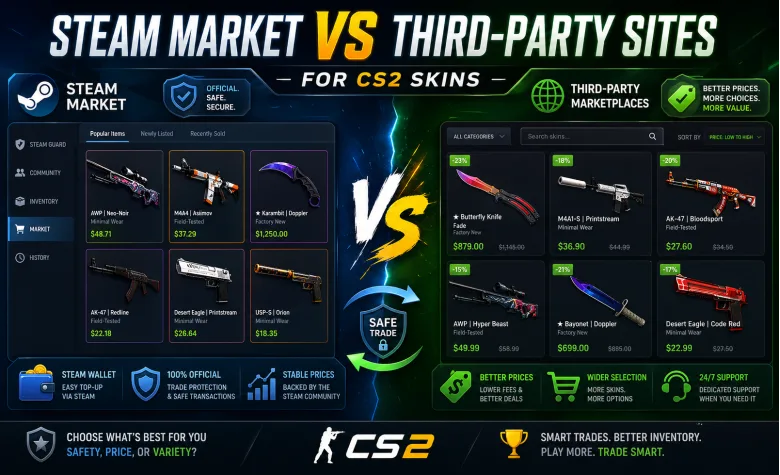
Valve's Community Market has two obvious advantages: it's built into the platform you're already using, and it's the safest possible execution because Valve handles every step. No accounts to create, no withdrawal flows to navigate, no third parties to trust.
The cost of those advantages is real money. Steam charges a 15% fee on every transaction — split between the game-specific fee and the Steam transaction fee — and the proceeds land in your Steam Wallet, which can only be spent on Steam. There's no way to convert Steam Wallet credit into actual currency">currency-farm">currency without violating the Steam Subscriber Agreement.
So the practical rule for Steam Market is straightforward: it's the right choice only if you plan to spend the proceeds on more Steam content. If you're a player who buys games regularly, selling skins on Steam to fund your library makes economic sense. If you want actual cash for your inventory, every Steam Market sale is a 15% tax plus a one-way ticket into a wallet you can't withdraw from.
When third-party platforms make sense
The moment you want real money, third-party platforms start winning the math by a lot. Seller fees on the major platforms range from 2% (CSFloat, BUFF Market) to 12% (Skinport's standard tier), with most settling between 4% and 8%. On a €500 skin sale, the difference between Steam's 15% and a P2P platform's 2% is €65 — for a single transaction.
Third-party platforms also pay out in actual currency. Bank transfer, PayPal, cryptocurrency, and various regional methods are all standard. The setup takes longer than Steam Market — you'll create an account, link your Steam profile, sometimes go through identity verification — but it's a one-time cost for repeated benefit.
The categories you'll encounter:
Peer-to-peer markets like CSFloat, Skinport, and BUFF163 list items from other users. You set your price, wait for a buyer, take payment. Lower fees, slower execution. Best for valuable items where waiting a few days is acceptable.
Bot-trading platforms like SkinsMonkey, Tradeit.gg, and CS.MONEY use automated inventories to give you instant trades. Faster, but the spread between buy and sell prices is wider — typically 5-15%. Best when you need to swap items quickly or when you'd rather take an immediate hit than monitor listings.
Instant cash services dump skins for around 70-80% of market value with near-immediate payout. Useful in emergencies, terrible for normal trading.
Picking the right platform for the trade
The trade itself should drive the platform choice, not loyalty to a brand. A few common scenarios:
If you're cashing out a high-value knife, the priorities are minimum fees and reliable payout. CSFloat (2% seller fee) and BUFF Market (2.5%) win this comparison. Skinport's standard tier looks worse on paper but offers the strongest EU consumer protection and bank-transfer payouts, which matters more on €1,500+ items than on €50 ones.
If you want to refresh your inventory by swapping items, bot trading platforms beat selling-then-buying every time. The fees on a sell-and-rebuy round trip almost always exceed the spread you'd take on a direct swap. SkinsMonkey and Tradeit.gg are the standard picks here.
If you're trying to maximize return on a niche or specific-pattern item — a particular Case Hardened seed, a high blue-percentage knife, a low-float Factory New — you need a platform with good filtering and an active buyer base for collectors. CSFloat's pattern and float search is the strongest in the space; nothing else really competes for this use case.
If you're a beginner with a few €5-€20 skins, the math actually flips. The fee savings on small items are tiny in absolute terms, and the friction of setting up accounts on multiple platforms isn't worth it. Steam Market is fine until you're routinely selling items above €50.
What to actually compare before committing
Most players who finally decide to move off Steam Market then make the second mistake: they pick the first third-party platform someone recommended on Reddit and never look at alternatives. Headline fee numbers don't tell the whole story — withdrawal fees, payment method restrictions, minimum payouts, and platform liquidity all affect what you actually pocket from a sale.
A few things worth checking before depositing skins anywhere:
The total fee, not the headline rate. A platform with a 4% seller fee and a 5% withdrawal fee is effectively 8.8% all-in, which puts it behind a flat 7% competitor.
The payout method. Crypto cashout is fast and cheap but irreversible. Bank transfer is slower but recoverable if something goes wrong. PayPal is convenient but adds chargeback risk for buyers, which some platforms restrict.
The Trustpilot score and how recent the reviews are. A 4.9 average from 35,000 reviews is meaningfully different from a 4.7 from 800 reviews. Recent reviews matter more than older ones because platform reliability changes.
Whether the platform takes custody of your items or works through Steam Trade Offers. P2P platforms that route trades directly between users via Steam are inherently safer than custodial platforms that hold inventory.
For a current breakdown of the major options across all of these dimensions, CS2WH maintains a comparison of the verified platforms, including fee structures and payment methods for each. Worth a look before committing inventory anywhere.
The honest summary
For most players, the right answer is: use Steam Market when buying or for items under €50 that you want to dispose of without effort, and use a low-fee third-party P2P platform for anything more valuable. The fee savings compound quickly, and once you're set up on one or two trusted platforms the friction is roughly equivalent to using Steam Market — just with significantly more money landing in your account at the end.
The players who lose the most money in CS2 skin trading aren't the ones making bad picks. They're the ones who've been quietly paying 15% to Steam for years without realizing the alternative was right there.