This WoW housing leveling guide is focused on what matters in Housing Early Access today: how house leveling works, how to level house fast WoW without wasting gold, and which housing XP farm tips actually move the bar. The core idea is simple: Early Access progression is mostly about expanding your unique, XP-eligible decor collection, then using those levels to unlock more building freedom through bigger placement budgets and more layout options.
It also matters what is not live yet. Neighborhood systems like the Neighborhood Favor grind and monthly Endeavors are part of long-term progression, but Early Access is intentionally limited. If you treat Early Access like a full Midnight-era race, you will pay the highest cost for the smallest gains.
WoW Housing Leveling Guide: The Core Loop
Housing leveling is a straightforward track: you earn house XP, fill a progress bar, and unlock the next house level upgrade when you hit the threshold. The reward is not cosmetic status. Levels translate directly into more building capacity, which means more decor placed, more layout flexibility, and fewer forced deletions when you hit limits.
During Housing Early Access, the game gives you enough progression to feel meaningful, but it also leaves some parts intentionally incomplete. That creates confusion because the UI does not always make it obvious which systems are active now and which are queued for the full Midnight launch.
The right mindset is to level efficiently up to the current cap, then shift into steady collection. Housing is built to be evergreen, so consistent progress beats binge grinding that burns you out before the best reward loops arrive.
House XP vs house level: what actually moves the bar
House XP is the fuel. House level is what you upgrade into. In Early Access, the biggest misconception is thinking that placing more items automatically means faster leveling. Placement helps you build a nicer home, but the leveling track cares most about what you unlock in your collection.
What matters most is first-time collection XP. In practice, that means you want unique decor that you have never collected before, and it must be eligible to award house XP. The clean way to stay honest is to trust the UI indicator. When you hover an item, or when you view it in your collection, look for a clear first-time or collection XP bonus marker. If the UI does not show a first-time collection bonus, treat it as a design item, not a leveling item.
That is why duplicates can feel like progress while barely helping your level. Buying ten copies of the same chair can make a room look complete, but it rarely counts as ten meaningful XP gains, because the system rewards new collection additions far more than repeated stacks.
So your leveling plan should be designed around unique additions first. Once you reach the cap you want, then duplicates become valuable for finishing rooms and building consistent themes.
Warband progress: why alts make leveling easier
Housing progression is warband-friendly. In practice, that means you can use whichever character is best positioned to collect decor efficiently, and your housing progress still benefits the whole account. If one alt has better travel, old reputations, or access to legacy content, that alt can become your housing farmer.
This prevents the common trap of overcommitting on your main. You do not need to force every housing task through one character if that character is slow at the specific farming lane you are doing that day. As long as you keep your focus on unique additions that are eligible for XP, rotating characters can make your route faster and less frustrating without changing your end goal.
Early Access mindset: head start, not endgame
Housing Early Access is designed to give you a real start. It is not designed to let you finish the entire progression arc. Some progression features and later upgrades are intentionally delayed, and the cap exists to prevent players from exhausting the system before Midnight is fully live.
That is why the best Early Access plan is to secure the biggest value upgrades, then slow down. If you keep pushing after your cheapest unique sources are exhausted, the cost per level climbs fast, and the activity starts feeling like a gold sink or a chore. Once your house level supports the kind of builds you like, your time is usually better spent expanding your catalog in ways that also serve your future decor themes, instead of buying random items just to see XP move.
House Level Cap in Housing Early Access
Housing Early Access has a limited house level cap. As of December 2025, the cap is level 5, and level 6 is shown as "Coming soon" in-game for many players. That means you can make meaningful progress, but you cannot push to the eventual Midnight-era ceiling yet. For builders, this is not a bad thing. Level 5 gives you enough freedom to create complete interiors and functional yards, while still leaving room for meaningful upgrades when Midnight fully launches.
It also changes your priorities. Your goal is not infinite leveling. Your goal is reaching the best practical level for your build style, then preparing your catalog so future levels feel like upgrades, not rebuild triggers.
What the level 5 cap means for builders
At low levels, you hit limits fast. You learn quickly that a detailed build is not only about taste, it is about budgets. Once you reach the cap, your house becomes dramatically more forgiving, especially for layered interiors with shelves, lighting, clutter, and wall fillers.
The cap also helps you avoid the most expensive mistake in Early Access: spending a lot of gold on final-build duplicates before your budgets can support your finished vision. If you build too early and too densely, you end up deleting and re-buying as you learn how the budget system really feels in practice.
So treat level 5 as your "stable builder" target. Build a strong baseline home that looks complete and functions well, then let future upgrades add ambition rather than forcing constant redesigns.
What to do after you hit the cap
First, stop chasing XP like it is a race. If you are capped, you are not failing. You are done with the early leveling phase, which is the point. Now you can build without constantly fighting the budget wall.
Second, shift from leveling mode into catalog quality mode. Start collecting decor because you want it, because it matches themes you plan to build, or because it fills staple gaps like lighting variety, wall decor, and outdoor anchors.
Third, use the downtime to learn budgets and placement patterns. The builders who look "rich" are usually not the ones with rare trophies. They are the ones who understand how to spend budget on a few anchors and fill the rest with low-cost detail that makes the space feel lived-in.
House XP Farm Tips: What Gives XP Right Now
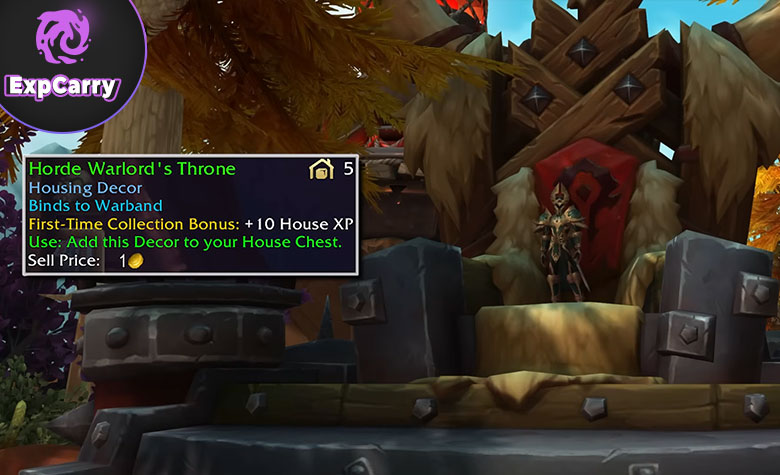
If you are trying to level efficiently, you need to separate "decor for looks" from "decor for XP." Early Access leveling is driven by collection growth, especially unique decor additions that the system flags as XP-eligible.
In practice, the fastest XP you can earn today comes from first-time collection bonuses on new decor unlocks. Neighborhood event progression such as Endeavors is part of the long-term design, but it is not available as a core XP lane during Early Access. That is why your leveling plan should be built around collecting unique, eligible decor efficiently.
This is why a clean leveling plan starts with cheap, deterministic sources and only uses expensive sources as a finishing move. If you start with the Auction House and duplicates, you can burn huge amounts of gold while barely improving your actual house level pace.
So the winning approach is breadth first: add unique pieces from many categories, then duplicate only the items you love once you have the level you want.
Unique decor beats duplicates for leveling
The most important XP rule is simple: new, unique, XP-eligible decor moves the bar. Duplicates mostly do not. Duplicates are still valuable for design, because you often need pairs and sets to make rooms look intentional, but they are usually not your fastest leveling tool.
That means you should delay bulk purchasing. If you see a vendor with ten decor options, the leveling move is to buy one of each unique piece that qualifies, not to buy ten copies of the same lamp.
Once you hit the cap, the priority flips. At that point, duplicates are how you turn a collection into a cohesive build, especially for things like lighting layers, matching rugs, and repeated storage props.
The best low-friction sources: vendors, quests, achievements
Vendors are boring but powerful because they are deterministic. A vendor sweep gives you multiple unique additions without RNG, and it is one of the cleanest "gold to progress" ratios you can get early. It also reduces your dependence on one stubborn drop that refuses to appear.
Quests and early housing tutorial rewards are also efficient because they usually hand you unique pieces that are clearly intended to kickstart your collection. Even if the items are not your final theme, they are useful as leveling fuel and as filler decor while you plan better builds.
Achievements can be a strong catch-up lane for returning players when they award decor tied to existing account progress. If you can convert old progress into new collection unlocks, that is effectively low-friction house XP because it avoids repetitive refarming.
If you want to optimize without turning the game into homework, the best routine is a short vendor pass, a quick check for near-complete achievements, and then normal gameplay that happens to produce unique decor on the side.
Crafting and the Auction House: the last push, not the first step
Crafted decor and Auction House buying can be extremely fast for leveling because they let you fill missing catalog gaps on demand. The danger is that this convenience makes it easy to overspend, especially if you are buying items you do not even like just to watch XP move.
The clean way to use these tools is late in the process. When you are close to the cap and you want to finish efficiently, crafting and targeted purchases can fill the last unique slots you cannot easily get elsewhere.
Early in the process, they are usually a trap. If you do not know your budget limits and you do not know which categories you will actually build with, you can waste gold on items that never make it into your home.
Explore services related to this guide, selected from our Player Housing catalog.
View All Player Housing Services

Placement Budgets: Why Leveling Matters for Real Builds
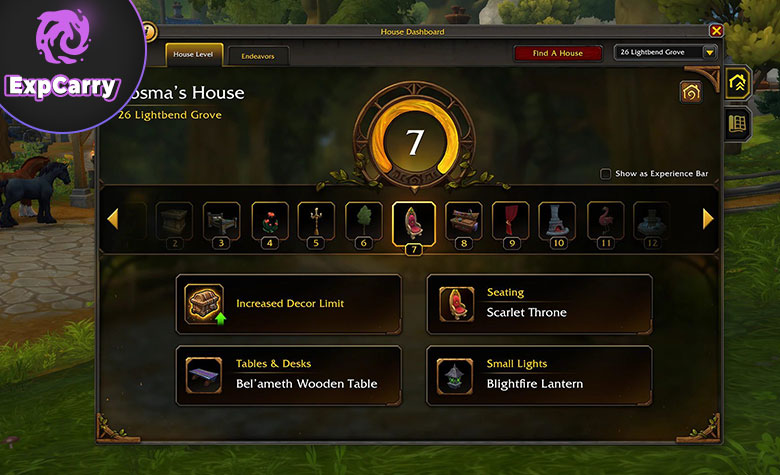
Housing budgets are the system that keeps neighborhoods stable. Without budgets, players would create performance nightmares that lag everyone around them. The budget model is basically a creative sandbox with guardrails.
This is why leveling matters. Higher levels translate into more room to build, especially for detail-heavy styles like cluttered workshops, libraries, trophy halls, and layered lighting builds that need many small objects to feel complete.
Once you understand budgets, you stop chasing levels for ego and start chasing levels for build freedom. That change in mindset makes your progression decisions cleaner and less emotional.
Budgets are a performance system, not a punishment
Every item has a budget cost. Your house has overall limits that determine how many items you can place, and how complex your build can become before you hit a wall. Expensive items tend to be large set pieces or visually complex objects, and they can consume budget quickly.
The biggest practical lesson is that scaling items does not make them cheaper. Shrinking a complex statue does not reduce its budget cost, so you cannot "cheat" the system by resizing everything into miniatures.
So good builds are about balance. Use a few high-cost anchors that define the room, then support them with low-cost detail pieces that create density without destroying your budget.
Interior vs exterior limits and why yards feel tight
Exterior budgets are usually stricter because exteriors are loaded by other players as they move through the neighborhood. Outdoor performance is shared, so the system is more cautious about how much it lets you place outside. If your yard feels harder to decorate than your interior, that is expected. It does not mean you are doing something wrong. It means the system is protecting the social neighborhood from turning into a lag festival.
The winning yard strategy in Early Access is structure over clutter. Use pathing, boundaries, and one or two anchors, and avoid spamming dozens of small props outside until you have the level and budget headroom to support it.
How to build under budget without looking empty
Empty rooms happen when players only decorate horizontally. They place furniture, then leave walls and vertical space blank. Fixing that does not require rare items. It requires staples: wall art, shelves, lighting layers, and a few vertical props that break up dead space.
Another trick is to define zones. Rugs, lighting clusters, and furniture groupings make a room look intentional even when you are working with a limited item count. A small number of well-zoned areas usually looks better than a large number of scattered items.
Finally, do not chase perfection while leveling. Build a baseline layout that looks finished enough, then refine once you stop fighting the budget wall every time you add one more detail piece.
Neighborhood Favor Grind and Endeavors: How Progression Will Change
Housing progression is not only personal. It also has a neighborhood layer, which is why you keep seeing systems like Neighborhood Favor described as a renown-like grind and Endeavors described as neighborhood-wide events.
Early Access is the awkward bridge where you can start building and collecting, but the neighborhood machine is not fully running yet. Planning around that reality keeps your guide accurate and keeps your readers from feeling misled.
Endeavors are not active in Early Access
Endeavors are designed as monthly neighborhood events with broad tasks that many playstyles can contribute to. The point is to make the neighborhood feel alive and to create a consistent reward cadence tied to participation.
In Early Access, Endeavors are not available yet. That is why so much of your current progression is collection-driven rather than event-driven. If someone is trying to grind Favor by waiting for Endeavors today, they are going to feel stuck.
The right Early Access message is: focus on leveling via unique decor collection and build your catalog foundation now, then shift into Endeavor and Favor optimization once the full system goes live with Midnight.
Favor as neighborhood renown and why your neighborhood choice matters
Think of Neighborhood Favor as the neighborhood renown track that ties your personal house progression into the shared community loop. Favor is the progression lane that connects participation to upgrades and themed rewards once the event layer is active.
This is why neighborhood choice is not cosmetic. A public neighborhood is low friction and good for solo players who want to build quietly. A guild neighborhood can be stronger for long-term progression if the guild is active, because coordinated participation is the fastest way to complete shared tasks when they matter.
If your long-term goal is faster progression later, pick a neighborhood that matches your reality. The best system design in the world cannot fix a neighborhood where nobody logs in.
What you can do now to make Favor easier later
Step one is simple: do not waste gold chasing Early Access progression that the system is not ready to reward yet. If Endeavors are locked, do not build your plan around them today.
Step two is to set yourself up socially. If you have an active guild, align early so you can move into a coordinated neighborhood rhythm later. If you are solo, commit to a public neighborhood and focus on collection breadth and clean baseline builds.
Step three is catalog readiness. When the Favor and Endeavor machine turns on, the players with broad catalogs and stable builds will be able to pivot faster into themed decorating without scrambling for basic staples.
How to Upgrade and Avoid the Biggest Progress Traps
Even when you earn enough XP, leveling does not always feel automatic. Early Access UI can be unclear, and many players miss a simple final step that converts "ready to upgrade" into the actual next house level.
This is also where bad habits become expensive. Overbuying duplicates, spending gold before you understand budgets, and treating leveling like a race are the fastest ways to burn time and motivation in an evergreen system. The goal is not to min-max yourself into hating housing. The goal is to reach a comfortable level, then keep progress sustainable so your house keeps improving across months instead of exploding in a single week and then dying.
How to upgrade your house level when you hit the threshold
When your XP bar reaches the next threshold, you may need to finalize the upgrade through the housing upgrade interaction in your neighborhood, rather than expecting an automatic level-up. If your bar looks full but nothing changed, assume you have an upgrade waiting to be claimed.
Check your housing UI, your neighborhood hub NPCs, and any tutorial prompts that appear after you hit the threshold. If you want the bigger budgets as soon as possible, claim upgrades quickly instead of letting progress sit unclaimed.
Common mistakes that slow leveling and waste gold
The first mistake is buying duplicates early because it feels like progress. It is progress for decoration, but it is usually slow progress for leveling. If your goal is levels, unique additions should come first.
The second mistake is building a perfect yard at low level. Outdoor limits are tight, and early perfection becomes constant demolition as you learn how budgets really constrain your style. A simple yard skeleton is enough until you have the headroom to detail it properly.
The third mistake is ignoring neighborhood choice. If Favor and Endeavors matter to your future pace, a dead neighborhood can turn the system into a slog. Choose convenience or coordination intentionally, not randomly. The fourth mistake is forcing content you hate just because it might drop decor. Housing is evergreen. If you hate a farm lane, skip it and use deterministic sources instead. Consistency wins over misery.
Fast progress option: when you want the level, not the grind
If your main goal is to reach the Early Access cap quickly so you can build with fewer budget constraints, the real grind is acquiring enough unique, XP-eligible decor efficiently. The last stretch is where many players either waste gold or burn out on repetitive loops. If you would rather spend your playtime designing and building, and not researching routes or farming for catalog breadth, ExpCarry can speed up the time-heavy steps that block builders from reaching their preferred level through a Housing Leveling boost focused on efficient first-time decor collection.
And once Midnight unlocks the full neighborhood layer, ExpCarry can also help with Favor farming and neighborhood progression, so you can keep building while the long-term tracks move in the background.