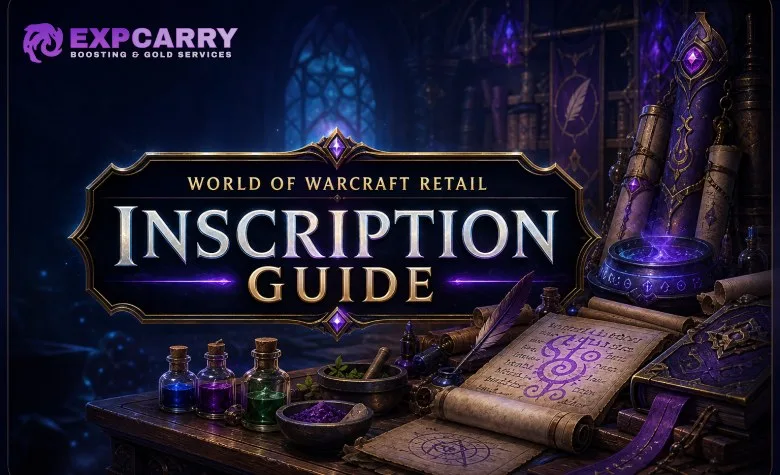
Midnight Inscription is a crafting profession built around milling herbs into pigments, turning those pigments into inks, and using them for weapons, profession tools, missives, contracts, treatises, runes, Darkmoon Cards, trinkets and other crafted products. The profession has a 1–100 skill range and four specialization trees.
Fastest leveling route: learn Midnight Inscription from Zantasia in Silvermoon City at 46.9, 51.6. Mill approximately 240 cheap Midnight herbs to reach around skill 20, craft Faunatender's Baton or useful First Crafts toward 30, then unlock Calm Hands and use Thalassian Treatises as the main route from roughly 30 to 100.
Treatises are the reason Inscription is easier to finish than many other Midnight crafting professions. A typical 30–100 route can require roughly 70 Treatise crafts, but the exact number varies because the recipe eventually turns green. First Crafts and weapon Crafting Orders can reduce that total.
Midnight Inscription 1–100 Leveling Route
| Skill | Recommended craft | What to do |
|---|---|---|
| 1–20 | Midnight Milling | Mill inexpensive Midnight herbs and keep the pigments. |
| 20–30 | Faunatender's Baton + First Crafts | Use cheap trainer crafts and collect First Craft bonuses. |
| 30–90+ | Thalassian Treatises | Main repeatable leveling route after unlocking Calm Hands. |
| 90–100 | Treatises / weapon Crafting Orders | Continue Treatises or use high-skill gear recipes to skip poor green skill-up RNG. |
Most important leveling rule: do not ignore First Crafts. A recipe can be worth crafting once even when it is not part of the cheapest raw skill route because First Crafts contribute profession Knowledge and progression.
Inscription 1–30 Shopping List
A flexible early route can be started with approximately:
| Material | Amount | Use |
|---|---|---|
| Cheap Midnight herbs | About 240 | Milling from 1 to around 20 |
| Thalassian Songwater | About 7 | Faunatender's Baton |
| Azeroot | About 56 | Faunatender's Baton |
The herb total is not exact. Milling becomes yellow and then green, so RNG changes the number required. Herb prices also change constantly, which means the cheapest Midnight herb is not always the same.
Do not sell all pigments immediately after milling. The pigments and inks you create are useful for First Crafts and later Treatises. Selling everything and buying it back can make the leveling route more expensive.
Midnight Inscription Trainer Location
The main trainer is Zantasia in Silvermoon City:
/way #15969 46.9 51.6 Zantasia
There is also another Midnight Inscription trainer at Zur'ashar Lu'kah:
/way #15355 53.2 55.6 Rhys Duskfrost
If your character has never learned Inscription, learn the base profession first and then the Midnight version. Previous-expansion Inscription skill is not required.
Explore services related to this guide, selected from our World of Warcraft catalog.
View All World of Warcraft Services


Inscription 1–20: Milling
Begin with Midnight Milling. A simple route is to mill roughly 90 herbs for the first ten skill points and another 150 or so while the recipe becomes yellow and green.
The goal is not only skill. Milling also creates the pigments required for your inks and later crafts.
The important Midnight herbs include:
| Herb | Important pigment |
|---|---|
| Tranquility Bloom | Powder Pigment |
| Mana Lily | Mana Lily Pigment |
| Argentleaf | Argentleaf Pigment |
| Sanguithorn | Sanguithorn Pigment |
If you are leveling only for skill, compare Auction House prices and favor the herb with the best expected pigment value rather than blindly buying one fixed herb.
Inscription 20–30: Faunatender's Baton
Faunatender's Baton is a convenient trainer craft for the transition into specialization-based leveling. Seven crafts use roughly:
- 7 Thalassian Songwater;
- 56 Azeroot.
You do not have to force all ten levels through this single item. Craft cheap First Crafts as they become available. At skill 25, you can already unlock your first specialization.
Inscription 30–100: Thalassian Treatises
For a character focused on reaching 100 efficiently, Calm Hands is the easiest first specialization because it teaches Thalassian Treatise on Inscription.
Treatises remain useful far beyond the trainer-recipe stage. The practical process is:
- Unlock Calm Hands at skill 25.
This gives you access to the Inscription Treatise recipe. - Finish the cheap trainer/First Craft stage to roughly 30.
- Craft Treatises while they continue giving skill.
You can craft Treatises for professions your own Warband actually uses. - Complete new First Crafts when available.
They improve Knowledge progression and can replace some repetitive Treatise crafts. - Use Crafting Orders for the final points if necessary.
High-level weapons can grant several skill points per craft.
Around 70 Treatises is a useful planning estimate for the later route, but the last skill points are green and therefore RNG-dependent.
Alternative for the Last Skill Points
If Treatises become inefficient in the 90s, weapon orders can be better. Recipes such as Aln'hara Cane, Aln'hara Pikestaff, Aln'hara Lantern and Aln'hara Sprigshot can provide several skill points per successful craft.
Because these items use expensive or time-gated materials, use customer Crafting Orders instead of buying all reagents yourself purely for leveling.
Midnight Inscription Specializations
Midnight Inscription contains four specialization trees. Additional trees unlock at skill 25, 50, 60 and 75.
| Specialization | Main focus | Best for |
|---|---|---|
| Blueprints | Staves, bows, off-hands and profession tools | Crafting Orders and high-value equipment |
| Calm Hands | General crafting stats and Treatises | Leveling and broad commodity crafting |
| Perfected Products | Milling, inks, ciphers, missives, contracts and Vantus Runes | Region-wide Auction House production |
| Darkmoon Curiosity | Darkmoon Cards, trinkets and Sigils | Darkmoon-focused crafting |
Best Inscription Specialization to Choose First
There is no universal first specialization. The correct choice depends on what you want to do.
The simplest first choice if your immediate target is skill 100 because it unlocks the Treatise route.
If your real goal is opening weapon or profession-tool recipes as quickly as possible, going directly into Blueprints can be better than spending early Knowledge in Calm Hands.
Best long-term direction for players planning high-volume reagent, ink, missive or contract production.
Choose this when you specifically want to craft cards, Dominion trinkets and Darkmoon Sigils.
How to Get Inscription Knowledge Points
Knowledge is much more important than raw profession skill after you reach the basic leveling breakpoints. Current sources include:
- First Craft bonuses;
- one-time profession Knowledge treasures;
- the weekly profession quest;
- weekly profession Knowledge drops;
- Patron Crafting Orders;
- Thalassian Treatise on Inscription;
- the monthly Darkmoon Faire profession quest;
- catch-up Knowledge from Patron Orders when your character is behind.
Current profession guides estimate roughly 40–50 Knowledge during the initial progression period if you collect the easy First Crafts and one-time sources, followed by a steady weekly income.
Fully developed Calm Hands improves the weekly Treatise value. That makes the tree useful even after you are finished leveling.
Inscription Profession Stats Explained
| Stat | What it actually does | Where it matters |
|---|---|---|
| Resourcefulness | Chance to consume fewer reagents | Milling, expensive crafts and general cost reduction |
| Multicraft | Chance to produce additional items on supported recipes | Inks, missives, contracts and other stackable products |
| Ingenuity | Chance to refund some Concentration through an Ingenious Breakthrough | High-quality crafts where Concentration is being used |
| Crafting Speed | Reduces craft time | Large production batches |
Ingenuity does not directly save reagents. That is Resourcefulness. Ingenuity interacts with Concentration.
For most high-volume recipes, Multicraft and Resourcefulness are the economic stats to watch. For expensive high-quality gear, Ingenuity becomes more valuable when Concentration is needed.
Midnight Inscription Item Quality
Midnight simplified quality on reagents and most consumables. Bronze quality was removed, leaving Silver and Gold quality for those items.
Weapons, profession equipment and Darkmoon trinkets still use their normal multi-rank item-quality progression.
This matters for gold making: reaching guaranteed Gold-quality production without Concentration can dramatically change your margin on commodity crafts.
How Darkmoon Cards Work in Midnight
Darkmoon Card crafting returned in Midnight. There are four suits:
- Blood;
- Hunt;
- Rot;
- Void.
Each suit contains eight cards. The basic flow is:
Craft cards → collect eight cards → create a Deck → use the Deck directly or turn it into a higher-end craft.
Under Darkmoon Curiosity, scribes can unlock Inscribe recipes that generate cards from a selected suit. Transcribe recipes let you reroll an existing card into another random card from the same suit, helping finish incomplete decks.
A completed deck can then be used to craft either:
- a Darkmoon Dominion trinket;
- a matching Darkmoon Sigil embellishment.
This market is more speculative than ordinary inks or missives. Check the value of individual cards, complete decks, trinkets and Sigils before investing heavily.
Important Midnight Inscription Crafts
Core leveling recipe and a recurring weekly Knowledge product for every profession.
Used to control secondary stats on crafted items and usually maintain steady demand.
Provide additional reputation from World Quests. Only one contract can be active for the Warband during its duration.
Aln'hara staves, bows and off-hands are high-value Blueprints crafts generally handled through Crafting Orders.
Scribes make tools for Inscription, Alchemy and Cooking.
A separate market based on the four Midnight Darkmoon suits.
Inscription in Midnight Season 2
Inscription remains relevant in Season 2 because crafted weapons can be recrafted with current-season Sparks and crests, while consumables and profession products continue to have repeat demand.
Patch 12.1 also expanded the profession with additional recipes, including Contract: Zul'jarra's Forces and the Chiseled Amani Tablet Housing decoration.
This means a Season 1 scribe does not need to abandon the profession or start a new specialization build. Existing Knowledge remains useful while new recipes create additional markets.
What Is Artisan Scribe's Moxie?
Midnight replaced the old cross-profession Artisan's Acuity model with profession-specific currencies. Inscription uses Artisan Scribe's Moxie.
Moxie earned through Inscription is intended for Inscription-related progression and recipe purchases. You cannot freely earn it on one profession and redirect that same currency into another profession.
Best Inscription Gold-Making Paths
There is no single best Inscription market. The strongest approach depends on your specialization and current material prices.
High-volume market with constant demand. Good choice for Perfected Products builds.
Region-wide commodity products. Margins can be thin, so Multicraft and Resourcefulness matter.
Weapons and epic profession equipment avoid some of the commodity-market competition.
Higher-risk market that can pay well when a particular trinket or Sigil becomes desirable.
Always compare the market value of herbs, pigments, inks and the finished product. Milling cheap herbs is not automatically profitable if the inks or final crafts sell below the underlying reagent value.
Best Profession Pairing
Herbalism is the most natural pairing because Inscription consumes large amounts of Midnight herbs. It reduces your direct gold cost and gives you control over raw materials.
However, gathering your own herbs is not actually “free.” If those herbs could be sold for more than the finished craft, selling the raw materials can be the better decision. Always calculate opportunity cost.
Common Inscription Mistakes
- Ignoring First Crafts while leveling.
- Assuming Calm Hands must always be the first specialization regardless of your goal.
- Spending Knowledge across several markets before completing one profitable path.
- Confusing Ingenuity with Resourcefulness.
- Using Concentration on low-margin products.
- Buying expensive materials for weapon skill-ups instead of using Crafting Orders.
- Mass-producing Darkmoon Cards without checking the value of the completed deck.
- Selling all pigments immediately after milling and buying them back later.
Midnight Inscription FAQ
What is the fastest way to level Midnight Inscription to 100?
Mill cheap Midnight herbs to around 20, use Faunatender's Baton and First Crafts to reach roughly 30, then use Thalassian Treatises as the main route toward 100.
Where is the Midnight Inscription trainer?
Zantasia is in Silvermoon City at approximately 46.9, 51.6.
Which Inscription specialization should I choose first?
Calm Hands is best for straightforward leveling. Blueprints can be better if your priority is unlocking weapons and profession tools as early as possible.
When do Inscription specializations unlock?
The four specialization slots unlock at profession skill 25, 50, 60 and 75.
Does Ingenuity save materials?
No. Resourcefulness saves reagents. Ingenuity gives a chance to refund Concentration after a craft.
Can Inscription craft Darkmoon Cards in Midnight?
Yes. Darkmoon Card crafting returned, with Blood, Hunt, Rot and Void suits under the Darkmoon Curiosity specialization.