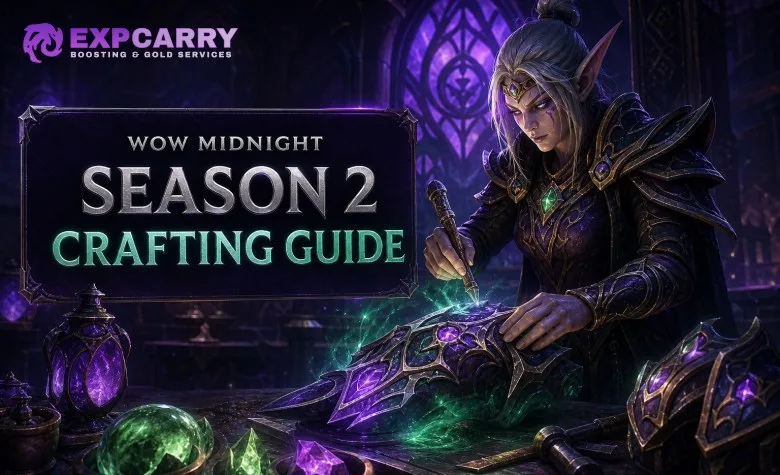
Midnight Season 2 crafting uses Sparks of Tides and regular Mistcrests to create high-level gear. Unlike earlier seasons, Sparks are used directly rather than being combined from fragments, and crafted items no longer require separate enchanted Crests. A Champion craft requires Sparks of Tides, while Hero and Myth crafts require both Sparks and the matching Mistcrest. Crafted gear remains one of the most reliable ways to target a specific slot, weapon, stat combination or embellishment, but you should spend Sparks and Crests only after comparing the craft with raid, Mythic+ and Great Vault upgrades.
If Mythic+ is part of your gearing route, review the current Mythic+ dungeon services before spending Sparks on a slot you may replace through dungeon loot or the Great Vault.
Midnight Season 2 Crafting at a Glance
| Crafting goal | Required endgame reagent | Purpose |
|---|---|---|
| Champion crafted gear | 2–4 Sparks of Tides | Creates Champion-track equipment at the Spark item-level range |
| Hero crafted gear | 80 Hero Mistcrests and 2–4 Sparks of Tides | Creates Hero-track equipment |
| Myth crafted gear | 80 Myth Mistcrests and 2–4 Sparks of Tides | Creates Myth-track equipment |
| Adventurer or Veteran crafted gear | Matching Mistcrests | Lower-level crafts for catch-up gear, alts and temporary upgrades |
| Embellished equipment | Crafted item plus an eligible embellishment | Adds a powerful secondary effect, subject to the two-item limit |
The exact number of Sparks of Tides required depends on the recipe and the item being crafted. Check the individual recipe before placing a Crafting Order, because not every crafted item uses the same Spark quantity.
What Changed from Midnight Season 1?
Season 2 simplifies the endgame crafting process in two important ways. First, players use Sparks of Tides directly instead of combining fragmented Sparks. Second, regular Season 2 Mistcrests are used directly for the relevant upgrade track; there is no separate Enchanted Crest reagent for high-level crafts.
You can still use Crafting Orders to have another player produce the item, and you can still recraft an existing item when you want to change its quality, stats, embellishment or upgrade level. The item itself is not destroyed during recrafting, but the new order must include the reagents required for the revised result.
How Sparks of Tides Work
Sparks of Tides are seasonal crafting reagents for Season 2 endgame equipment. They are used to move eligible crafted recipes into the Champion, Hero or Myth item-level ranges. Sparks are not a general currency, and they are not interchangeable with Mistcrests.
- Sparks of Tides are used directly rather than combined from fractured components.
- Players can obtain one Spark per week under the seasonal Spark acquisition system.
- Champion crafts use Sparks without a Mistcrest.
- Hero and Myth crafts require both Sparks of Tides and the matching Mistcrest.
- Sparks are consumed by the craft or recraft, so do not spend one on a temporary upgrade unless the item will remain useful.
The weekly Spark limit makes crafting decisions more important early in the season. A weapon, a powerful trinket or a well-simmed embellishment can provide more value than filling a low-impact armor slot that is likely to be replaced by raid or Mythic+ loot.
When Should You Spend a Spark?
Use a Spark when the item solves a specific gearing problem: a weapon upgrade, a difficult-to-obtain trinket equivalent, a missing tier-compatible slot, or a best-in-slot embellishment setup. Avoid spending a Spark merely because you have enough materials to craft something.
A practical order is:
- Replace a weak weapon or an important low-item-level slot.
- Craft a proven best-in-slot or near-best-in-slot embellishment combination.
- Complete a stat profile that cannot be obtained reliably from your current content.
- Craft secondary pieces only when the upgrade is meaningful and unlikely to be replaced immediately.
Explore services related to this guide, selected from our World of Warcraft catalog.
View All World of Warcraft Services
How Mistcrests and Upgrade Tracks Work
Mistcrests are the Season 2 upgrade reagents used to set the crafted item’s upgrade track. Each track accepts its own Crest type, and a craft uses the Mistcrest associated with the desired result.
| Track | Crafting reagent | Season 2 use |
|---|---|---|
| Adventurer | Adventurer Mistcrest | Low-level catch-up and inexpensive temporary gear |
| Veteran | Veteran Mistcrest | Early gearing and alt progression |
| Champion | Sparks of Tides | Mid-season crafted gear without a Mistcrest |
| Hero | Hero Mistcrest plus Sparks of Tides | High-level crafted gear for serious progression |
| Myth | Myth Mistcrest plus Sparks of Tides | Top-end crafted gear for characters pursuing the highest item levels |
Season 2 gear tracks contain six upgrade levels. Gear upgrades cost the Crest type associated with the track, while crafted items require a larger initial Crest investment than a normal upgrade. The current system uses 20 Crests per upgrade level and 80 Crests to create a high-track crafted item.
Crests are capped at 100 per week for each Crest type. Because the cap applies separately to each type, do not allow a lower track to remain capped while you are still progressing through that part of the gearing system.
Why You Should Not Upgrade Every Item Immediately
Midnight Season 2 gear tracks overlap at their boundaries. A low level on a higher track can occupy a similar item-level range to the final levels of the previous track. As a result, upgrading a Hero item from 1/6 to 2/6 may be less efficient than finishing a Champion item and allowing the upgrade system to move the character into the next track.
Before spending Crests, compare the current item level with the next track’s available starting level. This is particularly important for characters who are replacing several pieces at once, because early Crest mistakes can delay a weapon, tier slot or crafted best-in-slot item.
How to Craft a Season 2 Item
- Choose the exact item and slot you want to craft.
- Confirm the item’s primary and secondary stats for your specialization.
- Decide whether the craft needs a Spark of Tides, a Mistcrest or both.
- Select the desired optional reagents, including an embellishment if appropriate.
- Choose the highest practical crafting quality for the item.
- Place a personal or public Crafting Order, or contact a specialist crafter directly.
- Inspect the completed item before equipping it and confirm that the expected item level, stats and embellishment are present.
Use a personal Crafting Order when you already have the reagents and want to control the exact recipe. Public orders are convenient, but they may not provide enough commission to attract a crafter capable of producing the requested quality.
Embellishments in Midnight Season 2
Embellishments are powerful effects attached to crafted equipment. Some are built into specific profession recipes, while others are added through optional reagents. They are not the same as ordinary secondary-stat reagents: an embellishment changes the item’s effect profile and can be more valuable than a small increase in raw item level.
Only two embellished items can be equipped at the same time. The limit applies to the total number of embellished items, not simply the number created by one profession. Plan both crafts together before spending Sparks.
| Embellishment decision | What to check |
|---|---|
| First embellishment | Whether the effect benefits your specialization in raid, Mythic+ or both |
| Second embellishment | Whether it complements the first effect without wasting the unique-equipped limit |
| Built-in embellishment | Whether the recipe creates an item with a permanent effect that cannot be replaced |
| Optional-reagent embellishment | Whether the item can be recrafted later with a different effect |
How to Choose the Best Embellishments
There is no single universal crafted BiS combination for every Midnight Season 2 character. Embellishment value changes with specialization, talents, encounter length, target count, cooldown timing and the content you play.
Use this priority system:
- Raid-focused characters: favor consistent single-target effects unless your class guide identifies a stronger cooldown or multi-target option.
- Mythic+-focused characters: compare sustained area damage, target-count scaling and effects that remain useful during frequent pulls.
- Healers: evaluate throughput, mana efficiency and encounter uptime rather than looking only at a damage simulation.
- Tanks: compare survivability and mitigation value first; a damage embellishment is not automatically better than a defensive effect.
- Hybrid players: choose the combination that performs acceptably in both environments, or keep a second crafted setup if your gearing budget allows it.
Do not copy a best-in-slot craft from another specialization without checking the item slot and stat consequences. The same embellishment can be strong for one specialization and weak for another, and a craft that occupies a tier slot may be less attractive than a non-tier piece.
Crafted BiS Priorities for Season 2
Crafted BiS should be treated as a targeted gearing plan rather than a fixed shopping list. Your first craft is usually determined by the largest upgrade available today, while later crafts should be planned around raid drops, Mythic+ loot and tier-set requirements.
| Character situation | Recommended craft priority |
|---|---|
| Fresh level-90 character | Use lower-track crafts only when they replace weak quest or catch-up gear; save Sparks for a permanent upgrade. |
| Starting Season 2 progression | Craft a weapon or major slot if it is substantially below the current content’s item level. |
| Raid progression | Use crafts for slots with poor drop competition or to complete a strong embellishment setup. |
| Mythic+ progression | Prioritize the highest simulated upgrade and compare the craft with Great Vault options before spending the Spark. |
| Near-best-in-slot character | Reserve Sparks and Mistcrests for a confirmed final-slot upgrade, a high-value weapon or a recraft that remains useful for the rest of the season. |
Crafted Weapons
Weapons are often the strongest use of a Spark because weapon damage or primary-stat gains can affect nearly every ability. However, a crafted weapon is not automatically the correct first craft. Check whether your specialization receives a strong weapon from the current raid, whether a special weapon effect is required, and whether your current weapon can be upgraded efficiently with ordinary gear progression.
Crafted Jewelry
Rings and necklaces allow precise stat targeting and can be valuable when your character needs to reach a breakpoint. They are usually a lower priority than a badly outdated weapon or a required embellishment, but they become attractive when your existing jewelry has poor secondary stats or lacks a socket.
Crafted Armor
Armor crafts are most useful when they provide a strong embellishment, fill a slot with poor raid availability or let you correct an unfavorable stat distribution. Avoid crafting a tier-set slot without checking your planned Catalyst and raid drops.
Recrafting, Stats and Embellishment Changes
Recrafting lets you modify an existing crafted item rather than starting from zero. Depending on the recipe, you can change the item’s quality, upgrade level, secondary-stat reagents or optional embellishment.
- Recrafting does not make an old Season 1 item a Season 2 item automatically.
- A Season 2 recraft requires the relevant Season 2 reagents.
- Changing an embellishment can require the item to be recrafted with a different optional reagent.
- Built-in embellishments on specialized recipes cannot necessarily be removed or replaced.
- Do not recraft before confirming that the new item will retain the correct slot, stats and upgrade track.
If you are replacing an embellishment, compare the cost of recrafting with the cost of creating a new item. Recrafting is normally preferable when the base item is already at the desired track and quality, but a new craft may be better when the slot, stats and upgrade level are all changing.
Common Season 2 Crafting Mistakes
- Spending the first Spark on a minor upgrade: save it for a major item-level or performance gain.
- Confusing Sparks with Mistcrests: Sparks and Crests serve different purposes and cannot replace one another.
- Using the wrong Crest type: Hero and Myth crafts require the matching Mistcrest for the selected track.
- Crafting two embellished items without a plan: only two embellished items can be equipped.
- Ignoring tier slots: check the Catalyst and raid plan before crafting chest, head, shoulders, hands or legs.
- Upgrading across an overlapping track boundary: finish lower-track upgrades where possible before spending expensive higher-track Crests.
- Ordering the wrong recipe: inspect weapon type, armor class, stats and item level before confirming the order.
- Following an outdated Season 1 BiS list: Season 2 Sparks, Mistcrests, item levels and embellishment values are separate from Season 1 progression.
Recommended Season 2 Crafting Checklist
- Unlock and level the profession or identify a reliable crafter.
- Check the current Season 2 item level of your character.
- Compare raid, Mythic+, Delve and Great Vault upgrades for the same slot.
- Choose a craft that solves a real gearing gap.
- Reserve enough Sparks for your second embellished item if your specialization uses two.
- Use the correct Mistcrest for Hero or Myth crafting.
- Verify your stat combination and optional reagents before placing the order.
- Keep lower-tier Crests moving instead of allowing them to remain capped.
- Recraft only after confirming the new item’s track, quality and embellishment.