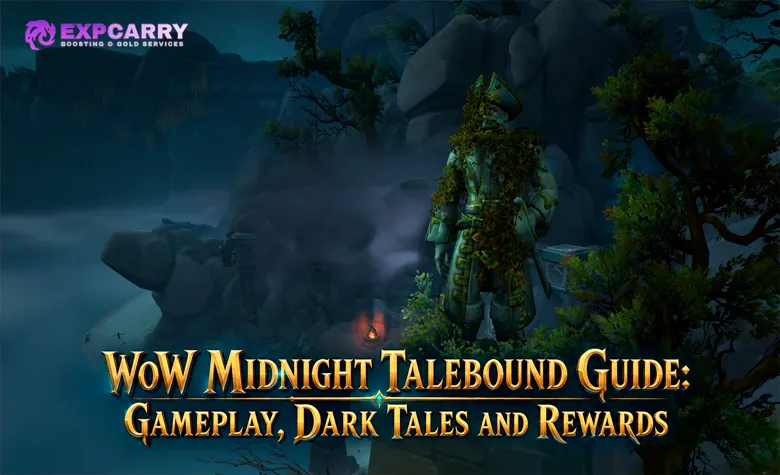
WoW Midnight Talebound takes Azeroth into darker territory with a standalone PvE action RPG mode built around sinister stories, fast combat, unsettling bosses, puzzles, and treasure. Instead of entering another dungeon with your usual class rotation, you step into the Storyteller's world as a Slayer, Inquisitor, or Witch. Each adventure leads through a themed nightmare before returning you to Quillgrave, where new talents and upgrades help prepare you for another attempt. Blizzard plans four stories for the full launch, along with cosmetics that carry over to your regular World of Warcraft collection. Talebound is coming with Midnight Patch 12.1.7: Echoes of the Worldcore, and its first playable demo is available on the PTR. Here is how the mode works, which class to try, what awaits inside each tale, and which rewards are worth watching.
Short answer: Talebound is a separate PvE action RPG experience inside WoW Midnight, featuring three playable classes, repeatable horror-themed adventures, combat-focused character progression, and Warband cosmetic rewards. The current PTR demo includes three stories, while the full release is planned to launch with four.
What Is Talebound in WoW Midnight?
Talebound is a new game mode arriving with the Echoes of the Worldcore update rather than part of the existing dungeon or raid system. Blizzard describes it as a standalone action RPG experience in which a mysterious Storyteller pulls players into dark tales that become playable worlds. These adventures contain enemies, bosses, puzzles, treasure, and relics, with a separate progression loop centered on the village of Quillgrave. You can explore alone or with friends, making the mode attractive to players who enjoy challenging PvE without committing to a traditional raid schedule.
Its biggest difference from regular WoW is the combat system. Talebound emphasizes dodging, guarding, double jumps, and positioning instead of relying entirely on the familiar ability rotations of Retail classes. Every playable class has a dedicated toolkit designed for the mode, and your choices between adventures influence how you approach the next nightmare. Blizzard outlined the core experience in its Talebound gameplay announcement.
| Feature | Talebound Gameplay |
|---|---|
| Game | World of Warcraft: Midnight |
| Content update | Patch 12.1.7: Echoes of the Worldcore |
| Game mode | Standalone PvE action RPG |
| Group options | Solo or cooperative play with friends |
| Playable classes | Slayer, Inquisitor, Witch |
| Launch adventures | Four themed stories |
| Combat | Class abilities, dodging, guarding, double jumping, and movement |
| Progression hub | Quillgrave |
| Progression currency | Ducats and resources used within Talebound |
| Reward currency | Bound Silver |
| Main collection rewards | Transmog, mounts, housing decor, and other cosmetics |
| Current availability | Playable demo on the Patch 12.1.7 PTR; full mode not yet live |
The mode has its own progression and reward systems, so it should not be confused with the main Midnight campaign. Finishing a Talebound story is not the same as completing a campaign chapter, a Mythic+ dungeon, or a raid boss. Players working through the regular expansion can compare those separate activities in the Midnight campaign progression overview. Talebound instead offers a different kind of PvE session built around replaying and mastering individual adventures.
How to Play the Talebound PTR Demo
Talebound became playable through a special Patch 12.1.7 PTR demo on October 30, 2026. Blizzard made this test available without requiring an active WoW subscription, allowing players to try its classes and combat before the full release. The demo includes the Red Hollow introduction, three adventures, and three difficulty settings. It is important to select the PTR game version, because Talebound is not yet available as a completed mode on the regular live client.
- Open Battle.net and select World of Warcraft.
- Choose the available Patch 12.1.7 PTR game version and install the test client.
- Launch the PTR and use the Talebound option from the character-selection interface.
- Create a Talebound character; class selection takes place during the introduction, not on the character-creation screen.
- Begin the Red Hollow introduction, choose Slayer, Inquisitor, or Witch during the tutorial, and follow the Storyteller into Quillgrave.
- Choose one of the available tales and select a difficulty to experience the new combat system.
Blizzard's Talebound demo announcement lists the event as October 30 through November 1. A later official PTR development update gives the more precise testing window as October 30 at 10:00 a.m. PDT through November 2 at 10:00 a.m. PDT. If you are joining near the end of the weekend, follow the later PTR notice and actual server availability rather than assuming the dates in the earlier announcement are definitive. The testing window does not establish the full release date.
PTR reminder: The current demo is a test version of Talebound, not the completed live release. Blizzard states that some talents are still being developed and combat tuning may change. Do not assume PTR character progress or rewards will transfer to live servers unless Blizzard explicitly announces that behavior.
How a Talebound Adventure Works
A Talebound adventure begins with a story rather than a dungeon queue. You enter one of the Storyteller's tales and fight through a themed environment filled with enemies, puzzles, relics, and treasure. Each adventure has its own setting and bosses, so the experience is designed around learning the dangers of that particular tale. When the run ends, you return to Quillgrave and prepare for another attempt with the tools and upgrades available there.
The structure encourages repeat runs instead of treating each story as a one-time quest. Blizzard has described the telling and retelling of tales as part of the mode, with new skills and improvements helping players approach subsequent adventures differently. A difficult encounter might require better positioning, more careful use of defensive abilities, or a different set of talents rather than simply more equipment from the main game. That is an important distinction for players who want to understand what Talebound asks of them.
- Choose your class: Decide whether to fight with weapons, holy abilities, or dark magic.
- Enter a tale: Explore its environment and follow the adventure's objectives.
- Survive the encounters: Fight enemies, avoid dangerous attacks, solve puzzles, and challenge bosses.
- Collect resources: Discover treasure, relics, and the currencies associated with the mode.
- Return to Quillgrave: Visit the village's specialists to prepare for future adventures.
- Enter another tale: Apply what you learned and continue building toward more difficult encounters and rewards.
For a first attempt, learning the movement system is likely to matter more than racing toward the final boss. Every class can dodge, guard, and double jump, giving players several ways to avoid damage without relying exclusively on class-specific spells. It is worth practicing those shared actions against ordinary enemies before confronting a boss whose attack patterns are unfamiliar. Talebound's combat is designed to reward active movement rather than standing still and trading damage.
Explore services related to this guide, selected from our World of Warcraft catalog.
View All World of Warcraft Services

Talebound Classes: Slayer, Inquisitor and Witch
Talebound launches with three distinct classes instead of importing the full World of Warcraft class roster. Each has its own attacks and abilities, but all three share the same movement and defensive fundamentals. Your class choice determines the rhythm of combat, the distance at which you prefer to engage enemies, and the tools available for escaping dangerous situations. There is no officially established best class for every tale or difficulty, so the strongest starting choice is the one whose playstyle feels most natural to you.
| Class | Combat Identity | Notable Abilities | Playstyle |
|---|---|---|---|
| Slayer | Monster hunter armed with a sword and firearm | Slash, Explosive Shot, Minefield, Silver Bolt | Weapon attacks, aggressive movement, and control of enemy distance |
| Inquisitor | Holy damage dealer using radiant attacks | Condemn, Denounce, Light's Wrath, Radiant Burst | Ranged pressure, area damage, and spells usable while moving |
| Witch | Spellcaster wielding poison, lightning, creatures, and transformation | Brewing Storm, Bubbling Cauldron, Feline Communion, Moonlight Ravens | Magical attacks, summoned effects, mobility, and unusual spell interactions |
Slayer: Sword, Gun and Monster-Hunting Tricks
The Slayer combines close-range weapon combat with firearm attacks and fast repositioning. Slash delivers a three-hit sequence, while Explosive Shot gives the class a way to punish enemies in front of it with a shotgun blast. Minefield creates distance by sending the Slayer backward while scattering mines that damage and slow enemies. This mix makes the Slayer appealing to players who enjoy staying aggressive but still want a reliable way to escape a dangerous melee position.
Other tools expand that approach. Shrapnel Round can bounce between enemies, Throwing Knives helps with rapid movement, and Silver Bolt targets the highest-health enemy in range. These abilities suggest a class that can respond to different enemy arrangements instead of relying on one repetitive attack. Exact talent combinations and the strongest damage rotations should be evaluated after live tuning is finalized.
Inquisitor: Holy Fire and Mobile Spellcasting
The Inquisitor fights with radiant magic, combining direct attacks with abilities that pressure groups of enemies. Condemn damages and slows targets while remaining usable on the move, giving the class a practical response to encounters where standing still is dangerous. Light's Wrath creates a damaging effect around an enemy, while Radiant Burst launches an explosive attack that can also be cast while moving. These tools make positioning central to the Inquisitor's combat style.
Denounce offers a different decision by becoming more powerful the longer you remain in place. That creates an interesting tension between maximizing an attack and maintaining enough mobility to avoid incoming damage. Rapture adds another form of pressure by surrounding enemies with flames that can be detonated. Players choosing Inquisitor should pay attention to which attacks reward movement and which ask them to commit to a position.
Witch: Poison, Lightning and Dark Magic
The Witch uses a less conventional arsenal built around magical effects, animals, and transformation. Brewing Storm provides lightning attacks, while Bubbling Cauldron releases explosive poisonous frogs that seek enemies. Winter Spiders sends a swarm forward, and Moonlight Ravens summons attacking birds through a channel that can be maintained while moving. The class is built around combining strange magical tools rather than following a traditional weapon-fighting style.
Feline Communion is one of the Witch's most distinctive abilities, briefly transforming the character into a cat surrounded by damaging stars. During the transformation, Crooked Path provides a forward blink that can help escape an unfavorable position. Thorns adds another way to strike nearby targets, giving the Witch several options when enemies close the distance. Its unusual toolkit should appeal to players who enjoy spell interactions and creative movement.
All Four Talebound Stories and Bosses
Blizzard plans four stories for Talebound's full launch, each with its own enemies, setting, and major encounters. The adventures draw on dark fantasy and horror themes, ranging from plague-stricken territories to haunted woods, deep-sea terrors, and nightmare royalty. These are separate playable tales rather than four chapters of the existing Midnight campaign. The first PTR demo includes three of them, with Grove of the Night Court reserved for the broader launch experience.
| Story | Setting | Announced Bosses | PTR Demo |
|---|---|---|---|
| Darkhaven | An isolated land that survived a plague devastating the world beyond its borders | Konrad von Sonnesheim, the Lord Marshal; Alexandre Dozsenc, the Blood Bishop | Available |
| Greenthistle Wood | Haunted woodland terrorized by witches, predators, and a giant | Granny Greenthumb, Witch of the Woods; Ylska Vilefang, Witch of the Wilds; Mobog, the Giant of Greenthistle | Available |
| Greywake's Expedition | An expedition consumed by deep-sea horrors | Zzyg'th, the Hadal Tyrant; Chathoa, the Herald from Beyond | Available |
| Grove of the Night Court | A nightmare realm ruled by dangerous fae royalty | Tilywth, the Fairy Queen; Maernok, the Nightmare King | Not included in the current demo |
Darkhaven
Darkhaven is a grim, isolated setting that survived a devastating plague which wiped out the population beyond its borders. Konrad von Sonnesheim, the Lord Marshal, and Alexandre Dozsenc, the Blood Bishop, are the major enemies Blizzard has named for the tale. Players can explore this story during the current demo, making it one of the first opportunities to experience Talebound's darker combat encounters. The full route and any final boss-specific loot tables should not be assumed from the announcement alone.
Greenthistle Wood
Greenthistle Wood brings players into a wilderness where two villages are terrorized by witches and dangerous creatures. Granny Greenthumb and Ylska Vilefang are joined by Mobog, the Giant of Greenthistle, giving the story a varied collection of major foes. Blizzard has not presented the tale as a simple sequence of ordinary enemy packs; it is part of a mode that also features puzzles, treasure, and exploration. Players who enjoy woodland horror and creature-focused encounters have a strong reason to try this adventure during the demo.
Greywake's Expedition
Greywake's Expedition changes the atmosphere from haunted settlements and forests to the aftermath of a doomed expedition. Its announced major threats are Zzyg'th, the Hadal Tyrant, and Chathoa, the Herald from Beyond. The setting offers a different kind of horror from the mode's witchcraft-heavy locations, with a focus on the terrifying fate of those who ventured into the unknown. It is also one of the three adventures available for testing before launch.
Grove of the Night Court
Grove of the Night Court is the fourth story planned for Talebound's release. Blizzard has named Tilywth, the Fairy Queen, and Maernok, the Nightmare King, as its major encounters. The story promises a different atmosphere built around dangerous fae royalty, but it is not part of the current three-story PTR demo. Until players can test the full adventure, exact puzzle solutions, boss strategies, and reward routes would be speculation.
Quillgrave: Upgrades Between Talebound Runs
Quillgrave is the village where players return between adventures to recover, prepare, and improve their chances in the next tale. Rather than functioning as a conventional capital city, it serves as the center of Talebound's gameplay loop. Four specialists provide different kinds of improvements, allowing players to prepare through consumables, talents, basic attributes, and passive effects. Choosing which of these systems to develop is part of learning how to survive increasingly difficult encounters.
| Specialist | What They Provide | Why It Matters |
|---|---|---|
| Arcanist | Potions, draughts, and flasks that can be found during tales | Expands the consumable options available during an adventure |
| Scribe | Talents that change class abilities | Allows players to experiment with how their combat toolkit works |
| Outfitter | Improvements to starting health, damage, energy, and focus | Strengthens basic combat capabilities at the beginning of a run |
| Antiquarian | Passive effects that influence the approach to a tale | Introduces additional ways to shape a character's playstyle |
The Outfitter is an obvious system to examine when your character struggles with basic survivability, while the Scribe becomes interesting when you want different ability interactions. The Arcanist and Antiquarian add preparation choices beyond straightforward damage increases. Blizzard has established what these specialists do, but exact upgrade costs, optimal progression orders, and final talent balance are still subject to the evolving PTR build. For now, the useful lesson is that returning to Quillgrave is part of preparing for the next story, not merely a place to collect rewards.
Talebound Rewards: Bound Silver, Mounts, Transmog and Decor
Talebound connects its separate adventures to your regular WoW collection through cosmetic rewards. Blizzard has announced a Warband-bound currency called Bound Silver, which players earn through quests, achievements, and progression in the Tales of the Storyteller. It is used to purchase cosmetic items through the Talebound store. That gives players a reason to replay stories even when they are primarily interested in the mount, appearances, or housing decorations rather than mastering every class.
Bound Silver and Ducats
Bound Silver is the currency associated with Talebound's cosmetic rewards. Blizzard says it can be earned by completing quests, achievements, and progress within the tales, with rewards collected after returning to Quillgrave. The store can be accessed through the character-selection screen, the Game Menu, or by speaking with Nib in Quillgrave. This makes the currency a bridge between the separate game mode and the collection rewards available to your WoW account.
Ducats serve a different purpose within the mode. Blizzard describes them as a currency that can be converted into resources needed for Talebound progression, so they should not be confused with Bound Silver. The distinction matters when planning your runs: one currency supports further adventures, while the other is tied to the cosmetic reward system. Blizzard has not published a complete final exchange-rate table, so exact farming calculations should wait until the live rules are established.
Announced Talebound Cosmetics
Several rewards have already been shown by Blizzard, including an outfit, housing decorations, and a distinctive flying mount. These are the clearest examples of what players can work toward when Talebound launches. They are worth tracking because the collection rewards are intended for use in regular WoW rather than remaining locked inside a temporary story character.
| Reward | Type | What Players Can Expect |
|---|---|---|
| Ensemble: Witch Hunter's Shadow Attire | Transmog | A dark Witch Hunter-themed outfit for character appearances |
| Quillgrave Storyteller's Lectern | Housing Decor | A decorative lectern inspired by the Storyteller's village |
| Quillgrave Talebound Shadowtome | Housing Decor | A sinister book-themed decoration for player housing |
| Shadowbound Storybook | Mount | A mount themed around the Storyteller's enchanted book |
The Shadowbound Storybook stands out because it turns the mode's storytelling theme into an actual mount. Players more interested in character appearances may prefer the Witch Hunter's Shadow Attire, while housing collectors have the lectern and Shadowtome to look forward to. Blizzard has shown these rewards, but the complete live vendor prices and exact effort required for each purchase are not yet finalized in the official announcements.
Talebound's decorations join a much broader collection of Midnight housing items, although earning them through this mode is a separate objective from progressing your house itself. Players building a themed home can compare the wider WoW player housing progression systems without assuming that Talebound automatically advances house levels or Neighborhood objectives. Similarly, the Shadowbound Storybook belongs to Talebound's reward system rather than the usual raid-drop routes covered by the WoW mount collection overview.
What Changes Between the PTR Demo and Full Talebound Launch?
The current demo is deliberately smaller than Blizzard's announced launch version. Players can explore three stories and experiment with all three classes across Normal, Veteran, and Heroic difficulties. The full release adds the fourth announced tale, Grove of the Night Court, and introduces the broader reward and progression experience described in the Echoes of the Worldcore preview. The demo is therefore useful for learning combat and testing the feel of each class, but it is not a complete picture of the finished mode.
| Feature | Current PTR Demo | Announced Full Release |
|---|---|---|
| Availability | Limited testing window | With Echoes of the Worldcore, Patch 12.1.7 |
| Introduction | Red Hollow | Talebound's full story experience |
| Stories | Darkhaven, Greenthistle Wood, Greywake's Expedition | The three demo tales plus Grove of the Night Court |
| Classes | Slayer, Inquisitor, Witch | Slayer, Inquisitor, Witch |
| Difficulties | Normal, Veteran, Heroic | Final live difficulty tuning remains subject to testing |
| Talents | Playable, with some work still in progress | Expected to reflect final balance and development changes |
| Cosmetic rewards | PTR testing; live reward transfer not established | Bound Silver store and announced cosmetics |
There is another important distinction between official reward announcements and PTR database discoveries. Additional items, achievement rewards, and potential character-power rewards have appeared in test-client records, but those records do not establish final live availability or acquisition rules. This guide focuses its reward list on items Blizzard has directly presented. The Echoes of the Worldcore overview is the main official source for the currency system and announced collection rewards.
Best Ways to Prepare for Your First Talebound Run
Talebound rewards a different set of habits from traditional WoW endgame content. Rather than planning around an established raid build or Mythic+ route, start by understanding your new class and the movement tools shared by every character. The demo is particularly useful for testing these basics because you can explore the three available adventures without waiting for the full mode to launch. The following approach should help you learn efficiently without depending on unverified damage rankings.
- Try each class before choosing a favorite. Slayer, Inquisitor, and Witch have sufficiently different toolkits that comfort with their combat rhythm matters more than a speculative tier list.
- Practice defensive movement immediately. Learn the timing and positioning of dodge, guard, and double jump before a difficult encounter forces you to use them.
- Pay attention to enemy behavior. Talebound emphasizes active combat, so recognizing when to move or defend is part of surviving bosses.
- Explore instead of rushing every room. Blizzard has built puzzles, treasure, and relics into the tales, making exploration part of the intended experience.
- Check Quillgrave between adventures. Examine the Arcanist, Scribe, Outfitter, and Antiquarian to understand how future runs can change.
- Keep the currencies separate. Ducats are linked to Talebound progression resources, while Bound Silver is associated with cosmetic rewards.
- Avoid planning around PTR reward prices. Wait for finalized live store details before calculating how many runs a particular cosmetic will require.
Players who usually concentrate on high-end dungeons may find the biggest adjustment in the moment-to-moment combat. A well-timed dodge, a useful movement ability, or a controlled pull can be more important than squeezing out one additional cast. The Slayer's weapon attacks, the Inquisitor's mobile spells, and the Witch's summoned effects all offer different ways to solve the same problem. Learning those differences is a better first goal than trying to force a familiar Retail rotation onto the new mode.
WoW Midnight Talebound FAQ
Talebound is a separate mode with its own characters, progression, and currencies, so several practical questions naturally come up before players try it. The answers below distinguish the currently available PTR demo from the planned live release. Details that Blizzard has not finalized should not be treated as guaranteed launch rules.
Is Talebound available on WoW live servers? Not as a complete released mode. As of November 1, 2026, Talebound is playable through a limited demo on the Patch 12.1.7 PTR. Its full launch is planned for the Echoes of the Worldcore content update, but the PTR demo should not be mistaken for that release.
Can you play Talebound without friends? Yes. Blizzard explicitly describes the mode as playable solo or with friends. A final maximum cooperative party size should not be assumed without a published live rule.
Do you need a WoW subscription to try the Talebound demo? No. Blizzard states that an active subscription is not required for the limited PTR demo. That does not automatically establish the access requirements of every future version of the mode.
Can you use Talebound rewards in regular WoW? Blizzard has announced cosmetics intended for use with your regular Midnight collection, including the Shadowbound Storybook mount, Witch Hunter's Shadow Attire, and housing decorations. Bound Silver is described as a Warband-bound reward currency. This does not mean rewards earned during PTR testing are guaranteed to transfer to live servers.
Conclusion
Talebound gives WoW Midnight players a different kind of PvE adventure: three new classes, active combat, repeatable horror stories, and a village that helps you prepare for whatever the Storyteller throws at you next. The current PTR demo is the best opportunity to learn the combat system and explore the first three tales, while the full release promises a fourth adventure and cosmetic rewards for your regular WoW collection. Start by finding a class you enjoy, learn to dodge and guard, and let the stories reveal their dangers before worrying about perfecting a build. Quillgrave's campfire is waiting, but the next tale is unlikely to have a happy ending.