

Restoration Druid in WoW Midnight Season 2 is a proactive healer that prevents deaths by preparing healing over time effects before damage arrives. The specialization combines strong single-target coverage, mobile healing, raid ramps, crowd control, and defensive utility. This guide covers Patch 12.1 talents, healing priorities, raid, Mythic+, Delves, gear, consumables, Solo Shuffle, 2v2, 3v3, Battleground Blitz, RBG play, and practical macros.
What Is the Best Restoration Druid Build in Midnight Season 2?
Wildstalker is the recommended default hero talent tree for Restoration Druid across Season 2 PvE. In raids, its healing modifiers strengthen the Lifebloom target and work especially well with the Everbloom Apex talent. In Mythic+ and Delves, it provides a strong default healing package without forcing the Druid to spend every safe damage global in Cat Form.
| Content | Recommended Hero Talents | Main Goal |
|---|---|---|
| Raid | Wildstalker | Prepare Rejuvenation coverage, maintain Lifebloom, and align Wild Growth and major cooldowns with raid damage. |
| Mythic+ | Wildstalker | Stabilize the tank and party, control enemies, dispel quickly, and add caster damage when healing is secure. |
| Delves | Wildstalker | Combine healing, ranged damage, crowd control, and early defensive use. |
| Rated PvP | Keeper of the Grove build from the current PvP recommendation | Maintain HoTs from safe positioning, recover with Swiftmend and Regrowth, and create Cyclone windows. |
Keeper of the Grove remains playable in PvE, particularly when its Grove Guardian pattern suits an encounter. It is not the default raid recommendation in Patch 12.1 because Wildstalker's healing modifiers have stronger synergy with Restoration's current Apex package.
What Changed for Restoration Druid in Patch 12.1?
Patch 12.1 focuses on quality of life, single-target recovery, mana tools, and clearer interactions between Nature's Swiftness, Regrowth, Swiftmend, Lifebloom, and major cooldowns. The live patch also includes a broader Restoration tuning pass, including stronger Mastery: Harmony, higher overall healing, stronger Wild Growth and Verdancy, and several mana-cost adjustments.
| Patch 12.1 Change | Practical Effect |
|---|---|
| New talent: Overgrowth | Nature's Swiftness makes the next Regrowth apply Lifebloom, Rejuvenation, and Wild Growth's HoT to the ally. |
| New talent: Flash of Clarity | Omen of Clarity increases Regrowth healing by 40 percent, improving clearcasting value. |
| Innervate redesigned | It restores 25 percent of the target's maximum mana over 8 seconds instead of making spells free. |
| Abundance redesigned | At five active Rejuvenations, Abundance sharply increases Regrowth's critical strike chance and reduces its mana cost, making the five-Rejuvenation threshold the important breakpoint. |
| Tranquility updated | The channel grows protective roots that absorb damage equal to 60 percent of the Druid's health and prevent knockbacks. |
| Incarnation: Tree of Life updated | Entering the form casts Regrowth on up to three nearby injured allies. |
| Swiftmend updated | Its direct heal gains additional healing based on the consumed HoT, restoring more of its emergency single-target role. |
| Everbloom Rank 3 updated | Blooming Frenzy now triggers from Swiftmend instead of Soul of the Forest. |
| Verdant Infusion and Germination adjusted | Verdant Infusion no longer extends HoTs, and Germination no longer adds two seconds to Rejuvenation. |
| Ysera's Gift updated | Overhealing on the Druid transfers to a nearby ally. Patch 12.1 also increases Mastery: Harmony's healing bonus by 15 percent, increases Restoration healing by 6 percent, increases Wild Growth healing by 20 percent and its mana cost by 15 percent, increases Verdancy healing by 40 percent, reduces Rejuvenation and Regrowth mana costs by 10 percent, reduces Lifebloom's mana cost by 20 percent, and reduces Regrowth healing by 20 percent. Passing Seasons now reduces Nature's Swiftness cooldown by 15 seconds, Germination and Verdancy have swapped positions in the talent tree, Symbiotic Relationship now highlights while inactive, and Nature's Splendor has been removed. |
The practical result is a more dependable emergency sequence: establish a HoT, use Swiftmend, and convert Soul of the Forest or Nature's Swiftness into the correct follow-up. Restoration still rewards preparation, but Patch 12.1 gives it better recovery when a target falls behind.
How Do Restoration Druid Apex Talents Work?
Restoration's Apex talent is Everbloom. Four points progressively turn Lifebloom into a stronger single-target anchor and a source of group healing.
- The first point lets Lifebloom build up to three stacks automatically, adding a stack every five seconds.
- The second and third points cause a portion of Lifebloom's final bloom to heal up to six injured allies nearby.
- The fourth point makes Swiftmend trigger Blooming Frenzy, causing Lifebloom to bloom three times in rapid succession.
Do not repeatedly move a fully stacked Lifebloom without a reason. Its value grows while it remains on the tank or another priority target, and Swiftmend becomes part of planning the Apex burst rather than only a reactive button.
Explore services related to this guide, selected from our World of Warcraft catalog.
View All World of Warcraft Services


Best Talents for Restoration Druid Raids
This Wildstalker raid build is designed for current Season 2 healing. It supports Lifebloom and Everbloom, broad Rejuvenation coverage, Wild Growth ramps, Convoke the Spirits, and strong personal survivability.
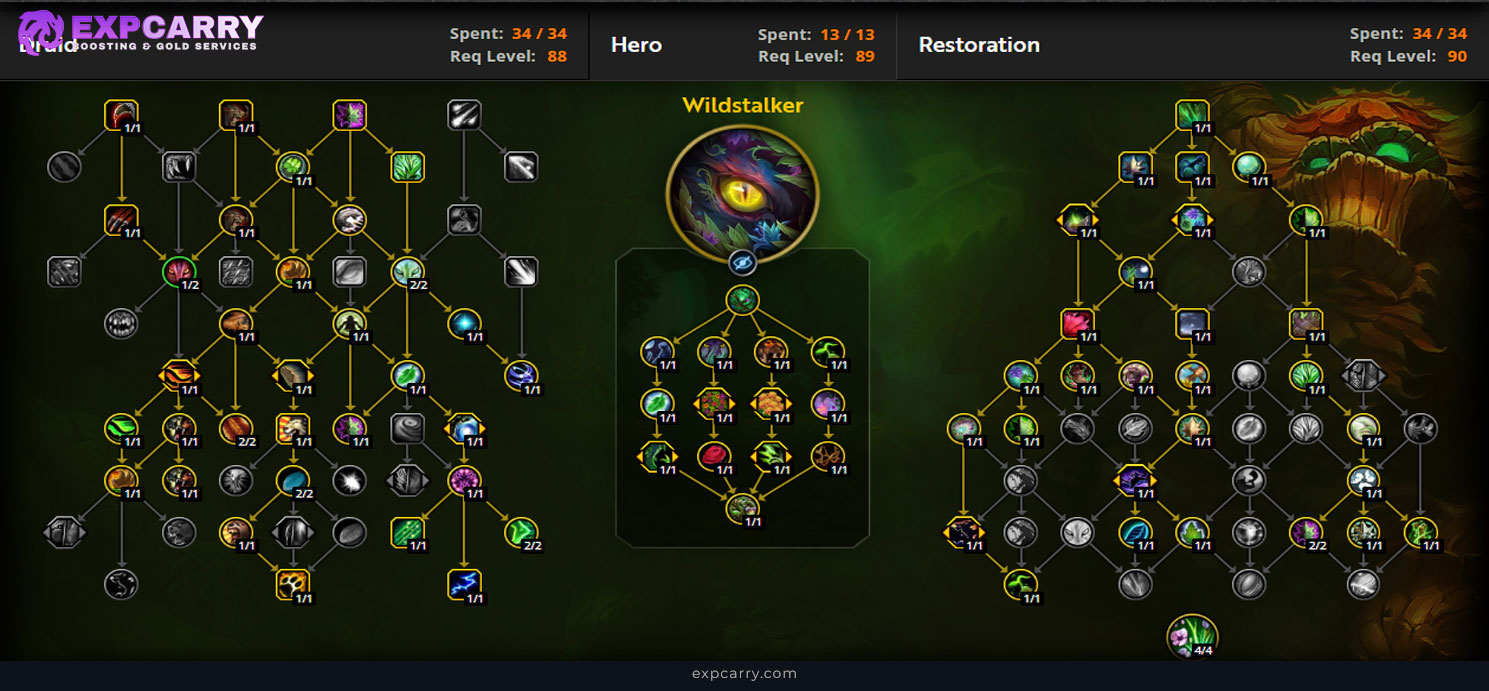
Convoke the Spirits is the default burst choice. Incarnation: Tree of Life can be substituted when an encounter demands healing while moving or a longer controlled recovery window. Utility points should follow the encounter rather than remain locked for every boss.
How Should Restoration Druid Heal in the Venomous Abyss Raid?
Restoration Druid performs best when every dangerous event has a short preparation plan. Place Efflorescence where players will stand, keep Lifebloom established, begin Rejuvenation coverage early enough to avoid rushed globals, and cast Wild Growth as damage begins. Use the Venomous Abyss raid overview to map mechanics before assigning major cooldowns.
| Situation | Restoration Druid Response |
|---|---|
| Predictable raid-wide damage | Pre-position Efflorescence, spread Rejuvenation, cast Wild Growth as damage starts, then use the assigned major cooldown. |
| Priority target under pressure | Maintain Lifebloom and Rejuvenation, use Ironbark before the largest hit, then Swiftmend into the appropriate Regrowth follow-up. |
| Heavy damage while moving | Refresh instant HoTs before movement and use Tree of Life if the assignment requires sustained mobile healing. |
| Mana-intensive progression pull | Avoid low-value blanket Rejuvenations, use the redesigned Innervate early enough to gain another use, and preserve mana for scheduled ramps. |
| Knockback during a healing channel | Use the updated Tranquility at the assigned time; its protective roots prevent knockbacks while channeling. |
Cooldown assignments are more valuable than reactive overlap. If another healer already covers an event, save Convoke, Tree of Life, or Tranquility for the next dangerous window. Players who want faster access to progression rewards can pair encounter preparation with a Venomous Abyss Heroic run.
Useful Restoration Druid Raid Macros
Mouseover macros reduce target switching and help preserve the timing of external cooldowns.
Mouseover Ironbark:
#showtooltip Ironbark
/cast [@mouseover,help,nodead][@target,help,nodead][] Ironbark
Mouseover Innervate:
#showtooltip Innervate
/cast [@mouseover,help,nodead][@target,help,nodead][] Innervate
Cursor Efflorescence:
#showtooltip Efflorescence
/cast [@cursor] Efflorescence
Best Talents for Restoration Druid Mythic Plus
This Wildstalker Mythic+ build emphasizes healing, control, dispels, and practical caster damage. Cat Form damage remains optional; use the damage pattern that lets you maintain awareness and respond to party health without delay.
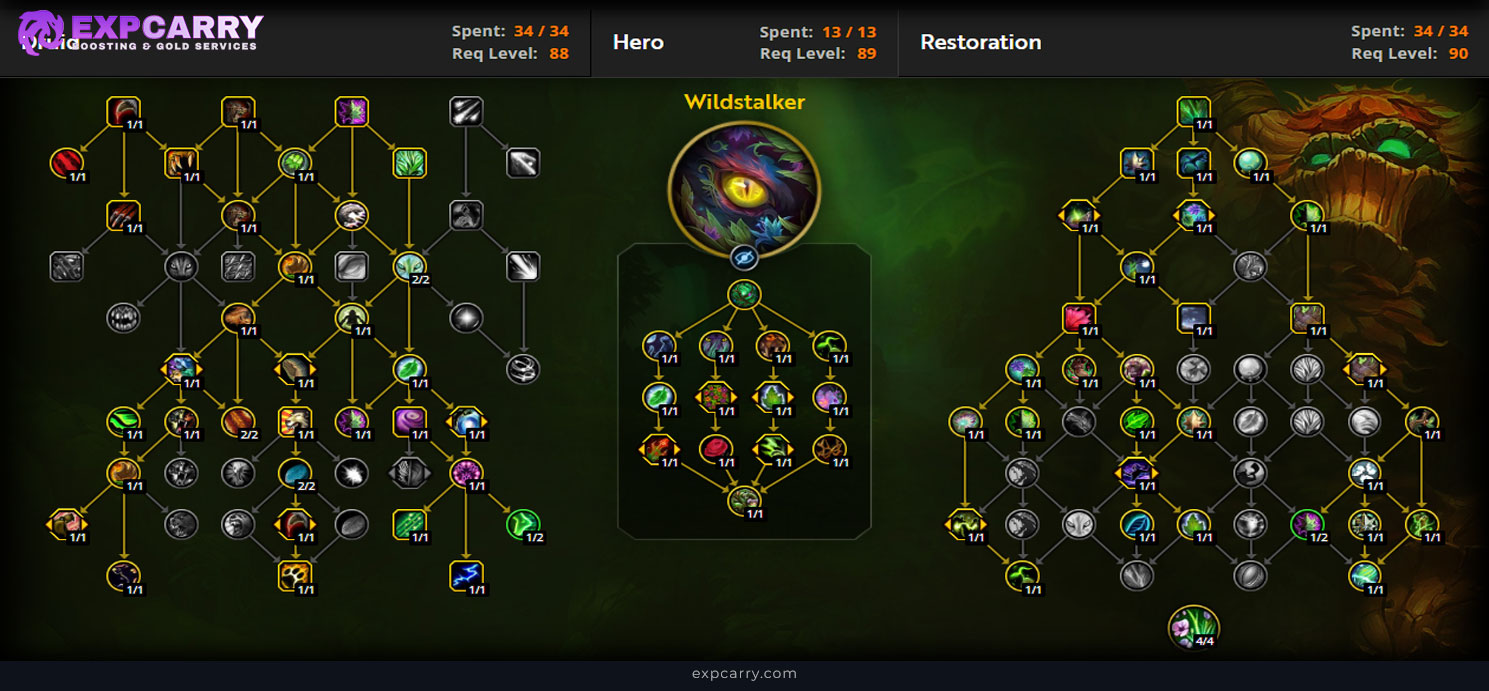
Before each key, confirm whether the route needs Typhoon, Ursol's Vortex, Mass Entanglement, Hibernate, Soothe, or additional defensive points. A useful dungeon build is not only its healing throughput; it must also answer the pulls in the planned route.
Which Dungeons Are in the Midnight Season 2 Mythic Plus Pool?
The Season 2 rotation contains eight dungeons. Restoration should identify dispels, stops, and high-damage pulls before the timer starts.
| Dungeon | Restoration Druid Focus |
|---|---|
| Altar of Fangs | Coordinate stops, keep HoTs ready for overlapping party damage, and use Vortex to help group enemies. |
| Murder Row | Use line of sight carefully, dispel promptly, and prepare healing before caster-heavy pulls connect. |
| Den of Nalorakk | Track tank pressure, use Soothe on eligible enrages, and commit Ironbark before dangerous physical sequences. |
| The Blinding Vale | Pre-HoT movement mechanics and avoid losing Efflorescence value when the group must reposition. |
| Voidscar Arena | Enter large pulls with Lifebloom stacked and reserve a group cooldown for unavoidable damage. |
| King's Rest | Coordinate crowd control, prepare for target swaps, and avoid spending every recovery tool on the first spike. |
| Temple of Sethraliss | Use roots and knockbacks to manage dangerous enemies while maintaining mobile healing. |
| Ruby Life Pools | Plan dispels and major cooldowns for caster packs and boss sequences with repeated party damage. |
How Does Restoration Druid Heal Mythic Plus Pulls?
Dungeon healing is a cycle of preparation, stabilization, and safe damage rather than a fixed spell rotation.
- Before the pull, establish Lifebloom on the tank and apply Rejuvenation to players who will take immediate damage.
- Place Efflorescence where the group will actually remain, not where the tank first touches the pack.
- Use Wild Growth when several players begin taking damage, then use Swiftmend to trigger the Everbloom interaction and prepare Soul of the Forest.
- Use Ironbark before a dangerous tank event instead of after the tank is already critical.
- Use Nature's Swiftness with Regrowth for rapid recovery; Overgrowth supplies multiple HoTs when the talent is selected.
- When health is stable, contribute Moonfire, Sunfire, Wrath, and Starfire damage while keeping control abilities available.
On Fortified weeks, major healing cooldowns often belong to planned trash pulls. On Tyrannical weeks, keep enough recovery for extended boss mechanics. The Season 2 Mythic+ dungeon overview is useful when learning the rotation.
Useful Restoration Druid Mythic Plus Macros
These macros speed up the dispel, external, and ground-control actions used repeatedly in keys.
Mouseover Nature's Cure:
#showtooltip Nature's Cure
/cast [@mouseover,help,nodead][@target,help,nodead][] Nature's Cure
Cursor Ursol's Vortex:
#showtooltip Ursol's Vortex
/cast [@cursor] Ursol's Vortex
Mouseover Soothe:
#showtooltip Soothe
/cast [@mouseover,harm,nodead][@target,harm,nodead][] Soothe
Best Talents for Restoration Druid Delves
Use the same Wildstalker import as Mythic+ for this guide. It supplies the healing, control, survivability, and damage access needed for solo and small-group Delves without maintaining a separate loadout.
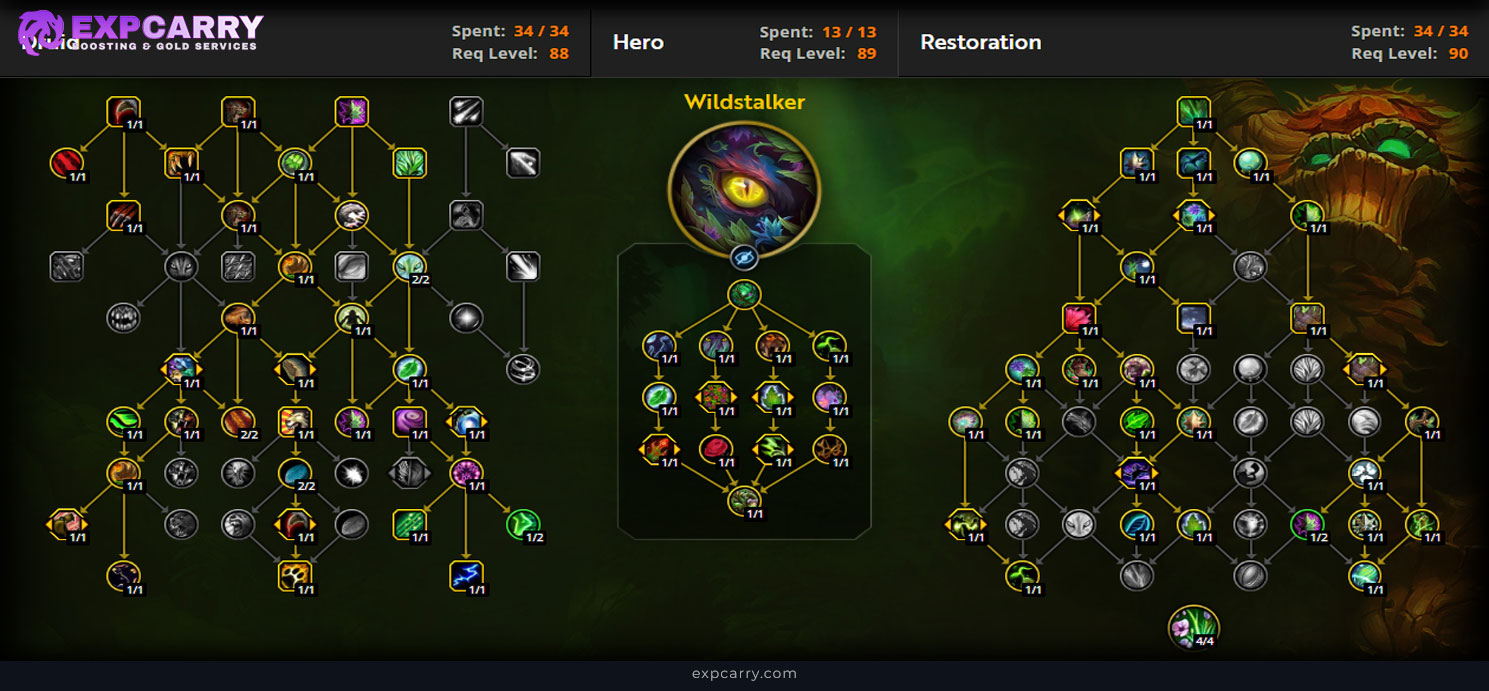
Keep Lifebloom and Rejuvenation on yourself or the ally holding enemy attention. Start dangerous fights from range, use Entangling Roots or Ursol's Vortex to control the pull, and move into Bear Form before a stun or heavy melee sequence. Barkskin should prevent damage, not become a last-second response at low health.
- Against one elite, maintain Lifebloom, use Moonfire and Wrath when safe, and save Nature's Swiftness for a real recovery need.
- Against several enemies, use Sunfire and Starfire for ranged damage while roots, Vortex, and Typhoon limit contact.
- If the pull becomes unsafe, create distance and let HoTs continue healing while enemies are controlled.
- Use Tranquility only after securing a channel location; the new roots help against damage and knockbacks but do not correct dangerous positioning.
Useful Restoration Druid Delve Macros
Delve macros should support quick self-preservation and control without adding unnecessary target changes.
Self Ironbark:
#showtooltip Ironbark
/cast [@player] Ironbark
Focus Entangling Roots:
#showtooltip Entangling Roots
/cast [@focus,harm,nodead][] Entangling Roots
Self Nature's Swiftness and Regrowth:
#showtooltip Nature's Swiftness
/stopcasting
/cast Nature's Swiftness
/cast [@player] Regrowth
What Is the Restoration Druid Healing Priority?
Restoration has priorities and preparation windows rather than one universal rotation. The correct spell depends on how many players are injured, which HoTs are already active, when the next damage event occurs, and which cooldown is assigned.
What Is the Restoration Druid Raid Ramp?
A raid ramp should begin early enough that the final globals land as damage starts, not after the group is already low.
- Maintain Lifebloom on the assigned priority target and place Efflorescence under a stable group.
- Begin spreading Rejuvenation before the event while preserving enough mana for the full sequence.
- Cast Wild Growth as raid damage begins.
- Use Swiftmend when its direct healing and Everbloom trigger have value, then spend Soul of the Forest on the needed follow-up.
- Use Convoke the Spirits, Incarnation: Tree of Life, or Tranquility according to the healing assignment.
- Continue with efficient HoTs and Regrowth only where additional direct recovery is required.
What Is the Single-Target Healing Priority?
- Keep Lifebloom established on the tank or priority ally.
- Maintain Rejuvenation before predictable damage.
- Use Ironbark before the dangerous hit when external mitigation is needed.
- Use Swiftmend for immediate healing and to prepare the next Soul of the Forest spell.
- Use Nature's Swiftness with Regrowth when fast recovery is required.
- Cast additional Regrowths only when the target still needs direct healing and the mana cost is justified.
What Is the Group Healing Priority?
- Keep Efflorescence under players who will remain grouped.
- Apply Rejuvenation before known damage rather than blanketing without a purpose.
- Use Wild Growth as multiple targets begin taking damage.
- Use the correct major cooldown for the size and duration of the damage window.
- Allow existing HoTs to work before spending extra mana on unnecessary Regrowth casts.
Which Defensive and Utility Abilities Matter?
Barkskin is the primary personal defensive and should be used before predictable damage. Bear Form increases durability when the Druid is targeted. Ironbark protects an ally, Nature's Cure removes eligible effects, Soothe removes eligible enrages, and Stampeding Roar helps the group reposition. In Mythic+ and PvP, Cyclone, Entangling Roots, Typhoon, and Ursol's Vortex can prevent more damage than an extra healing cast.
What Is the Best Restoration Druid Stat Priority?
For general Season 2 PvE gearing, use this priority as a starting point:
- Item level and Intellect
- Haste
- Mastery
- Versatility
- Critical Strike
Haste and Mastery are close in value, but the current general PvE starting order places Haste slightly ahead of Mastery. Haste improves HoT ticks, cast speed, and responsiveness, while Mastery increases healing according to the number of Restoration HoTs on the target. Intellect and total item level remain important enough that a large upgrade usually beats a lower-level item with cleaner secondary stats. Critical Strike is the weakest general secondary. For rated PvP, prioritize Intellect and build primarily around Mastery and Versatility, with their exact order varying by bracket, gear, and current ladder trends; Haste follows and Critical Strike is generally last.
What Is the Best Restoration Druid Gear in Season 2?
The following targets form a strong early Season 2 PvE set. Because Season 2 has only just opened, treat this as a target list rather than immutable Best-in-Slot: difficulty, Great Vault options, crafted stats, and live performance data can change the exact value of individual slots. Head, chest, and legs are intentionally left to tier or Catalyst choices needed to complete the 4-piece bonus.
| Slot | Recommended Item | Source |
|---|---|---|
| Weapon | Jan'thrazet, the Soul Fang | Ula'tek |
| Off-hand | Spine of the Hissing Abyss | Entombed Sentinels |
| Neck | Amulet of the Twin Fangs | The Twin Fangs |
| Shoulders | Silvermoon Agent's Mantle | Leatherworking |
| Cloak | Silken Voodoo Drape | The Coiled Altar |
| Bracers | Silvermoon Agent's Deflectors | Leatherworking |
| Gloves | Enigmatic Dreamwatcher's Gauntlets | Entombed Sentinels |
| Belt | Sash of the Forlorn Vessel | The Coiled Altar |
| Boots | Silvermoon Agent's Sneakers | Leatherworking |
| Ring | Alluring Bubbleband | Nymrissa Wavecaller |
| Ring | Sickening Signet of Atroxus | Voidscar Arena |
| Trinket | Wavecaller's Seastone | Nymrissa Wavecaller |
| Trinket | Soulcoiler Ritual Vessel | Nek'zali the Soulcoiler |
The Season 2 set is Bark of the Enigmatic Dreamwatcher. The 2-piece gives Rejuvenation a 15 percent chance to grant Genesis, increasing all HoT healing by 15 percent for eight seconds; multiple Genesis applications can overlap. The 4-piece makes Nature's Swiftness, Tranquility, and the selected Incarnation: Tree of Life or Convoke the Spirits cooldown grant Genesis, while also extending Genesis by four seconds. Reforestation does not trigger the 4-piece effect.
How Should Restoration Druid Use the Catalyst?
Build the 4-piece bonus while protecting high-value non-tier items. Head, chest, gloves, and legs are practical Catalyst targets; crafted shoulders are attractive because the available shoulder alternatives have weak stat distributions. In Patch 12.1, Catalyst conversions inherit the original item's secondary and tertiary stats and retain eligible special cantrip effects, so an eligible special-effect armor piece no longer automatically loses its defining effect when converted.
What Should Restoration Druid Craft First?
An early Aln'hara Lantern with Darkmoon Sigil: Hunt is useful when a strong off-hand has not dropped. For long-term armor, craft Silvermoon Agent's Mantle or Silvermoon Agent's Leggings with Arcanoweave Lining. Late in the season, shoulders and bracers are efficient permanent crafts, with boots available when they replace a weak slot.
How Should Restoration Druid Use the Great Vault and Nebulous Voidcores?
Prioritize a high-item-level weapon, special-effect raid items, and the strongest trinkets. Nebulous Voidcores are available through the Season 2 Great Vault and can be spent on eligible bonus-loot rolls; current raid targeting uses one core per roll, with an additional weekly source becoming available later in the season. Jan'thrazet, a powerful special-effect weapon, and Soulcoiler Ritual Vessel are high-value targets when they remain missing. Use the Great Vault to fill the largest upgrade rather than chasing a minor secondary-stat improvement.
What Are the Best Restoration Druid Consumables, Gems, and Enchants?
These options follow the current Season 2 PvE recommendations. Use the highest available quality when the content justifies the cost. Weapon enchants and secondary-stat enchants or gems can still shift with your current gear, so treat those slots as optimization targets rather than universal absolutes.
| Slot or Type | Recommended Option | Use |
|---|---|---|
| Flask | Flask of the Blood Knights | Default raid and Mythic+ flask. |
| Combat potion | Potion of Recklessness | Preferred throughput potion; align it with a demanding healing window. |
| Mana potion | Lightfused Mana Potion | Situational raid choice when mana determines the pull. |
| Health potion | Concentrated Silvermoon Health Potion | Emergency personal healing. |
| Weapon oil | Thalassian Phoenix Oil | Maintain for PvE combat. |
| Augment rune | Void-Touched Augment Rune | Additional primary stat for progression. |
| Feast | Harandar Celebration | Recommended group food. |
| Personal food | Royal Roast | Recommended individual food. |
| Weapon enchant | Enchant Weapon - Berserker's Rage | Haste-oriented weapon proc. |
| Helm enchant | Enchant Helm - Empowered Hex of Leeching | Recommended PvE helm enchant. |
| Shoulder enchant | Enchant Shoulders - Silvermoon's Mending | Recommended PvE shoulder enchant. |
| Chest enchant | Enchant Chest - Mark of the Worldsoul | Primary-stat chest enchant. |
| Leg enchant | Arcanoweave Spellthread | Intellect and maximum mana. |
| Boot enchant | Enchant Boots - Shaladrassil's Roots | Recommended PvE boot enchant. |
| Ring enchant | Enchant Ring - Silvermoon's Alacrity | Haste on both rings. |
| Unique gem | Indecipherable Eversong Diamond | Use one in the unique diamond socket. |
| Other sockets | Flawless Masterful Peridot | Haste and Mastery for remaining sockets. |
How Do You Play Restoration Druid in PvP Season 2?
Restoration Druid is a mobile HoT healer with strong single-target and spread healing, multiple crowd-control categories, and excellent ability to work from a pillar. Patch 12.1 returns Overgrowth and the Ancient of Lore PvP talent, increases Mastery: Harmony's healing bonus, strengthens Wild Growth, and changes several mana and defensive interactions. Restoration healing is also reduced by 10 percent in PvP, and Call of Ohn'ahra now increases Nature's Swiftness cooldown by 30 seconds, so its instant-Cyclone utility carries a much larger tradeoff. The specialization remains powerful but punishes dropped HoTs and unsafe attempts to cross the map for crowd control.
| Mode | Primary Plan | Recommended PvP Talent Approach |
|---|---|---|
| Solo Shuffle | Keep both teammates covered, trade defensives independently, and avoid crowd control that exposes you to a swap. | Early Spring and Forest Guardian, with the third slot adjusted for the lobby. |
| 2v2 | Support sustained pressure and connect Mighty Bash or Maim into Cyclone chains. | Use Call of Ohn'ahra for instant Cyclone access into ranged interrupts when the setup is worth its 30-second Nature's Swiftness cooldown penalty, or choose a matchup-specific defensive talent. |
| 3v3 | Maintain HoTs on both allies, stay in Bear Form before enemy stun setups, and coordinate cross-control. | Use the current arena build and flex the third PvP talent for enemy interrupts and damage profile. |
| Blitz and RBG | Rotate between objectives, heal spread pressure, support a flag carrier, and use control to protect space. | Use the current battleground build and select the defensive or control option required by the map. |
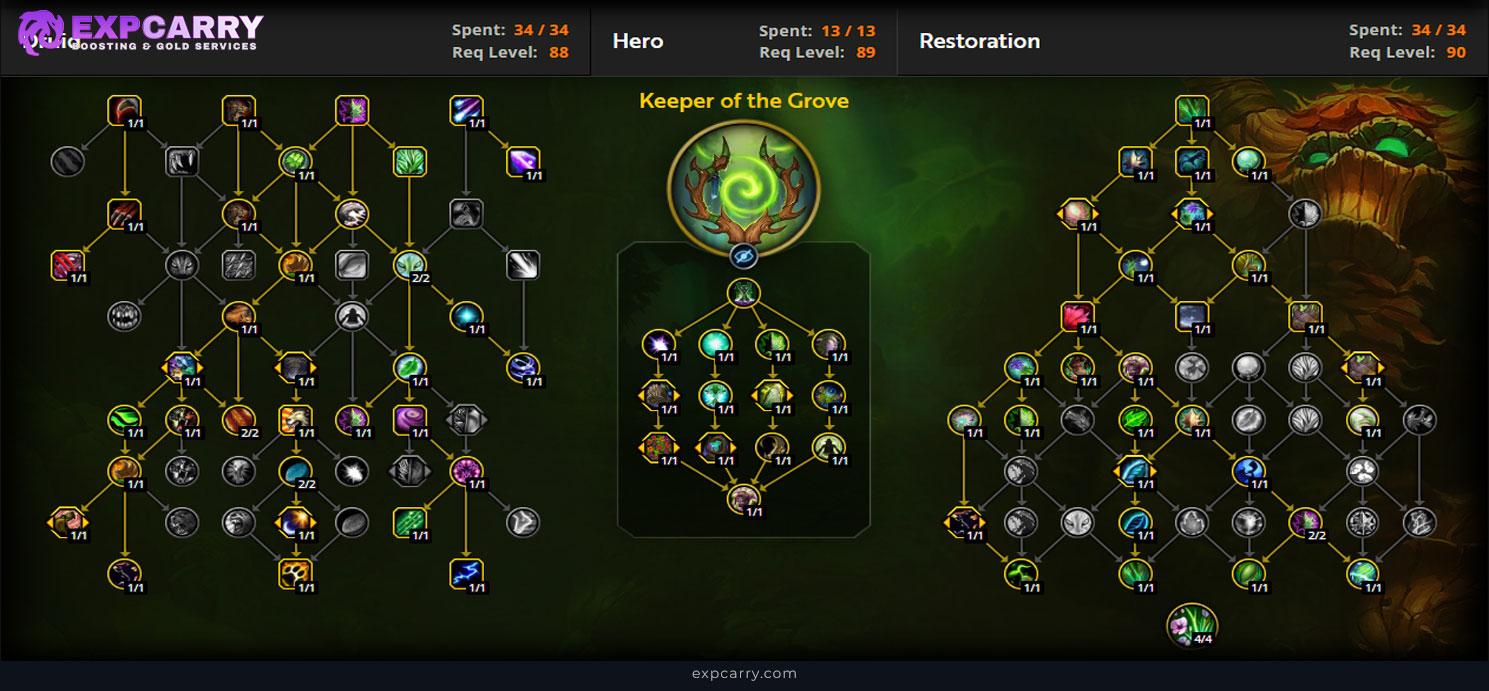
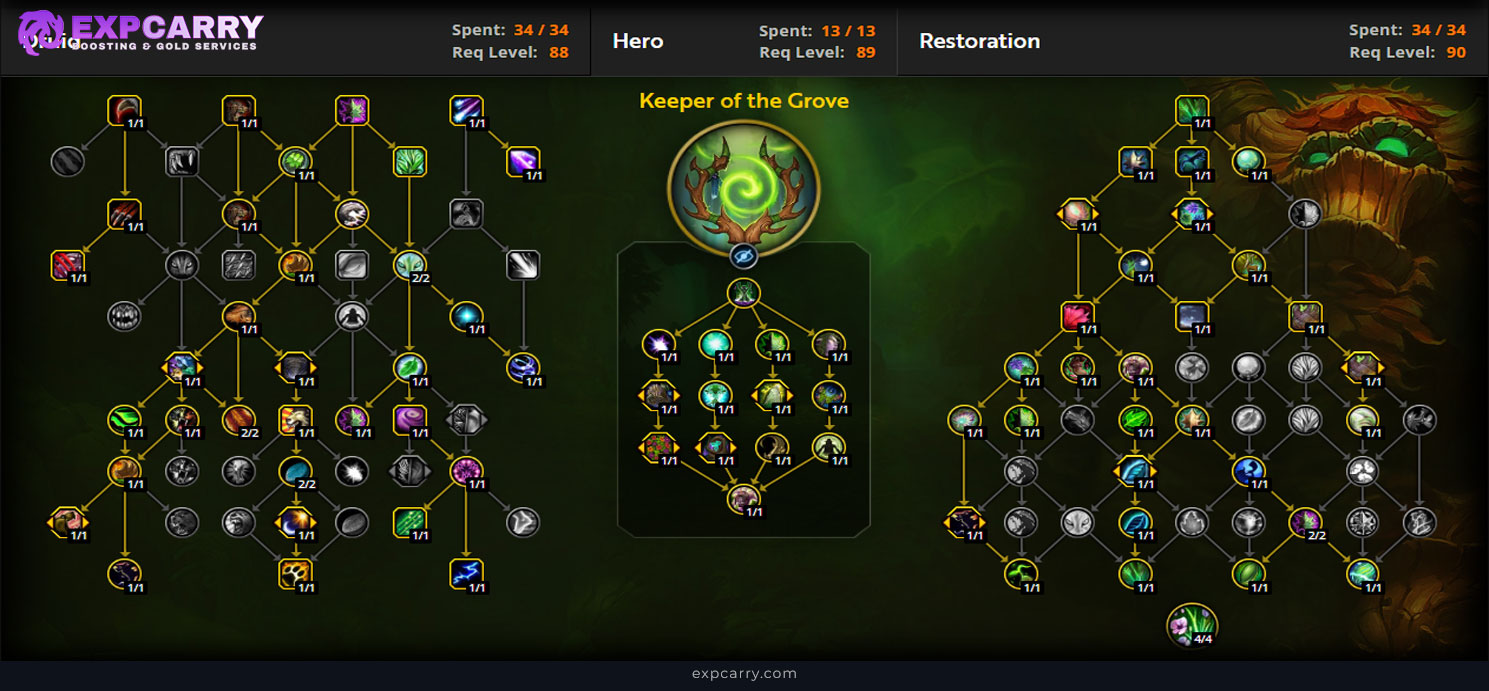
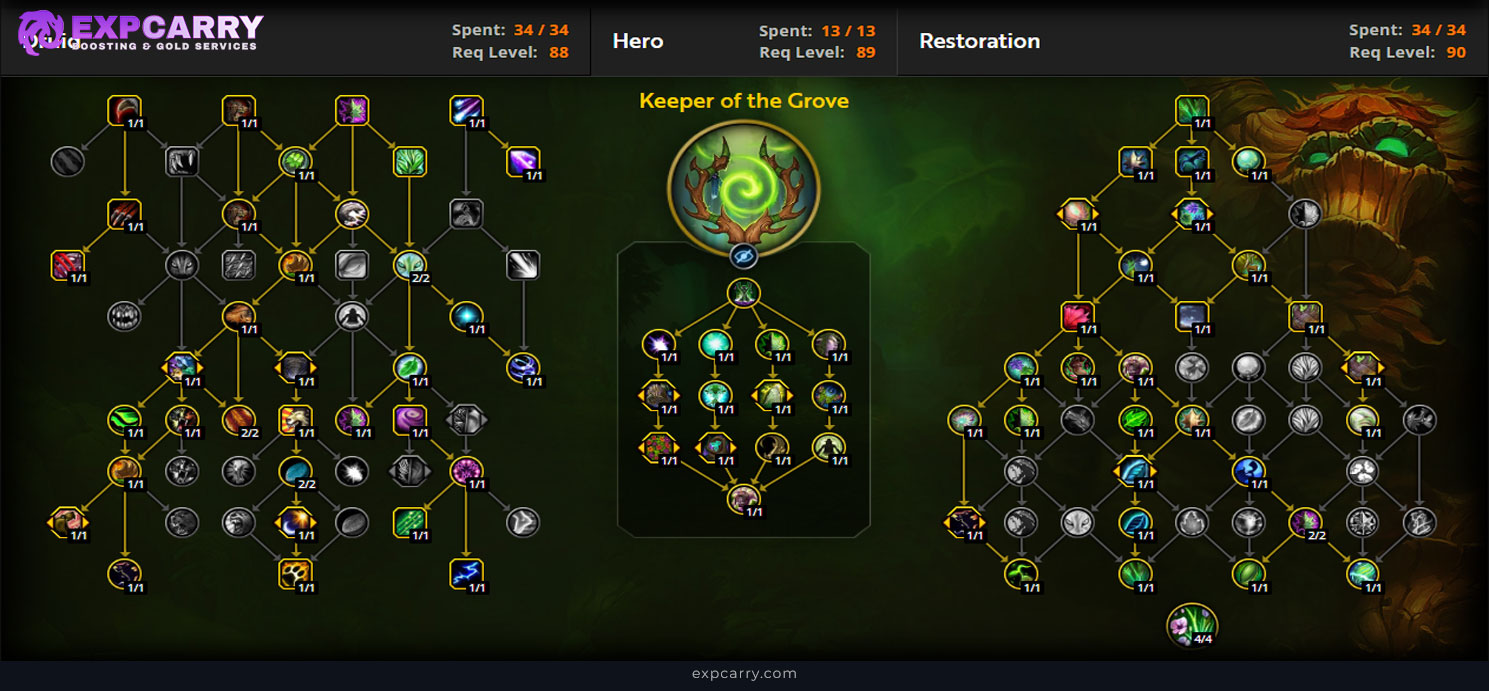
Early Spring and Forest Guardian are the current core PvP talents. Early Spring makes Wild Growth instant and enables Full Bloom after healing six allies; Forest Guardian extends active HoTs when the Druid uses listed offensive or control abilities. Call of Ohn'ahra, High Winds, Thorns, and Disentanglement are matchup choices rather than permanent selections. Call of Ohn'ahra should be chosen deliberately because Patch 12.1 increases the Nature's Swiftness cooldown penalty to 30 seconds.
Restoration Druid Solo Shuffle Guide
Solo Shuffle rewards stable positioning and repeatable defensive trades. Begin with Mark of the Wild, identify the likely target, apply Rejuvenation coverage, and use Prowl when it prevents an immediate crowd-control chain. Keep Lifebloom on the player receiving the most pressure and return to the pillar after an offensive Cyclone attempt.
Best Talents for Restoration Druid Solo Shuffle
Use the current arena build below. Early Spring and Forest Guardian provide the core healing pattern. Choose Call of Ohn'ahra against ranged interrupts when instant Cyclone creates a reliable setup and justifies the 30-second Nature's Swiftness cooldown penalty, High Winds for defensive Cyclones, Thorns against double melee, or Disentanglement against heavy slows.
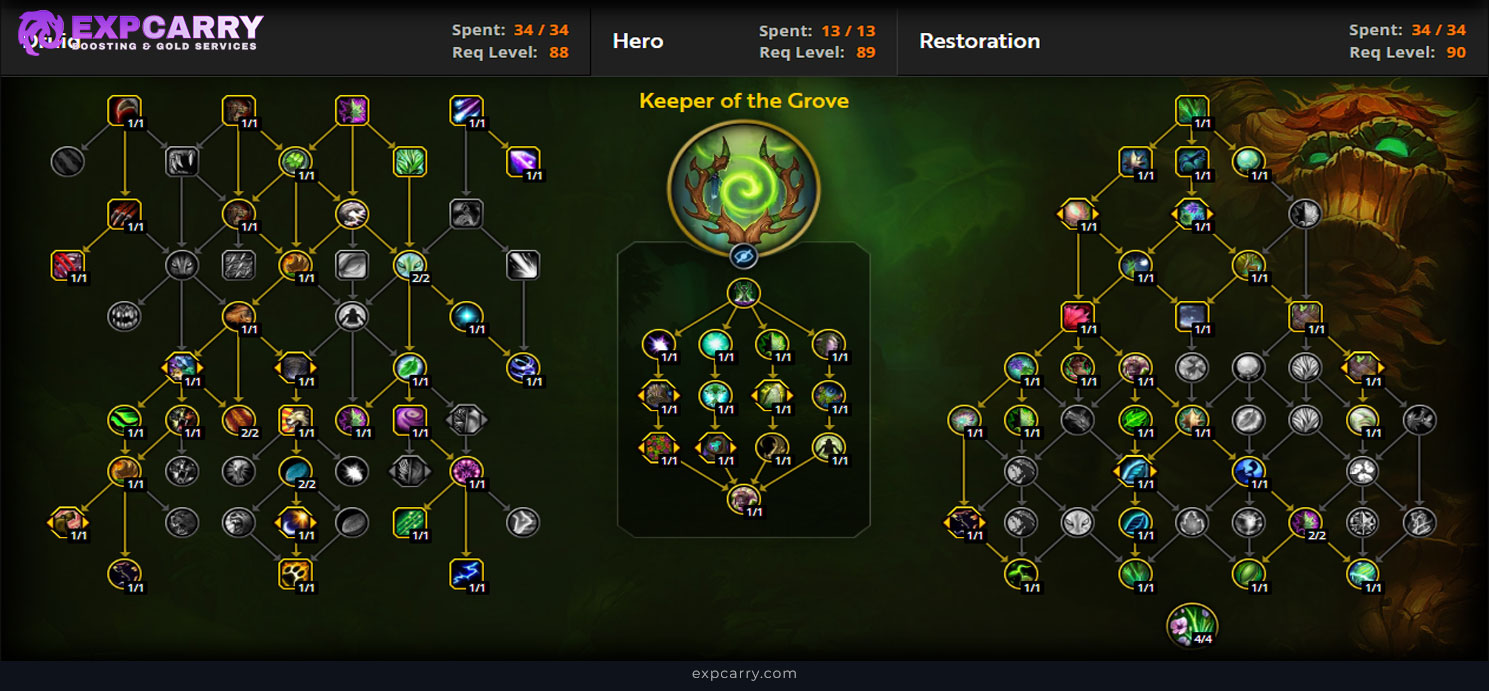
Restoration Druid Solo Shuffle Game Plan
- Keep Lifebloom and Rejuvenation on the pressured ally, but refresh the second teammate before an obvious swap.
- Use Ironbark before enemy burst lands and avoid overlapping it with a teammate's strongest defensive when possible.
- Use Swiftmend before the Soul of the Forest Regrowth sequence and pair Nature's Swiftness with Regrowth for urgent recovery.
- Use Cyclone on the enemy healer during allied burst or on an enemy DPS during dangerous offensive cooldowns.
- Enter Bear Form before predictable stun and silence chains when the enemy can swap to you.
Restoration Druid 2v2 Guide
In 2v2, Restoration Druid wins through efficient healing, repeated control, and a partner who continues applying pressure. Mighty Bash or Maim can start a Cyclone chain on the healer, while Entangling Roots separates targets and prevents melee uptime. Do not abandon HoT maintenance to chase a crowd-control attempt around a pillar.
Best Talents for Restoration Druid 2v2
Use the arena import and change the third PvP talent for the matchup. Call of Ohn'ahra is valuable when ranged interrupts make normal Cyclone casts unreliable, but the instant Cyclone comes with a 30-second increase to Nature's Swiftness cooldown; Thorns is a strong answer to melee pressure, and High Winds supports defensive Cyclones.
Best Restoration Druid 2v2 Partners
Strong early-Season 2 partner options include Rogue, Havoc Demon Hunter, Windwalker Monk, Warrior, Hunter, and Warlock, although the best pairing can shift quickly with tuning and ladder trends. Melee partners benefit from roots and Cyclone chains that preserve uptime, while Warlock pairs well with Restoration's efficiency and ability to heal spread pressure. Coordinate the partner's burst with Mighty Bash or Maim into Cyclone rather than using crowd control without offensive pressure.
Restoration Druid 3v3 Guide
In 3v3, maintain HoTs on both teammates and move Lifebloom stacks to the player receiving the heaviest pressure only when the swap is real. Position far enough from the enemy team to avoid free crowd control, but close enough to use a planned Cyclone without crossing the entire arena. Shift into Bear Form before predictable enemy stun chains.
Best Talents for Restoration Druid 3v3
This is the current arena import for Patch 12.1. Keep Early Spring and Forest Guardian, then select the third PvP talent according to interrupts, slows, defensive Cyclone value, and melee pressure.
Restoration Druid 3v3 Kill Setup
- Refresh HoTs before the team commits so the Druid can spend globals on control.
- Use Mighty Bash, Maim, or a partner's stun to begin crowd control on the enemy healer.
- Follow with Cyclone while teammates use offensive cooldowns on the kill target.
- If the kill target becomes low but cannot be finished, Cyclone that target to deny incoming healing, then move control back to the healer.
- Return to safe positioning before HoTs expire or the enemy team can swap to the Druid.
Established 3v3 shells to test in early Season 2 include MLD with Mage and Warlock, RMD with Mage and Rogue, LSD with Elemental Shaman and Warlock, Hero Cleave with Demon Hunter and Unholy Death Knight, TSG with Warrior and Death Knight, and God Comp with Mage and Shadow Priest. Their exact ranking can change rapidly with tuning and the developing ladder meta.
Restoration Druid Battleground Blitz and RBG Guide
Restoration Druid brings mobile spread healing, strong flag-carrier support, and control for entrances, chokes, and rotations. The healer should move with the objective instead of remaining in an irrelevant fight. Keep HoTs on the carrier or frontline, use Efflorescence where allies will hold ground, and save displacement effects for enemy pushes or escapes.
Best Talents for Restoration Druid RBG and Battleground Blitz
Use the current battleground build. Early Spring gains exceptional value when Wild Growth reliably reaches six allies, while Forest Guardian rewards active use of damage and control. Adjust the third PvP talent for the map, enemy composition, and assigned role.
Restoration Druid Battleground Role
- Maintain HoTs on the flag carrier, frontline, and allies likely to receive the next swap.
- Place Efflorescence at chokes and objectives where teammates can remain inside it.
- Use Wild Growth during team-wide pressure and plan major cooldowns for coordinated enemy pushes.
- Use Cyclone on enemy healers during a kill attempt or on offensive targets to stop their cooldowns.
- Use Entangling Roots, Typhoon, and Ursol's Vortex to protect space and delay enemy rotations.
- Leave lost fights early enough to reach the next objective instead of giving the enemy a free healer elimination.
Useful Restoration Druid PvP Macros
These macros follow the current Restoration PvP control and dispel pattern.
Arena 1 Cyclone:
#showtooltip Cyclone
/cast [@arena1] Cyclone
Duplicate the macro with arena2 and arena3 for the other enemy slots.
Focus Cyclone:
#showtooltip Cyclone
/cast [@focus,harm,nodead][] Cyclone
Party 1 Nature's Cure:
#showtooltip Nature's Cure
/cast [@party1,help,nodead] Nature's Cure
Nature's Swiftness and Regrowth:
#showtooltip Nature's Swiftness
/stopcasting
/cast Nature's Swiftness
/cast Regrowth
Focus Entangling Roots:
#showtooltip Entangling Roots
/cast [@focus,harm,nodead][] Entangling Roots
Is Restoration Druid Good in Midnight Season 2?
Yes. Restoration Druid has strong single-target and spread healing, excellent mobility, valuable raid ramps, multiple forms of control, and improved Patch 12.1 recovery tools. Wildstalker is a clear PvE default, Everbloom gives Lifebloom meaningful group value, and the redesigned Innervate and Swiftmend interactions improve practical healing decisions. In PvP, the specialization is competitive but demanding because it must maintain HoTs, read swaps, manage forms, and choose safe moments for Cyclone.
What Are the Most Common Restoration Druid Mistakes?
- Starting Rejuvenation coverage after raid damage has already landed.
- Moving Lifebloom repeatedly and losing the value of its accumulated Everbloom stacks.
- Using Swiftmend without considering the Everbloom trigger or the Soul of the Forest follow-up.
- Placing Efflorescence where the group immediately leaves it.
- Spending too much mana on low-value Rejuvenations and Regrowths before the real damage event.
- Holding Barkskin, Ironbark, Innervate, or a major cooldown until the danger has nearly ended.
- Forcing Cat Form damage in Mythic+ when caster damage would preserve awareness and healing access.
- In PvP, crossing into the enemy team for Cyclone while HoTs are expiring.
- Remaining in caster form before a predictable stun swap instead of entering Bear Form.
- Using a fixed third PvP talent without adapting to interrupts, slows, or melee pressure.
Restoration Druid FAQ
These answers cover the most common Season 2 build, rotation, gearing, and PvP questions.
Is Wildstalker or Keeper of the Grove Better for Raids?
Wildstalker is the current raid recommendation because its healing modifiers work especially well with Lifebloom and Everbloom. Keeper of the Grove remains playable but is not the default top raid build.
What Is the Best Restoration Druid Hero Talent Tree for Mythic Plus?
Wildstalker is the default healing choice. It does not require constant Cat Form damage; caster damage is effective and often easier to combine with quick healing reactions.
Do Mythic Plus and Delves Use the Same Talent Code?
Yes. This guide intentionally uses the same Wildstalker import for Mythic+ and Delves so one loadout covers both forms of small-group content.
When Should Restoration Druid Use Swiftmend?
Use Swiftmend when its direct heal is valuable and when you can use the resulting interaction. In Patch 12.1 it also triggers Everbloom Rank 3, while Soul of the Forest can strengthen the following Regrowth or Wild Growth.
How Should Restoration Druid Use Innervate in Patch 12.1?
Innervate now restores 25 percent of the target's maximum mana over eight seconds. Use it early enough in a long encounter to gain another cast and coordinate the target if it is assigned to another healer.
What Are the Best Restoration Druid PvE Stats?
Prioritize item level and Intellect, then Haste and Mastery, followed by Versatility and Critical Strike. Haste and Mastery are close enough that large item-level gains normally matter more than a perfect secondary distribution.
What Are the Best Restoration Druid PvP Talents?
Early Spring and Forest Guardian are the core current choices. The third slot changes by matchup: Call of Ohn'ahra, High Winds, Thorns, and Disentanglement each solve a different problem. Call of Ohn'ahra now carries a 30-second Nature's Swiftness cooldown penalty in Patch 12.1.
What Are the Best Restoration Druid 2v2 Partners?
Rogue, Havoc Demon Hunter, Windwalker Monk, Warrior, Hunter, and Warlock are strong early-Season 2 partner options, but their relative value can shift with tuning and ladder trends.
Does Restoration Druid Need to Catweave in Mythic Plus?
No, not for the basic healing plan. Restoration can play Mythic+ without constant Catweaving, and caster damage is often the safer choice for preserving healing access, positioning, and dungeon awareness. At higher key levels, however, safe Cat Form windows can still add useful damage and are worth learning when the pull allows them.
Changelog
This guide was rebuilt from the ground up for Midnight Season 2.
- August 20, 2026: Verified and updated for live Patch 12.1 and Midnight Season 2.
- Added current raid, Mythic+, Delve, Solo Shuffle, 2v2, 3v3, and Battleground Blitz or RBG talent imports.
- Added Patch 12.1 Restoration changes, Everbloom explanation, Season 2 raid and dungeon guidance, tier set, gear, crafting, consumables, enchants, and gems.
- Added separate raid, Mythic+, Delve, and PvP macro sections.
- Expanded rated PvP coverage with Solo Shuffle, 2v2, 3v3, and battleground game plans.
Conclusion
Restoration Druid in WoW Midnight Season 2 rewards preparation, efficient HoT coverage, and correct cooldown timing. Wildstalker is the current PvE default, Everbloom makes Lifebloom central to both priority-target and group healing, and Patch 12.1 improves emergency recovery through Overgrowth, Swiftmend, Nature's Swiftness, and major cooldown updates. In rated PvP, success comes from maintaining HoTs from safe positioning, entering Bear Form before swaps, and using Cyclone only when the team is ready to capitalize.