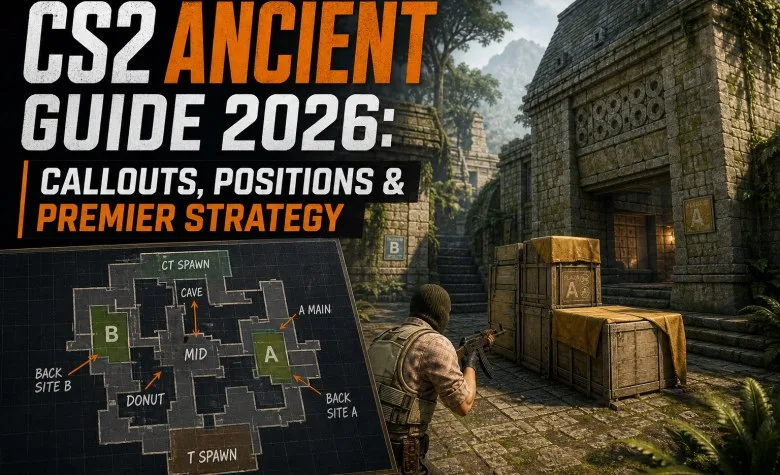
Ancient is one of the current CS2 Premier maps and a map where Mid control influences almost every round. The most important concept is understanding how Mid connects A through Donut and B through Cave. Once the T side owns those routes, both bombsites become much harder for CTs to defend with simple static setups.
Ancient also has two layers of callouts: official in-game zone names and more detailed community names used in voice communication. Learn both, but prioritize the names your teammates actually use during a match.
Is Ancient in CS2 Premier?
Yes. Ancient remains part of the current seven-map Premier pool alongside Anubis, Cache, Dust II, Inferno, Mirage and Nuke.
See the complete CS2 Premier Map Pool.
Ancient Map Structure
Ancient is built around three strategic zones:
- A side: A Main, Donut, Temple, Triple, Big Box, Plat;
- Mid: Top Mid, Mid, Red/House, Connector and the routes toward Donut or Cave;
- B side: Ramp, Cave, Jaguar/Lamp Room, Pillar, Short, Long, Back Halls and Alley.
The map becomes much easier when you stop thinking of A and B as isolated sites. Mid creates the connection between them.
Essential Ancient Callouts
| Area | Key Community Callouts |
|---|---|
| A | A Main, Donut, Temple, Triple, Big Box, Plat, Default, Boost |
| Mid | Top Mid, Mid, Bottom Mid, Red, House, Connector, Cubby, XBOX |
| B | Ramp, Cave, Jaguar/Lamp Room, Pillar, Short, Long, Back Halls, Alley, Wood |
| T Side | T Spawn, T Stairs, Split, Tunnel, Water, Ruins |
| CT Side | CT Spawn, CT Lane, Sniper's Nest, Temple |
Explore services related to this guide, selected from our Counter Strike 2 catalog.
View All Counter Strike 2 Services


Official Names vs Community Callouts
CS2 uses broader official place names such as Middle, Main Hall, Side Hall, Side Entrance, Ramp, Water, Ruins and House.
Players then add more precise terms inside those areas.
| Community Name | Related Official Area |
|---|---|
| Donut | Middle / Side Hall / Bombsite A area |
| Temple | Bombsite A / CT side |
| Red | Top of Mid / House area |
| Cave | Side Entrance / Bombsite B area |
| Jaguar | B-side central room |
| Pillar | Bombsite B |
| Triple | Bombsite A |
Why Mid Control Matters So Much
Mid is the hinge of Ancient.
When Ts control Mid, they can:
- enter Donut and split A;
- enter Cave and split B;
- hold CT rotations;
- fake one site and quickly redirect;
- force CTs to defend several angles simultaneously.
When CTs hold Mid, T attacks become much easier to predict because pressure is forced toward A Main or B Ramp.
Top Mid
Top Mid is where early central control often starts.
T players need enough utility and spacing to avoid losing the opening fight without a trade.
CTs can contest early, take information and then fall back rather than forcing an unnecessary death.
Red / House
Red or House is a critical CT-side Mid reference. It gives defenders information and influence over central movement.
Once Ts force this player away, deeper Mid control becomes much easier.
Donut
Donut is one of the most important positions on Ancient.
It connects Mid to A and allows Ts to transform a direct A Main attack into a split.
A CT Donut player also acts as a rotation hinge between A and Mid.
Cave
Cave performs a similar role on the B side.
When Ts control Mid and Cave, B defenders must worry about pressure from both Ramp and the central route.
How to Attack A on Ancient
A is strongest when attacked from two directions.
A simple structure is:
- contest Mid;
- gain or threaten Donut;
- pressure A Main;
- use utility on CT/Temple and close site positions;
- flash the site;
- activate A Main and Donut at similar timing;
- plant for positions your team controls.
A Main
A Main is the direct T route into A.
CTs can delay it heavily with incendiaries, HE grenades and early spam, so walking through without utility is rarely reliable against prepared opponents.
Temple
Temple is a major CT-side route and retake position.
During an execute, isolate it with smoke or force the player away with pressure before committing the bomb carrier.
Triple and Big Box
These positions provide strong cover and must be included in the site-clear sequence.
Do not focus entirely on Temple and forget the players already inside A.
Simple A Execute
- smoke CT/Temple-side pressure;
- use a Donut smoke or control Donut directly;
- molotov close A-Main positions;
- flash over the site;
- enter from A Main;
- activate Donut pressure immediately;
- trade instead of entering one by one.
How to Defend A
A CT setup should normally have someone responsible for direct A pressure and someone capable of influencing Donut.
The important part is communication. If Donut is lost, the A anchor is no longer defending one entrance.
How to Attack B on Ancient
B attacks revolve around Ramp and Cave.
A simple B hit through Ramp alone can work against weak utility, but a coordinated Ramp + Cave split is much harder to defend.
Ramp
Ramp is the primary direct T approach.
CT incendiaries can delay this route significantly, so be prepared to wait, extinguish the fire or change timing.
Cave
Cave creates the second angle and forces B defenders to split their attention.
Pillar
Pillar is one of the central pieces of cover on B and must be cleared systematically.
Jaguar / Lamp Room
This area matters for both site defense and the Mid-to-B connection.
Short and Long
These names help distinguish the different CT-side and deeper B approaches during executes and retakes.
Simple B Execute
- take Ramp space;
- create Cave pressure from Mid when possible;
- smoke deep CT sightlines;
- molotov Pillar or another close defender;
- flash over Ramp;
- enter in trading distance;
- clear Back Site before planting.
Why B Rushes Fail
Common reasons:
- Ramp incendiary stops the entire team;
- the first player runs too far ahead;
- no Cave pressure exists;
- Pillar is not cleared;
- everyone stops to throw utility at the same time;
- the bomb is planted before deeper angles are safe.
Best T-Side Default
A practical default:
- one player controls A Main information;
- two players work Mid;
- one player controls B Ramp;
- one flexible lurker/support plays around the strongest information.
The objective is to make CTs spend utility and reveal their setup before the final hit.
What to Do After Winning Mid
Do not immediately run into Donut or Cave without thinking.
Check:
- which CTs rotated toward Mid;
- whether Donut is open;
- whether Cave is weak;
- which site already spent more utility;
- whether your lurker can cut the CT rotation.
How to Play CT Side
A common structure is approximately 2-1-2:
- A anchor;
- Donut/A support;
- Mid player;
- B anchor;
- B/Cave or rotation player.
Do not repeat the exact same setup every round. Change openings based on spawns, economy and what the T side has shown.
Use Utility to Delay
Ancient rewards defensive utility.
High-value early CT utility includes:
- incendiary at A Main;
- incendiary or smoke at Ramp;
- Mid flash for information;
- late smoke for Donut/Cave or a retake.
Do Not Over-Rotate
Mid control lets Ts fake quickly.
Do not leave a bombsite because one teammate heard two footsteps.
Useful rotation calls should include:
- number of opponents;
- whether the bomb was seen;
- which route is lost;
- whether Donut or Cave is controlled.
Ancient Retakes
The sites contain many close corners, so retakes are much stronger when two or three CTs regroup.
Use flashes before crossing and clear positions in a consistent order rather than taking separate duels.
Common Ancient Mistakes
- giving Mid away without gaining information elsewhere;
- ignoring Donut;
- attacking B only through Ramp;
- not clearing Pillar;
- rotating from sound alone;
- using all CT utility immediately;
- taking isolated Mid fights;
- planting before the site is controlled;
- repeating the same T default every round.
Ancient in Solo Queue
Solo players should prioritize clear calls:
- “Two Top Mid.”
- “One Donut.”
- “Cave lost.”
- “Three Ramp, bomb seen.”
- “Last Temple.”
Information is often worth more than one extra risky peek.
Ancient With a Duo or Stack
Coordinated teams get strong value from:
- A Main + Donut splits;
- Ramp + Cave B splits;
- planned Mid flashes;
- late lurks;
- fake utility;
- delayed second-wave executes.
What Utility Should You Learn First?
Start with:
- Top Mid smoke;
- Donut smoke;
- A CT/Temple smoke;
- A Main molotov;
- B-site isolation smokes;
- Pillar molotov;
- Ramp entry flash;
- CT Ramp-delay utility.
If search demand justifies a dedicated page, Ancient utility should live separately rather than turning this guide into a 40-lineup database.
AWP on Ancient
Ancient has many tight corridors, so the AWP is strongest when used selectively for information and controlled long sightlines.
Avoid becoming predictable by holding the same Mid or site angle every round.
How to Practice Ancient
- learn A Main, Mid, Donut, Cave and Ramp;
- walk Mid → Donut → A;
- walk Mid → Cave → B;
- learn one basic A execute;
- learn one basic B execute;
- practice CT rotation routes;
- add detailed grenade lineups afterward.
Ancient Practice Checklist
- A Main;
- Donut;
- Temple;
- Triple;
- Top Mid;
- Mid;
- Red;
- Connector;
- Cave;
- Jaguar;
- Ramp;
- Pillar;
- Back Halls;
- Water;
- Ruins;
- Tunnel.
Improve Your Premier Results on Ancient
For the current rotation, see CS2 Premier Map Pool.
For the current season, see CS2 Premier Season 5.
For overall progression, read How to Rank Up in CS2 Premier.
If you want to reach a specific target such as 15K, 20K, 25K or 30K+, see our CS2 Premier Rating Boost.
Last verified: October 2026. Community callouts are more detailed than the official CS2 place-name system, so exact terminology can vary slightly between teams.