
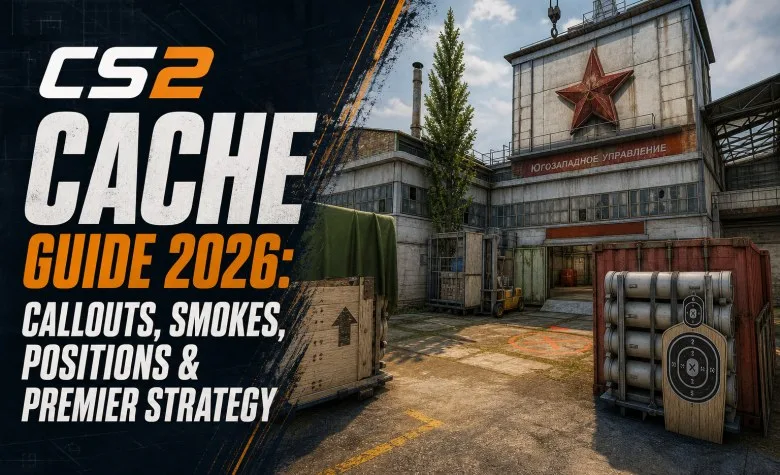
Cache is back in the CS2 Active Duty pool and is now a core Premier map. Valve added Cache on July 8, 2026, replacing Overpass, and continued adjusting the map through August and September with clipping, spawn, wallbang and Mid geometry fixes.
This guide focuses on the parts of Cache that remain useful beyond individual grenade lineups: current callouts, map structure, Mid control, A and B site positions, T-side defaults, CT rotations, executes, retakes and the utility every Premier player should learn first.
Is Cache in CS2 Premier?
Yes. Cache entered the Active Duty Map Pool on July 8, 2026 and replaced Overpass.
The current Premier pool contains:
- Ancient;
- Anubis;
- Cache;
- Dust II;
- Inferno;
- Mirage;
- Nuke.
See the full CS2 Premier Map Pool for the current rotation and map-selection system.
Cache Callouts You Should Learn First
| Area | Essential Callouts |
|---|---|
| A Site | A Main, Squeaky, Forklift, Quad, NBK, Default, Truck, Balcony, Highway |
| Mid | Mid, Garage, White Box, Sandbags, Boost, Connector, Vents |
| B Site | B Main, B Halls, Checkers, Heaven, Hell, Tree, Headshot, Back Site, Default |
| CT Side | CT Spawn, CT Halls, Highway, Connector |
| T Side | T Spawn, Garage, Outside A, B Halls |
Why Mid Control Is So Important on Cache
Mid is the central strategic area of Cache.
If Ts control Mid, they gain multiple options:
- pressure Highway and split A;
- enter Vents and split B;
- hold CT rotations;
- force defenders away from bombsites;
- fake one site and quickly redirect.
If CTs control Mid, the T side becomes much more predictable because most pressure has to come directly through A Main, Squeaky or B Main.
Explore services related to this guide, selected from our Counter Strike 2 catalog.
View All Counter Strike 2 Services

Key Mid Positions
Garage
Garage is the main T-side route into Mid. Ts often use early smokes and flashes here before fighting for White Box and the central lane.
White Box
White Box provides cover and a strong central position. It can be contested from multiple angles, so players should avoid isolating themselves without trade support.
Sandbags
Sandbags can punish players who clear Mid carelessly. Always include it in your clearing sequence rather than focusing only on the obvious central angles.
Boost
Boost positions can create unexpected lines into Mid. Cache has received geometry adjustments since entering Active Duty, so old CS:GO boost guides should be checked in the current build before relying on them.
Vents
Vents connect Mid pressure toward B. Once Ts threaten Vents, B defenders must respect a split instead of watching only B Main.
Highway
Highway links Mid control with A. A successful Mid take can turn a simple A Main hit into a much harder crossfire for CTs to defend.
A Site Callouts and Positions
A Main
A Main is the primary T entrance to A. The CT side can contest it with utility or hold deeper positions depending on economy and setup.
Squeaky
Squeaky creates a second T entry and forces CTs to divide their attention. It becomes especially dangerous when coordinated with A Main and Highway pressure.
Forklift
Forklift is a common close defensive position and a frequent utility target during A executes.
Quad
Quad offers strong cover and can be difficult to clear if Ts enter without flashes or molotovs.
NBK
NBK is another common A-site defensive reference point. Learn the callout even if your team uses a slightly different local nickname.
Truck
Truck gives CTs and retaking players useful sightlines into A and A Main.
Essential A Site Utility
You do not need twenty lineups before playing Cache. Start with utility that solves specific defensive positions:
- Highway smoke — reduces pressure from Mid/Highway during an A hit;
- Forklift smoke or molotov — removes a dangerous close anchor;
- Back-site or Truck utility — limits deep CT sightlines;
- A Main entry flash — helps the first player cross into the site;
- Squeaky support flash — creates timing pressure from the second entrance.
How to Attack A Site
A strong A execute usually combines at least two lanes.
Basic structure:
- pressure or smoke key Mid/Highway angles;
- use utility on Forklift and deeper site positions;
- enter from A Main;
- add Squeaky or Highway pressure;
- trade the first contact instead of entering one by one;
- plant for positions your team can actually defend.
A Main-only attacks are easier for CTs to read and concentrate utility against.
B Site Callouts and Positions
B Main
B Main is the primary direct entrance from the T side.
Checkers
Checkers is one of the most important intermediate positions around B. Control of it improves both site entry and post-plant options.
Heaven
Heaven provides a powerful elevated CT angle and is one of the first positions T utility should isolate during many B executes.
Hell
Hell sits beneath Heaven and matters heavily during retakes and close post-plant fights.
Tree
Tree/CT-side access is another critical rotation and retake route.
Headshot
Headshot is a common defensive reference that can punish players entering B without properly clearing the site.
Essential B Site Utility
Learn these first:
- Heaven smoke;
- Tree/CT smoke;
- B Main anti-rush smoke for CT side;
- Checkers-clearing molotov or flash;
- entry flashes over B.
A basic B execute becomes much easier when Heaven and CT rotation sightlines are removed simultaneously.
How to Attack B Site
Direct B Main rushes can work against weak utility, but a structured B hit is more reliable.
- establish B Main control;
- clear or pressure Checkers;
- smoke Heaven;
- isolate Tree/CT;
- flash through the entry;
- enter as a trading unit;
- use Mid/Vents pressure when available.
A B split through Vents is especially strong because the defenders cannot focus entirely on B Main.
Best T-Side Default on Cache
A practical Premier default can look like:
- one player controlling A Main information;
- two players contesting Mid/Garage;
- one player holding B Main;
- one flexible support or lurk.
The objective is not to execute immediately. It is to force CT utility, identify the setup and create options for the mid-round.
How to Play CT Side on Cache
CTs must protect the bombsites without giving Mid for free every round.
A standard concept is:
- A anchor;
- A/Mid rotator around Highway;
- Mid player;
- B anchor;
- B/Mid rotator.
Exact positions should change based on spawn, economy, opponent tendencies and available utility.
What to Do When CTs Lose Mid
Once Mid is lost, defenders should stop pretending nothing changed.
Ts can now threaten:
- Highway → A;
- Vents → B;
- rotation cuts;
- late splits.
CTs should tighten site setups, communicate possible splits and avoid isolated fights in rotation lanes.
Cache Retake Strategy
Retakes are easier when players arrive together rather than taking three separate 1v1s.
For A:
- coordinate Truck/Highway pressure;
- clear Quad and Forklift systematically;
- use flashes before crossing exposed angles.
For B:
- combine Heaven and Tree/CT pressure;
- clear Checkers and Headshot;
- avoid dropping from Heaven without teammate timing.
Common Cache Mistakes
- giving Mid away every CT round;
- fighting Mid without trade spacing;
- attacking A only through A Main;
- entering B without smoking Heaven;
- forgetting Checkers during B clears;
- using old grenade lineups after geometry changes;
- not tracking enemy rotation patterns;
- forcing the same site after several failed rounds.
Cache for Solo Queue
Solo players should focus on utility and information that teammates can immediately use.
High-value solo habits include:
- calling Mid control clearly;
- knowing one reliable Heaven smoke;
- knowing one reliable Highway smoke;
- flashing teammates into A or B;
- holding rotations instead of chasing kills;
- communicating enemy numbers before rotating.
Cache for Duo or Full Stack
Coordinated teams can get much more value from:
- Mid + A Main splits;
- Vents B splits;
- double-entry flashes;
- fake utility;
- late lurks;
- planned anti-eco setups.
Cache in the New Premier Map Pick System
Since September 22, Premier no longer uses the old ban-down-to-one system.
Teams now select four candidate maps and one is randomly chosen.
If Cache is one of your strongest maps, your team can deliberately include it in the candidate pool, but you still cannot guarantee that Cache will be selected.
See CS2 Premier Map Pool for the complete current system.
How to Practice Cache Efficiently
Do not spend two hours memorizing twenty niche lineups before learning the map.
Use this order:
- learn essential callouts;
- learn routes and rotations;
- learn one basic A execute;
- learn one basic B execute;
- learn essential Mid utility;
- practice CT anchor positions;
- add advanced utility later.
Cache Practice Checklist
- A Main, Squeaky, Forklift and Quad callouts;
- Mid, White Box, Sandbags, Vents and Highway;
- B Main, Checkers, Heaven, Hell and Tree;
- one Highway smoke;
- one Heaven smoke;
- one Tree/CT smoke;
- one Forklift clear;
- basic A and B entry flashes;
- CT rotations through Mid/Highway;
- post-plant positions on both sites.
Use Cache to Improve Your Premier Rating
Cache is now part of every Premier player's active map pool. Track whether it is helping or hurting your climb instead of judging the map from only a few games.
For the current season, see CS2 Premier Season 5.
For climbing strategy, see How to Rank Up in CS2 Premier.
If you are targeting a specific rating such as 15K, 20K, 25K or 30K+, see our CS2 Premier Rating Boost.
Last verified: October 2026. Cache entered Active Duty on July 8, 2026. Valve shipped additional Cache geometry, wallbang, spawn and clipping fixes during August and September, so exact grenade lineups should always be checked against the current build.