
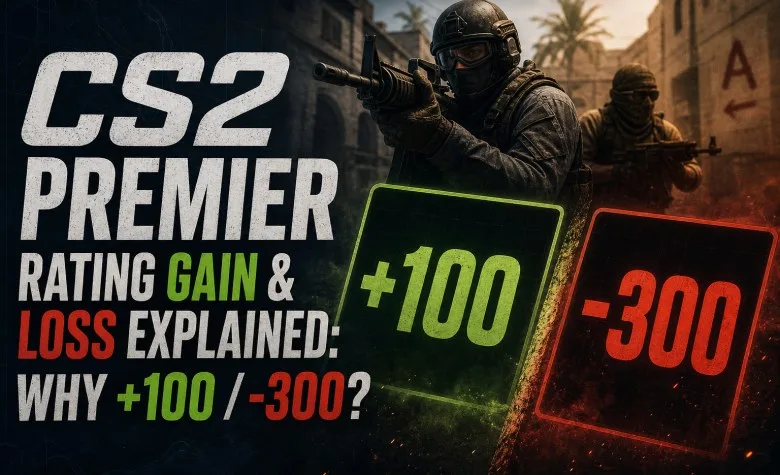
If CS2 Premier is offering you +100 for a win but -300 for a loss, your current rating stakes are heavily asymmetric. You would need to win about 75% of matches if those exact values remained unchanged just to break even over time.
The frustrating part is that Valve does not publish the complete CS Rating formula. We know several official rules, but claims about exact win-streak multipliers, hidden MMR coefficients, K/D bonuses or opponent-rating formulas go beyond what Valve has publicly documented.
Why Am I Getting +100 but Losing -300 in CS2 Premier?
Because Premier does not award one fixed amount of CS Rating for every win or loss.
Your possible rating change can be different from one match to the next. Valve has explicitly increased the possible win and loss amounts in the past so players can move faster after calibration.
What Valve has not published is the exact formula behind each individual +/− pair.
So if you see:
- +105 for a win;
- -298 for a loss;
the correct conclusion is that your current match has unfavorable rating risk.
The incorrect conclusion is pretending we can prove an exact hidden reason such as “you lost exactly four matches, therefore Valve applied multiplier 3.0.”
What Valve Actually Confirms About CS Rating
| Claim | Status |
|---|---|
| Premier uses visible CS Rating | Confirmed |
| Promotion and relegation matches occur at 5,000-point color boundaries | Confirmed |
| Possible win/loss amounts were increased to move players faster after calibration | Confirmed |
| Rating can later be adjusted after a match you abandoned or were kicked from | Confirmed |
| Lost rating can be recovered after playing against a cheater | Confirmed |
| Premier has a separate algorithm for re-establishing rating after inactivity | Confirmed |
| Exactly three wins activate a fixed multiplier | Not officially documented |
| K/D, ADR or MVPs directly add a fixed rating bonus | Not officially documented |
| Round difference has a published rating multiplier | Not officially documented |
| Premier uses a publicly known Elo or Glicko formula | Not officially documented |
How Much Rating Do You Gain per Premier Win?
There is no universal value.
You may see relatively small gains in one session and much larger gains in another.
The useful number is the potential gain shown by the game for the current match.
If it displays +320, winning that match has substantially more upside than a match showing +105.
If it shows +105 / -350, the downside is much larger than the upside.
Do not plan a climb around an article that tells you every Premier win is worth exactly +250. That is not how the live system behaves.
Explore services related to this guide, selected from our Counter Strike 2 catalog.
View All Counter Strike 2 Services


What Win Rate Do You Need With +100 / -300?
You can calculate the break-even win rate from the displayed stakes.
The formula is:
Break-even win rate = Loss ÷ (Win Gain + Loss)
For +100 / -300:
300 ÷ (100 + 300) = 75%
That means if those values stayed exactly the same, a 75% win rate would only keep you approximately level.
| Win / Loss Stake | Break-Even Win Rate |
|---|---|
| +100 / -100 | 50% |
| +100 / -200 | 66.7% |
| +100 / -300 | 75% |
| +150 / -300 | 66.7% |
| +200 / -300 | 60% |
| +300 / -100 | 25% |
| +350 / -100 | 22.2% |
Why One Win and One Loss Can Still Lose Rating
With symmetric stakes, one win and one loss roughly cancel each other.
With asymmetric stakes they do not.
Example:
- start: 18,000;
- win +100 → 18,100;
- loss -300 → 17,800.
You went 1–1 but lost 200 rating.
This is why a 50% win rate can still produce a strong downward trend when your current losses are much larger than your gains.
Does a Win Streak Increase Your Rating Gain?
Players frequently observe that offered gains improve during extended winning runs.
Likewise, players frequently see increasingly unfavorable stakes during losing runs.
That is useful observational information, but the exact streak formula is not publicly documented by Valve.
There is no official Valve table saying:
- 1 win = +100;
- 2 wins = +150;
- 3 wins = +300;
- 4 wins = +400.
Real accounts can show different patterns.
The safest method is to look at the actual stake offered for your next match.
Does a Loss Streak Cause -300 or -400?
A bad run can coincide with much larger negative stakes.
But again, Valve does not publish a precise threshold such as “after the third loss the penalty becomes -300.”
If you see:
- -110;
- then -180;
- then -280;
- then -350;
the practical conclusion is simple: your current rating downside has become increasingly expensive.
You do not need the hidden formula to know that continuing a tilted session is dangerous.
Can Kills, ADR or MVPs Change the Current Match Gain?
Not the already displayed stake.
The potential gain and loss are visible before the result of the match.
If the game tells you a win is worth +120 before you play, finishing with 35 kills does not turn that already displayed +120 into +400 because of your scoreboard.
Your performance still matters because it affects your probability of winning the match.
What Valve does not publicly document is whether individual performance contributes to any hidden future rating estimate behind later matches.
Therefore the accurate distinction is:
- personal performance cannot retroactively change the displayed stake for the current match;
- Valve has not publicly documented every input that may affect future rating calculations.
Does Opponent Rating Affect Your Gain?
Many guides claim that defeating stronger opponents automatically gives more rating and losing to weaker opponents automatically costs more.
That is a logical feature in many rating systems, and Valve has said Premier matchmaking aims to reduce rating differences between teams.
However, Valve has not published a complete formula stating exactly how the opponent's displayed CS Rating changes your personal gain or loss.
So it is reasonable to treat team strength as a possible component of the internal system, but not to invent an exact equation.
Why Do Two Players With Similar CS Rating Get Different +/− Values?
Because visible CS Rating does not tell us everything about the internal state Valve uses to calculate the next adjustment.
Two players can both be around 17K while having:
- different recent match histories;
- different calibration histories;
- different periods of inactivity;
- different current streak patterns;
- different internal rating states that Valve does not expose publicly.
Valve does not publish enough information to assign an exact weight to each factor.
What Happens Near 5K Rating Boundaries?
Valve officially places promotion and relegation matches only at color boundaries, every 5,000 CS Rating:
- 5K;
- 10K;
- 15K;
- 20K;
- 25K;
- 30K.
These boundaries separate the visible Premier colors.
This can create unusual-looking stakes when you are very close to promotion or relegation.
For example, a player close to 15K may see a smaller immediate gain as the system places them at the promotion boundary before the next decisive match.
Do not confuse this with a permanent reduction in your normal win value.
Why Did I Gain Only a Few Points?
If your normal wins are worth much more but one match awards only a very small amount, check whether you were approaching a 5K color boundary.
The promotion structure can make the visible movement around those boundaries look different from an ordinary match in the middle of a rating band.
The important question is what the next match shows.
Why Did My CS Rating Change Without a Normal Win or Loss?
Valve has confirmed that CS Rating can be adjusted outside the simple result screen.
Examples include:
- the final outcome of a match you were kicked from;
- the final outcome of a match you abandoned;
- recovering rating lost in a match involving a cheater.
That means an unexpected rating change is not automatically a bug.
Can You Get Rating Back After Playing Against a Cheater?
Yes, Valve has explicitly documented recovery of lost CS Rating after playing against a cheater.
The game can notify you when an adjustment is applied.
This is one of the few cases where a previous match can later modify your current rating.
What Happens to Rating After Inactivity?
Valve uses a separate algorithm to re-establish CS Rating after a period of Premier inactivity.
Valve has updated this algorithm in the past but has not published every internal parameter or a complete public formula.
That means you should not assume your old +/− pattern will immediately return unchanged after a long absence.
Do Season Resets Affect Rating Gains?
Premier seasons can recalibrate player ratings.
Valve has previously described seasonal recalibration based on performance from the previous season and required players to re-establish their visible rating.
Because Valve specifically increased possible rating movement to place players faster after calibration, unusually large early post-calibration swings should not automatically be treated as a bug.
Is +100 / -300 Permanent?
No public Valve rule says it is permanent.
Displayed stakes can change between matches.
If your account enters a prolonged unfavorable pattern, the sensible approach is to evaluate the next values individually rather than assume every future match will remain +100 / -300.
How Do You Fix Bad Premier Gain/Loss?
There is no confirmed trick that resets the system.
You cannot officially reset it by:
- getting more kills;
- buying Prime again;
- switching maps;
- changing your profile;
- waiting exactly one day;
- winning one specific magic number of matches.
The practical solution is to improve the result trend and avoid compounding expensive losses.
Our How to Rank Up in CS2 Premier guide covers the climbing side in detail.
Should You Stop Playing When You See -300?
Not automatically.
A -300 potential loss does not mean the match is unwinnable.
But it changes the risk of continuing a poor session.
If you are:
- playing well;
- communicating clearly;
- not tilted;
- comfortable with the selected maps;
you may reasonably keep playing.
If you are already on several bad losses and mechanically deteriorating, continuing with a -300 or -400 downside becomes increasingly poor risk management.
How to Read Your +/− Before Queueing Again
| Displayed Pattern | What It Means Practically |
|---|---|
| +100 / -100 | Balanced stakes; around 50% is mathematical break-even |
| +200 / -100 | Favorable upside; break-even is about 33% |
| +300 / -100 | Very favorable upside; break-even is about 25% |
| +100 / -200 | Unfavorable; break-even rises to about 66.7% |
| +100 / -300 | Highly unfavorable; about 75% needed to break even if unchanged |
Do Not Confuse Rating Gain With Your Percentile
Your percentile describes where your rating sits in the current population.
Your +/− describes how much the next result can move your rating.
They are different concepts.
A 20K player can be around a high population percentile while still seeing unfavorable next-match stakes.
Check your approximate standing with our CS2 Premier Rating Percentile Calculator.
Do Not Confuse CS Rating With FACEIT Elo
Premier and FACEIT use independent rating systems.
The fact that FACEIT openly calls its rating Elo does not mean Premier uses the same formula.
Valve has not publicly identified Premier as a standard Elo system.
See CS2 Premier vs FACEIT for the full comparison.
What Should You Track Instead of Guessing the Formula?
Track information you can actually observe:
- CS Rating before each match;
- displayed win gain;
- displayed loss amount;
- result;
- current win/loss streak;
- whether you are near a 5K boundary;
- 20–30 match rating trend.
After enough games, you can see whether your stakes are improving without pretending to know Valve's hidden coefficients.
The Correct Way to Interpret +100 / -300
Do not interpret it as proof that the game is permanently “against” your account.
Interpret it mathematically:
- the current upside is small;
- the current downside is large;
- a 50% win rate loses rating under these stakes;
- the stakes may change later;
- Valve does not publish the exact formula that created them.
Want to Reach a Specific Premier Rating?
For the full climb strategy, read How to Rank Up in CS2 Premier.
To understand whether your current number is average, strong or elite, see What Is a Good CS2 Premier Rating?.
If your goal is a specific target such as 15K, 20K, 25K or 30K+, see our CS2 Premier Rating Boost.
Last verified: October 2026. Official Valve documentation confirms 5,000-point promotion/relegation boundaries, increased possible win/loss movement after calibration, rating adjustments related to abandoned or kicked matches, cheater-related rating recovery and a separate inactivity re-establishment algorithm. Valve does not publish the full CS Rating formula.