Premier and FACEIT are two different competitive ecosystems for CS2. Premier is Valve's official ranked mode and uses CS Rating. FACEIT is an external competitive platform with its own Elo ladder, Skill Levels 1–10, matchmaking options and Anti-Cheat.
Neither system automatically makes the other irrelevant. Many serious CS2 players use Premier as their official Valve rank while using FACEIT as a second, more granular competitive ladder. The better choice depends on whether you care more about Valve's seasonal CS Rating ecosystem or FACEIT Elo, Level 10 progression and its dedicated matchmaking environment.
CS2 Premier vs FACEIT at a Glance
| Feature | Premier | FACEIT |
|---|---|---|
| Platform | Valve / CS2 | Third-party competitive platform |
| Main rating | CS Rating | Elo |
| Visible rank structure | Numerical rating + color bands | Levels 1–10 + exact Elo |
| High milestone | 30,000+ Gold color band; rating continues higher | Level 10 at 2001+ Elo |
| Elite status | Regional/global Premier leaderboard position | Challenger for Top 1000 Level-10 players |
| Anti-cheat | Valve's CS2 systems | FACEIT Anti-Cheat required for Counter-Strike players |
| Map selection | Four maps picked, one randomly selected | Standard lobby uses captain map/server veto flow |
| Seasons | Premier seasons | FACEIT seasons |
| Current season | Season 5 | Season 9 |
| Placements / recalibration | Premier calibration / seasonal rating re-establishment | Season 9 soft reset + 10 placements |
| Free entry | Premier requires Prime and Profile Level 10 | Standard FACEIT matches are available to free users |
The Biggest Difference: CS Rating vs FACEIT Elo
Premier and FACEIT both use numbers, but the numbers belong to completely separate ladders.
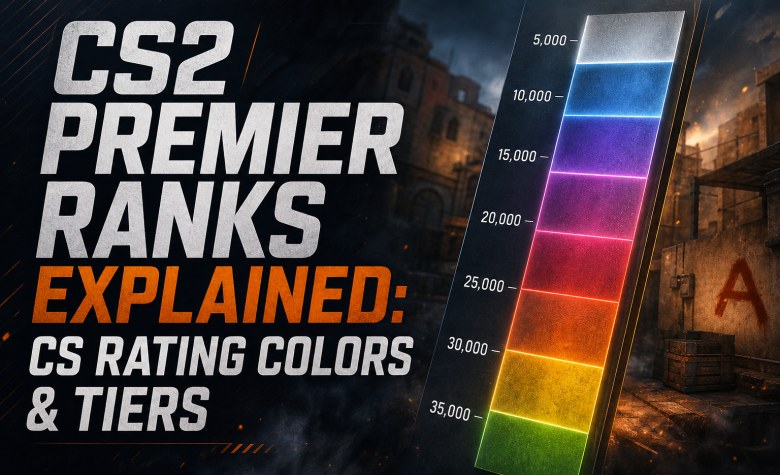
Premier CS Rating is Valve's numerical measure for Premier matchmaking. It is displayed with color bands at 5,000-point boundaries.
FACEIT Elo is FACEIT's numerical rating. The number determines your visible FACEIT Skill Level from Level 1 to Level 10.
Winning on FACEIT does not add Premier CS Rating. Winning Premier does not add FACEIT Elo.
There is also no official universal conversion table between the two systems.
How Premier CS Rating Works
Premier uses one numerical rating across the entire mode.
| CS Rating | Visible Color Band |
|---|---|
| Below 5,000 | Gray |
| 5,000–9,999 | Light Blue |
| 10,000–14,999 | Blue |
| 15,000–19,999 | Purple |
| 20,000–24,999 | Pink |
| 25,000–29,999 | Red |
| 30,000+ | Gold |
Gold is the highest visible color band, but 30,000 is not a published hard maximum. CS Rating can continue above that point.
If you need the full Premier mechanics, see our CS2 Premier Ranks & CS Rating guide.
Explore services related to this guide, selected from our Counter Strike 2 catalog.
View All Counter Strike 2 Services


How FACEIT Elo and Levels Work
FACEIT uses exact Elo and converts that number into ten Skill Levels.
| FACEIT Level | Current CS2 Elo |
|---|---|
| Level 1 | 100–500 |
| Level 2 | 501–750 |
| Level 3 | 751–900 |
| Level 4 | 901–1050 |
| Level 5 | 1051–1200 |
| Level 6 | 1201–1350 |
| Level 7 | 1351–1530 |
| Level 8 | 1531–1750 |
| Level 9 | 1751–2000 |
| Level 10 | 2001+ |
Level 10 has no fixed upper Elo limit. That means a player at 2010 Elo and another at 3000 Elo are both Level 10 even though their exact positions are very different.
FACEIT Challenger is not Level 11. It is the status given to the Top 1000 Level-10 players.
For the full system, see FACEIT Levels & Elo Explained.
Which Rating Is More Precise?
Both systems give you an exact numerical value, so both are more precise than a simple named rank.
Premier gives you an exact CS Rating such as 18,742.
FACEIT gives you an exact Elo such as 1,867.
The difference is mainly how those numbers are used and what player ecosystem surrounds them.
On FACEIT, exact Elo becomes especially important inside Level 10 because the Level itself stops separating players once they pass 2001.
In Premier, the exact number is also more useful than simply saying “Purple” or “Red,” because each color covers a 5,000-point range.
Premier Is Valve's Official Ranked Ladder
The strongest reason to play Premier is simple: it is built directly into Counter-Strike 2 and represents Valve's official numerical ranked ecosystem.
Your CS Rating is connected to Premier leaderboards and the current Active Duty map pool.
Premier also follows Valve's seasonal structure, so map changes, recalibration and seasonal progression are all part of the same CS2 client.
If you want one rating that represents your position inside Valve's own ranked mode, Premier is the logical system to track.
FACEIT Is a Separate Competitive Ecosystem
FACEIT operates outside Valve's Premier ladder. You link your Counter-Strike account and play matches through the FACEIT platform.
The platform maintains its own:
- Elo system;
- Levels 1–10;
- leaderboards;
- seasonal statistics;
- match types;
- verification systems;
- Anti-Cheat;
- party and matchmaking restrictions for certain queues.
This makes FACEIT more than simply another number attached to your Steam account. It is a separate competitive environment with its own progression history.
Anti-Cheat: Premier vs FACEIT
This is one of the most concrete differences between the systems.
Premier runs inside Counter-Strike 2 using Valve's own game and integrity systems.
FACEIT requires Counter-Strike players to use the FACEIT Anti-Cheat. FACEIT states that players will not be able to participate in matches requiring the Anti-Cheat if it is not running.
This does not mean it is reasonable to claim that one platform has “zero cheaters.” No competitive system can honestly be described that way.
The real difference is that FACEIT operates an additional dedicated Anti-Cheat layer as part of its platform.
Map Selection Is Very Different
Premier
Since September 22, 2026, Premier no longer bans maps down to one.
The current Valve process is:
- Team 1 picks one map.
- Team 2 picks two maps.
- Team 1 picks one final map.
- One of the four maps is selected randomly.
This means players benefit from being comfortable across the current Active Duty pool.
FACEIT
In the standard FACEIT lobby flow, team captains participate in selecting the server location and maps. Maps are vetoed until one remains.
This creates a more traditional competitive-lobby flow rather than Premier's current four-map random draw.
Premier Season 5 vs FACEIT Season 9
Both systems are seasonal in 2026, but their season structures are independent.
Premier Season 5
Premier Season 5 began on July 8, 2026.
Valve changed the Active Duty pool by adding Cache and removing Overpass.
The current Premier pool is:
- Ancient;
- Anubis;
- Cache;
- Dust II;
- Inferno;
- Mirage;
- Nuke.
FACEIT Season 9
FACEIT Season 9 began on August 5, 2026.
It introduced a lighter soft Elo reset followed by 10 placement matches.
The reset considers recent form over the previous 50 games, including activity, win rate and FACEIT Rating, rather than looking only at the final Elo from the previous season.
The two seasonal systems therefore should not be compared as if one reset directly affects the other.
Which Has Better Matchmaking?
There is no objective answer that applies to every player.
Premier uses Valve's native CS2 matchmaking ecosystem.
FACEIT provides additional matchmaking layers. Its Standard Matches are open to free users, while Super Match and Premium Match can add stricter conditions around factors such as party composition, account experience and verification.
That gives FACEIT users more matchmaking formats, but it can also add complexity compared with clicking Premier directly inside CS2.
If simplicity matters most, Premier wins.
If you want more control over the type of competitive queue you enter, FACEIT provides more options.
Which Is Better for Solo Queue?
Both can work for solo players.
Premier is simpler: queue directly through CS2, play the current Premier system and move your CS Rating.
FACEIT offers more queue structures. Certain advanced match types place restrictions on party size and Elo disparity, which can reduce how much large premades affect those specific queues.
However, queue quality still depends on region, time, player population and your current rating. There is no guarantee that every FACEIT solo match will automatically be better than every Premier match.
Which Is Better for Playing With Friends?
Premier is convenient when you want to enter CS2 and play within Valve's official system with your group.
FACEIT also supports parties, but some match types use specific restrictions on party size or Elo differences.
If your group has very different skill levels, check the current FACEIT restrictions before choosing a queue.
For a consistent team with similar Elo, FACEIT can provide another structured ladder. For a casual mixed-skill friend group, Premier may be simpler.
Which Is Better for Beginners?
FACEIT itself describes its Counter-Strike player base as notably competitive and warns newcomers that their first matches may be challenging.
For a completely new CS2 player, learning the fundamentals in Valve matchmaking first is often the easier route.
A sensible progression is:
- learn movement, economy and basic utility;
- build a usable map pool;
- unlock and play Premier;
- start FACEIT once you want a second competitive ladder and are comfortable with the core game.
This is not a requirement. New players are allowed on FACEIT, but a new FPS player should expect a demanding environment.
Which Is Better for Serious Improvement?
The better system is the one that exposes the weaknesses you actually need to fix.
Premier tests whether you can maintain results across Valve's current map pool while protecting one CS Rating.
FACEIT gives you a separate Elo environment where exact rating, Levels and seasonal performance can be tracked independently.
For improvement, the best approach can be to use both:
- Premier for your official Valve progression;
- FACEIT for a second independent Elo benchmark;
- demo review to identify repeated mistakes;
- map-specific win rates to identify weak maps;
- exact rating trends rather than individual good or bad games.
Is FACEIT Harder Than Premier?
There is no official formula converting difficulty between the two.
FACEIT describes its own player base as notably competitive, and experienced players frequently use the platform as a dedicated matchmaking environment.
That does not mean every FACEIT Level is automatically harder than every Premier rating.
The player pools are different, the rating distributions are different and the systems recalibrate independently.
A Level 8 FACEIT player might have one Premier rating today and a very different one after more Premier matches. Likewise, two 20K Premier players can have very different FACEIT Elo.
Can Premier Rating Be Converted to FACEIT Elo?
There is no public exact conversion.
FACEIT can use recent Premier performance to determine the initial Elo of some new eligible accounts, but FACEIT explicitly keeps that conversion formula private.
This means charts such as:
- 10K Premier = FACEIT Level 4;
- 15K Premier = FACEIT Level 6;
- 20K Premier = FACEIT Level 8;
- 25K Premier = FACEIT Level 10;
should be treated as community estimates rather than official mappings.
If you want to calculate an actual FACEIT target from your existing FACEIT Elo, use our FACEIT Elo Calculator instead.
Premier Leaderboards vs FACEIT Challenger
Both platforms give high-level players goals beyond simply crossing a basic rating threshold.
Premier uses regional and global leaderboard positions connected to CS Rating.
FACEIT uses its own leaderboards, with Challenger representing the Top 1000 players within Level 10.
The important distinction is that Challenger does not start at a fixed Elo value. The cutoff moves as leaderboard positions change.
Level 10 always begins at 2001 Elo; Challenger does not.
What Does a Good Rank Mean in Each System?
In Premier, milestones such as 15K, 20K, 25K and 30K correspond to official color boundaries.
Valve does not publish a complete current percentile distribution for every CS Rating band, so claims like “20K is officially top X%” require a third-party dataset and date.
On FACEIT, Level boundaries are exact and published. Level 10 begins at 2001 Elo, while the Challenger cutoff is dynamic.
This means the safest comparison is always:
- Premier CS Rating against another Premier CS Rating;
- FACEIT Elo against another FACEIT Elo;
- not a guessed conversion between the two.
Premier vs FACEIT for Different Player Goals
| Your Goal | Better Fit |
|---|---|
| Track your official Valve rating | Premier |
| Reach Level 10 | FACEIT |
| Compete on Valve leaderboards | Premier |
| Track exact Elo separately from Valve | FACEIT |
| Play directly inside CS2 without another platform | Premier |
| Use FACEIT's dedicated Anti-Cheat environment | FACEIT |
| Push a 20K/25K/30K CS Rating target | Premier |
| Push 2001+ Elo and Level 10 | FACEIT |
| Maintain two independent competitive benchmarks | Both |
Should You Play Premier or FACEIT?
Choose Premier if:
- you want the official Valve ranking system;
- you prefer playing directly through CS2;
- your main goal is CS Rating;
- you care about Premier seasons and Valve leaderboards;
- you want your progress tied to the current Active Duty ecosystem.
Choose FACEIT if:
- you want a separate Elo ladder;
- your goal is Level 10 or Challenger;
- you want FACEIT's dedicated Anti-Cheat environment;
- you want additional competitive matchmaking options;
- you want another benchmark beyond your Valve rank.
Play both if: CS2 is one of your main competitive games and you want independent indicators of your performance instead of relying on one ladder.
Which Service Matches Your Target?
If your goal is a specific Premier value such as 15K, 20K, 25K or 30K+, see our CS2 Premier Rating Boost.
If your target is a specific FACEIT Elo or Level, see our CS2 FACEIT Elo Boost.
If you are climbing FACEIT yourself, our How to Reach FACEIT Level 10 guide breaks down the path to 2001 Elo.
For the wider ranking ecosystem, see CS2 Ranks Explained.
Last verified: October 2026. Premier Season 5, September 2026 Premier map selection, FACEIT Level thresholds, FACEIT Season 9 placements and FACEIT Anti-Cheat requirements were checked against current Valve, Steam and FACEIT documentation.