

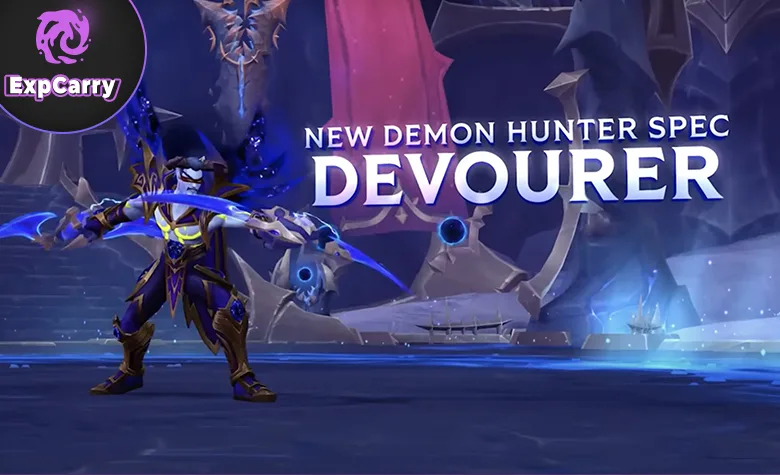
The Devourer Demon Hunter is the new third Demon Hunter specialization in WoW Midnight, and it does not play like a simple Void-colored Havoc clone. Blizzard designed it as a mid-range DPS spec that uses Intellect, fights mostly at 25 yards, and revolves around a dual-resource loop built around Fury and Soul Fragments. The short version is simple: you generate Soul Fragments and Fury with your basic toolkit, harvest those fragments to build toward Void Metamorphosis, and then cash that setup into a high-damage transformation window built around Void Ray and Collapsing Star.
That structure is what makes Devourer feel different from the older Demon Hunter specs. Havoc is a fast melee spender spec. Vengeance is a tank. Devourer sits in the middle as a mobile Void spellcaster that can still dive in and out of melee when talents reward it. The spec is built around rhythm more than spam. If you understand the resource flow, it makes sense quickly. If you do not, the spec feels messy because its power is locked behind proper Soul Fragment handling, clean Void Metamorphosis timing, and better channel discipline than many players expect from a Demon Hunter spec.
How the Devourer Demon Hunter Works in WoW Midnight
At its core, Devourer is a build-and-burst specialization. Blizzard's official overview says the spec generates Soul Fragments with abilities like Consume, gathers them with Reap, and then enters Void Metamorphosis once enough souls have been collected. At the same time, those same abilities also generate Fury, which you spend on Void Ray. That means Devourer is always juggling two connected jobs at once: preparing the next transformation and keeping current damage flowing.
This is why the spec has a cleaner identity than many new specs get at launch. The theme is obvious. You harvest souls, convert that pressure into Void power, and then cash it out in your transformation window. Icy Veins and Method both describe the same loop from different angles: outside Void Metamorphosis you build resources and prepare, and inside it you shift into your real payoff phase where your strongest Void tools take over.
The Two Resources That Define Devourer Demon Hunter
Devourer uses Fury as its main active resource and Soul Fragments as its defining secondary resource. Fury is the fuel that keeps the spec moving moment to moment. Soul Fragments are the bigger mechanic because they gate access to Void Metamorphosis and shape how valuable your setup phase becomes. This is the part many players need to understand first: Soul Fragments are not just passive extras. They are the engine that determines when your strongest window begins.
Method's current Midnight guide also notes that Devourer uses Intellect as its primary stat and that most of its abilities operate at 25 yards, which reinforces the spec's identity as a mid-range caster-style Demon Hunter rather than a pure melee one. That range changes how the class feels in real play. You still have Demon Hunter mobility, but you are not locked into traditional melee uptime the way Havoc is.
Soul Fragments, Fury, and Void Metamorphosis Explained

If you want to understand Devourer fast, start here. The spec's real gameplay loop is not about memorizing every button first. It is about understanding how Soul Fragments and Fury feed into Void Metamorphosis. Blizzard's official deep dive explains that Consume is your filler, that it can be cast while moving, and that it generates both Soul Fragments and Fury. Those Soul Fragments can then be collected by moving near them or by casting Reap, while Fury is spent on Void Ray.
Once enough Soul Fragments have been gathered, you can enter Void Metamorphosis. This is the point where Devourer stops feeling like a setup spec and starts feeling like a payoff spec. Blizzard explains that while you are in Void Metamorphosis, Fury slowly drains over time and you fight to stay in the form as long as possible. That creates the spec's main pressure loop: build cleanly, enter form, and make that window count.
Why Soul Fragment Management Matters So Much
Soul Fragment management is not a side issue for Devourer. It is the central skill check. Icy Veins explicitly warns that Soul Fragments are your main resource for accessing Void Metamorphosis and that wasting fragments above the cap costs you real value. That is the difference between Devourer and a simpler builder-spender class. Bad fragment play does not just lower your damage slightly. It weakens the timing and frequency of your strongest phase.
This also means the spec rewards planning more than panic. If you enter a fight with no control over where your fragments are, when Reap is available, or how much Fury you have built, your damage window becomes weaker before it even starts. Devourer is not a spec that forgives sloppy setup.
That said, fragments are not the only thing that matter. Real Devourer gameplay also punishes poor timing on channels and casts. If you break your own Void Ray channel through bad movement or lose value on your transformation window because you entered it without a clean setup, the spec feels much worse than it should. Soul Fragment management is the foundation, but the full gameplay test is really about setup plus execution.
Core Devourer Demon Hunter Abilities You Need to Know
The Devourer kit makes more sense when you split it into setup tools and payoff tools. Consume and Soul Immolation belong to the setup side. Reap sits in the middle because it both gathers resources and can be modified by talents for more damage or different utility. Void Ray and Collapsing Star are the payoff tools that define the spec's burst pattern.
| Ability | What it does | Why it matters | Role in the spec |
|---|---|---|---|
| Consume | Mobile filler that generates Fury and Soul Fragments | Starts the resource loop | Core setup ability |
| Reap | Harvests Soul Fragments and can gain extra effects through talents | Connects setup to burst | Resource conversion tool |
| Void Ray | Medium-range frontal channel that spends Fury outside Void Metamorphosis | Main spender outside your power window and one of your main damage tools inside it | Primary damage engine |
| Soul Immolation | Generates extra Fury and Soul Fragments over time | Accelerates setup and resource flow | Support generator |
| Void Metamorphosis | Transformation unlocked through Soul Fragments | Core burst phase of the spec | Main power window |
| Collapsing Star | Major Cosmic damage attack used in Void Metamorphosis | Signature payoff button | Transformation finisher |
| Cull | Important damage button in current builds, especially on priority targets and lower-health enemies | Adds pressure outside the simple core loop | Supplemental damage tool |
| Devour | High-impact talent-driven damage button in several current builds | Shows that modern Devourer builds are more varied than the early overview suggested | Build-dependent payoff tool |
Void Ray Is the Button That Ties the Spec Together
Void Ray is Devourer's version of Eye Beam, but Blizzard's official explanation makes one major difference clear: unlike the other Demon Hunter specs, Void Ray does not use a traditional cooldown outside of talent interactions and can be cast much more frequently. Method's current rotation guide adds another important point: outside Void Metamorphosis, Void Ray costs Fury, while inside Void Metamorphosis it no longer costs Fury and instead works on a cooldown pattern.
That is one of the biggest reasons the spec feels unique. Void Ray is not just another spender. It is one of the main bridges between your normal state and your transformed state, and both Blizzard and guide writers emphasize that talent interactions between Reap and Void Ray are a major part of how the spec flows.
It is also one of the buttons that exposes weak execution. Devourer has excellent movement overall, but Void Ray is still a channel and your best windows are not completely freeform. If your positioning is poor and you keep clipping channels or losing uptime at the wrong moment, the spec immediately feels worse.
Explore services related to this guide, selected from our World of Warcraft catalog.
View All World of Warcraft Services


What Happens During Void Metamorphosis
Void Metamorphosis is the real answer to the question "how does Devourer work?" Outside of it, you are building and preparing. Inside it, you are cashing out the spec's fantasy and damage profile. Blizzard's official description says Fury slowly drains while you are transformed, and as you gather Soul Fragments during that form you gain access to Collapsing Star, a major Cosmic damage attack that hits your target and nearby enemies.
The important takeaway is that Void Metamorphosis is not a normal cooldown with a standard timer button. It is a resource-earned transformation. That alone changes the feel of the spec. You are not waiting for an icon to light up every fixed interval. You are earning your burst phase through correct setup. Icy Veins also highlights this as one of the defining strengths of the spec, because the gameplay rewards planning and execution around these windows instead of simple cooldown pressing.
Why Collapsing Star Is the Big Payoff
Collapsing Star is the spec's signature hit, and Blizzard's original deep dive made that clear even before launch by centering multiple Apex Talents around it. The official preview also revealed the Apex Talent named Midnight, which makes Collapsing Star always critically strike and adds more critical damage based on your Critical Strike chance. That tells you exactly what Blizzard wants players to feel: Devourer is meant to build toward a dramatic Void-finisher identity, not just maintain flat rotational pressure forever.
One important post-launch detail is that Blizzard changed how Collapsing Star consumes its required souls. Early on, that made the spell more punishing if the cast failed at the wrong time. In the February update, Blizzard changed it so the required souls are consumed on cast completion instead of cast start and also added a cooldown. That made the spell fairer in real combat without removing the need for planning.
So when people ask whether Devourer is a ranged Demon Hunter, the honest answer is not fully. It is a mid-range setup-and-burst spec with a transformation phase built around a huge Void payoff. That is a more accurate read of how it actually plays.
Hero Talents and the New Devourer Demon Hunter Trees
With Devourer, Demon Hunter also gained access to a new Hero Talent tree called Annihilator, shared between Devourer and Vengeance. Blizzard also states that Devourer has access to the Scarred tree, later presented in Void-themed form as Void-Scarred in follow-up material. That matters because Hero Talents do not just add passive bonuses here. They shape whether your Devourer leans harder into Void-themed ranged pressure or picks up more aggressive dive-and-combo flavor.
Blizzard's February 25 feature article specifically says you can use specialization and Hero Talents to push the spec toward deeper melee engagement and more devastating combo attacks. That means Devourer is not locked into one exact rhythm. Its baseline identity is mid-range Void DPS, but talents let you tune how close and aggressive the gameplay becomes.
That flexibility matters more now than it did in the first round of previews. Current Icy Veins and Method guides already show multiple real build directions rather than one single fixed version of the spec. Some builds lean harder into the classic Collapsing Star payoff pattern, while others put more weight on tools like Voidsurge, Cull, Devour, or other talent packages. So if you want a fully accurate summary, the core resource loop is fixed, but the way you cash that loop into damage is no longer identical across every build.
Devourer Demon Hunter Playstyle: What It Feels Like in Real Combat

In practice, Devourer feels like a mobile mid-range spec that alternates between steady resource setup and very deliberate burst windows. It is less about frantic button density than Havoc and more about getting your sequence right. Method summarizes the basics cleanly: Fury is your main resource, Soul Fragments feed Void Metamorphosis, most abilities work at 25 yards, and your mobility remains strong through classic Demon Hunter movement tools.
That means the spec usually feels strongest when you are allowed to maintain rhythm. Build with Consume and Soul Immolation, manage fragment collection cleanly, funnel into Reap and Void Ray at the right moments, and then exploit Void Metamorphosis without letting the window slip. If you like specs that reward setup and timing, Devourer makes sense. If you want constant instant gratification with no ramp, it will feel more demanding.
What Makes Devourer Different From Havoc and Vengeance
The biggest difference from Havoc is range, stat profile, and damage structure. Devourer uses Intellect, deals Cosmic damage through Void-themed spells, and operates from mid-range rather than pure melee. The biggest difference from Vengeance is obvious: Devourer is not a tank and its Soul Fragment gameplay exists to feed burst windows and damage flow, not survivability first.
This is why calling it "Void Havoc" is lazy and wrong. Blizzard gave it a separate identity on purpose. The resource loop, range profile, transformation access, and spender structure all point to a distinct spec rather than a cosmetic remix.
Where the Spec Feels Strong and Where It Punishes You
Devourer's strengths are easy to understand. It has excellent mobility, a flexible mid-range profile, strong burst windows, and a real feeling of setup leading into payoff. It also benefits from still being a Demon Hunter, so it keeps the movement tools and general class identity that make the class appealing in the first place.
Its weaknesses are just as real. The spec is not especially forgiving if you overcap Soul Fragments, mistime Reap, or enter Void Metamorphosis without a clean resource setup. It also punishes careless movement more than some players expect. Void Ray and Collapsing Star are both high-value buttons, but that value drops fast when encounter mechanics force you to move at the wrong time or when your own positioning is poor.
What Changed for Devourer After Launch
Devourer has already seen live tuning and fixes, which is normal for a brand-new specialization. Blizzard's second Midnight pre-expansion update changed Entropy so it grants a Soul Fragment every 12 seconds in combat instead of every 8, and changed Waste Not so Void Ray has a 200 percent increased chance to generate a Soul Fragment instead of 100 percent. More recently, Blizzard hotfixes on March 13 fixed an issue causing Reaper's Toll to sometimes be unusable for Devourer Demon Hunters.
Those changes matter because they show two things. First, Blizzard is actively tuning the Soul Fragment flow around the spec. Second, Devourer is not frozen in place. Any serious guide about how the spec works has to acknowledge that the class is still new enough to receive regular adjustment.
The February update also included several other changes worth knowing because they affect how the spec feels in practice. Reap's damage was increased, Consume gained more damage and an extra Soul Fragment, and Collapsing Star was adjusted so it no longer eats its required resources too early. Blizzard also pushed PvP tuning into the spec's Hero Talent and damage package during the same tuning cycle, which is another sign that Devourer is still actively being shaped.
Who Should Play Devourer Demon Hunter in WoW Midnight
Devourer is a strong fit for players who like structured burst, mobility, and resource planning. It is not the best fit for players who want a completely brain-off rotation or a pure turret caster. The spec asks you to think about positioning, fragment collection, resource timing, and transformation value at the same time. That is where most of its skill expression lives.
If that sounds appealing, Devourer is one of the more interesting additions Midnight brought to the game. It gives Demon Hunter a fresh ranged-leaning identity without throwing away the mobility and aggression that define the class. If that sounds annoying, then Havoc is probably still the cleaner fit.
It is also a much better fit for players who like priority systems than for players who want a very rigid script. Devourer does have a clear loop, but in live combat it feels more like managing phases than repeating one fixed sequence forever. That is part of the appeal and part of the difficulty.
Conclusion
The Devourer Demon Hunter in WoW Midnight works through a very clear core loop: generate Fury and Soul Fragments, use those fragments to unlock Void Metamorphosis, and turn that setup into heavy burst through Void Ray and Collapsing Star. Blizzard built it as a mid-range Intellect DPS spec with strong mobility and a much more deliberate rhythm than Havoc.
The spec's identity is also more distinct than some players expected. It is not just a recolor of older Demon Hunter gameplay. The Soul Fragment economy, the earned transformation window, the mid-range combat profile, and the Hero Talent options all give it a real mechanical identity. That is the main reason it matters. Midnight did not just add another spec slot. It added a new way to play Demon Hunter entirely.
If you want the shortest accurate summary, this is it: Devourer is a Void-powered mid-range DPS spec that rewards clean resource setup and sharp burst timing. Learn how Soul Fragments feed Void Metamorphosis, understand how Void Ray and Reap connect the kit, and respect how much positioning matters during your best channels and casts. Ignore that resource loop, and the spec will always feel worse than it really is.