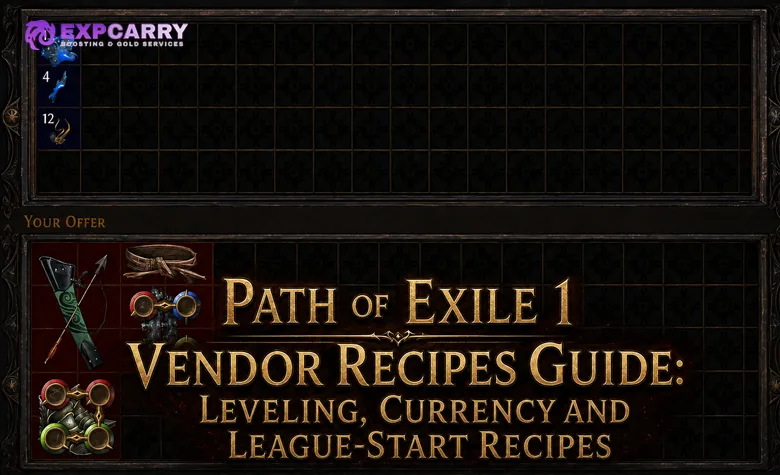
Path of Exile 1 has hundreds of vendor interactions, but only a small group deserves space in a modern league-start checklist. The recipes that actually save time are the ones that fix movement speed, create a usable leveling weapon, upgrade an underleveled flask, turn socketed drops into currency, convert spare maps into Atlas progress, or produce guaranteed Chaos and Regal Orbs from otherwise disposable rares. Everything else should earn its place by solving a real campaign, mapping, or SSF problem.
This guide is written specifically for Path of Exile 1 and reflects the current 3.29 rules. That distinction matters more than usual because old recipe lists contain several traps: the classic flat elemental spell-damage wand recipe was removed, six-linked items no longer vendor for a Divine Orb, the Cartographer's Chisel recipe no longer accepts Stone Hammers or Rock Breakers, and the 3.29 socket rework removed the town-vendor exchange that sold Chromatic Orbs for Jeweller's Orbs. The tables below filter the recipes by Campaign, League Start, Maps, and SSF so you can ignore the encyclopedia-sized list and keep only what is useful.
PoE 1 Vendor Recipes Quick Reference
The fastest way to use this page is to start with the filter columns. "High" means the recipe is worth actively remembering for that stage, "Situational" means it solves a specific shortage, and "Low" means you normally should not change your loot filter or route around it.
| Recipe | Input | Output | Campaign | League Start | Maps | SSF |
|---|---|---|---|---|---|---|
| 10% movement speed boots | Normal Boots + Quicksilver Flask + Orb of Augmentation | Magic Boots with 10% increased Movement Speed | High | High | Low | High |
| Movement speed upgrade | Magic/Rare Boots with Movement Speed + Quicksilver Flask + Orb of Augmentation | Same base with Movement Speed raised by 5%, up to 30% | High | High | Low | High |
| Physical leveling weapon | Weapon + Magic/Rare/Unique Rustic Sash + Blacksmith's Whetstone | Magic weapon with increased Physical Damage | High | High | Low | High |
| Spell-damage leveling weapon | Rune Dagger/Sceptre/Wand/regular Staff + Magic/Rare/Unique Chain Belt + Blacksmith's Whetstone | Magic weapon with increased Spell Damage | High | High | Low | High |
| +1 spell-tag weapon | Normal Rune Dagger/Sceptre/Wand/regular Staff + at least 2 quality Skill Gems totaling 40% with the matching tag | Magic weapon with +1 to Level of all matching Spell Skill Gems | Situational | Situational | Low | High |
| Life Flask upgrade | 3 Life Flasks of the same base type | 1 Life Flask of the next base type | High | High | Low | High |
| Mana Flask upgrade | 3 Mana Flasks of the same base type | 1 Mana Flask of the next base type | Situational | Situational | Low | High |
| Glassblower's Bauble | Flasks/tinctures totaling at least 40% quality, or one normal 20% item | 1 Glassblower's Bauble | Situational | High | High | High |
| Chromatic Orb | Item with linked red, green, and blue sockets | 1 Chromatic Orb | High | High | High | High |
| Six sockets | Any item with 6 sockets that is not using the six-link recipe instead | 7 Jeweller's Orbs | Low | High | High | High |
| Six links | Any item with 6 linked sockets | 20 Orbs of Fusing | Low | High | High | High |
| Map upgrade | 3 copies of the same Map base | 1 normal Map one tier higher | Low | High | High | High |
| Cartographer's Chisel | 20% quality Gavel + any Map | 1 Cartographer's Chisel | Low | Situational | Situational | High |
| Chaos recipe | Full Rare set with lowest item level 60-74 | 1 Chaos Orb, or 2 if all unidentified | Low | High | Situational | High |
| Regal recipe | Full Rare set with lowest item level 75-100 | 1 Regal Orb, or 2 if all unidentified | Low | Situational | Situational | High |
| Quality gem currency | Gems totaling at least 40% quality, or one 20% quality gem | 1 Gemcutter's Prism | Low | Situational | High | High |
The most important rule is not to turn these recipes into mandatory chores. If collecting a component costs more time than the reward saves, skip it. A natural six-socket drop is free Jeweller's Orbs; running backward across a zone for a low-value quality item usually is not.
Best Campaign and League-Start Vendor Recipes
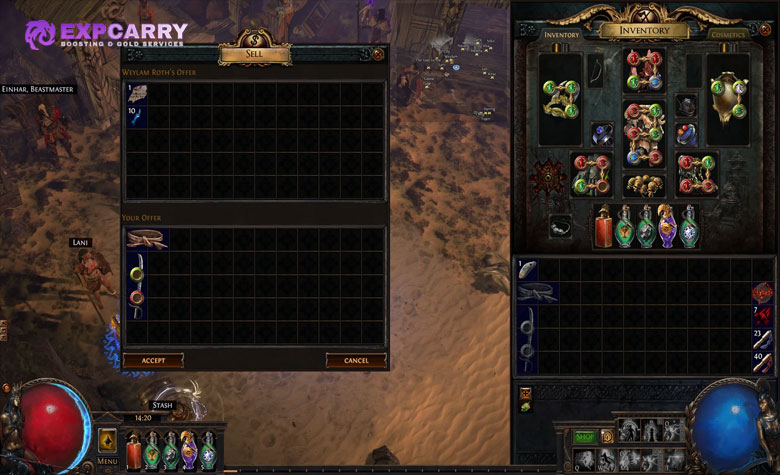
The campaign recipes should solve one of three problems: movement is too slow, damage has fallen behind the zone, or recovery flasks are several base tiers out of date. They are strongest when the ingredients drop naturally while you are already moving toward the next quest objective.
Movement Speed Boots: Use a Spare Quicksilver, Not Your Only One
Normal Boots plus a Quicksilver Flask and an Orb of Augmentation produce Magic Boots with 10% increased Movement Speed. The same idea can upgrade Magic or Rare Boots that already have Movement Speed by another 5%, and the process can be repeated up to 30%. The base boot type remains, although sockets can change when the recipe is used.
This is one of the best Act 1-10 recipes when you have a spare Quicksilver Flask. It is a bad trade if the recipe consumes the only Quicksilver you are actively using. A functional flask often saves more time than changing slow boots into 10% boots, so the correct priority is to keep one movement flask equipped and use an extra copy for the recipe.
The current PoE 1 campaign route keeps the same philosophy: spend as little time as possible in inventory while solving the upgrades that directly increase movement, damage, or survival.
Physical Weapon Recipe for Attack Builds
A weapon, a Rustic Sash, and a Blacksmith's Whetstone produce a Magic weapon with increased Physical Damage. The rarity of the Rustic Sash controls the modifier tier: a Magic sash produces the 40-49% tier, a Rare sash produces the 50-69% tier, and a Unique sash produces the 65-84% tier.
The main advantage is predictability. A melee, bow, or other physical attack starter can take a correctly leveled weapon base and guarantee a useful local physical modifier instead of waiting for a random rare weapon. Because the recipe returns a Magic weapon, do not feed it a valuable Rare or Unique weapon whose existing modifiers are better than the guaranteed result.
Recraft when the weapon base becomes the bottleneck. A perfect modifier on an obsolete base can still be worse than a modest modifier on a much stronger base several acts later.
Spell-Damage Weapon Recipe for Casters
A Rune Dagger, Sceptre, Wand, or regular Staff combined with a Chain Belt and a Blacksmith's Whetstone produces a Magic weapon with increased Spell Damage. Warstaves are not valid bases for this recipe. Chain Belt rarity affects the modifier tier: Magic gives 10-19% Spell Damage on one-handed weapons or 15-29% on a Staff, Rare gives 20-29% or 30-44%, and Unique gives 30-39% or 45-59% respectively.
This is the current general-purpose caster recipe to remember. Do not confuse it with the old Ruby, Sapphire, or Topaz Ring recipe that added flat elemental damage to spells. Grinding Gear Games removed that recipe in the official 3.21 Crucible patch notes because the early weapons it created remained too strong for too much of the campaign.
+1 Spell Skill Gem Weapons Are More Valuable in SSF Than Speed Runs
A normal Rune Dagger, Sceptre, Wand, or regular Staff can be vendored with at least two quality Skill Gems whose combined quality reaches 40% and whose relevant tag matches the desired spell type. The result is a Magic weapon with +1 to Level of all Spell Skill Gems of that tag. Generic Daggers and Warstaves are not valid bases for this recipe.
This recipe is powerful but not a normal Act 1 speed recipe because 40% combined gem quality is not something a fresh character reliably owns immediately. In SSF, however, saving low-value quality gems can turn the recipe into a deterministic way to make a useful caster base. In Trade, compare the value of the quality gems and the resulting base before consuming them.
Players who want to bypass repeated campaign leveling can use the verified PoE leveling option for an eligible character. For self-play, the vendor recipes above are the ones worth keeping visible mentally during Acts 1-10.
Flask Recipes Worth Using While Leveling
Flask recipes are useful because recovery bases become obsolete quickly during the campaign. You do not need to pick up every flask, but three identical Life or Mana Flask bases can repair a bad recovery slot when the next base has not dropped naturally.
Three Flasks Into the Next Base
Three Life Flasks of the same base type vendor into one Life Flask of the next base type. The same rule applies to Mana Flasks and Hybrid Flasks. The resulting flask uses the lowest item level among the three inputs, and if all three inputs are Magic the result is Magic and unidentified. For Life and Mana Flasks, the recipe works only through Hallowed Flask to Sanctified Flask; Divine and Eternal Flasks cannot be produced by repeatedly combining lower bases.
This recipe is strongest when all three inputs were already on the ground or in the stash. Do not spend several minutes farming an old zone for one missing flask. During normal progression, the next base will often begin dropping soon enough that forcing the recipe costs more time than it saves.
Glassblower's Bauble From Quality Flasks
Selling flasks or tinctures whose combined quality reaches at least 40% gives one Glassblower's Bauble. A single normal flask or tincture with 20% quality also qualifies for the one-item quality recipe. This is much more relevant near maps and in SSF than it is during a rushed early campaign.
Since the quality rework, applying Glassblower's Baubles to non-unique flasks depends on item level rather than the old normal-versus-magic rarity advice. That is why this article does not repeat the old recommendation to scour a flask only so each Bauble gives more quality. The current PoE 1 Flask Guide covers item-level quality, rolling, Instilling Orbs, Enkindling Orbs, and current flask upgrade order in detail.
Explore services related to this guide, selected from our Path of Exile catalog.
View All Path of Exile Services

Socket and Link Recipes After the PoE 1 3.29 Rework
Patch 3.29 changed what socket colours mean without removing the main socket vendor recipes. Gems can now be placed into any Equipment Socket regardless of colour, while matching a red, green, or blue gem to the same socket colour grants +10% Quality to that gem. Equipment sockets are white by default, coloured sockets are less common, and Chromatic Orbs are rarer. GGG also removed the town-vendor exchange that sold Chromatic Orbs for Jeweller's Orbs.
Linked Red, Green and Blue Sockets Still Give a Chromatic Orb
An item containing linked red, green, and blue sockets vendors for one Chromatic Orb. The three colours need to be part of the same linked group; the item can have additional sockets. In 3.29 this combination appears less routinely because newly generated equipment sockets are white by default, but the reward itself is more strategically useful because Chromatic Orbs became rarer.
Do not confuse the recipe with the removed vendor purchase. The recipe is selling a naturally qualifying RGB-linked item for one Chromatic. The obsolete interaction was buying Chromatics from a town vendor with Jeweller's Orbs.
Six Sockets Give Seven Jeweller's Orbs
An item with six sockets normally vendors for seven Jeweller's Orbs. A six-linked item is the important exception because the six-link recipe takes precedence and returns 20 Orbs of Fusing instead. For ordinary unlinked or partially linked six-socket drops, this remains one of the simplest mapping recipes because it asks for no quality, rarity, or matching equipment set.
During a fast campaign the recipe is less important because six-socket items become relevant later and carrying a large base can interrupt routing. In early maps and SSF, however, Jeweller's Orbs remain useful for socket work and can also participate in other vendor currency exchanges.
Six Links Give Twenty Orbs of Fusing, Not a Divine Orb
A six-linked item vendors for 20 Orbs of Fusing. Old videos and static recipe images that promise a Divine Orb are obsolete. GGG explicitly changed the six-link vendor reward in the official 3.19 Lake of Kalandra patch notes, replacing the Divine Orb reward with 20 Fusings.
Before vendoring any six-link, price the item itself. A usable base, valuable implicit, influenced item, or desirable rare can be worth more than 20 Fusings. The recipe is a floor for a bad six-link, not a reason to destroy every six-link you find.
Map Vendor Recipes for Atlas Progression
Map recipes become useful when the Atlas is incomplete or when you have too many low-tier duplicates. They should complement natural map drops and Kirac rather than become a full-time conversion project.
Three Maps Into One Map One Tier Higher
Three copies of the same Map base can be sold for one normal map one tier higher. For common Atlas progression, the practical use is combining duplicate lower-tier maps when the result helps open a missing higher tier. Different combinations of copies can sometimes produce different valid results when more than one connected higher-tier map is possible, so check the vendor preview before clicking Accept.
Do not convert every duplicate automatically. A map can be more valuable as a runnable layout, a favourite farming base, or a trade item. The recipe is strongest while filling early Atlas gaps and in SSF where you cannot simply buy the missing map from another player.
Cartographer's Chisel Recipe: Gavel Only
The current recipe uses a 20% quality Gavel plus any map to produce one Cartographer's Chisel. Old guides that tell you to use a Stone Hammer or Rock Breaker are outdated: since version 3.25 the recipe accepts only the Gavel base.
This is primarily an SSF or league-start shortage recipe. In established Trade, manually collecting and qualitying Gavels is often less efficient than earning currency and obtaining Chisels through normal play or trade. If you choose to use it, add Gavel to a temporary early-map loot-filter rule rather than showing every mace forever.
For characters already running maps but missing general currency or Atlas progress, the verified PoE hourly option can be configured around an eligible progression goal. For self-play, the best map recipe is still the one that fixes a specific Atlas gap instead of creating more stash management.
Chaos and Regal Vendor Recipes Explained
The Chaos recipe and Regal recipe are the vendor interactions most likely to be misunderstood because the deciding number is item level, not the character level required to equip the item and not the monster level printed on the map. A full Rare equipment set can generate guaranteed currency, but the recipe becomes less attractive once picking up and sorting rares costs more time than the currency is worth.
| Recipe | Lowest item level in set | Identified set | All unidentified | All quality-applicable items at least 20% | Unidentified and quality-qualified |
|---|---|---|---|---|---|
| Chance recipe | 1-59 | 1 Orb of Chance | 2 Orbs of Chance | 2 Orbs of Chance | 3 Orbs of Chance |
| Chaos recipe | 60-74 | 1 Chaos Orb | 2 Chaos Orbs | 2 Chaos Orbs | 3 Chaos Orbs |
| Regal recipe | 75-100 | 1 Regal Orb | 2 Regal Orbs | 2 Regal Orbs | 3 Regal Orbs |
A complete set fills the normal equipment slots: helmet, body armour, gloves, boots, belt, amulet, two rings, and either one two-handed weapon, two one-handed weapons, a one-handed weapon plus shield, or two shields. A quiver does not replace the weapon requirement. For the quality versions of these recipes, armour and weapons that can normally receive base quality must meet the quality requirement; belts, amulets, and rings are treated as satisfying it automatically and do not need Catalysts.
How to Keep a Chaos Recipe Working in Higher Maps
The recipe result is controlled by the lowest item level in the set. Players farming content where most drops are item level 75 or higher can keep one item level 60-74 piece in the set to force the Chaos recipe instead of receiving Regals. Jewelry is convenient to stock because rings, amulets, and belts take little stash space, but any valid slot can supply the lower item level.
If the vendor offers Orbs of Chance instead of Chaos, at least one item is below item level 60 or the set is incomplete. If the vendor offers Regal Orbs when you wanted Chaos, every qualifying item is in the higher range. Always inspect the vendor result before accepting the trade.
When the Chaos Recipe Is Actually Worth Doing
In a fresh Trade league, the unidentified two-Chaos version can be useful during the first mapping stage when a handful of Chaos Orbs buys meaningful resistance, Life, movement speed, or weapon upgrades. Community discussion continues to treat it as an early-economy tool rather than a permanent high-end farm: once your mapping strategy produces more value by staying in maps, sorting complete sets becomes expensive in time.
- Use it early when 2 Chaos meaningfully changes your next gear purchase.
- Stop doing it when stash sorting, missing jewelry, and repeated vendor trips reduce maps per hour.
- Keep it longer in SSF when guaranteed Chaos is more valuable than trade efficiency.
- Do not identify the set if your goal is the common two-Chaos version.
- Do not quality the armour and weapons of an entire set just to reach three Chaos unless the quality materials are genuinely worth less to you; normally that is poor efficiency. Jewellery does not need Catalysts for this recipe.
The PoE 1 Currency Guide explains where Chaos, Regal, Fusing, Jeweller's, Chromatic, and other current orbs fit into progression. Vendor recipes generate currency; they do not automatically make spending that currency efficient.
Quality Currency Recipes Worth Remembering
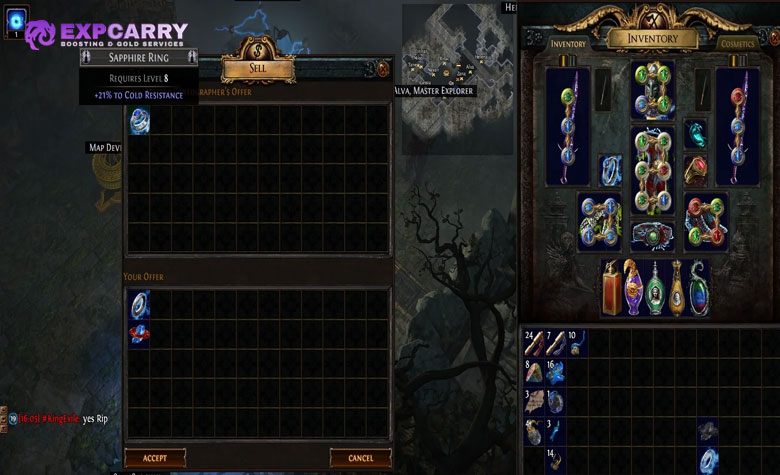
Quality recipes are simple: one normal armour piece, weapon, flask, or tincture at 20% quality, or a group of items in the same quality category totaling at least 40%, can produce the corresponding quality currency. For gems, one 20% quality gem or gems totaling at least 40% quality produce a Gemcutter's Prism. These recipes are most useful when the items would otherwise be ignored and when the currency has a clear SSF or early-map use.
- Weapons: 40% total quality produces one Blacksmith's Whetstone.
- Armour: 40% total quality produces one Armourer's Scrap.
- Flasks and tinctures: 40% total quality produces one Glassblower's Bauble.
- Skill Gems: 40% total quality produces one Gemcutter's Prism.
The important inventory rule is that 80% total quality does not automatically guarantee two currency items unless the vendor can split the inputs into two valid groups that each satisfy a separate recipe. Check the preview. If a collection sums to 80% but the matching algorithm cannot form two qualifying groups, the vendor can still offer only one result.
Gemcutter's Prism Recipe Has a Real Endgame Use
Random quality gems are worth checking because multiple low-value gems can become a Gemcutter's Prism without using Trade. There is also a separate recipe for eligible Support Gems: a level 20 Support Gem plus one Gemcutter's Prism returns a level 1 version of that Support Gem with 20% quality. It does not apply to corrupted gems, and the support must be compatible with the recipe's normal level requirements.
Do not automatically vendor a valuable alternate, exceptional, or build-enabling gem just because it contributes quality. The recipe is for surplus quality gems, not a universal instruction to convert every quality drop into GCPs.
Currency Conversions vs Vendor Recipes
Path of Exile uses two different vendor systems that old guides often mix together. A vendor recipe means placing a specific combination in the Sell Items window. A vendor purchase means buying currency or an item from an NPC's shop for another currency. Patch changes can remove one interaction while leaving a similarly named recipe intact.
The best 3.29 example is Chromatic Orbs. The RGB-linked sell recipe still exists, but GGG removed the town-vendor purchase that exchanged Jeweller's Orbs for Chromatics because the socket rework made Chromatics rarer. That is why a current guide must not copy a vendor-purchase table from an older database without checking the live patch notes.
Direct vendor currency exchanges can still be convenient for small quantities of basic crafting currency, but do not assume the fixed NPC ratio is the best economic rate in Trade. Compare the Currency Exchange or player market when converting meaningful amounts. In SSF, fixed vendor conversions have more strategic value because there is no external buyer offering a better rate.
Outdated Vendor Recipes You Should Stop Following
Several of the most repeated Path of Exile recipe tips are now historical. Keeping them in an evergreen article without a removal label causes more harm than omitting them, especially because search results often surface years-old screenshots with no version context.
| Old advice | Current status | What to do now |
|---|---|---|
| Sell a 6-link for 1 Divine Orb | Removed in 3.19 | A 6-link now vendors for 20 Orbs of Fusing; price the item before selling it |
| Wand/Sceptre/Rune Dagger + elemental ring + Alteration gives flat elemental spell damage | Removed in 3.21 | Use current bases, the Spell Damage + Chain Belt recipe, or other current crafting methods |
| 20% Stone Hammer or Rock Breaker + map gives a Chisel | Outdated since 3.25 | Use a 20% quality Gavel + map |
| Scour a non-unique flask before qualitying because normal rarity gets more quality | Outdated since 3.25 quality rework | Quality gain for non-unique flasks now depends on item level, not normal versus magic rarity |
| Buy a Chromatic Orb from a town vendor for Jeweller's Orbs | Removed in 3.29 | Use drops, Currency Exchange, or the current RGB-linked sell recipe |
| Socket colours block mismatched gems | Outdated in 3.29 | Any gem can go in any equipment socket; a matching red, green, or blue socket grants that gem +10% Quality |
| PoE 2 vendor recipes apply to PoE 1 | Wrong game version | Use Path of Exile 1 recipes and patch notes only |
This section is intentionally short. Legacy Standard items can preserve properties from old systems, but a new league character needs recipes that can be reproduced in the current PoE 1 client.
Loot Filter Rules for Vendor Recipes
A vendor recipe only saves time if the loot filter identifies the ingredient without flooding the screen. The best filter changes are temporary and progression-specific. When the recipe stops being useful, remove or hide the ingredient again.
Campaign Filter.
Prioritize useful boot bases, spare Quicksilver Flasks, Rustic Sashes for physical starters, Chain Belts for spell starters, and current Life Flask bases. Do not show every quality weapon or every rare set component during the acts; Chaos recipe item levels do not begin until 60.
League-Start Mapping Filter.
Show six-socket items, qualifying RGB-linked items, early duplicate maps, and unidentified Rare set components if you are actively running the Chaos recipe. Rings and amulets are usually the bottleneck, so a dedicated Chaos-recipe filter can emphasize them while hiding bad large bases once enough armour slots are stored.
SSF Filter.
SSF justifies more recipe ingredients because guaranteed currency and deterministic crafts cannot be replaced by trade. Consider showing quality gems, quality flasks, Gavels while Chisels are scarce, useful Chain Belts and Rustic Sashes, six-sockets, RGB links, and the item-level bands needed for Chaos or Regal sets.
When to Turn Recipe Filters Off.
Remove the Chaos-recipe rules when you consistently make more currency by running another map than by sorting a full set. Remove Gavel highlighting when Chisels are no longer scarce. Remove leveling belt rules once the build has an endgame weapon. A filter should become stricter as the opportunity cost of picking up weak items increases.
Players who prefer to fund a specific Trade-league upgrade directly can use the verified PoE Chaos Orb option where available. For self-farming, the correct exit condition is simple: stop a recipe when the pickup and sorting time is worth more than its guaranteed currency.
Best Vendor Recipes by Player Type
The same recipe can be essential in SSF and pointless in an established Trade character. Use the following priority order instead of carrying every recipe into every stage of the league.
- Campaign speedrunner: movement boots, physical or spell weapon, flask upgrade, naturally found RGB links.
- Fresh Trade league mapper: six-sockets, RGB links, map upgrades, unidentified Chaos sets for a short period.
- Established Trade mapper: convenient six-socket drops and unwanted six-links; most set and quality recipes can be hidden.
- SSF character: leveling weapons, flasks, quality currency, map upgrades, Chisel recipe, socket recipes, Chaos/Regal sets, +1 spell-tag craft.
- Crafting-focused character: quality gems, quality flasks, socket currency recipes, and targeted deterministic weapon recipes.
The core principle is opportunity cost. Vendor recipes are guaranteed, but guarantee alone does not make an interaction efficient. A recipe is good when its ingredients are cheap to collect and its result removes a real bottleneck.
PoE 1 Vendor Recipes FAQ
These answers cover the recipe questions most likely to send players toward outdated wiki screenshots or a PoE 2 guide by mistake.
What are the best vendor recipes for PoE 1 league start?
Movement Speed Boots, Rustic Sash physical weapons, Chain Belt spell-damage weapons, flask upgrades, RGB-linked Chromatics, six-socket Jeweller's Orbs, early map upgrades, and the unidentified Chaos recipe are the main practical recipes.
How do I make 10% Movement Speed Boots?
Vendor Normal Boots, a Quicksilver Flask, and an Orb of Augmentation. Keep your only usable Quicksilver equipped and use a spare flask for the recipe.
What is the current physical weapon vendor recipe?
Vendor a weapon with a Magic, Rare, or Unique Rustic Sash and a Blacksmith's Whetstone. The result is a Magic weapon with increased Physical Damage, with the sash rarity affecting the modifier tier.
What bases work for the Spell Damage + Chain Belt recipe?
Use a Rune Dagger, Sceptre, Wand, or regular Staff with a Magic, Rare, or Unique Chain Belt and a Blacksmith's Whetstone. Warstaves are not valid for this recipe.
Does the old elemental wand recipe still work?
No. The flat elemental damage to spells vendor recipe using elemental rings was removed in Path of Exile 3.21.
Does a six-link vendor for a Divine Orb?
No. Since version 3.19, selling a six-linked item gives 20 Orbs of Fusing instead of a Divine Orb.
Does an RGB-linked item still give a Chromatic Orb in 3.29?
Yes. The sell recipe remains useful. What changed in 3.29 is the socket system and the removal of the town-vendor purchase that sold Chromatics for Jeweller's Orbs.
What does a six-socket item vendor for?
A normal six-socket item gives seven Jeweller's Orbs. If all six sockets are linked, the six-link recipe takes precedence and gives 20 Orbs of Fusing instead.
How does the Chaos recipe work?
Vendor a full Rare equipment set whose lowest item level is 60-74. An identified set gives one Chaos Orb and a fully unidentified set gives two.
Do I need Catalysts for the quality Chaos or Regal recipe?
No. Rings, amulets, and belts are treated as satisfying the quality requirement for this full-set recipe. Only the equipment slots that normally use base item quality need to meet the required quality threshold.
Why am I getting Regal Orbs instead of Chaos Orbs?
Your full set is in the higher item-level range. Keep at least one valid item level 60-74 component in a higher-level mapping set when you specifically want the Chaos result.
Why am I getting Orbs of Chance instead of Chaos Orbs?
At least one component is below item level 60 or the set is not valid. Recheck item levels and make sure the belt, amulet, two rings, armour slots, and a valid weapon or shield combination are all present.
Is the Chaos recipe worth doing?
It can be worth doing at a fresh league start or in SSF. Stop once sorting and vendoring complete sets reduces your mapping income more than the guaranteed Chaos helps.
How do I upgrade maps with a vendor?
Vendor three copies of the same Map base and inspect the preview for the resulting normal map one tier higher. Use it mainly to fill Atlas gaps.
What is the current Cartographer's Chisel recipe?
Use a 20% quality Gavel plus a map. Stone Hammer and Rock Breaker versions are outdated since 3.25.
Can I combine three Life Flasks to get a better one?
Yes. Three Life Flasks of the same base type produce the next base type. For Life and Mana Flasks, this upgrade chain stops at Sanctified Flask; Divine and Eternal bases cannot be created this way.
Are these recipes for Path of Exile 2?
No. This guide is specifically for Path of Exile 1. Do not transfer PoE 2 vendor, currency, socket, or crafting rules into PoE 1.
Conclusion
The useful Path of Exile 1 vendor recipe list is much shorter than the full database. During the campaign, remember Movement Speed Boots, the Rustic Sash physical weapon, the Chain Belt spell weapon, and three-to-one flask upgrades. At league start, add RGB-linked Chromatics, six-socket Jeweller's Orbs, map upgrades, and the temporary unidentified Chaos recipe. In SSF, quality-currency recipes, the Gavel Chisel recipe, +1 spell-tag weapons, and Regal sets remain useful longer because guaranteed resources cannot simply be purchased from another player.
The other half of using recipes well is knowing when old advice died. A six-link is worth 20 Fusings at the vendor, not a Divine; the old flat elemental spell wand recipe is gone; Stone Hammer and Rock Breaker no longer work for the Chisel recipe; and 3.29 removed the vendor purchase of Chromatics for Jeweller's Orbs while changing how socket colours function. Keep a recipe visible only while it saves more time or currency than it costs to collect, and your loot filter will become cleaner as your character moves from campaign survival to efficient mapping.