




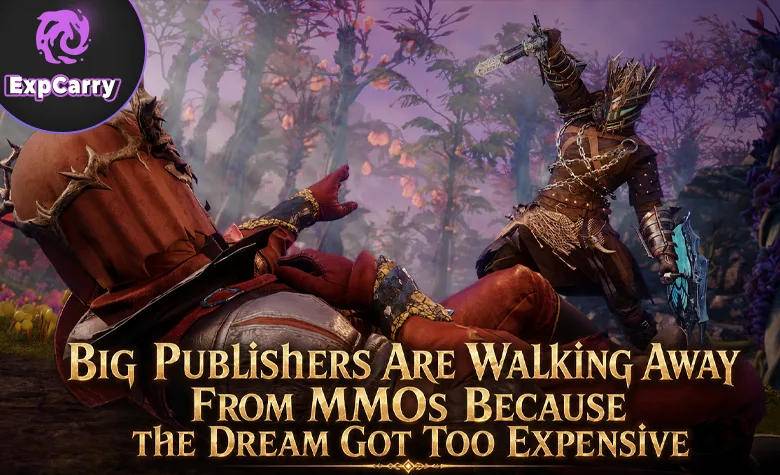
Big publishers are no longer chasing MMO dreams with the same hunger they had a decade ago. The fantasy is still seductive: one giant online world, millions of loyal players, years of subscriptions, cosmetics, expansions, and a community that refuses to leave. On a spreadsheet, it looks like a machine that prints money forever. In reality, it looks more like a burning cargo ship staffed by exhausted developers while players ask where the next raid is.
The retreat is not imaginary. Amazon is taking New World: Aeternum offline on January 31, 2027 after ending major new content updates and delisting the game from storefronts. Amazon's second Lord of the Rings MMO attempt has also reportedly collapsed, although the company has not formally announced the cancellation. Riot's League of Legends MMO was reset and pushed into a long period of silence. ZeniMax Online's unannounced MMO, Project Blackbird, was canceled during Microsoft layoffs. Sony has cut several live-service projects, and Sega recently canceled its ambitious Super Game initiative while pointing to intense market competition. The pattern is clear: large companies still like online revenue, but many are becoming much colder toward the massive risk of building new MMOs.
MMO Development Became Too Expensive for Corporate Patience
The first reason big companies are pulling back from MMOs is brutally simple: cost. A modern MMO is not just a big game. It is a platform, a content pipeline, a customer-service machine, a social network, a security problem, a server infrastructure problem, and a live production treadmill glued together with hope and emergency patches.
A single-player RPG can be expensive, but it has a clearer finish line. An MMO does not. Launch is not the end of development. Launch is the beginning of the part where players start consuming content faster than the studio can build it. Every zone, class, dungeon, raid, profession, economy system, PvP mode, guild feature, housing system, seasonal event, and balance patch becomes a permanent obligation.
That makes the genre a terrible fit for publishers that want predictable returns. An MMO can spend six or seven years in development and still need several more years after launch before it becomes stable, profitable, and trusted. In the current industry climate, where layoffs and project cuts are common, that kind of patience is rare. Corporate boards like long-term revenue. They like long-term expense much less, because apparently capitalism has discovered object permanence.
Live-Service Fatigue Hit MMOs From the Side
MMOs used to be the natural home of live-service design. Then every publisher decided every game should be a live service. Shooters, action games, survival games, sports games, mobile games, extraction games, and even single-player franchises were pushed toward seasons, stores, passes, events, and endless engagement loops. The result was market saturation.
This hurts MMOs because they no longer compete only against other MMOs. A new MMO has to fight for time against Fortnite, Roblox, Destiny, Warframe, Genshin Impact, Final Fantasy XIV, World of Warcraft, Old School RuneScape, survival sandboxes, gacha games, extraction shooters, and whatever social game is currently eating half the internet. The player does not have infinite evenings. The industry keeps pretending otherwise, because apparently every studio thinks it owns a private copy of the human calendar.
The live-service correction is already visible. Sony has canceled multiple multiplayer and live-service projects after struggling to make the model work across its first-party pipeline. Sega canceled its Super Game initiative and shifted resources toward more traditional full games after pointing to harsher market conditions. These are not classic MMO cancellations, but they matter because MMOs are the most expensive and demanding version of the same live-service promise. If companies are becoming more careful with smaller online bets, they have even more reason to fear giant persistent worlds.
Amazon's MMO Retreat Shows the Genre's Harshest Lesson
Amazon is the clearest recent example of the MMO problem. New World launched with huge attention in 2021, then struggled with retention, endgame direction, technical issues, content cadence, and identity. New World: Aeternum tried to reposition the game for consoles and a wider audience, but Amazon later ended major new content development, delisted the game from storefronts, and set the final shutdown date for January 31, 2027.
That matters because Amazon had money, infrastructure, brand reach, and time. It still could not turn New World into a durable MMO success on the level needed to justify ongoing expansion. The result sends a harsh signal to the rest of the industry: if a tech giant with massive resources cannot easily stabilize a first-party MMO, smaller or less committed publishers have even more reason to hesitate.
The reported collapse of Amazon's Lord of the Rings MMO makes the signal even louder, with one important caveat: the project has been reported as canceled, but Amazon has not formally confirmed the cancellation. That distinction matters. Still, if those reports are accurate, the lesson is ugly. Middle-earth is one of the strongest fantasy settings in the world, yet even that kind of IP cannot erase the production risk, internal strategy shifts, long development timelines, and live-service pressure attached to a modern MMO.
| Project | Company | Current signal | Industry meaning |
|---|---|---|---|
| New World: Aeternum | Amazon Games | New content ended, delisted from storefronts, shutdown set for January 31, 2027 | Even a launched MMO can become too expensive to keep growing |
| Lord of the Rings MMO | Amazon Games | Reportedly canceled after layoffs and strategy changes | A huge IP does not remove MMO production risk |
| League of Legends MMO | Riot Games | Development reset, long silence expected | Even strong IP owners hesitate if the game is not distinct enough |
| Project Blackbird | ZeniMax Online Studios | Canceled during Microsoft layoffs | Long-running MMO expertise does not guarantee project survival |
| Sega Super Game | Sega | Canceled amid live-service market pressure | Large online bets are being questioned beyond the MMO genre |
The Content Treadmill Is Worse Than Publishers Expected
The core MMO trap is the content treadmill. Players want a huge world at launch, then they want new dungeons, raids, zones, systems, classes, cosmetics, balance patches, events, story chapters, and quality-of-life improvements immediately after. If the studio moves slowly, players say the game is dead. If the studio moves quickly, quality drops and developers burn out. Elegant little system, this. Very normal thing to build a business around.
This is why many MMOs struggle after the first month. Launch hype brings players in, but retention depends on endgame depth, social structure, reward design, and update rhythm. A studio can spend years building the leveling experience, then discover that players chew through it in two weeks and judge the entire game by the endgame loop. That is not unfair, but it is brutal.
Traditional expansions help, but they are expensive and slow. Seasonal content helps, but it can feel disposable. Player-generated content can extend a world, but it is hard to moderate and even harder to fit into a tightly designed MMO economy. Procedural systems can add variety, but they rarely replace handcrafted raids, storylines, and social goals. The genre needs content volume and content quality at the same time, which is precisely the kind of demand that makes production directors age in dog years.
MMO Monetization Has Become a No-Win Argument
Money is another reason major publishers are careful. A modern MMO needs years of revenue after launch, but every monetization model brings a different public execution method. A subscription can make players ask why they should pay monthly when so many online games are free. A buy-to-play model still creates pressure for paid expansions, cosmetics, and season passes. A free-to-play model can attract a large audience, but it immediately raises fears about pay-to-win design, grind inflation, whales, and cash-shop rot.
This is especially dangerous because MMOs are built on trust. Players invest hundreds or thousands of hours into characters, guilds, economies, collections, and social networks. If they think the publisher is bending progression around a store, trust collapses fast. Cosmetic monetization can work, but even that has limits when players feel the best armor, mounts, housing items, or visual rewards are being pulled away from gameplay and sold separately.
That leaves publishers in an awkward position. They need recurring money to fund recurring content, but the audience often rejects the systems that make recurring money easier. This is not impossible to solve, but it demands discipline, restraint, and long-term planning. Naturally, those are the exact qualities large publishers love to put in investor presentations and then misplace during production.
Player Expectations Became Almost Impossible to Satisfy
Modern MMO players want contradictory things, and publishers know it. Players want fresh systems, but not systems that betray the old genre. They want convenience, but not a world that feels frictionless. They want challenging raids, but also broad accessibility. They want fair monetization, but also endless updates. They want class balance, but also strong class identity. They want a living economy, but not one ruined by bots, dupes, whales, or bad tuning.
This creates a dangerous design problem. If a new MMO copies World of Warcraft or Final Fantasy XIV too closely, players call it outdated. If it tries to be too different, players say it is missing basic genre features. If it launches with a subscription, players question the value. If it launches free-to-play, players fear monetization rot. If it launches buy-to-play, players still expect a full live-service cadence.
Riot's MMO reset is a perfect example of this pressure. Riot had one of the strongest possible IP foundations with League of Legends and Runeterra, but the project was reset because the earlier direction was not considered distinct enough from existing MMOs. That is the nightmare: being too familiar is dangerous, but being too experimental is also dangerous. Large companies hate that kind of uncertainty, because uncertainty is hard to sell in quarterly planning documents without using very expensive euphemisms.
MMO Communities Are Powerful, But They Are Also Expensive to Serve
A strong MMO community can keep a game alive for decades. World of Warcraft, Final Fantasy XIV, RuneScape, EVE Online, Guild Wars 2, and The Elder Scrolls Online prove that the model can work when a game finds its audience and keeps feeding it. That is the part publishers love. The part they like less is everything required to maintain that community.
MMO players do not just buy a game and leave. They need moderation, server stability, economy control, anti-cheat, support tickets, guild tools, account recovery, customer communication, roadmap clarity, balance transparency, and regular social management. Every exploit becomes an economy emergency. Every class nerf becomes a forum war. Every delayed update becomes proof that the game is dying. Every cash-shop decision becomes a moral trial conducted by people with anime avatars and frightening persistence.
That community intensity is good for engagement but dangerous for brand risk. A failed MMO does not quietly disappear. It creates years of bad reputation, angry veterans, refund pressure, YouTube autopsies, Steam review damage, and internal blame. A publisher that cancels an MMO before launch may lose sunk costs, but a publisher that launches a bad MMO can damage a brand for years.
Layoffs Made Long-Term MMO Bets Much Harder to Defend
The last few years of game industry layoffs changed the math around large online projects. When companies are cutting staff, shutting studios, and narrowing pipelines, a huge MMO in pre-production becomes vulnerable. It may not generate revenue for years. It may require hundreds of developers. It may need custom tools and infrastructure. It may still fail even after launch.
That is why projects like ZeniMax Online's Blackbird are so important to this conversation. ZeniMax Online had real MMO experience through The Elder Scrolls Online, yet its unannounced MMO was still canceled during broader Microsoft cuts. Experience helps, but it does not protect a project when leadership decides the risk is too high.
This creates a vicious loop. MMOs need stable long-term teams, but the current industry keeps interrupting long-term development with restructures. Every layoff damages institutional knowledge. Every reset slows production. Every leadership change can redirect the product. A massive MMO cannot survive constant corporate weather changes unless the company is deeply committed. Many companies are proving they are not.
Existing MMOs Are Too Entrenched for Newcomers to Attack Directly
New MMOs do not enter an empty market. They enter a battlefield dominated by games with years of content, mature systems, established communities, and enormous player investment. World of Warcraft has two decades of history. Final Fantasy XIV has a complete expansion structure and loyal fanbase. RuneScape has generational persistence. Guild Wars 2 has a strong niche. The Elder Scrolls Online still has a massive IP and years of content. Even smaller MMOs have communities that are hard to pull away.
This matters because an MMO is not only competing for money. It is competing for identity. Players build social lives, guilds, characters, achievements, mounts, houses, cosmetics, reputations-farm">reputations, and memories inside these games. Asking them to abandon that for a new MMO is difficult unless the new game offers something genuinely stronger. "New but unfinished" is not enough.
That is why publishers are cautious. A new MMO must be good at launch, deep enough to retain players, different enough to justify switching, familiar enough to be readable, and stable enough not to embarrass itself. That is a horrible checklist. It is also the minimum entry price now.
Licenses No Longer Make MMO Projects Safe
For years, publishers treated major IP as a shield. The logic was simple: attach a famous world to an MMO, and players will come. The Lord of the Rings, League of Legends, Dune, Horizon, Star Wars, Marvel, DC, Warcraft, The Elder Scrolls - big names create instant attention. But attention is not retention.
A licensed MMO adds new problems. Rights holders need approvals. Lore rules restrict design. Revenue may be shared. Expectations are higher. Fans judge every class, region, faction, and costume against the source material. Marketing can get people through the door, but the actual game has to keep them there for years.
The reported Lord of the Rings MMO collapse is a harsh reminder, even with the usual caution around unofficial reports. Tolkien's world is nearly perfect for an online RPG on paper, but a famous setting cannot reduce the cost of content, the difficulty of endgame, the pressure of live operations, or the pain of keeping servers healthy while players test every system like bored raccoons with broadband.
Publishers Prefer Smaller Online Games With Cleaner Risk
Large companies are not abandoning online games entirely. They are abandoning the most dangerous version of the dream. Instead of funding huge MMOs, many publishers prefer smaller live-service games, extraction shooters, co-op action games, survival sandboxes, gacha RPGs, mobile titles, or platform-based ecosystems with user-generated content.
These projects can still fail, but their risk profile is cleaner. A co-op game does not need a full persistent world. A shooter can launch with fewer zones and clearer match structure. A survival game can lean on player-driven chaos. A gacha RPG can monetize characters and updates without simulating a giant social world. A creator platform can outsource part of the content burden to users.
This is the real shift. Companies still want recurring revenue. They still want long-term engagement. They still want stores, seasons, cosmetics, and communities. They just increasingly want those things without building a true MMO, because true MMOs combine the cost of a blockbuster game with the operational misery of a permanent public service.
MMOs Are Not Dead, But the Easy Money Myth Is
The genre is not dying. That claim is lazy. Existing MMOs remain strong, and the audience for persistent online worlds still exists. The difference is that major publishers are learning that launching a new MMO is not a shortcut to infinite money. It is one of the hardest bets in gaming.
The successful MMOs tend to have either long histories, loyal niches, strong identities, or years of patient support. They are not easy products. They are ecosystems. Their strength comes from accumulated content, social bonds, player habits, and trust built over time. That is why the companies already operating successful MMOs often keep supporting them, while companies without that foundation hesitate to build new ones from scratch.
This distinction matters. Publishers are not rejecting MMO players. They are rejecting the idea that every major IP should become a massive persistent online world. The market can support good MMOs, but it does not have room for every corporation's fantasy of becoming the next Blizzard in 2004. The industry tried to clone the dream. The dream sent back an invoice.
Final Thoughts
Major companies are backing away from MMO projects because the genre has become too expensive, too risky, and too slow for the current industry mood. The fantasy of a permanent online world still attracts publishers, but the reality is brutal: long development cycles, huge teams, server costs, live operations, content pressure, monetization backlash, community management, and years of support before the business case becomes clear.
Amazon's retreat from New World and the reported collapse of its Lord of the Rings MMO show how dangerous the model has become even for a company with enormous resources. Riot's MMO reset shows that a strong IP is not enough if the design is not distinct. ZeniMax's canceled Blackbird proves even experienced MMO studios can lose projects during corporate cuts. Sony and Sega's live-service pullbacks show the broader market has become less tolerant of giant online bets that may never pay off.
The future of MMOs will probably belong to fewer, more deliberate projects rather than a flood of corporate attempts. The companies that succeed will need patience, a clear identity, stable teams, fair monetization, and the nerve to support a game for years before it fully proves itself. Everyone else will keep chasing smaller online formats with cleaner risk. That may disappoint MMO fans, but it is not hard to understand. The genre still has magic. It also has one of the ugliest balance sheets in gaming.