
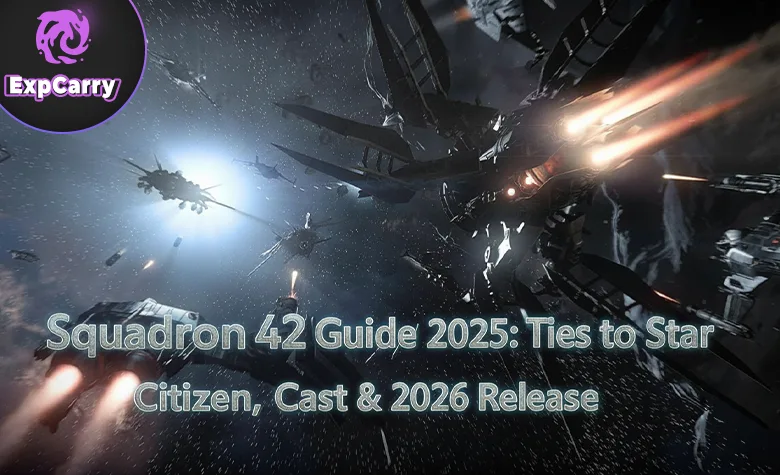
Persistent Universe is the long-term MMO sandbox where you build a life, reputation, and income, then Squadron 42 is the cinematic entry point: a curated military narrative where you play a rookie United Empire of Earth Navy pilot and live through a specific period of the setting that explains why the wider universe looks and feels the way it does.
People often describe Squadron 42 as "Star Citizen, but single-player." That is close, but not complete. The important distinction is that Squadron 42 is designed around authored pacing: missions, set-pieces, character arcs, and a structured military chain of command. Star Citizen is designed around systems and player agency: you decide the job, the route, the ship, the risks, the grind, and the stories emerge from your session. Squadron 42 is where the universe is presented as a directed story first, and a sandbox second.
Current Status: Where Squadron 42 Stands In Late 2025
Cloud Imperium Games publicly announced that Squadron 42 reached the "feature complete" milestone on October 22, 2023, and stated that the project moved into a polishing phase focused on optimization, refinement, and final quality work. In late 2025, the public-facing status is still framed as polish: the planned content and core systems exist, and the remaining work is about stability, performance, bug fixing, cinematic reliability, and final tuning that makes a story campaign feel shippable.
The current public target window communicated on RSI marketing for Squadron 42 is 2026. Treat that as the stated goal rather than a promise, because the project has a long history of shifting dates and changing production realities across the years, and even recent developer commentary has emphasized that hitting a specific window is not guaranteed. Still, the difference between "we are building it" and "we are polishing it with a public 2026 target" is meaningful. It signals that the studio wants to move from endless iteration into delivery, and that the campaign is framed as the nearest-term flagship release that anchors the broader roadmap.
If you are trying to map this to a practical player expectation: Squadron 42 is positioned as the big narrative product that can be shipped as a standalone premium experience, while Star Citizen continues to evolve as a live, expanding universe. They are connected by technology, assets, lore, and long-term direction, not by being the same gameplay mode.
What Squadron 42 Is About: The Setting, The War, And The Core Fantasy
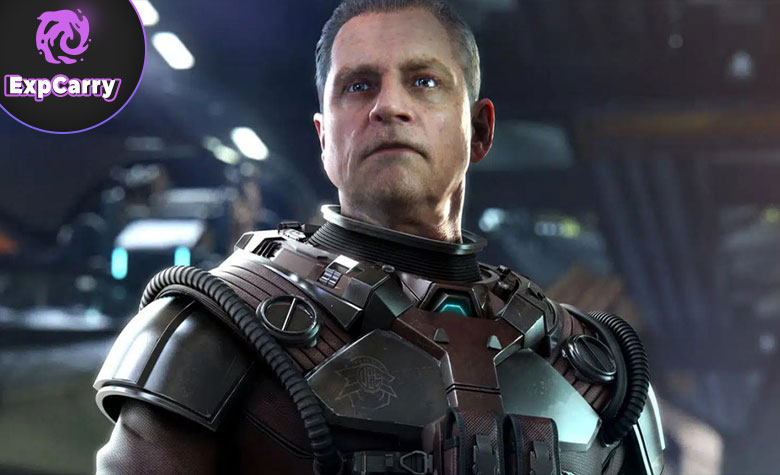
At the center of Squadron 42 is the UEE Navy and the escalating tension and conflict with the Vanduul. In Star Citizen lore, the Vanduul are the existential external pressure that forces systems, corporations, and citizens to accept militarization, security spending, and political compromises. Squadron 42 puts you inside that pressure cooker, not as an independent freelancer, but as a recruit inside a Navy machine. That changes the tone. You are not hustling contracts, you are following orders. You are not choosing the law, you are living under it. You are not the hunter, you are the instrument.
The core story fantasy is "you are the new pilot who gets thrown into a war that is bigger than you." That usually implies three things in practice. First, a progression from training and early deployment into high-stakes combat operations where mistakes carry narrative weight. Second, exposure to the political and moral machinery behind the UEE, including propaganda, command decisions, cover-ups, and the personal cost carried by pilots and crews. Third, a set of missions that deliberately alternate between space combat, ship operations, and on-foot scenes, because the game wants to present the universe as a lived, physical place rather than a menu of mechanics.
If Star Citizen is "make your own legend in a frontier economy," then Squadron 42 is "survive the empire's war and learn what this universe is really built on." It is a story about duty, identity, and scale, designed to make the UEE Navy feel like a real institution with a culture, doctrine, and hierarchy. It is a story about duty, identity, and scale, designed to make the UEE Navy feel like a real institution with a culture, doctrine, and hierarchy. That kind of military framing also fits items like the UEE 6th Platoon Medal. It should also function as a lore foundation: it explains why the Navy matters, why certain ships and technologies have the reputations-farm">reputations they do, and why the Vanduul threat is more than a random enemy faction.
What You Actually Do In Squadron 42: Gameplay Structure And What Makes It Different From The PU
Squadron 42 is built around mission structure rather than open-ended loops. That does not mean it is on rails in a simplistic way. It means the flow is intentional: briefing, launch, objective, escalation, climax, debrief, move forward. The game can still enable choice inside that structure, but the overall arc is directed. This is how cinematic pacing is created. In a sandbox, pacing is mostly created by the player. In a campaign, pacing is authored by design.
Based on public descriptions, the campaign blends space combat with on-foot FPS segments. In practical terms, that means your core skill set is broader than in a pure flight sim. You must be competent in ship combat, situational awareness, target prioritization, and power management style decision-making under pressure. You must also be competent in first-person movement, weapon handling, use of cover, and problem-solving in interior spaces.
One reason this matters for the wider Star Citizen universe is that Squadron 42 forces the studio to make those moment-to-moment systems feel "good enough for a boxed product." It is one thing for a sandbox alpha to have rough edges. It is another thing for a narrative campaign with pacing, cinematics, and scripted sequences to tolerate those same rough edges. That pressure tends to harden systems: AI behavior, mission state logic, animation reliability, performance in dense scenes, and the ability of the engine to carry a long session without collapsing. Even if you never play Squadron 42, the campaign acts as a quality forcing function for the shared tooling and pipeline.
Explore services related to this guide, selected from our Star Citizen catalog.
View All Star Citizen Services
How Squadron 42 Connects To Star Citizen: The Real, Practical Links
To understand the connection properly, you need to separate three layers: universe connection, technology connection, and account progression connection. The first two are strong and clearly visible. The third exists in official messaging, but the exact shape is still not something you should plan around until it is documented closer to launch.
Universe connection is the simplest and the strongest. Squadron 42 is set in the Star Citizen universe, under the same factions, corporate brands, and timeline logic. UEE Navy is not a side lore footnote. It is one of the main pillars of the setting. Squadron 42 uses that pillar as its primary stage. That means events and organizations that matter in Squadron 42 shape how the broader universe is framed. Even if the PU never forces you to care about the Navy, the universe is built with the Navy in mind.
Technology connection is the second strong link. The studio has explicitly framed Squadron 42 as a place where features and improvements are developed and then become available for use in Star Citizen as they mature. Think of Squadron 42 as the "campaign product" that can justify deep investment in AI, cinematic tools, combat encounter design, environments, and performance work. Those same investments are valuable to the PU because they create better NPC behavior, better mission spaces, better animation, and better foundations for future systemic gameplay. In other words, Squadron 42 is not only a game, it is also a production engine for systems that the MMO needs.
Account progression connection is the most misunderstood layer. Earlier marketing leaned into the fantasy of service, citizenship, and identity. More recent public framing focuses on shared universe and shared technology. However, CIG have also stated that playing Squadron 42 may earn bonuses that carry over into Star Citizen, including access to the F8C Lightning. The key word is access: do not assume "free ship" or a specific reward list. Treat carry-over as possible and officially referenced, but not fully defined until a current, explicit implementation is documented closer to launch.
The healthiest way to describe the connection to a new player is this: Squadron 42 is meant to give you a curated, cinematic reason to understand the universe, and Star Citizen is where you live in that universe afterward. The campaign is the story. The PU is the life. They reinforce each other by sharing worldbuilding and technology, even if they do not share your character progression in a simple MMO sense.
How Long Squadron 42 Has Been In Development (And Why The Number Matters)
Squadron 42 was announced as part of the broader Star Citizen project during the original crowdfunding era, around 2012. That means that by late 2025 the campaign has been in development for roughly 13 years. When people say that number, they usually mean one of two things. Either they mean it as criticism of delays and scope changes, or they mean it as evidence of ambition and the cost of building bespoke technology and content pipelines over time.
The reality is more complicated, and you can hold both truths at once. The development has stretched across years because the tech stack and the studio itself were not fully formed at the start. The project had to build studios, pipelines, engine modifications, and multi-location production capacity while also building content. That is not an excuse, it is a description of the project shape. The more important practical point is this: a long development cycle means the game has seen multiple design eras. Systems have been rebuilt. Tools have evolved. Visual targets have shifted. What you get at the end is not simply "a game that took 13 years to make," it is also a snapshot of a studio that built itself while building a product.
If Squadron 42 actually ships in 2026, it will be one of the most unusual AAA development arcs in modern history: a crowdfunded campaign that evolved inside a live, public universe, and then emerged as a standalone narrative product. That uniqueness is why it matters. Even if you dislike the delays, the project is not "normal AAA." That means your expectations should be tuned to what it is: an attempt to deliver a cinematic space war campaign with extremely high fidelity in a universe that also needs to function as an MMO sandbox.
The Confirmed Cast: Which Actors Are Officially Associated With Squadron 42
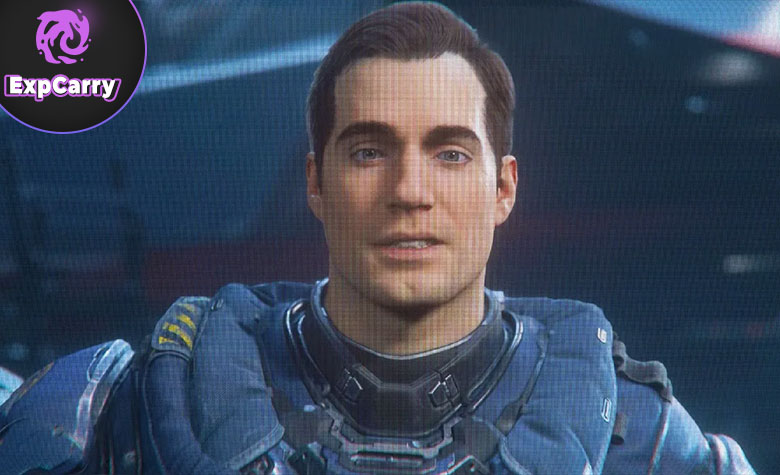
One of Squadron 42's most distinctive public signatures has always been its Hollywood-style cast. Cloud Imperium have used this as proof of intent: this is not an indie story mode, it is meant to be a cinematic production with recognizable performances. The safest way to talk about the cast is to stick to names that have appeared in official RSI communications.
Actors that have been publicly named by RSI in connection with Squadron 42 include Gary Oldman, Mark Hamill, Henry Cavill, Gillian Anderson, Andy Serkis, Liam Cunningham, Mark Strong, John Rhys-Davies, Sophie Wu, and Ben Mendelsohn. You will see additional names in community databases and media coverage, but if you want "confirmed by official RSI messaging" these are core names that have been repeatedly associated with the project.
What matters about the cast is not only star power. It hints at structure. A cast like this suggests a command-level narrative: admirals, captains, senior officers, political figures, and recurring characters that can carry long arcs. That fits the UEE Navy fantasy. It also implies that the game is not "just missions." It is a story with relationships, conflict of ideology, and the kind of scenes where performance matters.
Why Squadron 42 Matters Even If You Only Play The Persistent Universe
Even if you never touch Squadron 42, the campaign can still matter to you as a Star Citizen player in three ways: systems, tone, and long-term direction.
Systems: a shipped campaign needs stable encounter logic, AI reliability, animation quality, and performance. Those same areas are exactly where a sandbox MMO struggles the most, because the sandbox creates infinite edge cases. If Squadron 42 polishing genuinely hardens these systems, the PU benefits. This is why you repeatedly see the framing that features built for Squadron 42 can later be leveraged in Star Citizen. It is not a charity gesture, it is production logic: the engine improvements and tools do not disappear after launch.
Tone: Squadron 42 is likely to set the emotional tone for the entire universe in a way the PU cannot. The PU is player-driven and often chaotic. A campaign can emphasize fear, sacrifice, propaganda, military discipline, and the human cost of power. After you play the campaign, the PU can feel different. You will see ships, uniforms, factions, and propaganda elements with context, not as random art dressing.
Direction: a real shipped product forces a point of clarity. It proves what the studio considers "done enough." That matters for Star Citizen because it signals when the studio can shift some priorities away from campaign delivery and toward MMO-scale content. If Squadron 42 is truly the nearest-term priority, then its release is also a milestone that can change resource allocation in the next phase of Star Citizen development.
What To Expect From The Story Without Spoilers
Without going into spoilers, expect a war story framed through the UEE Navy that aims to humanize a massive conflict. The Vanduul threat is the external shape, but the internal shape is the UEE itself: how a government wages war, what it asks of its people, and what pilots actually experience when politics becomes combat. You should expect a mixture of tactical mission urgency and slower sections that focus on character, ship life, and the kind of tension that builds before a major operation.
Also expect that the campaign will do heavy lifting on "why the universe is like this." Star Citizen's PU often throws players into a world where corporations own too much, security is fragmented, and the frontier is lawless in practice. Squadron 42 can show you the institutional perspective that makes that world coherent: the Navy, the bureaucracy, the propaganda machine, and the compromises that happen when survival becomes policy.
If you enjoy military sci-fi, the appeal is clear. If you prefer pure sandbox freedom, the campaign can still work as an origin myth: you do not play it for freedom, you play it to understand the empire that the sandbox sits inside.
A Realistic Buying And Waiting Mentality (Late 2025)
The only correct mindset for Squadron 42 in late 2025 is disciplined optimism. The public messaging suggests forward motion: feature complete (announced October 22, 2023), polishing, 2026 target. But the project also has a decade-plus history of shifting timelines. That means you should avoid any plan that depends on a specific month. Treat it as "a 2026 target exists, but dates can still move."
If you are primarily a Star Citizen player, your best approach is to see Squadron 42 as a separate premium story game that can upgrade your relationship with the universe, not as a required step to enjoy the PU. If you are new and you want a guided entry into the setting, Squadron 42 may become the most approachable way to join the universe, because a campaign can teach you tone and context without the chaos of an alpha sandbox.
If you are a lore-focused player, Squadron 42 is likely to be the single biggest canonical content drop the setting has ever had in one package. The PU delivers lore in fragments: missions, events, locations, terminals. A campaign can deliver it as a coherent arc with characters that carry meaning. That is rare in modern space sims.
The Bottom Line
Squadron 42 is Star Citizen's cinematic campaign: a directed military story where you play a rookie UEE Navy pilot in the same universe as the Persistent Universe. The connection is strongest in lore and technology: it is a shared universe and a shared production foundation. CIG announced "feature complete" on October 22, 2023 and publicly framed the current phase as polish, with RSI marketing listing a 2026 target window. The cast includes major names that signal a heavy cinematic focus.
If it ships as described, Squadron 42 will be both a standalone single-player war story and a milestone for the broader Star Citizen ecosystem, because it forces core systems to meet a higher bar and clarifies the next chapter of priorities for the studio. If it slips, it will still remain the narrative anchor the universe has been built around for more than a decade. Either way, it is not "optional fluff." It is the project that defines what Star Citizen ultimately wants to be when it grows up.