
According to the first WoW Midnight Patch 12.1 PTR development notes, Curse of Ula’tek is shaping Housing into a stronger long-term player system rather than leaving it as a simple decorating feature. The update plans to add Blueprints for saving, importing and sharing house layouts, Pet Beds for placing companion pets inside and outside the house, four new Endeavors, dye crafting improvements, new dye colors, house level 12, larger limits, large exteriors, movable entry rooms and new decor categories. Since these details come from the PTR, exact numbers, limits and implementation details can still change before the live release.
The important part is that these changes are not only cosmetic. Blueprints solve one of the biggest problems for serious builders by letting them preserve layouts, share designs and recover from failed imports. Pet Beds make houses feel more alive by turning collected pets into placed residents. Level 12 homes increase the ceiling for decorators who push current limits. Dye consolidation reduces inventory pressure and makes Blueprint imports less painful. Endeavors give neighborhoods more rotating social goals. Together, these systems make Housing more practical, more social and easier to maintain across multiple builds.
WoW Midnight Patch 12.1 Housing Changes Overview
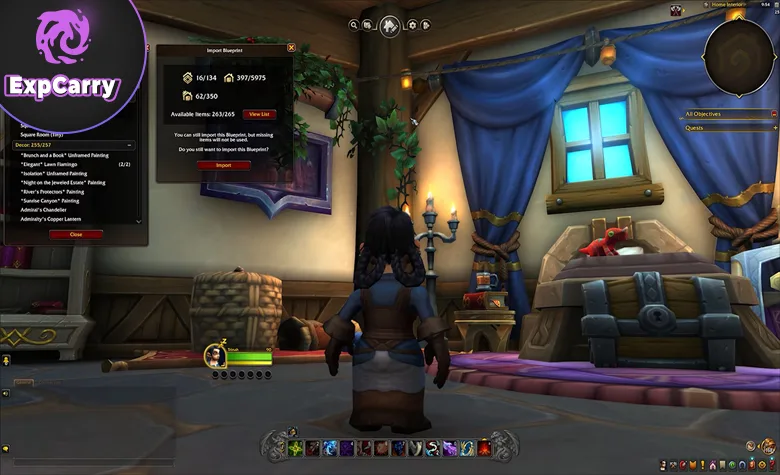
The first Patch 12.1 PTR notes list several Housing systems at once, with Blueprints clearly positioned as the headline feature. Players will be able to save housing creations, swap between saved layouts, share Blueprint codes with other players and import layouts created by someone else. Blizzard says Blueprints can apply to the entire house, the interior only, the exterior only or a single room. That flexibility is important because players will not be forced to replace a full build just to copy one room idea or test a new exterior.
Pets are the second major feature. Pet Beds allow players to place collected pets inside and outside the house, with up to 10 beds indoors and up to 5 beds outdoors. Indoor pets can be set to Stationary or Roaming, while outdoor pets are Stationary for now. Houses can now reach level 12, unlocking increased limits, large exteriors and more. Players can also move the entry room anywhere in the house, including other floors, which gives builders far more control over layout flow and basement-style designs.
| System | Patch 12.1 PTR Change | Main Impact |
|---|---|---|
| Blueprints | Save, import, export and share layouts | Players can preserve builds, copy rooms and share full house designs |
| Blueprint scope | Entire house, interior, exterior or single room | Sharing becomes flexible instead of forcing full house replacement |
| Save slots | Up to 50 save slots and 10 auto-save slots | Builders can keep multiple layouts and revert after imports |
| Pet Beds | Up to 10 indoor beds and 5 outdoor beds | Collected pets can become part of the house presentation |
| House level | Homes can now reach level 12 | Higher limits and large exteriors expand endgame building space |
| Entry room | Can be moved anywhere, including other floors | Players get more control over interior layout logic |
| Dyes | Crafting streamlined and new colors added | Less bag space pressure and better color options for decor |
| Endeavors | Four new Neighborhood Endeavors | Neighborhoods get more rotating themes and shared activity goals |
Blueprints Make Housing Builds Shareable
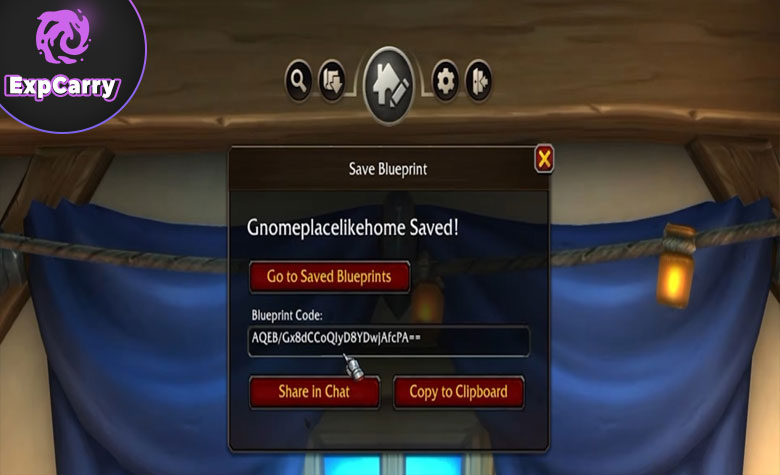
Blueprints are the most important Housing addition in Curse of Ula’tek because they solve a problem that decorators hit as soon as they start building seriously. Without a system like this, every major redesign carries risk. Changing a room, testing a theme or rebuilding an exterior can destroy hours of placement work unless the player manually rebuilds everything later. In 12.1, Blueprints let players save creations and swap between layouts, which turns experimentation into a safer process instead of a permanent commitment.
Blueprint codes can be shared cross-region, excluding China, and imported by other players. The system also supports partial sharing. A creator can share the entire house, only the interior, only the exterior or one specific room. That is a strong structure because Housing communities rarely share only full builds. Players often want one kitchen, one study, one garden, one tavern room or one exterior idea. Single-room Blueprints give the feature practical use beyond full-house copy-and-paste.
Importing also includes safeguards. Blizzard says the import screen shows all required rooms and decor, the budget needed, missing items and related requirements before the player commits. Dyed items also get special handling, with the system trying to use correctly dyed items or dye items where appropriate without replacing already dyed pieces incorrectly. This matters because Housing builds often depend on exact colors, room budgets and object placement density. A Blueprint system that ignores missing items or dye states would create confusion instead of solving it.
Save Slots, Auto-Saves and Export Permissions
Players can have up to 50 save slots for different layouts and 10 additional auto-save slots. Auto-saves are created automatically when importing a Blueprint so players can revert if the import does not work as expected. This is one of the most practical parts of the system because it recognizes how decorators actually play. Importing someone else's design can be useful, but it can also disrupt an existing build. Auto-saves reduce that risk and make testing community Blueprints less dangerous.
Patch 12.1 also adds a new house permission called Export, and it defaults to no one. Visitors who pass that permission can import the design into their own save slots. This is important for creator control. A player may want friends to tour a house without automatically letting anyone copy it. Blueprint codes can also be linked and inspected in chat, and Blueprints can be reported, which gives the system basic moderation and safety tools from the start. The Reset button is another practical addition, allowing players to reset the whole house, only the interior or only the exterior if they want to start fresh.
Pet Beds Bring Companion Pets Into Housing
Pet Beds let players display companion pets as part of their home instead of leaving them only as summonable collection items. In Patch 12.1, players can place up to 10 Pet Beds inside the house and up to 5 outside. Once a bed is placed, the player can choose a pet to live there. Indoor pets can either stay Stationary or Roam, while outdoor pets are Stationary for the current PTR implementation. Blizzard also notes that a small number of pets cannot be placed for various reasons.
This is a strong Housing change because pets solve the emptiness problem. A well-built house can still feel static if only decor objects exist inside it. Roaming indoor pets add movement and personality, while stationary outdoor pets can make gardens, yards, porches and themed exterior spaces feel more occupied. The feature also gives pet collectors a new reason to care about their collection. A rare pet is no longer only a battle pet or summon. It can become part of a room's identity.
The indoor and outdoor difference is worth noting. Indoor pathing is more advanced because pets can roam through the house, while outdoor pets are not roaming yet. That means builders should plan outdoor pet placement more like display decor for now, while indoor pets can be used to make bedrooms, libraries, kitchens, workshops and lounges feel alive. Pet Beds also get their own decor category, which should make them easier to find and manage inside the Housing UI.
Explore services related to this guide, selected from our World of Warcraft catalog.
View All World of Warcraft Services


House Level 12 and Larger Building Limits
Homes can now reach level 12 in Curse of Ula’tek. Blizzard lists increased limits, large exteriors and more as part of that progression. The exact value of every limit can still change during PTR, but the direction is clear. Housing is getting a higher ceiling for players who push their homes hard in Midnight. For decorators, this is not a small reward. Limits define what kind of build is possible, how dense rooms can become and how far exterior ideas can go before the system blocks further placement.
Large exteriors are especially important because exterior building has a different identity from interior decoration. Interiors are about room layout, lighting, furniture, wall coverage and object composition. Exteriors support gardens, yards, storefronts, paths, outdoor markets, shrines, tavern fronts and neighborhood-facing presentation. Increasing exterior options means houses can become more recognizable from the outside, not only impressive after someone enters the door.
The ability to move the entry room anywhere in the house may become one of the most important builder tools in the patch. A fixed entry room restricts how players stage the first impression of a home. In 12.1, players can move that entry room to another floor or deeper into the layout, which opens basement builds, vertical designs, split-level interiors and more controlled tour routes. This is the kind of change that affects advanced builders immediately because it changes the logic of the entire house.
New Endeavors Add More Neighborhood Goals
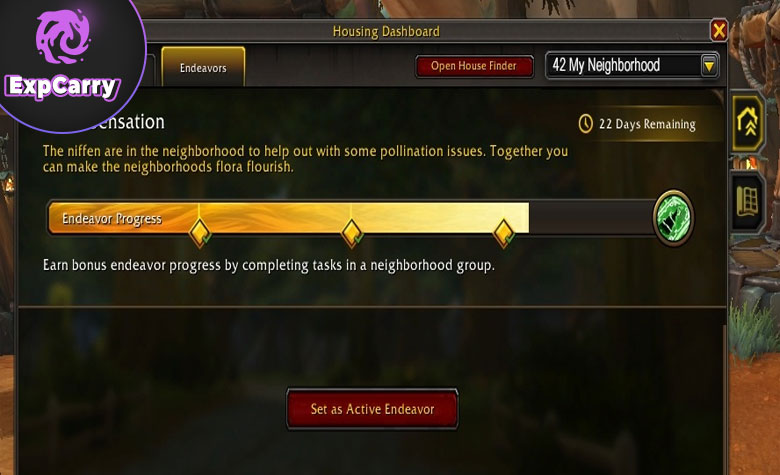
Patch 12.1 adds four new Endeavors: Knock-off Amani, Every Bakar Has Its Day, Candle Culture and Vacation Season. Knock-off Amani is the featured Endeavor with the release of Curse of Ula’tek and brings Griftah with a travelling troupe of traders selling questionable traditional Amani goods. Every Bakar Has Its Day focuses on neighborhood residents and pet training with help from centaurs of the Ohn'ahran Plains. Candle Culture brings strange wax deposits and kobold involvement from the Ringing Deeps. Vacation Season brings Tortollan visitors who have apparently been vacationing in the neighborhood long before the player arrived.
Endeavors matter because Housing is not only about the individual house. Neighborhoods need shared reasons to feel active. A personal build gives players control over their own space, but Endeavors give the neighborhood a rotating social layer. The new themes also fit the broader direction of Housing as a long-term system. Amani, bakar, kobolds and Tortollans each bring different visual styles, NPC tones and potential decor reward themes into neighborhood activity.
Blizzard also says players may notice new things in their Neighborhood based on Endeavors that have been completed, both old and new. That detail is important because it suggests Endeavors can add visible neighborhood context rather than being only a monthly task list. If the system keeps adding traces of completed community activity, neighborhoods can start to feel more like places with history instead of static housing instances.
Dye Updates Reduce Bag Space And Fix Color Gaps
The Dye Update in Curse of Ula’tek is partly a quality-of-life change and partly a response to player feedback after 12.0.5. Blizzard explains that Housing originally launched with a dye bug that made some darker colors appear much more intense. When that bug was fixed in 12.0.5, many decorated objects looked different from what players expected, especially with colors such as Obsidium Black, Mahogany and Mesquite Brown. Instead of reverting the rendering fix, Blizzard is adding new darker color options that better match the pre-fix appearances.
The new darker colors include Dark Obsidium, Dark Mahogany and Dark Mesquite. Blizzard is also adding Amani Green, Klaxxi Amber, Aethril Pink, Foxflower Orange, Faded Mana, Stonetalon Brick, Verdant Green, Tirisfal Green, Dusty Red, Tranquility Blue, Pearl White and Petal Pink. These colors expand the Housing palette while also giving decorators tools to recover some visual looks that changed after the 12.0.5 correction.
The larger system change is dye consolidation. Blizzard says the old structure had 62 colors plus 10 pigments, and with 15 new colors the total could have pushed a full dye collection to 87 inventory slots. Curse of Ula’tek reduces that to nine housing dye items. Teal is retired as a separate dye category and rolled into Blue or Green. Pigments are removed as an intermediate crafting step, so alchemists and scribes can take herbs to a dye station and turn them directly into dyes. This matters for Blueprints because importing dyed builds is much cleaner when players do not need a separate item for every single shade.
Players who already have old dyes or pigments should also expect a conversion process when the patch goes live. Blizzard says outdated dyes and pigments will be replaced through in-game mail with the new base dye items. That detail matters because it makes the dye update less punishing for players who already invested in Housing colors before Curse of Ula’tek.
Housing UI and Decor Category Improvements
The 12.1 PTR notes also include smaller Housing UI changes that matter for everyday building. Two new decor categories are being added: Vines and Hanging Plants, and Pet Beds. These categories sound minor, but category cleanup becomes important once a decor collection grows. Housing players often spend as much time searching for the right object as they do placing it, so clearer categories reduce friction during build sessions.
Blizzard is also removing an extra pop-up when deleting a room with no decor in it. That kind of change is not a headline feature, but it fits the same design direction as Blueprints, auto-saves and dye consolidation. Curse of Ula’tek is trying to reduce the number of small interruptions that slow builders down. The more Housing becomes a major evergreen system, the more these small friction removals matter.
Why Patch 12.1 Is A Major Housing Update
Patch 12.1 matters for Housing because it addresses three different audiences at the same time. Serious decorators get Blueprints, save slots, auto-saves, export permissions, reset tools, dye consolidation and higher house levels. Pet collectors get a way to place pets inside and outside their homes. Neighborhood players get four new Endeavors and more visible community flavor. That combination makes the update broader than a normal feature pass.
The strongest part is how the systems reinforce each other. Blueprints become more useful when dye handling is cleaner. Pet Beds become more valuable when homes have higher limits and larger exteriors. Endeavors become more interesting when neighborhoods can visually react to completed activity. Moving the entry room becomes more powerful when players can save multiple layouts and share full designs. These are connected improvements rather than a list of unrelated Housing additions.
The main risk is complexity. Housing already has decor budgets, rooms, placement rules, dyes, neighborhoods, Endeavors, permissions and collection systems. Blueprints, export permissions, pet limits and dye conversions add more layers for players to understand. The update will work best if the UI explains imports, missing decor, budget requirements and permissions clearly. If those tools are easy to use, Patch 12.1 can make Housing feel much more professional. If they are confusing, casual players may ignore some of the best features.
Final Thoughts
WoW Midnight Patch 12.1 Curse of Ula’tek is a major Housing update because it moves the feature from decoration toward a proper creative platform. Blueprints give players a reason to build for sharing, not only for personal use. Pet Beds make homes feel occupied. Level 12 homes raise the ceiling for ambitious builds. Dye consolidation removes a real inventory problem. New Endeavors keep neighborhoods active. None of these changes works alone as the entire future of Housing, but together they make the system easier to use, easier to share and harder to treat as a side feature.
The update's long-term value will depend on how well Blizzard supports the creator loop after Blueprints go live. If players can easily save, inspect, import and share builds, Housing communities will produce their own content faster than Blizzard can manually add it. That is the real point of Patch 12.1. It gives decorators the tools to turn individual houses into a shared ecosystem of rooms, themes, pets, dyes and neighborhood stories. For an evergreen WoW system, that is more important than any single new decor item.