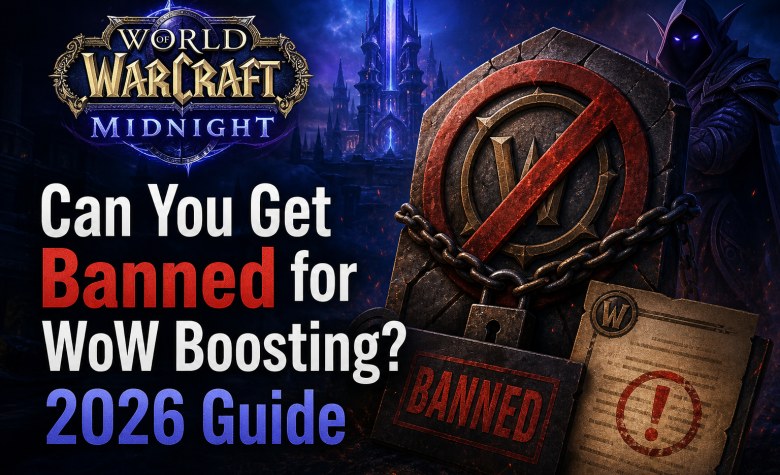

World of Warcraft boosting is a paid or gold-based service in which experienced players help another character complete content, obtain rewards, or reach a progression milestone. The key distinction is how the service is delivered: with self-play, you remain logged in and play your own character while the group assists you; with a piloted service, another person logs into your account and plays the character for you. Self-play avoids account sharing and is the safer format. Piloted boosting carries account-security and policy risks because you must provide access to your Battle.net account.
What WoW Boosting Includes
A boost can refer to several different services. The exact offer depends on the activity, difficulty, season, character requirements and whether the provider supports gold, real-money payment or both.
| Service type | What the customer receives | Typical delivery |
|---|---|---|
| Mythic+ carry | Completion of a selected keystone, timed run, rating progress or dungeon loot opportunity | Usually self-play |
| Raid carry | Boss kills, achievement progress, gear opportunities or a full raid clear | Usually self-play; some providers advertise piloted options |
| Mount or achievement run | Progress toward a specific achievement, title, mount or cosmetic reward | Normally self-play |
| Delve or outdoor progression | Completion of seasonal activities, objectives or progression milestones | Self-play or guided play |
| PvP carry | Wins, rating progress, conquest-related progression or achievement credit | Self-play is the safer format |
| Piloted service | The provider plays the customer’s character directly | Requires account access and should be treated as high risk |
Boosting does not guarantee a random drop. A provider can normally guarantee the completion of an agreed activity, but a mount, rare transmog item, trinket, raid drop or Great Vault reward remains subject to the game’s reward rules and random chance. A reputable order should clearly separate guaranteed achievements or boss kills from chance-based loot.
How Self-Play Boosting Works
Self-play is the standard low-risk format. You log into your own account, join the provider’s group and participate in the activity. The booster team supplies the experience, group composition and execution needed to complete the run, while your account remains under your control.
- Select the activity: Choose the dungeon, raid, PvP bracket, Delve, achievement or other service you want completed.
- Provide character details: The provider usually needs your region, faction or realm, character name, class, specialization and the desired difficulty.
- Schedule the run: You select an available time or wait for the provider to arrange a group.
- Join the group: The booster contacts you through the agreed channel and invites your character.
- Complete the content: You remain logged in and follow the group’s instructions. The provider handles the coordination and carries the difficult parts of the run.
- Confirm delivery: After the activity is completed, verify the achievement, rating, boss kills or other agreed result before closing the order.
Self-play may require you to meet the activity’s entry requirements. These can include level, item level, campaign access, dungeon access, rating, a completed quest or a suitable specialization. A provider should tell you about those requirements before payment rather than after the group is ready.
What You Should Do During a Self-Play Run
- Remain at your keyboard unless the provider explicitly allows a brief break.
- Use the character named in the order and do not switch characters without confirmation.
- Follow positioning, movement and boss instructions.
- Do not install an addon, executable, macro package or third-party tool supplied by an unknown person.
- Do not share your Battle.net password, authenticator codes or recovery information.
- Keep the conversation and payment details inside the provider’s official order system where possible.
Self-play is not the same as being carried while completely inactive. Some activities require every group member to move, interact with objects, avoid mechanics or meet participation conditions. Failing to participate can cause a run to fail or prevent the intended reward from being credited.
How Piloted Boosting Works
A piloted boost means the provider logs into your character and performs the activity on your behalf. The provider may request your Battle.net credentials, a temporary login method or remote access to your computer. This can appear convenient for difficult content, but it creates risks that self-play does not.
The main issue is account sharing. Blizzard’s account rules require players to protect their account credentials and prohibit allowing another person to access or use the account in ways that violate the game’s terms. Blizzard also states that boosting and carry services are unsupported. Even when a provider promises that piloting is safe, no commercial service can remove the risk of account action, compromised credentials, lost items or unauthorized changes.
Risks of Piloted Services
- Account action: Sharing access can create a policy problem even if the provider completes the order without using prohibited software.
- Credential theft: A provider can retain passwords, recovery information or session details.
- Unauthorized changes: The character, guild, friends list, settings, professions, equipment or mailbox may be altered.
- Stolen gold or items: A dishonest operator can transfer valuables before you regain control.
- Malware and remote-access abuse: Remote desktop tools or executable files can expose your computer and other accounts.
- Unclear responsibility: If the account is suspended or compromised, the provider may deny responsibility.
A service that claims to be “fully ban-proof,” promises that Blizzard cannot detect account sharing, or asks you to disable security features should be avoided. VPNs, location changes and unusual login patterns do not make account sharing compliant or guaranteed safe.
Explore services related to this guide, selected from our World of Warcraft catalog.
View All World of Warcraft Services


Gold Boosting, Real-Money Boosting and Policy Boundaries
WoW players commonly use “boosting” to describe both in-game services paid with gold and commercial services paid with real money. These are not the same transaction.
Blizzard permits some player-to-player in-game services for gold under its advertising and service rules, but boosting remains unsupported and must follow the current restrictions on advertising, group listings and organized services. You should not assume that an advertisement in Trade chat, the Group Finder or a community channel is automatically approved.
Real-money transactions outside Blizzard’s authorized systems create a separate risk. Blizzard’s terms prohibit unauthorized commercial uses of the game, including performing in-game services for payment and account boosting or power-leveling. Never send money directly to an individual through an unprotected payment method when the service is presented as an unofficial transaction.
Blizzard’s own character services and WoW Token systems are separate from third-party boosting. Buying an official character service does not authorize a third party to log into your account, and purchasing gold through the WoW Token does not make every gold-based service trustworthy.
How Boost Delivery Usually Works
Delivery should be defined before the order begins. A clear service description states exactly what is guaranteed, what is optional and what happens if the run cannot be completed.
| Delivery point | What to verify |
|---|---|
| Completion | Which dungeon, raid wing, boss, keystone level, rating target or achievement is included |
| Loot | Whether loot is personal, tradable, randomly assigned or not guaranteed |
| Timing | Whether the order is scheduled, queued or dependent on booster availability |
| Character requirements | Level, item level, campaign, rating, quest and class or role requirements |
| Failure handling | What happens after a disconnect, group failure, server problem or customer absence |
| Refunds | Which situations qualify for a refund, reschedule or replacement run |
For a Mythic+ order, completion and timing are different outcomes. If the order promises a timed key, a depleted or untimed key is not the same delivery. For a raid order, killing the listed bosses is different from guaranteeing a specific item. For PvP, a number of wins is different from a guaranteed rating increase because matchmaking results depend on the games played.
How to Check a Boosting Provider
Before ordering, verify the provider rather than relying only on a low price or impressive screenshots.
- Check whether the company clearly identifies the service, delivery method and payment terms.
- Confirm that self-play is available and that piloting is not presented as risk-free.
- Look for a written refund, reschedule and failed-run policy.
- Ask whether the booster group uses only normal game clients and permitted addons.
- Check that the provider does not require your account password for self-play.
- Use a payment method with documented dispute protection where appropriate.
- Be cautious of urgent discounts, unusually cheap high-end services and requests to pay a personal account.
- Verify the exact character, region, realm and activity before accepting the group invitation.
Impersonation is a common scam pattern. A fraudulent seller may copy a guild name, use a level-one character, send you to a lookalike Discord server or claim to represent a known raiding team. Verify the provider through an independently located official channel rather than through a link supplied only by the person contacting you.
Account-Safety Checklist for Self-Play
- Enable Battle.net two-factor authentication and account notifications.
- Use a unique Battle.net password that is not used on the boosting website.
- Do not share authenticator approvals, security codes or recovery answers.
- Do not download “required” executables, injectors, automation tools or remote-control software.
- Keep payment information away from in-game chat.
- Record the order details, agreed character and promised result.
- Take screenshots of important pre-order items, gold and settings if the transaction is large.
- After the run, review mail, guild bank activity, item transfers, account security and connected devices.
If you believe your account has been compromised, change the Battle.net password from a trusted device, secure the email account connected to Battle.net, remove unknown authenticator or phone changes and contact Blizzard Support. Do not continue negotiating with a provider who is still attempting to access the account.
Self-Play or Piloted: Which Should You Choose?
Choose self-play when you want the lowest account risk, need achievement or loot credit on your own character, or want to remain compliant with account-security requirements. It is also the better choice for learning the mechanics because you are present for the run.
A piloted service may appear easier when you lack time or cannot perform the required role, but the convenience comes from giving up control of the account. The possible consequences—account action, stolen items, malware or permanent loss of access—are disproportionate to the time saved. A trustworthy provider should offer a self-play alternative instead of pressuring you to hand over your credentials.
Common WoW Boosting Mistakes
- Assuming a specific mount, trinket or raid item is guaranteed.
- Confusing a completed key with a timed key.
- Paying before confirming the character and exact delivery condition.
- Using the Group Finder for an advertisement that belongs in an approved service channel.
- Sharing an account because the provider describes piloting as “safe.”
- Installing software supplied by a booster.
- Buying from an impersonator without independent verification.
- Ignoring regional, faction, realm or scheduling restrictions.
- Accepting a replacement activity that is not equivalent to the original order.
The safest way to use a WoW boost is to treat it as a normal group service: define the result, remain on your own character, use protected payment procedures, and never surrender account credentials. Self-play can provide assistance with current Retail content, including Midnight activities, while piloted boosting adds account-sharing and security risks that no provider can guarantee away.