
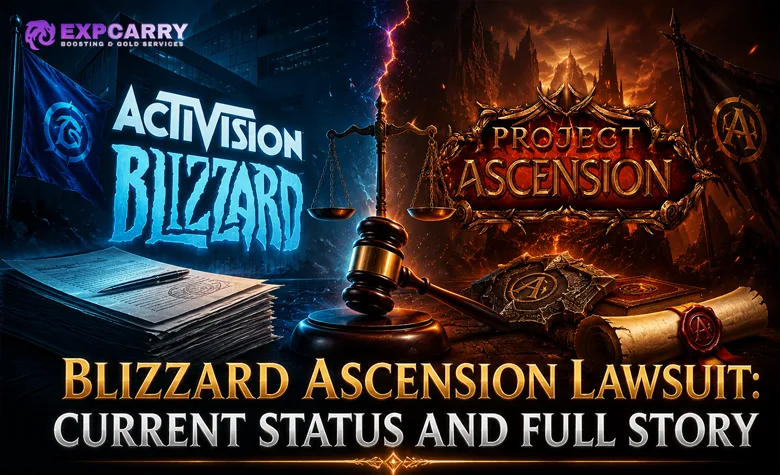
Blizzard Entertainment brought Project Ascension into federal court on June 12, 2026, after years in which the custom World of Warcraft project expanded far beyond a small community realm. The filing challenges the foundation of the service: an altered game package derived from WoW, separate login and realm infrastructure, paid Donation Point products, and a network of people and businesses that Blizzard says kept the project running. The Blizzard Ascension lawsuit remains open as of July 14, 2026. Ascension is still reachable, its public status page lists active realms, and no final judgment or announced settlement has ended the service. At the same time, the developers have not published a detailed legal rebuttal. Players therefore have two facts, not one: the server is operating today, but its long-term position is unresolved.
Blizzard Ascension Lawsuit Status at a Glance
The case is Blizzard Entertainment, Inc. v. Derek S. Powell et al., filed in the Central District of California under case number 8:26-cv-01506. Blizzard submitted a 51-page complaint and later sought summonses for the named defendants. A summons normally requires an answer or an allowed pretrial motion within 21 days after that defendant receives valid service. The deadline is personal to each served party and does not automatically run from the date shown on gaming news reports.
| Question players are asking | Position on July 14, 2026 |
|---|---|
| Has Blizzard won? | No final decision on liability has been published |
| Is Project Ascension offline? | No, its website continues to show live realms |
| Did Ascension file a public defense? | No detailed answer was located in the public materials reviewed |
| Can the court close the realms? | Blizzard is requesting relief that could stop the client, servers, promotion, and sales |
| When is the next major update? | The next important event will be service records, a defense filing, an injunction request, or a settlement notice |
The most reliable source for procedural movement is the public Ascension lawsuit docket. The Wowhead report on the summons stage reproduces the federal response language, but a requested or issued summons should not be confused with proof that every defendant has already received it.
The Product at the Center of the Project Ascension Lawsuit
Ascension is not marketed as an ordinary copy of a historical WoW patch. Its main classless realms let players combine abilities that Blizzard separates into fixed classes, while Conquest of Azeroth uses a different structure built around 21 custom classes. The project also offers seasonal progression, custom encounters, modified systems, a launcher, its own accounts, and shop purchases. These additions explain its popularity, but they do not remove the legal question surrounding the base technology and Warcraft material used to deliver them.
The Game Package and Independent Realm Network
Blizzard's complaint says users obtain a changed version of the WoW software and connect it to Ascension-controlled infrastructure rather than official Battle.net services. The legal focus is therefore not limited to class design. Blizzard points to game files, visual and audio content, maps, written material, client behavior, authentication, and the process that sends players from Ascension's site and launcher into its realms.
From Blizzard's perspective, the distribution chain creates several different issues. One concerns unauthorized reproduction and adaptation of protected works. Another concerns technology that allegedly avoids the normal checks required for licensed access. A third concerns the tools, instructions, patches, and technical assistance supplied to players. The court will need to decide which acts occurred, who controlled them, and whether the identified defendants can be linked to those acts with admissible evidence. The distinction between an original rule system and the files used to run it will be one of the most important factual questions in the case.
Donation Points and the Scale of the Operation
The official Ascension website describes Donor Points as optional currency used for cosmetics, boosts, and access bundles. Blizzard presents the shop differently, arguing that payments turned the project into a commercial service built on its property. The complaint also connects the realms to management companies, technical staff, customer support, marketing, and payment activity rather than describing Ascension as an informal server maintained by a few volunteers.
This financial layer could affect both liability and remedies. Records may show who controlled accounts, how purchases were processed, which entities received revenue, and what profit remained after operating costs. None of those questions is answered merely by the words "donation" or "free to play." The court has not yet accepted Blizzard's financial description as fact, but the shop gives the company a concrete basis for seeking revenue records and profits connected to the service. The same records may also show whether separate companies performed genuine services or only moved revenue between related parts of the project.
What Blizzard Is Claiming Against Ascension
The complaint contains nine counts, but they can be understood as four larger groups. Blizzard says its copyrighted material was used without permission, that access restrictions were bypassed, that Ascension caused or benefited from player activity, and that the operation was organized through a commercial enterprise. Grouping the claims this way avoids treating several related forms of copyright responsibility as completely separate stories.
| Part of Blizzard's case | Core question | Examples of claims included |
|---|---|---|
| Use of protected WoW material | Was Blizzard content copied, altered, displayed, or distributed without authorization? | Direct infringement and related secondary copyright theories |
| Access and client controls | Did Ascension technology avoid measures that protect official access to WoW? | DMCA circumvention |
| Players, agreements, and presentation | Did the service encourage prohibited use or create confusion about its relationship to Blizzard? | Interference with contract and false designation of origin |
| Organization and monetization | Did the named people and companies coordinate a revenue-generating operation around the alleged conduct? | Civil RICO participation and conspiracy |
The RICO counts make the filing sound more conclusive than the current procedural position. They are accusations that must meet specific legal requirements, not a court declaration that Ascension is a racketeering organization. Blizzard must still connect the alleged enterprise, activity, revenue, and individual defendants. The same caution applies to all nine counts: filing them starts the dispute, while proof and judicial decisions determine the outcome.
Blizzard also refers to statutory damage ranges. The complaint identifies a possible ceiling of $150,000 for a copyright found to have been willfully infringed and up to $2,500 for certain prohibited circumvention acts or services. These are legal maximums available under particular findings, not a total already owed by Project Ascension. Any final amount would depend on which claims survive, what the evidence shows, and which remedy Blizzard ultimately chooses to pursue.
Explore services related to this guide, selected from our World of Warcraft catalog.
View All World of Warcraft Services


What Blizzard Wants to Happen to Project Ascension
The practical threat to players comes from the nonfinancial relief. Blizzard is asking for orders capable of dismantling the service rather than collecting damages while allowing the realms to continue. The requested outcome reaches distribution, technical operation, marketing, payments, and future replacements that could reproduce the same service under another name.
| Relief requested by Blizzard | Possible result for Ascension |
|---|---|
| Court-ordered restrictions | The defendants could be barred from maintaining or promoting the disputed service |
| Realm closure | Current servers and substantially similar successors could be taken offline |
| Control of disputed files | Copies of the altered client and related material could be surrendered or destroyed |
| Review of finances | Payment processors, sales, company accounts, and project income could be examined |
| Monetary recovery | Blizzard could seek damages, attributable profits, legal expenses, or a combination |
Nothing in the available record shows that the court has granted all of these requests. A complaint lists the plaintiff's desired result. A temporary restraining order, preliminary injunction, settlement, default, or final judgment would be a separate event. This is why the server can remain available even though the requested remedies are severe.
Project Ascension Response to the Blizzard Lawsuit
The clearest public response from Ascension is continued operation, not a legal statement. The project still presents its classless realms, Conquest of Azeroth, account creation, downloads, and store access. Its website emphasizes work produced by its independent team and describes the 21-class realm as an in-house project. That explains how Ascension wants users to view its original development, but it does not answer Blizzard's claims about the underlying WoW-based package and realm technology.
No official page reviewed for this article contains a complete response to the complaint. Ascension has not publicly gone through the nine counts, stated which factual allegations it accepts or disputes, announced a settlement, or published a shutdown schedule. It is therefore inaccurate to claim that the developers have defeated Blizzard, ignored a binding order, or agreed to close. The absence of a public statement also does not prove that no lawyers are working privately.
A formal response could challenge the court's authority over particular people, dispute whether service was completed, argue that some legal counts are insufficient, deny control of specific companies or systems, or contest the requested damages. Ascension could also negotiate instead of litigating every issue. Until a defense document appears, the public website shows only that the project continues to operate, not the strategy it will use in court.
Is Project Ascension Shutting Down?
There is no confirmed Project Ascension shutdown date as of July 14. The current service page lists the login server and several realms as online, including Conquest of Azeroth and classless realms. That status answers whether players can connect now. It does not answer whether the service will survive the lawsuit.
Several legal routes could end the project. The parties could settle with closure terms, Blizzard could obtain an early injunction, the defendants could fail to respond after valid service, or the court could rule for Blizzard after litigation. Other routes could keep the case open for months through jurisdiction disputes, dismissal motions, evidence collection, expert analysis, and negotiations. An early-stage federal case does not produce a dependable shutdown date unless one side announces an agreement or the judge enters an enforceable order. Players should assume that characters, Donation Points, collections, and guild progress carry service risk. There is no Blizzard-supported migration from Ascension to retail or Classic WoW.
How the Ascension Case Differs From a Normal Mod Dispute
The public debate often reduces the case to a choice between Blizzard protecting its property and a creative community preserving a better version of WoW. The complaint is more complicated. Ascension combines custom design with a complete public service: account creation, downloadable software, realm hosting, customer support, regular content, payment products, and a large player base. That combination gives Blizzard more targets than it would have in a dispute over an offline fan mod.
Original classes and systems may matter when the parties separate Ascension-created work from Blizzard-owned material. They do not automatically authorize the use of the remaining client, art, audio, locations, characters, names, or network behavior. On the other side, Blizzard still needs evidence that connects each challenged act to the people and entities it sued. A brand comparison or screenshot can illustrate the complaint, but the full case may require files, records, account control, payment data, and technical testimony.
This distinction also explains why the health of retail WoW is not a legal defense. Players may prefer Ascension's systems, dislike subscriptions, or believe Blizzard should create its own classless realm. Those opinions can influence community reaction and business strategy, but the court will focus on ownership, authorization, conduct, control, and available remedies.
What Happens Next in the WoW Ascension Lawsuit
The next update that changes the legal picture should appear as a filing, not a social-media prediction. Proof of service establishes a deadline for a particular defendant. An answer identifies admitted and disputed points. A motion to dismiss attacks the legal sufficiency of one or more claims before a full evidence process. A request for preliminary relief would show that Blizzard wants restrictions before the final stage of the case.
- Look for service records tied to individual defendants.
- Check whether the first defense is an answer or a dismissal motion.
- Watch for a request aimed at stopping the realms during the lawsuit.
- Separate a negotiated settlement from a judgment after litigation.
- Confirm current server availability through Ascension, not through rumors.
Silence on the docket for a short period is not unusual. Service can require additional work, lawyers can request more time, and settlement discussions are often private. The article should be updated when Ascension files its first substantive defense, Blizzard seeks urgent restrictions, or either side announces an agreement affecting the realms.
Final Thoughts
The lawsuit places two different questions beside each other. Ascension has produced original game systems that attracted a large audience, but the service still depends on technology and material that Blizzard says it owns and controls. The court will not decide which version of WoW players enjoy more. It will decide whether the defendants are legally responsible for the specific acts Blizzard can prove.
The current answer is therefore limited. Blizzard has started a case that could close Project Ascension, but has not yet secured a public final victory. Ascension remains online, but continued access is not a legal defense or a guarantee of survival. The first detailed court response from the defendants will be the point where the situation moves from Blizzard's account of events to a genuine two-sided dispute.