



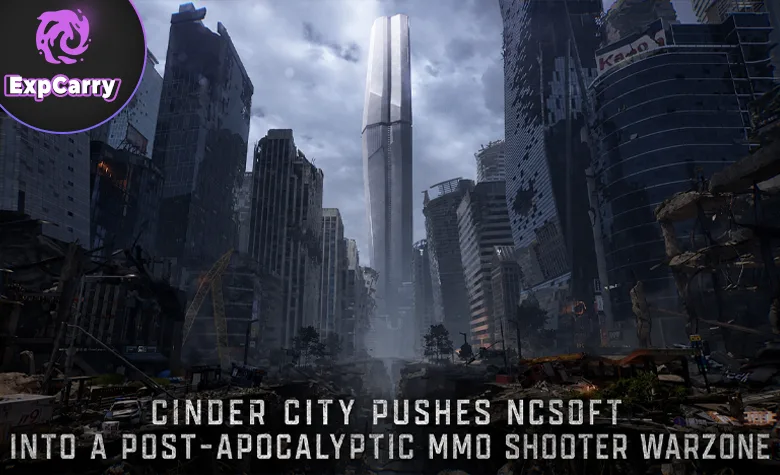
Cinder City is NCSOFT's new open-world MMO tactical shooter, and it is the final public name for the project previously known as Project LLL. The game is being developed in-house by BigFire Games, an NCSOFT studio, and is planned for release in the second half of 2026 on PC and consoles. That already makes it one of the company's more interesting upcoming projects, because Cinder City pushes NCSOFT further into shooter territory instead of leaning only on the MMORPG legacy that built its name.
The pitch is direct: Cinder City sends players into a post-apocalyptic version of Seoul shaped by future technology, ruined landmarks, tactical gunfights, monsters, giant mech battles, and squad-based play. NCSOFT is not presenting it as a small arena shooter or a simple extraction clone. The company is aiming for a larger open-world shooter structure with campaign elements, co-op, realistic firearm handling, and MMO-scale ambition. Naturally, because one genre label was apparently too peaceful.
The strongest hook is the setting. Cinder City uses real Korean locations as the foundation for its world, including Seoul areas such as Samseong-dong and Nonhyeon-dong. Preview coverage also points to Pangyo as a second major map, with NCSOFT's own office recreated inside the game. That gives the project a sharper identity than another anonymous sci-fi wasteland made of gray concrete, fog, and marketing confidence.
Cinder City Game Details NCSOFT Has Shown So Far
NCSOFT describes Cinder City as an MMO tactical shooter powered by Unreal Engine 5, built around a seamless open-world experience, high-fidelity visuals, realistic firearm operations, and a sci-fi alternate history where 23rd-century technology collides with a devastated 21st-century city. In plain language, the game wants to mix grounded urban combat with futuristic armor, monsters, mechs, and large multiplayer systems without turning into a disconnected pile of trailer moments.
The release window is currently set for the second half of 2026, but NCSOFT has not announced an exact release date. The game is planned for PC and consoles, though the final platform breakdown has not been detailed in the main official reveal. Cinder City has appeared through Gamescom 2025 coverage and NVIDIA-related showcases, with footage highlighting open-world firefights, giant mech encounters, close-corridor monster fights, helicopters, futuristic equipment, and ruined city environments.
| Category | Current detail | Why it matters |
|---|---|---|
| Game title | Cinder City, formerly Project LLL | The rebrand gives NCSOFT's long-running shooter project a clear public identity before launch. |
| Developer | BigFire Games, an internal NCSOFT studio | The project is being developed inside NCSOFT rather than simply licensed to an outside team. |
| Genre | Open-world MMO tactical shooter | The game blends shooter combat, co-op play, open-world exploration, and MMO-scale structure. |
| Engine | Unreal Engine 5 | NCSOFT is using modern technology for dense city environments, large combat spaces, and high-detail visuals. |
| Setting | Post-apocalyptic Seoul in a sci-fi alternate history | Real Korean geography gives the game a stronger identity than generic future ruins. |
| Release window | Second half of 2026 | The game is still in development, so systems, balance, platforms, and launch details can still change. |
| Platforms | PC and consoles | NCSOFT is aiming beyond a single-platform PC-only launch, but the exact console list still needs final confirmation. |
| Story hook | A search for the lead character's missing daughter | NCSOFT's Gamescom materials frame the shooter action around a personal narrative thread. |
Cinder City Turns Seoul Into a Tactical Shooter Map
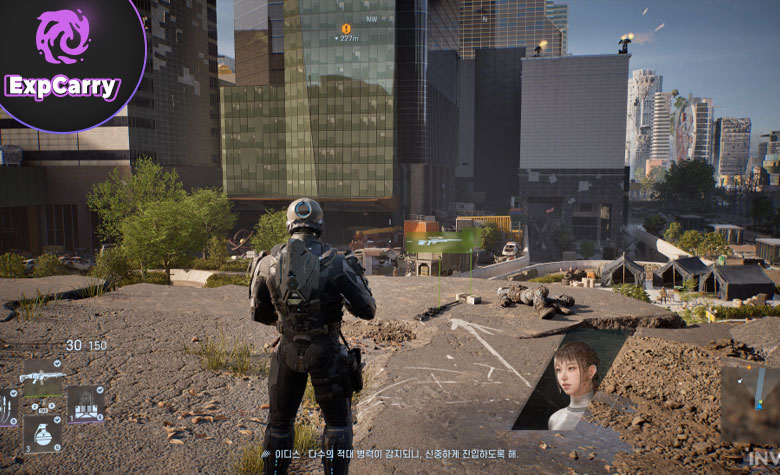
The most valuable part of Cinder City's pitch is its version of Seoul. NCSOFT is not only using the city as a stylish name on a loading screen. Official materials mention real-world Seoul locations, and preview coverage describes areas built closely around actual layouts, roads, buildings, and landmarks. That matters because urban shooters live or die through map identity. A ruined city has to feel like a place, not just a corridor system wearing debris.
Seoul gives Cinder City a dense, vertical, and recognizable foundation. Broken skyscrapers, wide roads, abandoned infrastructure, cramped interiors, ruined public spaces, and high-rise traversal can all create different combat rhythms. Long-range fights can happen across streets and collapsed city blocks. Close-range encounters can move inside buildings, where sightlines shrink and shotguns become a very direct form of communication.
This is where Cinder City can separate itself from genre competitors. The Division used New York and Washington, D.C. as recognizable urban spaces. Cinder City can work in a similar way with Seoul, but through Korean geography, infrastructure, and city texture. It does not need to pretend it invented the urban apocalypse shooter. It needs to make its city specific enough that players remember where they fought, not only what loot dropped.
Seoul and Pangyo Give Cinder City Two Different Map Identities
Current preview information points to two open-world maps at launch: Seoul and Pangyo. Seoul is described as the larger and more chaotic space, with dense urban terrain, destroyed buildings, roads between combat zones, and more vertical complexity. Pangyo sounds more structured and sector-based, which could give squads a cleaner battlefield after Seoul's more tangled urban layout.
Pangyo is also where the game gets one of its stranger details: NCSOFT's office recreated in the map and populated by hostile zombie workers with name tags. That is ridiculous, but useful. It suggests the developers are willing to give the world some personality instead of treating the apocalypse like a grayscale mood board. A post-apocalyptic shooter becomes exhausting fast if every corner is only rubble, smoke, and someone whispering about humanity's sins.
Helicopter traversal could also shape how players read the open world. Preview coverage says players can move between maps by helicopter and fly between buildings. That can support fast repositioning, dramatic entry points, and city-scale movement, but it also creates a design risk. If travel becomes too convenient, danger turns into scenery. Cinder City needs movement to feel powerful without making every dangerous route optional.
Cinder City Combat Mixes Realistic Firearms With Mechs and Monsters
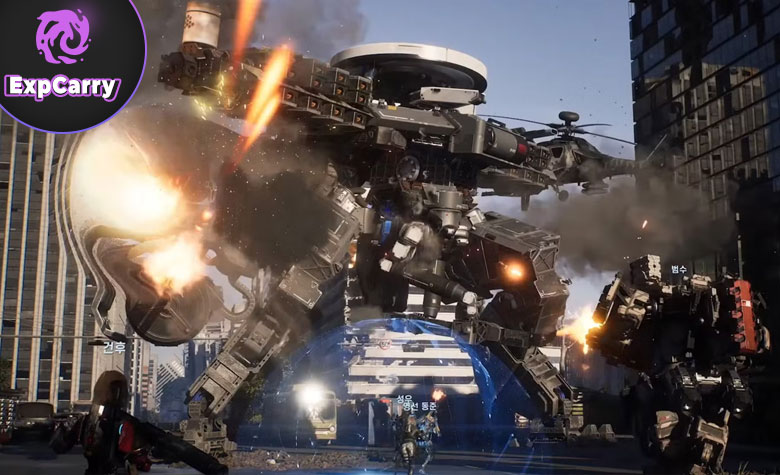
NCSOFT says Cinder City uses realistic combat mechanics designed to replicate firearm operations. That suggests the studio wants grounded gun handling to remain part of the experience, even though the world itself is full of futuristic armor, large-scale threats, and sci-fi technology. The trailers and Gamescom materials show soldiers in advanced gear, human enemies, monsters in tight corridors, open-world firefights, and giant mech battles.
Hands-on impressions describe a playable character named Seven, high-tech armor, multiple weapons, grenades, a knife, special abilities, and enemy groups called Knights. The previewed combat leaned heavily on human opponents, including enemies with shields, smoke grenades, and aggressive movement. That is important because Cinder City's combat cannot survive on spectacle alone. Mechs and monsters look good in trailers, but the minute-to-minute shooting needs clean feedback, readable recoil, useful cover, responsive movement, and enemy behavior that does more than wait to be deleted.
The monster fights may give Cinder City a useful break from pure human combat. Open-world shooters can become repetitive when every encounter is just another squad hiding behind another wrecked vehicle. Monsters can change pressure, pacing, and distance. Close-corridor creature fights can force panic and movement, while mech battles can create large set pieces for squads. The risk is tonal overload: military realism, futuristic knights, zombies, monsters, and mechs all need a consistent combat logic, or the game may feel like several prototypes arguing in the same engine.
Cinder City Story Gives the MMO Shooter a Personal Thread
One of the stronger story details from NCSOFT's Gamescom materials is the search for the lead character's missing daughter. Players are described as making brutal choices while pushing through post-apocalyptic Seoul either solo or with a squad. That gives Cinder City a personal hook inside its larger online shooter frame, which is useful because MMO shooters often struggle to make players care about anything beyond gear score, enemy health bars, and the next weekly reset.
A personal story can anchor the scale of the setting. Seoul gives Cinder City a large physical space, but the missing daughter plot gives it emotional direction. The danger is that the story becomes background noise once the open-world and multiplayer systems take over. Many online shooters promise narrative weight, then quietly become daily-task dispensers with cutscenes attached like decorative receipts.
The first hours will matter. Preview coverage describes a single-player campaign section that also functions as a tutorial before the wider map opens up. That structure makes sense. It can introduce movement, shooting, enemy types, exploration, and world logic before throwing players into the broader MMO shooter layer. Cinder City has to explain its identity quickly: not just another looter shooter, not just another zombie city, and not just another futuristic soldier game with expensive lighting.
Cinder City Still Has Major Questions Before 2026
Cinder City has enough shown material to be interesting, but several important details are still missing. NCSOFT has not given an exact release date. The final console list has not been locked in through the main official announcement. The business model has not been clearly explained. It is also still unclear how deep the MMO layer goes, how progression works, how endgame activities are structured, and how much of the experience is built around PvE, PvP, or possible PvPvE systems.
The same applies to long-term support. MMO shooters need more than a strong first trailer. They need stable servers, readable co-op roles, enemy variety, mission depth, performance optimization, rewarding progression, and enough post-launch content to keep the world from turning into a pretty museum full of repeatable chores. Cinder City can have ruined Seoul, helicopters, mechs, monsters, and a personal story, but all of that means little if the actual loop collapses after the first dozen hours.
This is the correct place to be cautious. The footage and hands-on reports make Cinder City look ambitious, but ambition is not a feature. It is a bill the final game has to pay. Until NCSOFT explains progression, multiplayer structure, monetization, beta plans, platform details, and endgame design, Cinder City should be treated as promising rather than proven.
Cinder City Enters a Crowded MMO Shooter Market
Cinder City is entering a difficult space. Online shooters already cover looter shooters, extraction shooters, survival shooters, co-op shooters, tactical shooters, and live-service action games. Players have seen too many expensive projects arrive with beautiful trailers, vague genre labels, and a content plan held together by hope and quarterly targets. NCSOFT cannot rely only on Unreal Engine 5 visuals or the novelty of post-apocalyptic Seoul.
The game does have strong hooks: a Korean urban setting, BigFire Games' internal backing, real-world map inspiration, solo and squad play, giant mech battles, monster encounters, helicopter traversal, and a personal narrative about a missing daughter. Those pieces are enough to get attention. The harder part is retention. MMO shooters are judged by feel, not press release vocabulary. Shooting, movement, mission flow, enemy behavior, build depth, co-op rhythm, and technical stability will decide whether Cinder City becomes a serious new branch for NCSOFT or another expensive lesson in genre gravity.
The city itself has to be the main system. Rooftops, interiors, roads, office districts, ruined landmarks, traversal routes, and vertical combat need to shape actual decisions. If Seoul becomes only a backdrop, Cinder City loses its biggest advantage. Backdrops do not keep online shooters alive. Good spaces do.
Conclusion
Cinder City is NCSOFT's clearest push into the MMO tactical shooter space. It is the official evolution of Project LLL, developed by BigFire Games on Unreal Engine 5, set in post-apocalyptic Seoul, and planned for the second half of 2026 on PC and consoles. The game combines open-world shooting, solo and squad play, realistic firearm mechanics, future technology, giant mech battles, monster encounters, and a personal story about searching for the protagonist's missing daughter.
The strongest part of Cinder City is its setting. Seoul and Pangyo give the game a sharper identity than another generic sci-fi battlefield, especially if NCSOFT uses real geography, landmarks, interiors, roads, office districts, and vertical city design to shape combat. The hands-on details about Seoul's chaotic layout, Pangyo's more structured design, helicopter movement, and hostile office zombies suggest the world may have more personality than the average live-service ruin pile.
The risk is just as clear. Cinder City needs excellent gunplay, stable online systems, meaningful co-op, strong mission design, varied enemies, satisfying progression, and a city that stays interesting after the trailer glow fades. If BigFire Games turns Seoul into a real tactical playground, Cinder City could give NCSOFT a serious shooter identity beyond its MMORPG comfort zone. If it only becomes a shiny mix of familiar ideas, it will be another reminder that the apocalypse is easy to render and hard to make worth revisiting.