
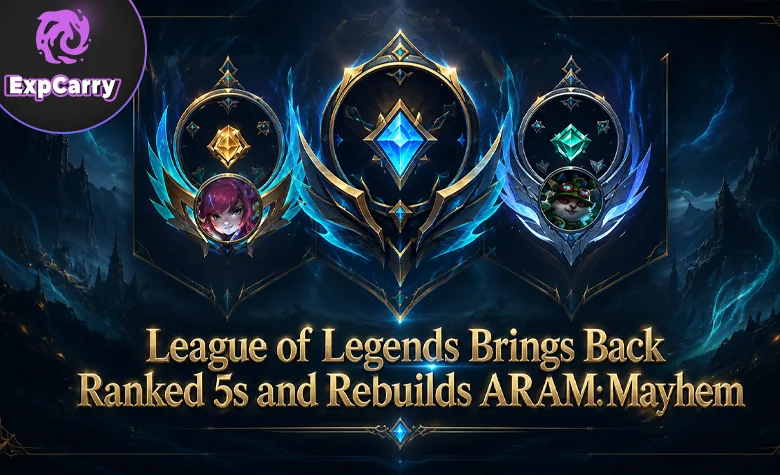
League of Legends is bringing back Ranked 5s and rebuilding ARAM: Mayhem in the same dev cycle, which makes Riot's latest update more important than a normal patch preview. One change targets the game's competitive social core. The other targets its chaos-driven casual side. Together, they show Riot trying to solve two very different problems: giving full premade teams a real ranked space again and keeping ARAM: Mayhem fresh before its Augment system turns into another solved spreadsheet for players who mistake efficiency for joy.
Riot announced the changes in the May 27, 2026 Dev Update and followed with separate dev blogs for Ranked 5s and ARAM: Mayhem. Ranked 5s is returning as an experimental Summoner's Rift queue for full five-player premades, but not as a simple revival of the old version. This new format removes fixed teams, lets friends queue together across rank gaps, limits availability to scheduled weekend windows, and uses Tournament Draft instead of the standard ranked draft format.
ARAM: Mayhem is moving in the opposite direction: less structure from Traits, more direct chaos from Augments. In Patch 26.12, Riot is phasing out the Trait system because it made too many games feel similar, pushed players toward universal effects instead of champion identity, and left some individual Augment picks feeling weak. The replacement direction is built around stronger standalone Augments, new Ability Augments, and more Quest Augments that create clearer build identities without forcing every player into the same pattern.
League of Legends Ranked 5s Returns as a Limited Experiment
Ranked 5s is not coming back as nostalgia bait with a ladder stapled to it. Riot is framing the mode as an experiment built around full-team League, where five players queue together and try to play something closer to coordinated competition. That matters because Solo/Duo and Flex have never fully replaced the old team-ranked fantasy. Solo/Duo is personal climbing with four strangers and occasional psychological hazards. Flex allows groups, but it has never carried the same identity as a dedicated five-stack ranked environment.
The old Ranked 5s had a fatal problem: matchmaking and queue health. Riot says the previous version struggled to consistently match teams of similar skill, which caused very long queue times. That is the boring technical answer, which is usually the real answer. A ranked queue can sound perfect on paper, but if there are not enough comparable teams searching at the same time, players either wait forever or get terrible matches. Both outcomes are just different flavors of losing before champ select.
The new version tries to fix that by treating Ranked 5s like a focused event window instead of a permanently open queue. Riot wants interested teams to show up at the same time, which should improve the match pool and reduce queue problems. That is why the mode is limited to scheduled weekend slots and will run for a few weeks as a test. It is not as convenient as an always-on queue, but it gives the experiment a better chance to produce actual matches instead of a museum exhibit called "Estimated Wait Time."
Ranked 5s Queue Rules Rewrite the Old Team Formula
The biggest change is that Ranked 5s no longer requires a fixed team roster. Players will be able to queue with any group of friends, as long as they bring a full five-stack. That is a smart adjustment because the old fixed-team model was brittle. Real people have jobs, school, time zones, broken sleep schedules, and the mysterious ability to vanish exactly when the group needs a jungler. Removing set teams makes the queue much easier to use.
Riot is also allowing players to queue with friends regardless of rank. That part will make competitive purists twitch, and not without reason. Large rank gaps can create ugly match quality if the system fails. Riot says it has built mechanisms to balance major skill differences within teams, and it also points to improved smurfing and boosting detection since the last Ranked 5s era. That is the correct problem to name, because any five-stack ranked queue immediately becomes a magnet for boosting attempts if left unattended.
The draft format also changes the tone. Ranked 5s will use Tournament Draft with 3 bans, 3 picks, 2 bans, and 2 picks. That is a stronger fit for coordinated play than standard Ranked draft because it gives teams more room to plan, protect counterpicks, react to enemy priorities, and build strategy through champion select. It also means players who queue into Ranked 5s with five random comfort picks and no plan are going to discover, with scientific precision, that friendship does not automatically produce macro.
| Feature | New Ranked 5s version | Why it matters |
|---|---|---|
| Queue type | Summoner's Rift ranked queue for full five-player premades | It gives coordinated groups a clearer competitive space than normal ranked queues. |
| Team structure | No fixed teams required | Players can queue with whichever friends are available instead of being locked into rosters. |
| Rank limits | Friends can queue together regardless of rank | The mode prioritizes playing with friends, while Riot tries to protect match quality through matchmaking systems. |
| Availability | Scheduled weekend windows by region | Limited slots should concentrate players and improve matchmaking health. |
| Draft format | Tournament Draft with 3 bans, 3 picks, 2 bans, 2 picks | Champion select becomes more strategic and better suited to coordinated team play. |
| Rewards | Icon for everyone, unique banner for players who hit Gold or above | The rewards give players a reason to test the queue without turning them into the only reason to play. |
Ranked 5s Weekend Windows Decide the Matchmaking Test
The weekend schedule is not a small detail. It is the design pressure point of the entire experiment. Riot plans to run Ranked 5s during fixed regional windows, with most listed slots set from 9:00 PM to 1:00 AM in each region's specified time zone. North America, EU West, EUNE, Latin America North, Latin America South, Brazil, Oceania, Southeast Asia, the Middle East, Korea, Japan, Taiwan, Vietnam, and Turkey are all listed with their own scheduled windows.
This approach is less convenient than a permanent queue, but it directly attacks the problem that killed the older version: too few comparable teams at the same time. If Riot can concentrate enough five-stacks into a narrow window, matchmaking has a better chance to create fair games. If players ignore the windows, the mode will quickly prove that nostalgia is not the same as population. Video game communities are very good at demanding features they then do not use. A proud tradition, really.
The limited schedule also changes how teams prepare. Ranked 5s becomes more like a weekly competitive session than a background queue. Players may organize around it, build small champion pools, prepare drafts, assign roles properly, and treat the mode like a low-pressure tournament night. That is where the mode could find its identity. It does not need to replace Solo/Duo or Flex. It needs to create a space where coordinated League feels worth scheduling.
Explore services related to this guide, selected from our League of Legends catalog.
View All League of Legends Services


ARAM: Mayhem Drops Traits Before They Flatten the Mode
ARAM: Mayhem is also getting a major adjustment, and the headline is simple: Traits are being phased out in Patch 26.12. Riot says the Trait system succeeded in some ways, but it also created several design problems. Different Augment choices could lead to the same gameplay fantasy, games started to feel too similar, Trait effects often became more important than the champion, and individual Augments could feel underwhelming because too much power was locked behind Trait bonuses.
That is a strong diagnosis. ARAM: Mayhem works best when it turns a champion into a ridiculous, unstable version of itself. The mode becomes weaker when everyone starts chasing the same universal effect package, because the champion matters less and the build pattern matters more. If the same Trait fantasy appears too often across matches, Mayhem stops feeling like Mayhem and starts feeling like a rotating checklist. Riot is trying to stop that before the mode calcifies into a tier list with particle effects.
Popular Trait ideas are not all disappearing, though. Riot says some of them are being reintroduced as standalone Augments. Stackasaurus is the clearest example: instead of needing a second matching Augment to complete the Trait bonus, it becomes an Augment that immediately unlocks stack-scaling potential. That is a cleaner structure because it preserves a popular fantasy while reducing the frustration of incomplete Trait setups.
ARAM: Mayhem Patch 26.12 Builds Around Stronger Augments
The Mayhem update in Patch 26.12 is built around making Augments feel more meaningful by themselves. Riot wants Augments to enhance champion identity instead of pushing every champion toward the same universal build fantasy. That means the mode is shifting away from broad Trait packages and toward effects that make individual champions feel more extreme, more specialized, or more absurd in ways tied to their kit.
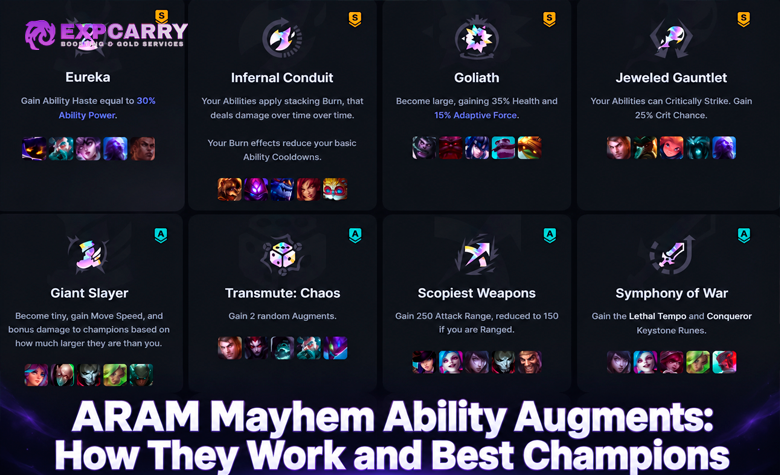
The new Ability Augments are the clearest sign of that direction. Riot describes them as Augments that significantly enhance a single ability and can create gameplay experiences that feel different from the original champion. Multishot is one example: on ability cast, it fires additional spell bolts at up to two enemies in front of the player. Riot gives Lux Q as the example, where Light Binding could snare the entire enemy team. Chain Reaction is another example, built around knockups colliding with enemy champions or terrain for extra crowd control and damage.
Quest Augments are also expanding. Riot mentions Quest: Tooth Fairy, which rewards players for dealing a chunk of damage in a short window by causing enemies to drop teeth that grant Lethality and Magic Pen. Quest: Support Main rewards healing or shielding allies, then gives teammates additional Health Regen based on the value of those heals or shields. These are exactly the kind of effects Mayhem needs: clear goals, weird rewards, and enough silliness to remind everyone that ARAM was never supposed to become a courtroom about optimal play.
Ability Augments Push Champion Identity Harder
Ability Augments matter because they target the part of Mayhem that should be most interesting: changing how a champion's kit feels. A generic damage effect can be fun for a few games, but it does not always make the champion feel different. A single-ability modifier can. Lux throwing a wider snare pattern or knockup champions creating chain collisions changes how players think about positioning, timing, and teamfight angles.
This also gives Riot more design space. Instead of making Augments that must be equally exciting on every champion, the team can create effects that become special when attached to certain ability patterns. That is risky for balance, but Riot is not pretending Mayhem should be perfectly sterile. The goal is not tournament fairness. The goal is controlled nonsense that still feels fair enough to keep playing. Finally, a balance philosophy honest enough to admit chaos is the product.
Quest Augments Give Mayhem Builds a Clearer Spine
Quest Augments matter because they give a match a direction. ARAM: Mayhem can become noise if players only pick random power spikes without a goal. Quests give players something to build around: deal burst damage, heal allies, shield teammates, scale through a task, or chase a weird payoff. That structure helps each match feel different without needing the old Trait system to tell players which bucket their build belongs in.
The danger is that Quest Augments can become too mandatory if the rewards are overtuned. Riot says its balance goal is to keep Mayhem fun and fresh while still fair at a high level. That means strong builds should exist, but no champion should always hit one, and a strong build should not instantly decide the game. That philosophy is sensible for a mode where absurd outcomes are the appeal. The real test is whether Riot can tune the worst outliers without sanding away the fun.
Ranked 5s and ARAM: Mayhem Pull League in Opposite Directions
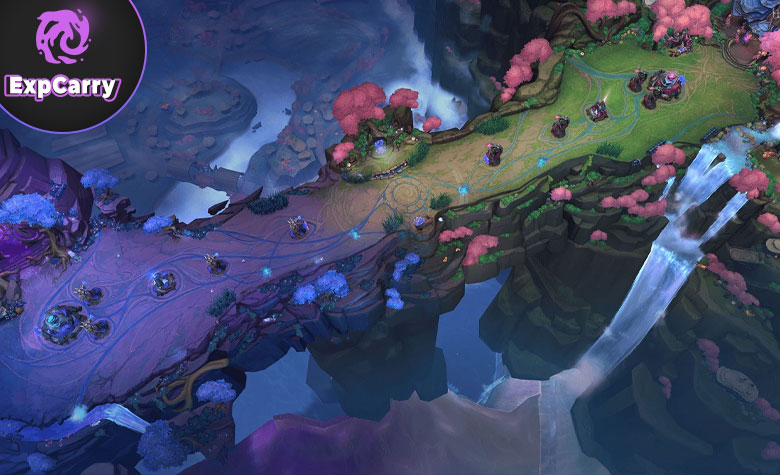
The interesting part is that these two updates serve opposite audiences without contradicting each other. Ranked 5s pushes League toward organized, strategic, team-based competition. ARAM: Mayhem pushes it toward louder, stranger, more experimental build chaos. One asks players to coordinate bans, drafts, roles, and macro. The other asks players whether they would enjoy turning a normal ability into a small war crime in a single-lane clown blender.
That split is healthy for League. The game is too old and too broad to survive by treating every player like the same ranked grinder. Some players want serious five-stack competition. Some want chaotic ARAM nights. Some want both, depending on whether their friends are online and emotionally stable enough for voice chat. Riot's update recognizes that League needs different types of engagement instead of pretending Summoner's Rift ranked is the only thing that matters.
The risk is execution. Ranked 5s can fail if queue windows feel too narrow, matchmaking cannot handle rank gaps, or boosting becomes too visible. ARAM: Mayhem can stumble if the new Augments create repetitive outliers or if removing Traits makes the mode feel less directed. Both systems are experiments, and Riot is openly treating them that way. That is better than pretending the first version will be sacred law, though players will still behave as if every test change was personally carved into their driveway.
Patch 26.12 Gives ARAM: Mayhem a Clearer Season 2 Act 2 Hook
Patch 26.12 is the main date for ARAM: Mayhem's next step. Riot's patch schedule lists 26.12 for June 10, 2026, and the Mayhem dev blog says the mode's next major changes arrive with Season 2 Act 2 in that patch. That gives the update a clearer identity than a normal balance pass. It is not only numbers and skins. It is a structural shift for one of League's rotating game modes.
Ranked 5s does not have the same simple patch-date framing in the dev blog, because Riot describes it as an experiment that will run for a few weeks during windowed slots. That wording matters. Players should not treat the queue as a permanent fixture yet. Riot wants feedback and expects the mode to evolve over time. The smart reading is that Ranked 5s is returning as a test with enough changes to answer a real question: can modern League support a dedicated five-stack ranked environment without repeating the old queue's failures?
If the answer is yes, Riot gets a valuable competitive format for friends, amateur groups, and players who miss coordinated ranked League. If the answer is no, the experiment still gives Riot data about what players say they want versus what they actually play. That gap is where many multiplayer features go to die, usually while players insist they would have used them next weekend.
Conclusion
League of Legends bringing back Ranked 5s and reshaping ARAM: Mayhem is a meaningful update because it touches two different versions of why people still play League. Ranked 5s is about coordinated competition, team identity, draft strategy, and the old dream of playing serious Summoner's Rift with four friends instead of four strangers who communicate exclusively through danger pings and regret. ARAM: Mayhem is about keeping casual chaos fresh by moving away from Traits and leaning harder into stronger, champion-focused Augments.
The Ranked 5s experiment is smart because Riot is not simply restoring the old mode and hoping nostalgia solves population problems. No fixed rosters, broader friend eligibility, scheduled weekend windows, Tournament Draft, improved matchmaking tools, and anti-smurfing detection all point toward a more realistic version of the queue. It may still fail if not enough teams show up or if match quality collapses under rank gaps, but at least Riot is attacking the actual problems instead of pretending the old system only needed a fresh coat of paint.
ARAM: Mayhem's redesign is just as important on the casual side. Removing Traits sounds like a loss at first, but Riot's reasoning is clear: Traits were starting to flatten builds, reduce game variety, and overpower champion identity. Stronger standalone Augments, Ability Augments, and Quest Augments are a better direction if Riot can keep them powerful, strange, and fair enough to avoid becoming predictable. Patch 26.12 now has a real reason to matter, because it tests whether League can support both sharper team competition and better controlled chaos in the same season.