
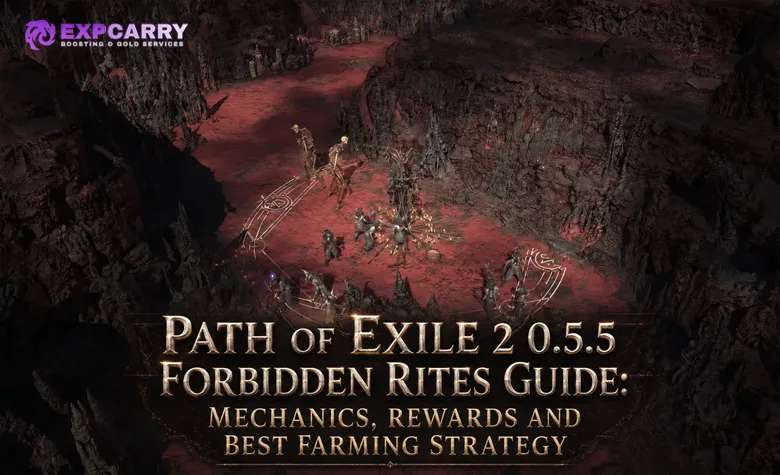
Forbidden Rites is the official name of the Path of Exile 2 event league launching with patch 0.5.5 on September 4, 2026. It places Ritual encounters in every campaign area, introduces linked boss Rituals with unique rewards, starts a fresh economy, and adds a new endgame farming layer built around Sacred Bloom and the returning Wildwood.
The best progression strategy is to use campaign Rituals for immediate gear and crafting help without turning every zone into a full clear, prioritize the marked boss clusters, enter the Atlas with a stable build, and save Sacred Bloom for maps your character can already complete safely. Forbidden Rites is not live yet, so this guide uses the systems shown by Grinding Gear Games and does not invent drop rates, profit per hour, or a final best Wisp combination before players can test the release build. GGG has also said that the balance changes originally planned for 0.5.5 have been moved to version 1.0.
PoE 2 Forbidden Rites Release Date and Quick Answer
Forbidden Rites starts on September 4 at 1:00 p.m. PDT alongside Path of Exile 2 patch 0.5.5. That converts to 4:00 p.m. EDT, 8:00 p.m. UTC, 9:00 p.m. BST, and 10:00 p.m. CEST. The official 0.5.5 event announcement confirms the start time, eight new challenges, exclusive rewards, and the Trial of Chaos overhaul.
| Event detail | Confirmed rule | Practical meaning |
|---|---|---|
| Official name | Forbidden Rites | Select the Forbidden Rites league when creating the new character. |
| Start | September 4, 2026, at 1:00 p.m. PDT | The economy and event progression begin from zero at launch. |
| Campaign mechanic | Ritual in every campaign area | Tribute and reward decisions become part of leveling rather than an endgame-only concern. |
| Endgame mechanic | Sacred Bloom and the Wildwood | Wisps empower map monsters and improve their rewards at higher risk. |
| Challenge track | Eight challenges | Four cosmetic rewards and an upgrading Hideout Statue are available. |
| Existing league | Runes of Aldur continues separately | Existing characters can remain there, but they do not enter the fresh Forbidden Rites economy. |
GGG's August 27 announcement confirms the September 4 start and that the existing Runes of Aldur league will continue separately, but it does not publish a closing date for Forbidden Rites. Path of Exile 2 version 1.0 is scheduled for December 11, 2026; players should not treat that date as the confirmed event endpoint unless GGG publishes a dedicated closure schedule.
The Path of Exile 2 guides hub covers the campaign, builds, Atlas systems, bosses, crafting, and permanent progression that sit around this event-specific loop.
How to Join Forbidden Rites and What the Fresh Economy Changes
Forbidden Rites is a separate event league, not a conversion of an existing Runes of Aldur character. To participate, create a new character in the Forbidden Rites league after the event opens. Existing characters, equipment, currency, Atlas progress, and league stash remain in their current league and do not provide a head start in the new economy.
A fresh economy changes early priorities. Common crafting currency, resistance gear, movement speed, useful skill gems, and reliable leveling bases matter more than theoretical endgame value during the first hours. Trade listings will be thin and unstable, so a starter that functions with campaign drops is safer than a build requiring one exact Unique or expensive modifier combination.
Prepare the build, loot filter, passive route, and first support gems before launch, but still verify the final patch 0.5.5 notes when GGG publishes them. GGG explicitly said that the balance changes originally planned for 0.5.5 have been moved to version 1.0. The final notes may still contain bug fixes, system changes, or implementation details, but players should not expect a 0.5.5 balance pass. The PoE 2 league start checklist provides a broader preparation route without duplicating the Forbidden Rites mechanic covered here.
How Forbidden Rites Rituals Work in the Campaign
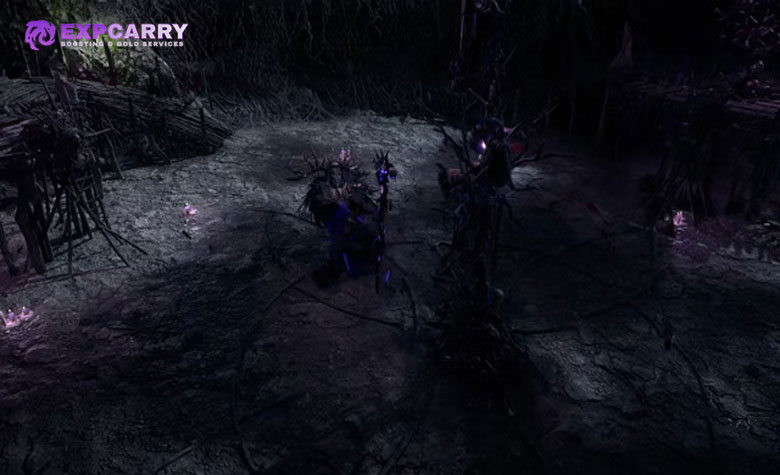
Every campaign area contains a Ritual encounter. The core loop is to defeat enemies guarding an effigy, activate the effigy, fight the resurrected enemies inside the Ritual area, earn Tribute, and spend that Tribute on a reward. Dangerous plagues affect the Ritual site, so the fight is more than a second clear of the same pack.
The normal campaign Ritual loop
Campaign Rituals are designed to support leveling with equipment and crafting resources, while the special boss-cluster Rituals are the campaign encounters that add Unique reward options. Ordinary Rituals should be treated as upgrade checks, not as a reason to clear every corner of every zone. If the effigy is near the route, complete it and inspect the reward panel. If reaching it requires a long detour and the build is already ahead of the area, continuing toward the quest objective may produce better experience and progression per minute.
- Clear the monsters immediately around the effigy before activating it.
- Check that flasks, charges, and defensive skills are ready for the resurrected wave.
- Stay inside the encounter area and prioritize dangerous Rare or named enemies.
- Keep killing the resurrected enemies to generate Tribute rather than abandoning the encounter when the first dangerous plague appears.
- Open the reward panel and buy an upgrade that removes a current bottleneck.
- Return to the main quest route instead of repeatedly searching an exhausted area.
This creates a controlled leveling rhythm: quest progress remains the main route, while nearby Rituals repair damage, defenses, sockets, or currency supply. Players who want to reach a specific level without repeating the entire leveling grind can compare that route with a PoE 2 leveling service, but event selection and the desired league must be confirmed before any character progression begins.
Boss Ritual clusters are the campaign priority
The official showcase introduced marked clusters of unique Ritual Effigies on the World Map. These appear twice per Act and once in each Interlude, attach the Ritual to an area boss, and carry earlier bosses forward through the cluster. The later encounters can therefore become multi-boss fights rather than ordinary pack revivals.
These clusters deserve higher priority than a random detour because completing the special boss Rituals lets players spend Tribute on Unique rewards, and because campaign Ritual completion forms part of the event challenge track. Do not enter the final link with an underleveled weapon, missing resistances, or an untested single-target setup. A fast clearing build can still fail when several boss mechanics overlap inside a restricted Ritual arena.
Explore services related to this guide, selected from our Path of Exile 2 catalog.
View All Path of Exile 2 Services


Tribute Rewards and the Best Spending Priorities
Tribute is local encounter currency used to select rewards after a Ritual. It is not a resource to hoard across the entire campaign, and the official preview has not published a universal price list for Forbidden Rites. Judge each panel against the character's current weakness and the likely lifetime of the item.
Solo and party Tribute rules
Party members now earn Tribute individually and can spend it on their own reward choices. The group no longer needs to decide which single player receives the value from a shared Tribute pool. This makes coordinated leveling more attractive because every member can use the same completed encounter to solve a different gearing problem.
GGG also showed an important party-play restriction: party members have fewer Favour choices and cannot reroll their Ritual offerings, preventing group play from multiplying the reward pool too aggressively. Each player should inspect their own options quickly. The useful party habit is to pause once after the fight, announce only build-defining finds, and then resume the route together.
What to buy while leveling
The strongest campaign purchase is the upgrade that immediately prevents lost time. Damage matters when normal packs require several skill rotations, while defenses matter when bosses or Ritual plagues force repeated deaths. Currency is valuable when it can repair a usable base, but saving every Orb while wearing weak equipment defeats the purpose of a fresh league.
- Weapon or main damage upgrade: Prioritize it when clear speed and boss damage have fallen behind the area level.
- Resistance and Life: Buy these before a dangerous boss cluster or when one damage type repeatedly causes deaths.
- Movement speed: A meaningful boot upgrade saves time across every remaining campaign zone.
- Useful sockets and modifiers: Value equipment that enables the planned skill setup, not merely a higher item rarity.
- Common crafting currency: Take it when no direct item is better and there is already a suitable base to improve.
- Speculative items: Avoid tying up early resources in slow-selling gear before the event market establishes real prices.
For a deeper explanation of Favours, Tribute, Omens, and the connected endgame boss path, use the current PoE 2 Ritual guide. Forbidden Rites changes where the mechanic appears and how it supports the campaign, but normal reward discipline still matters.
Forbidden Rites Challenges and Cosmetic Rewards
The event contains eight challenges. GGG has named completing campaign Rituals, defeating named Rare monsters, and reaching level 90 as example objectives. The official preview screen also showed the reward track below, but the complete challenge descriptions and final counters should be checked in the live client because the written patch notes are still pending.
| Challenges completed | Reward shown in the official preview | Progression advice |
|---|---|---|
| 1 | Forbidden Rites Challenger Trophy stage | Complete the first natural objective rather than stopping the campaign to force it. |
| 2 | Locust Footprints Effect | Early target for players who only want the first wearable cosmetic. |
| 3 | Forbidden Rites Challenger Trophy stage | Continue combining campaign and character progression objectives. |
| 4 | Locust Swarm Finisher Effect | A practical midpoint target before the longer endgame objectives. |
| 5 | Forbidden Rites Challenger Trophy stage | Review the remaining requirements and group compatible farms together. |
| 6 | Wildwood Guardian Pet | Requires broader progression than the early cosmetic tiers. |
| 7 | Forbidden Rites Challenger Trophy stage | Finish the hardest content-specific objective before the level grind if possible. |
| 8 | Wildwood Affliction Level-up Effect | Full-completion target that includes the longest remaining challenge. |
The official Forbidden Rites and Duelist showcase displays the challenge panel and reward progression. Reaching level 90 is likely to be one of the longest deterministic goals, so players seeking all eight rewards should choose a durable character and avoid unnecessary deaths once the experience penalty becomes important.
Sacred Bloom and the Wildwood Endgame Mechanic
Ritual continues in the endgame, where Sacred Bloom can appear as a Tribute purchase after Ritual encounters. Applying a Sacred Bloom adds a Wildwood entrance to an endgame map. Inside the Wildwood, the player has limited time to follow trails and collect Wisps before returning to the map, where those Wisps empower monsters and improve rewards.
What We Know About Primal, Vivid, Wild, and Sacred Wisps
GGG confirmed three standard Wisp types and teased a much rarer fourth type. Each changes the map differently, so the best choice depends on the character's strengths and the reward target rather than one universal color priority.
- Primal Wisps: Can transform Normal monsters into Magic monsters, increasing the number of stronger enemies the build must clear.
- Vivid Wisps: Can add modifiers to Rare monsters, creating the most obvious risk for builds that struggle with stacked Rare abilities.
- Wild Wisps: Increase the rarity of items dropped by monsters, making them attractive when the base map already contains enough enemies worth empowering.
- Sacred Wisp: Officially teased as a fourth type, but its exact effect and appearance rate have not been published.
The detailed Forbidden Rites feature overview is the current official source for Sacred Bloom and Wisp behavior. It confirms that empowered monsters become considerably more dangerous, so the reward increase should never be evaluated without the cost of deaths, failed maps, and lost Waystones.
When to use Sacred Bloom
Do not spend the first Sacred Bloom on the hardest map the character owns. The safest learning run is a map whose boss, layout, and modifiers are already comfortable without Wildwood empowerment. This isolates the new mechanic and shows whether the build can handle empowered Magic and Rare monsters without adding several unknown risks at once.
After two or three successful tests, add one investment layer at a time. A stronger Waystone, useful Tablet, or another mechanic can improve the reward ceiling, and GGG also showed that Ritual Tablets can increase the quantity of Wisps found in the Wildwood. Combining all of these layers immediately makes it harder to identify which modifier caused a failure. Trade players should compare the market value of Sacred Bloom with the expected value of running it, while SSF players should favor maps that can drop several resources the character already needs.
Players with a defined high-value gear project can also compare the cost of self-farming with a PoE 2 Divine Orb option. Confirm Forbidden Rites availability and current event pricing first, because currency held in another league cannot fund the fresh economy.
Best Forbidden Rites Farming Strategy
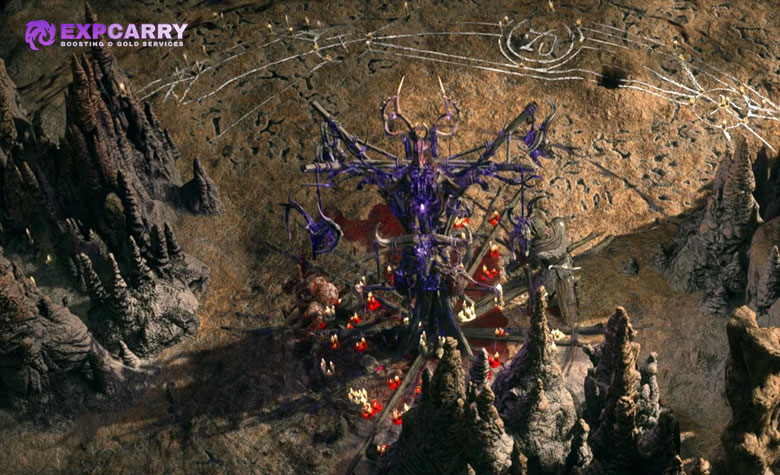
The best pre-launch strategy is a staged route rather than one claimed currency farm. Campaign Rituals provide progression value, boss clusters provide focused unique opportunities, and Wildwood becomes the scalable endgame layer. Exact profitability cannot be ranked until the live drop tables, Sacred Bloom supply, player economy, and average map completion times are known.
Campaign farming strategy
During leveling, complete Rituals that sit near the main route and every marked boss cluster the build can handle. Spend Tribute on immediate power, then keep moving. Repeating ordinary campaign zones for speculative Tribute value is unlikely to beat reaching higher-level areas, unlocking permanent bonuses, and entering the Atlas unless a specific live challenge explicitly requires the repetition.
The exception is a measurable build failure. If the character cannot safely finish the next boss cluster, farming one efficient nearby area for experience and a few additional reward panels is better than repeatedly dying. Set a concrete exit condition such as one level, capped resistance, or a weapon upgrade rather than farming without a stopping rule.
Endgame farming strategy
At endgame, separate acquisition from investment. First run ordinary Ritual maps to build supplies, stabilize Waystones, and obtain Sacred Bloom. Then use Blooms on maps the build clears reliably. Track the Bloom cost, Waystone and Tablet investment, clear time, deaths, and sale value of rewards instead of judging the strategy from one exceptional drop.
| Progression stage | Recommended farm | Primary goal | Main risk |
|---|---|---|---|
| Campaign | Nearby Rituals and all viable boss clusters | Leveling gear, crafting resources, and challenge progress | Losing time to long detours or multi-boss deaths |
| Early Atlas | Comfortable Ritual maps without heavy investment | Waystone sustain, first Atlas upgrades, and Sacred Bloom supply | Spending more on maps than the build can reliably recover |
| Wildwood testing | Low-risk maps with one new investment layer | Measure Wisp danger and clear-speed impact | Overempowering Rare monsters before defenses are ready |
| Established farm | Repeatable layouts with selected Wisps and supporting investment | Consistent returns per map and progress toward challenges | Copying a high-budget strategy without matching its build or capital |
A farming plan is only profitable when failed maps and unsold items are included. Players should record at least several comparable runs before changing the entire Atlas around one result. The PoE 2 Atlas farming setups explain how to include Waystone, Tablet, replacement, and failure costs when the live Forbidden Rites economy becomes measurable.
Best Progression Order From Launch to Level 90
Forbidden Rites rewards players who progress several goals together. The efficient route reaches endgame quickly enough to unlock Sacred Bloom and higher-level challenges while collecting campaign Ritual credit naturally.
- Choose a proven current-patch starter that functions without a specific Unique. GGG has moved the planned 0.5.5 balance changes to 1.0, but still check the final 0.5.5 notes for bug fixes and system details.
- Create the character in Forbidden Rites rather than Runes of Aldur or Standard.
- Follow the main campaign route and complete nearby Rituals for immediate upgrades.
- Prioritize marked boss Ritual clusters, repairing single-target damage and defenses before their final multi-boss encounters.
- Collect permanent campaign bonuses and complete the required Ascendancy path instead of overfarming low-level Rituals.
- Enter the Atlas, establish Waystone sustain, and complete comfortable maps before adding Wildwood difficulty.
- Acquire Sacred Bloom through Ritual, test each Wisp type on manageable maps, and record the result.
- Group remaining event challenges by activity so one map can advance multiple objectives.
- Push level 90 on the safest repeatable content the build can clear without frequent deaths.
Level 90 should be treated as a consistency target, not a demand to run the most dangerous available map. Experience lost to repeated deaths can erase the advantage of higher monster levels. If the reworked Trial of Chaos is part of the chosen progression route, review the new Wager Modifiers before accepting them; players seeking help with that separate system can use a PoE 2 Trial of Chaos service after confirming the required run and reward.
Trade League and SSF Farming Priorities
Trade and Solo Self-Found use the same Forbidden Rites mechanics but value their rewards differently. A profitable Trade strategy can sell resources the current build never uses, while an SSF strategy must target materials, bases, and upgrades that directly advance the character.
- Trade league: Price Sacred Bloom before using it, track liquid rewards separately from rare items, and avoid valuing an item at a listing price that never sells.
- SSF: Use Tribute to fill resistance, weapon, socket, and crafting gaps; choose Wildwood maps containing several needed drop sources.
- Low investment: Run comfortable Ritual maps and sell or save expensive inputs until the build can exploit them.
- High investment: Add Wisps and supporting map layers gradually, with enough reserve currency or Waystones to survive a losing streak.
- Challenge completion: Optimize for objective overlap and survival rather than maximum theoretical currency return.
Trade prices during the first days will move quickly. Do not build a permanent strategy around one launch-hour listing or assume a pre-event price from Runes of Aldur applies to Forbidden Rites. The PoE 2 trading guide explains how to compare modifier combinations, price rare items, and avoid treating an unsold listing as realized profit.
PoE 2 Forbidden Rites FAQ
These answers cover the launch, economy, Ritual rewards, Sacred Bloom, challenge track, and farming questions players are asking before patch 0.5.5 goes live.
When does the PoE 2 Forbidden Rites event start?
Forbidden Rites starts on September 4, 2026, at 1:00 p.m. PDT, which is 8:00 p.m. UTC, 9:00 p.m. BST, and 10:00 p.m. CEST.
Is Forbidden Rites a fresh economy?
Yes. Players create new event characters and begin without the currency, equipment, stash, or Atlas progress held in Runes of Aldur.
Does Runes of Aldur end when Forbidden Rites starts?
No. GGG says Runes of Aldur continues for players who want to finish its endgame progression and challenges.
How long does Forbidden Rites last?
GGG has not published the event's closing date in the August 27 announcement. Path of Exile 2 version 1.0 is scheduled for December 11, 2026, but that date should not be treated as the confirmed Forbidden Rites endpoint until GGG publishes a dedicated event schedule.
Does every campaign area contain a Ritual?
Yes. The event places a Ritual encounter in every campaign area, while marked boss clusters appear at specific points on the World Map.
Can party members earn their own Ritual rewards?
Yes. Each party member earns individual Tribute and can spend it on personal reward choices. Party members have fewer Favour choices and cannot reroll their Ritual offerings.
How do I get Sacred Bloom?
Sacred Bloom can appear as a Tribute purchase through endgame Ritual. It can be applied to an endgame map to add a Wildwood entrance.
What is the best Wisp for farming?
There is no confirmed universal winner before launch. Primal can transform Normal monsters into Magic monsters, Vivid can add modifiers to Rare monsters, and Wild increases item rarity. The best choice depends on map content, build strength, input cost, and the live economy.
How many Forbidden Rites challenges are there?
There are eight. The track awards four exclusive cosmetics and upgrades a commemorative Hideout Statue as challenges are completed.
What is the best Forbidden Rites farming strategy?
Use nearby Rituals for campaign upgrades, prioritize boss clusters, establish safe Atlas sustain, test Sacred Bloom on comfortable maps, and add Wisp or Tablet investment one layer at a time while tracking total cost and failures.
Conclusion
Forbidden Rites turns Ritual into a full progression path from the first campaign area to invested endgame maps. Start a new event character on September 4, use nearby Rituals to repair real leveling weaknesses, prioritize the linked boss clusters, and reach the Atlas without wasting hours farming low-level reward panels. The eight challenges should advance naturally until only their specific endgame and level requirements remain.
In the Atlas, treat Sacred Bloom as an investment rather than free profit. Learn Primal, Vivid, and Wild Wisps on maps the build already handles, count failed maps and consumed inputs, and scale only after several repeatable results. That route is slower than copying an untested maximum-investment setup on day one, but it is the safest way to protect Waystones, currency, experience, and challenge progress in a completely new economy.