
Mage is a pure ranged damage class with three genuinely different PvE approaches in TBC Anniversary. Arcane converts mana and raid support into explosive boss damage, Fire builds a steady Fireball engine around Improved Scorch, and Frost trades some ceiling for a smaller hit requirement, controlled damage, and strong utility. Phase 3 introduces Hyjal Summit, Black Temple, five initial Tier 6 set slots, plus several powerful haste items. Blizzard outlines the raid rollout in its official Phase 3 announcement. This hub explains the raid role, talent choices, single-target and area rotations, stat caps, equipment logic, weapons, set bonuses, and Phase 3 BiS targets for Arcane, Fire, and Frost Mage.
Mage PvE Specializations at a Glance
All three Mage specializations bring Arcane Brilliance, reliable crowd control, curse removal, interrupts, food, portals, and flexible area damage. Their raid requirements are not identical, however. Arcane needs a mana plan and performs best in a carefully supported party. Fire is less dependent on external mana but must maintain a raid debuff and stand still for long casts. Frost has the easiest spell-hit target and useful control, yet its best Phase 3 damage build gives up the Water Elemental to reach Arcane Power.
| Specialization | Primary PvE Identity | Major Strength | Main Constraint |
|---|---|---|---|
| Arcane | Mana-driven burst caster | Highest Mage boss ceiling with short kills, correct support, and disciplined cooldown stacking | Arcane Blast becomes extremely expensive and punishes weak mana planning |
| Fire | Fireball caster and Fire debuff provider | Stable damage, strong execute pressure, and Improved Scorch support for every Fire damage dealer | Movement, mana use, and selected resistance mechanics reduce its practical output |
| Frost | Frostbolt caster with burst and control | Low hit requirement, dependable spell cycle, useful slows, and strong hybrid Arcane cooldowns | Lower supported boss ceiling than Arcane and no Water Elemental in the damage-focused hybrid |
Arcane is the usual progression and speed-kill choice when the roster can feed it mana. Fire remains a functional raid specialization and can improve a Fire-heavy caster group, while the 34/0/27 Frost hybrid becomes a credible Phase 3 alternative rather than merely a leveling build. The ExpCarry Phase 3 DPS tier list places these options in wider raid context, and the Black Temple composition guide helps explain party support. For attunements, raid routing, and equipment planning in one place, consult the WoW TBC progression hub.
Arcane Mage Phase 3 PvE Guide
Arcane is the premier Mage damage specialization when it receives enough mana regeneration and the encounter permits long casting windows. Its output rises sharply during Arcane Power and Icy Veins, but every repeated Arcane Blast increases the cost of the next one until the debuff reaches three stacks. The specialization therefore has two operating modes: spend mana aggressively while damage multipliers are active, then control expenditure with Frostbolt cycles when the fight will outlast the mana pool. It is powerful, mobile only in short bursts, sensitive to threat, and far less forgiving when assigned to an unsupported party.
Arcane Talent Framework and Raid Assignment
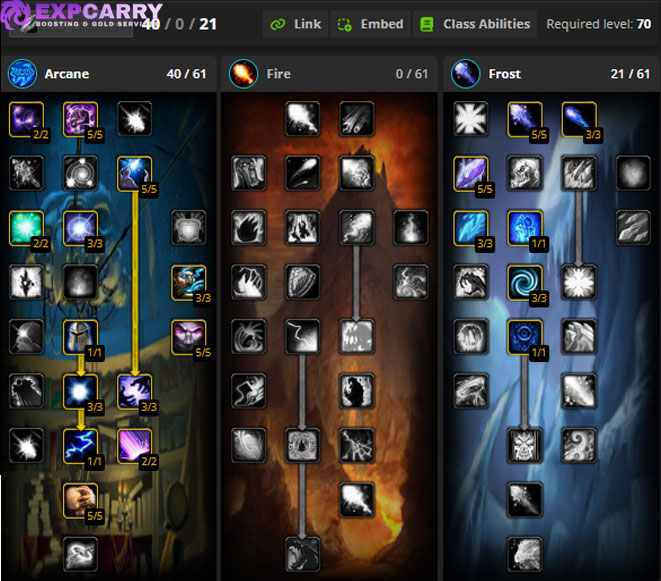
The standard raid framework is 40/0/21 Arcane/Frost. The Arcane side takes Arcane Focus, Arcane Concentration, Arcane Impact, Arcane Meditation, Presence of Mind, Arcane Mind, Arcane Instability, Arcane Potency, Arcane Power, Spell Power, and Mind Mastery. Together, these talents provide Arcane spell hit, Clearcasting, critical-strike scaling, a larger intellect pool, mana regeneration during casting, and the main burst cooldown. Mind Mastery also converts part of total Intellect into spell damage, which is why Intellect has unusually high value for this specialization.
The Frost investment supplies Improved Frostbolt and Elemental Precision for the conserve spell, then reaches Icy Veins and Cold Snap. Ice Shards and Piercing Ice improve Frostbolt damage in the single-target version. A control-oriented variation moves flexible Frost points into Permafrost and Improved Blizzard. That adjustment costs a little filler damage but gives the raid a stronger ranged slow on dangerous add waves. Both versions remain 40/0/21 and use the same Arcane Blast engine; the encounter determines whether direct filler damage or Blizzard control is more valuable.
Arcane performs best beside a Shadow Priest and a Shaman. Passive mana return, Mana Spring Totem, Mana Tide Totem when available, and Bloodlust or Heroism extend the number of full Arcane Blast casts the Mage can afford. Totem of Wrath also changes the gear hit requirement. Innervate can support an especially aggressive plan, but it should be agreed before the pull rather than assumed. If that party package is unavailable, the player must adopt conserve cycles earlier and should judge Arcane by the actual roster, not by a fully supported theoretical result. The current TBC Mage talent reference shows the point placement for the standard and Improved Blizzard versions.
Arcane's strengths are immediate ramp, exceptional stacked-cooldown damage, strong close-range area output, and the freedom to trade mana for faster kills. Its weaknesses are long forced movement, target downtime, high threat, and a dramatic loss when Evocation or external regeneration is interrupted. A raid leader should place Arcane where its burn phase can be supported; a Mage should enter every boss with an estimated kill time and a written plan for mana cooldowns.
Arcane Burn Windows, Conserve Cycles, and Area Damage
Keep Arcane Brilliance active and use Mage Armor for boss encounters. With full Arcane Meditation, Mage Armor allows a large portion of normal spirit regeneration to continue during casting, which matters across a long fight. Before the pull, confirm the Bloodlust or Heroism timing, planned movement, threat lead, and expected Evocation window. Begin with Arcane Blast when the tank has established the pull, then decide whether the opening is a full burn or a controlled ramp. A short encounter with strong support can be solved by casting Arcane Blast continuously; a longer encounter cannot.
During a burn, repeatedly cast Arcane Blast and combine Arcane Power, Icy Veins, an on-use trinket, and Bloodlust or Heroism whenever the encounter permits. Arcane Power increases both damage and mana consumption, so entering this window with a nearly empty pool wastes the cooldown. Presence of Mind is best used for an instant Arcane Blast when movement, a target transition, or the final moment of a damage vulnerability would otherwise remove a cast. Cold Snap makes another Icy Veins available. Use the first Icy Veins early enough that the reset produces a meaningful second window instead of sitting unused at the end of the fight.
The standard conserve cycle builds three Arcane Blast stacks, then casts three Frostbolts while the Arcane Blast debuff expires. Repeat that three-and-three sequence until mana and cooldown timing justify another burn. Latency, temporary haste, movement, and the remaining debuff duration can alter the exact final cast, so track the debuff rather than memorizing only six buttons. Do not insert Arcane Missiles into the routine: the Tier 6 bonus can improve that spell, but the TBC Arcane raid build still gains more from Arcane Blast and Frostbolt.
Mana recovery is part of the damage rotation. Use the highest-rank conjured mana gem early enough to gain another use if the kill time allows, and plan Evocation during a safe interval with minimal movement or incoming pushback. Do not wait until zero mana if a mechanic is about to prevent channeling. External regeneration should extend the next burn, not encourage random overspending before the agreed timing. When threat approaches the tank, pause, use Invisibility with enough time for the fade to complete, or adjust the burn; dying with mana remaining is still a total damage loss.
For nearby groups, Arcane Explosion provides fast uncapped movement-friendly damage, but standing inside a pack increases personal risk. Blizzard is the safer ranged choice and becomes excellent control with the Improved Blizzard variation. Flamestrike can open on a stationary group that will survive its ground effect. Counterspell, Remove Lesser Curse, Polymorph, Spellsteal, Blink, and defensive wards take priority whenever they prevent a wipe. The TBC Mage rotation guide provides additional ability timing context.
Arcane Stats, Spell Hit, and Rating Thresholds
Arcane gearing starts with the hit requirement for Arcane Blast, then balances spell damage, Intellect, haste, critical strike, and regeneration around the expected encounter length. The universal level 73 spell target is 16 percent effective hit because the final 1 percent miss chance cannot be removed. Arcane Focus supplies 10 percent hit to Arcane spells, so the main nuke reaches that target far earlier than Fireball or Frostbolt.
- Arcane Blast needs 6 percent spell hit from gear when no party hit bonus is present. At level 70, that is about 76 spell hit rating.
- Elemental Precision effectively supplies 6 percent hit to binary Frostbolt, leaving a 10 percent gear requirement, or about 126 rating, for the conserve spell. Arcane Blast reaches its own cap first; do not damage the main set merely to cap a filler.
- Totem of Wrath removes 3 percent, about 38 rating, from the relevant gear target while the Mage remains in that Shaman's party and within range.
- Draenei Inspiring Presence removes another 1 percent, about 13 rating. With both party bonuses, Arcane Blast needs only 2 percent from gear, roughly 26 rating.
- At level 70, approximately 12.62 spell hit rating grants 1 percent hit, 15.77 spell haste rating grants 1 percent haste, and 22.08 spell critical strike rating grants 1 percent critical strike chance.
- One point of Intellect grants 15 mana, while roughly 81 Intellect grants 1 percent spell critical strike chance before talents. Arcane Mind and Mind Mastery multiply its usefulness.
- After the main hit cap, spell damage and Intellect are generally the safest gains. Haste raises cast throughput but also accelerates spending; critical strike value changes with set bonuses and the existing gear package.
- Spirit contributes through Mage Armor and Arcane Meditation, yet it does not replace spell damage, Intellect, or the required hit. Its value rises with fight length and falls when the encounter ends inside the first burn.
- Mage has no expertise requirement or defensive raid cap. Spell penetration is normally a PvP statistic, with resistance-heavy encounter exceptions evaluated separately.
Never copy a 76-rating target without checking party composition. A persistent Totem of Wrath, a Draenei group member, or a change of specialization can turn valuable hit into an overcap. Haste is similarly contextual: it is excellent when the mana plan can fund the extra casts, but it may only make an unsupported Mage run dry sooner. Compare complete gear sets and expected fight duration rather than ranking isolated secondary stats. The Mage stat reference confirms the level 70 conversions and base spell cap.
Arcane Phase 3 Gear, Weapons, Set Logic, and BiS
Arcane's defining equipment rule is to retain four pieces of Tirisfal Regalia. Its two-piece bonus raises Arcane Blast damage and base mana cost by 20 percent, while four pieces allow spell critical strikes to grant 70 spell damage for 6 seconds. The four-piece bonus from Tempest Regalia improves Fireball, Frostbolt, and Arcane Missiles by 5 percent but does not improve Arcane Blast. Consequently, Tier 6 item level alone is not a reason to dismantle the Arcane Tier 5 core.
| Slot | Arcane Phase 3 Target | Source | Selection Logic |
|---|---|---|---|
| Head | Cowl of Tirisfal | Lady Vashj, Serpentshrine Cavern | Preserves the four-piece Arcane Blast package |
| Shoulders | Mantle of Tirisfal | Void Reaver, Tempest Keep | Efficient Tier 5 slot with useful Intellect |
| Back | Cloak of the Illidari Council | Black Temple, High Nethermancer Zerevor | Strong hit and spell damage for cap control |
| Chest | Robes of Tirisfal | Kael'thas Sunstrider, Tempest Keep | Another stable component of the retained set bonus |
| Wrists | Cuffs of Devastation | Rage Winterchill, Hyjal Summit | High spell damage and critical strike value |
| Hands | Gloves of Tirisfal | Leotheras the Blind, Serpentshrine Cavern | Secures the retained four-piece bonus |
| Waist | Waistwrap of Infinity | Black Temple, dropped by Supremus | Excellent haste and spell damage in an off-set slot |
| Legs | Leggings of Channeled Elements | Hyjal Summit, dropped by Kaz'rogal | Powerful off-set legs with a favorable stat package |
| Feet | Slippers of the Seacaller | Black Temple, High Warlord Naj'entus | Large spell damage and haste upgrade |
| Neck | The Sun King's Talisman | Tempest Keep, Kael'thas Sunstrider | High spell damage, critical strike, and Intellect |
| Rings | Ring of Ancient Knowledge and Band of the Eternal Sage | Black Temple trash and Scale of the Sands Exalted | Combines haste with a dependable reputation reward |
| Trinkets | Serpent-Coil Braid and The Skull of Gul'dan | Morogrim Tidewalker and Illidan Stormrage | Mana-gem synergy plus a controllable haste burst |
| Two-Hand Weapon | Zhar'doom, Greatstaff of the Devourer | Black Temple, Illidan Stormrage | Exceptional haste, damage, and Intellect in one slot |
| One-Hand Alternative | Tempest of Chaos with Chronicle of Dark Secrets | Archimonde and Rage Winterchill, Hyjal Summit | Competitive modular pair when its hit profile fits the set |
| Wand | Eredar Wand of Obliteration | Magtheridon, Magtheridon's Lair | Strong damage stats without disturbing the Tier layout |
Treat this table as a coherent target set, not a command to equip every isolated drop immediately. The staff and one-hand package change total hit, while replacing any Tirisfal slot can disable the most important bonus. Recalculate hit after every weapon, cloak, or ring change and compare complete combinations. The current Arcane Phase 3 BiS guide contains additional progression alternatives, while ExpCarry's Phase 3 class BiS index connects Mage drops to the wider roster. For raid-specific acquisition planning, the Black Temple progression page provides the relevant encounter context.
Fire Mage Phase 3 PvE Guide
Fire is a direct-damage specialization built around Fireball, critical strikes, Ignite, and a five-stack Improved Scorch debuff. It requires less external mana engineering than Arcane and rewards a stable casting position, accurate debuff refreshes, and well-timed execute cooldowns. Its personal Phase 3 ceiling is lower than that of a properly supported Arcane Mage, but it remains viable, contributes extra Fire damage for the raid, and scales well with haste and the Tier 6 four-piece bonus. Long movement and fire-resistant targets are its clearest encounter weaknesses.
Fire Talents, Debuff Responsibility, and Raid Value
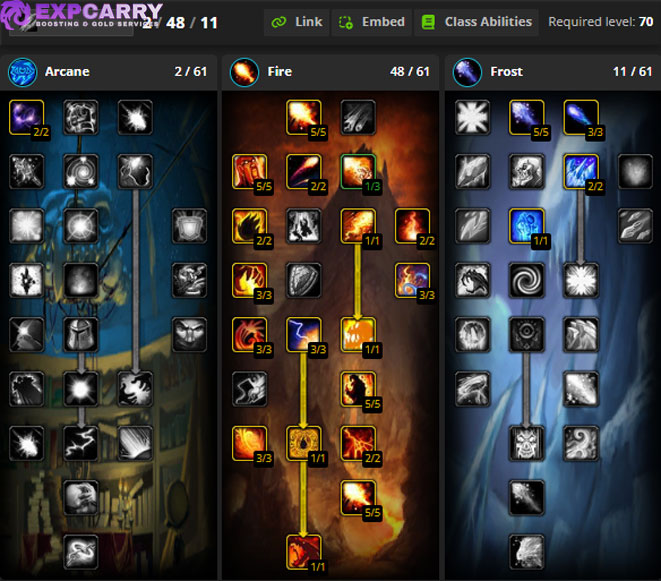
The maximum-output raid build is 2/48/11. Fire receives the majority of the points: Improved Fireball, Ignite, Flame Throwing, Burning Soul, Improved Scorch, Master of Elements, Playing with Fire, Critical Mass, Fire Power, Pyromaniac, Combustion, Molten Fury, and Empowered Fireball form the central package. The Frost branch reaches Elemental Precision and Icy Veins. Two Arcane points normally enter Arcane Subtlety for its resistance reduction; its Arcane-threat clause does not reduce Fireball threat.
Improved Scorch is the specialization's raid assignment. Each successful Scorch adds a stack that increases Fire damage taken, reaching 15 percent at five stacks. Build the full stack quickly and refresh it before expiration so Fireball, Ignite, Fire Blast, and allied Fire spells retain the benefit. This can be valuable to Fire-based Warlocks as well as the Mage. A second Fire Mage can protect uptime, but the raid should still nominate an owner so both players do not refresh inefficiently at the same moment.
The 10/48/3 Arcane Concentration variation is an endurance option. It trades Icy Veins for Clearcasting and spends less mana across a long encounter, but its lower burst makes it a fallback for weak support or incomplete gear rather than the normal Phase 3 damage build. The 2/48/11 framework should remain the first choice when mana can cover the kill. Fire's strengths are predictable output, powerful sub-20-percent damage through Molten Fury, strong critical-strike interactions, and useful area spells. Its limitations are hard-cast dependency, debuff maintenance, threat, and faster mana loss as haste rises.
A Fire Mage fits naturally into a caster party that supplies Totem of Wrath and Wrath of Air Totem. Bloodlust or Heroism should be coordinated with Icy Veins and the execute portion of the encounter where possible. The build does not need the same dedicated mana package as Arcane, but Mana Spring Totem and a Shadow Priest still improve how freely Fire Blast and area spells can be used. Talent choices should therefore match the actual kill time and group rather than assume perfect support.
Fire Single-Target Rotation, Cooldowns, and Multi-Target Play
Use Molten Armor for its critical-strike benefit and maintain Arcane Brilliance before combat. Open with Scorch until Improved Scorch reaches five stacks, then cast Fireball continuously. Refresh the debuff with enough time to finish the Scorch cast before it expires; a late refresh can remove 15 percent Fire amplification from several raid spells. If another assigned Mage already owns the debuff, confirm that responsibility before switching directly to Fireball.
Fire Blast is a single-target damage gain when used between Fireballs, but it has a higher mana cost per damage and a shorter range. Add it when mana will last, during brief movement, or when a target will die before another Fireball lands. Omit repeated Fire Blasts when the encounter is long enough to threaten cast uptime. Scorch is faster than Fireball but is still a cast, so it does not solve movement by itself. Blink, an instant Fire Blast, early repositioning, and knowledge of the next mechanic preserve more damage than reacting after a long cast is already canceled.
Combine Combustion, Icy Veins, an on-use trinket, and Bloodlust or Heroism for a major damage window. Molten Fury increases damage after the target falls below 20 percent, making the execute a natural stacking point. However, cooldown count matters more than waiting automatically: if early use clearly permits a second activation, use the first window near the pull and reserve the next for execute or an encounter vulnerability. Enter every haste window with sufficient mana and enough stationary time to complete Fireballs.
On groups that remain stationary, begin with Flamestrike so its periodic ground damage can run for its full duration. Blizzard is a safe ranged option when control or distance matters, while Arcane Explosion provides immediate damage from close range. Blast Wave and Dragon's Breath add instant area burst if the chosen talent placement includes them, but frontal positioning and tank control must be respected. Polymorph, Counterspell, Spellsteal, Remove Lesser Curse, and defensive wards remain part of the job; maintaining one more Fireball is never worth ignoring a required interrupt or dispel.
Fire is easier to describe than to execute perfectly because the practical challenge is encounter uptime. Record how often movement breaks a Fireball, how many Improved Scorch stacks fall, whether Fire Blast causes an early mana failure, and whether each cooldown gains its full duration. Those four observations produce more improvement than adding unsupported buttons to the priority.
Fire Stat Priority and Spell Hit Cap
Fire must solve a larger gear hit requirement than Arcane or Frost. Spells aimed at a level 73 raid boss need 16 percent effective hit, and Elemental Precision supplies 3 percent to Fire spells. The self-contained target is therefore 13 percent from equipment. Once capped, Phase 3 haste and spell damage provide strong consistent gains, while critical strike rating feeds Ignite, Combustion, and Master of Elements.
- Without a party hit bonus, Fire needs 13 percent from gear, approximately 164 spell hit rating.
- Totem of Wrath reduces the gear requirement to 10 percent, about 126 rating, as long as its 3 percent effect remains active.
- A Draenei party member reduces the target by another 1 percent. Fire with both Totem of Wrath and Inspiring Presence needs 9 percent from gear, roughly 114 rating.
- Spell hit above the active cap has no damage value. Build separate capped sets if party placement changes regularly rather than carrying wasted rating in every raid.
- After hit, spell haste, spell damage, and critical strike are the main offensive stats. Their exact weights depend on set bonuses, existing haste, mana support, and fight length.
- Haste shortens Fireball casts and can reduce the global cooldown, but it also increases mana consumed per minute. A faster cast is useful only while mana and target uptime remain available.
- Critical strike creates Ignite damage and supports mana return through Master of Elements. Spell damage improves every Fireball without relying on a critical event.
- Intellect adds 15 mana per point and a small amount of spell critical strike. Spirit has limited in-combat value because the standard Fire build does not combine Arcane Meditation with Mage Armor.
- Expertise and defensive rating caps do not apply to a Fire Mage. Stamina and resistance are encounter-specific survival considerations, not general damage targets.
Do not compare a haste item and a hit item until the entire loadout is assembled. Removing one ring can place Fire below cap, while a Shaman party can make the same ring excessive. The most useful upgrade order is to establish the current group-adjusted hit target, preserve four Tier 6 pieces, then improve the weapon, high-budget off-set slots, and trinkets. Simulation is appropriate for close choices because Ignite, haste, and mana duration change each other's value.
Fire Phase 3 Armor, Tier 6, Weapons, and BiS Targets
Fire should pursue four pieces of Tempest Regalia. Two pieces extend Evocation by 2 seconds, while four pieces increase Fireball, Frostbolt, and Arcane Missiles damage by 5 percent. Fireball receives the full value on nearly every boss cast, making the four-piece effect a central gearing requirement. The strongest arrangement uses shoulders, chest, hands, and legs, leaving the head slot open for a high-budget Illidan drop.
| Slot | Fire Phase 3 Target | Source | Selection Logic |
|---|---|---|---|
| Head | Cowl of the Illidari High Lord | Black Temple, dropped by Illidan Stormrage | Exceptional hit and critical strike in the off-set slot |
| Shoulders | Mantle of the Tempest | Mother Shahraz, Black Temple | First component of the four-piece Fireball bonus |
| Back | Shroud of the Highborne | Black Temple, obtained from Illidan Stormrage | A large haste gain for a long-cast specialization |
| Chest | Robes of the Tempest | Illidan Stormrage, Black Temple | Strong Tier stats and set-bonus progression |
| Wrists | Bracers of Nimble Thought | Crafted by Tailoring | Outstanding haste and spell damage from a crafted slot |
| Hands | Gloves of the Tempest | Azgalor, Hyjal Summit | Efficient Tier slot with spell hit |
| Waist | Belt of Blasting | Crafted by Tailoring | Helps meet Fire's larger hit requirement |
| Legs | Leggings of the Tempest | Black Temple, the Illidari Council encounter | Completes the preferred four-piece configuration |
| Feet | Slippers of the Seacaller | Black Temple, dropped by High Warlord Naj'entus | High spell damage and haste with useful sockets |
| Neck | Hellfire-Encased Pendant | Trash enemies in Hyjal Summit and Black Temple | Supplies hit while preserving strong offensive stats |
| Rings | Ring of Ancient Knowledge in both ring slots | Trash enemies within Black Temple | No unique restriction prevents the double-haste setup |
| Trinkets | The Skull of Gul'dan and Serpent-Coil Braid | Illidan Stormrage and Morogrim Tidewalker | Controllable haste with strong mana-gem interaction |
| Two-Hand Weapon | Zhar'doom, Greatstaff of the Devourer | Black Temple, looted from Illidan Stormrage | Premier Phase 3 haste weapon when the set remains capped |
| One-Hand Alternative | Tempest of Chaos with Chronicle of Dark Secrets | Archimonde and Rage Winterchill, Hyjal Summit | Flexible pair for balancing hit, damage, and sockets |
| Wand | Wand of the Forgotten Star | Tempest Keep, High Astromancer Solarian | Excellent critical strike and spell damage |
The displayed set assumes the raid hit package remains available. If Fire falls below cap, preserve hit even when a haste item appears stronger in isolation. If the Mage is substantially over cap, Waistwrap of Infinity can replace the hit-heavy belt in a different complete set. The two-ring arrangement is valid because the trash ring has no unique restriction. The Fire Phase 3 BiS guide lists slot alternatives, and ExpCarry's Tier 6 token guide maps the four required armor pieces to their bosses.
Explore services related to this guide, selected from our WoW TBC Anniversary catalog.
View All WoW TBC Anniversary Services


Frost Mage Phase 3 PvE Guide
Frost is a real Phase 3 raid option, but its strongest boss build is not the familiar deep-tree Water Elemental setup. A 34/0/27 Arcane/Frost hybrid uses Frostbolt as its main spell while gaining Arcane Instability, Spell Power, Arcane Power, and stronger Arcane Explosion. It can compete with Fire in the current gear environment, though regular Arcane remains ahead under equal high-end support. Deep Frost 18/0/43 is still useful for players who value the Water Elemental, mana stability, and control over the highest possible raid parse.
Frost Hybrid and Deep Frost Talent Builds
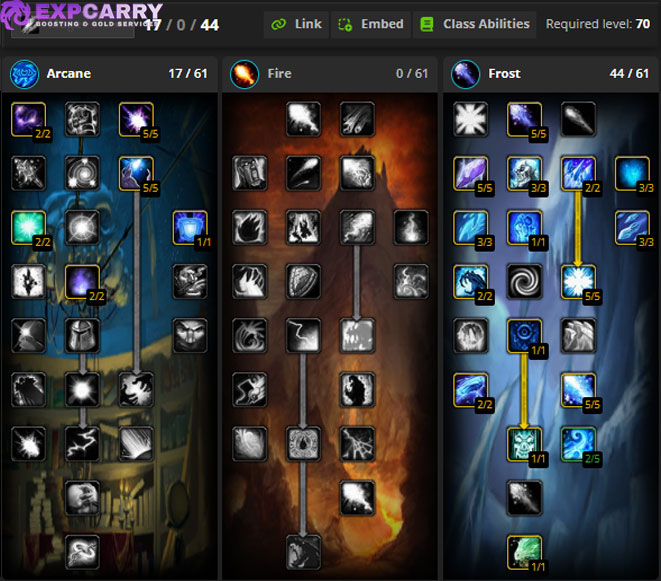
The damage-focused 34/0/27 build reaches Arcane Focus, Arcane Concentration, Arcane Impact, Arcane Meditation, Presence of Mind, Arcane Mind, Arcane Instability, Arcane Potency, Arcane Power, and Spell Power. It then takes Improved Frostbolt, Elemental Precision, Ice Shards, Piercing Ice, Icy Veins, Cold Snap, and two points in Winter's Chill. Frostbolt gains Arcane's critical damage and burst modifiers, while Arcane Explosion receives enough support to become a serious close-range area tool.
Only two points in Winter's Chill means the raid debuff stacks less reliably at the opening than it would in a deep Frost build. Begin Frostbolt casting early, track the debuff, and do not assume five stacks exist after one spell. Multiple Frost casters improve ramp consistency. The hybrid also lacks Summon Water Elemental, Empowered Frostbolt, and the deeper defensive talents, so it plays as an Arcane-powered turret rather than the full control specialization familiar from PvP.
The alternative 18/0/43 build gives up Arcane Power and Spell Power to reach Empowered Frostbolt and Summon Water Elemental. Arcane Concentration and Arcane Meditation support mana efficiency, while the deeper Frost tree adds stronger control, a pet cooldown, and more flexible Winter's Chill coverage. This build has a lower pure boss ceiling in Phase 3 but is comfortable in long fights, dungeons, add encounters, and groups that cannot provide Arcane-style support. It is a valid PvE choice when those benefits match the content.
Frost's strengths are its low hit threshold, simple core cast, good mana behavior, ranged slows, Cold Snap flexibility, and competitive hybrid burst. Its weaknesses are a lower supported ceiling than Arcane, the lack of the pet in 34/0/27, and boss immunity to freeze effects that enable Ice Lance burst elsewhere. Choose between the hybrid and deep build according to the raid goal rather than mixing points until neither package reaches its defining talents.
Frostbolt Rotation, Cooldown Pairing, Pet Use, and AoE
Use Molten Armor when the mana plan supports full casting uptime; use Mage Armor on an unusually long encounter if regeneration prevents more lost Frostbolts than the critical-strike armor would add. Maintain Arcane Brilliance and begin with Frostbolt as soon as threat permits. For 34/0/27, Frostbolt is the complete sustained single-target rotation outside utility and cooldowns. Keep casting through Winter's Chill ramp and avoid unnecessary instant spells that delay the next bolt.
Combine Arcane Power and Icy Veins with Bloodlust or Heroism and an on-use trinket during a stable damage window. Arcane Power makes spells stronger and more expensive, so the Mage still needs enough mana to use the entire window. Cold Snap resets Icy Veins and should be planned early enough to create another useful activation. Presence of Mind can finish an instant Frostbolt at the edge of movement or a vulnerability, although it should not replace a normal cast when no time would be lost.
Deep Frost follows the same Frostbolt foundation but adds Summon Water Elemental. Summon the pet where it can attack for its full duration without being killed by avoidable area damage, and align its uptime with raid haste or a boss vulnerability. Cold Snap can make another Water Elemental summon available, so timing the first pet too late may discard a substantial part of the talent's value. Control the pet actively during target swaps instead of leaving it on an immune, distant, or soon-to-die target.
Ice Lance deals meaningful damage against frozen enemies, but raid bosses normally cannot be frozen. It is therefore not a standard boss filler and should not be inserted merely because movement begins. It can be useful on eligible frozen adds or when an instant spell is the only action possible. Blink early, finish movement efficiently, and return to Frostbolt. Fire Blast is another emergency instant, but its mana and lack of Frost talent scaling make it a situational movement action rather than part of the base cycle.
The 34/0/27 hybrid uses Arcane Explosion for exceptional immediate area damage when standing close is safe. Blizzard is preferable at range and whenever its slow protects the group. A deep Frost build can invest more heavily in Improved Blizzard for dungeon control and add waves. Flamestrike adds value when enemies remain inside the ground effect. As with the other Mage specializations, Counterspell, Spellsteal, Polymorph, curse removal, and survival cooldowns override the damage sequence when the encounter calls for them.
Frost Spell Hit Cap and PvE Stat Priorities
Frost has the smallest equipment hit requirement because Elemental Precision provides an effective 6 percent hit to binary Frost spells such as Frostbolt. The boss target remains 16 percent effective spell hit, leaving 10 percent for gear before party effects. That advantage lets Frost equip more haste, spell damage, and critical strike pieces than Fire while maintaining reliable casts.
- Frostbolt needs 10 percent spell hit from equipment with no relevant party bonus, approximately 126 spell hit rating at level 70.
- Totem of Wrath reduces the gear requirement to 7 percent, about 89 rating.
- With both Totem of Wrath and Draenei Inspiring Presence, Frostbolt needs 6 percent from gear, roughly 76 rating.
- The 6 percent Elemental Precision result applies to binary Frost spells. Arcane Explosion follows Arcane hit talents in the hybrid build and should not be used to infer the Frostbolt cap.
- Spell damage, haste, and critical strike are the main uncapped damage stats. Spell damage is consistent, haste adds more Frostbolts to available time, and critical strike benefits Ice Shards and Spell Power.
- Haste can create mana pressure during stacked cooldowns even though Frostbolt is efficient. Evaluate it against encounter duration rather than treating every haste point as free throughput.
- Intellect adds mana and critical strike, with extra value in the hybrid through Arcane Mind. Spirit becomes useful during casting when Arcane Meditation or Mage Armor is active.
- Spell penetration is not a standard raid gearing goal. Resistance-heavy mechanics can justify a temporary swap, but general boss damage uses hit, spell damage, haste, and critical strike instead.
- Frost has no expertise or defensive rating cap. Resistance and Stamina are selected only when a specific mechanic makes survival the limiting factor.
Recalculate the hit target whenever group placement changes. The difference between an unsupported Frost Mage and one receiving both party hit effects is roughly 50 rating, enough to alter several equipment slots. After the correct cap is met, the 34/0/27 hybrid generally values haste strongly because Arcane Power amplifies a compressed cast window, while deep Frost may place relatively more value on sustained spell damage and mana stability. A full-set comparison remains more accurate than a universal static weight.
Frost Phase 3 Gear, Tempest Set, Weapons, and BiS
Frost shares Fire's central Phase 3 objective: four pieces of Tempest Regalia. The four-piece bonus increases Frostbolt damage by 5 percent, so it directly affects almost every sustained boss cast. Shoulders, chest, hands, and legs provide the preferred combination, leaving the head slot for an Illidan off-piece. The two-piece Evocation extension is useful, but it is the four-piece Frostbolt modifier that determines the layout.
| Slot | Frost Phase 3 Target | Source | Selection Logic |
|---|---|---|---|
| Head | Cowl of the Illidari High Lord | Black Temple, Illidan Stormrage | Best off-set head while four Tier slots remain equipped |
| Shoulders | Mantle of the Tempest | Mother Shahraz, Black Temple | Required part of the preferred Frostbolt set layout |
| Back | Shroud of the Highborne | Black Temple, looted from Illidan Stormrage | Heavy haste supports both sustained and burst casting |
| Chest | Robes of the Tempest | Illidan Stormrage, Black Temple | Strong stats while advancing the set bonus |
| Wrists | Bracers of Nimble Thought | Crafted by Tailoring | Major haste and spell damage upgrade |
| Hands | Gloves of the Tempest | Azgalor, Hyjal Summit | Efficient Tier slot with useful hit |
| Waist | Waistwrap of Infinity | Black Temple, Supremus | Low hit needs allow Frost to favor its haste profile |
| Legs | Leggings of the Tempest | Black Temple, dropped by the Illidari Council | Completes the four-piece Frostbolt bonus |
| Feet | Slippers of the Seacaller | Black Temple, High Warlord Naj'entus | Excellent haste, spell damage, and sockets |
| Neck | The Sun King's Talisman | Tempest Keep, dropped by Kael'thas Sunstrider | Strong critical strike and spell damage without excess hit |
| Rings | Ring of Ancient Knowledge in both ring slots | Trash creatures throughout Black Temple | Non-unique haste rings suit the low hit requirement |
| Trinkets | The Skull of Gul'dan and Ashtongue Talisman of Insight | Illidan Stormrage and Ashtongue Deathsworn Exalted | Pairs a controlled haste window with a strong caster proc |
| Two-Hand Weapon | Zhar'doom, Greatstaff of the Devourer | Black Temple, obtained from Illidan Stormrage | Best complete stat package for the standard target set |
| One-Hand Alternative | Tempest of Chaos with Chronicle of Dark Secrets | Archimonde and Rage Winterchill, Hyjal Summit | Competitive pair when its combined stats fit the cap |
| Wand | Wand of the Forgotten Star | Tempest Keep, High Astromancer Solarian | Efficient critical strike and spell damage |
This target set is built around the 34/0/27 damage hybrid, but deep Frost uses the same four-piece principle. Frost does not need Fire's hit-heavy waist and neck configuration unless party support disappears or another slot changes. Always resolve the active cap before copying the double-ring setup. The current Frost Phase 3 BiS guide includes alternatives for every slot. Once the final configuration is known, ExpCarry's Phase 3 epic gem guide helps allocate new raid gems without socketing around an outdated hit target.
Final Verdict
Arcane is the strongest general raid choice for a Mage who receives mana support, understands the expected kill time, and can protect long Arcane Blast windows. Preserve four Tirisfal pieces, cap Arcane Blast rather than blindly capping every school, and plan burn and conserve phases before combat. Its performance is a product of both the player and the party assigned to that player.
Fire offers a straightforward Fireball core, valuable Improved Scorch support, and powerful execute timing, but it must solve a larger hit requirement and maintain four Tempest pieces. Frost is not merely a defensive fallback in Phase 3: the 34/0/27 hybrid combines a low Frostbolt hit cap with Arcane Power and competitive burst, while 18/0/43 remains the utility and Water Elemental option. The correct specialization is the one whose mana needs, debuff value, movement profile, and gear package match the raid rather than the one chosen from an isolated damage ranking.