

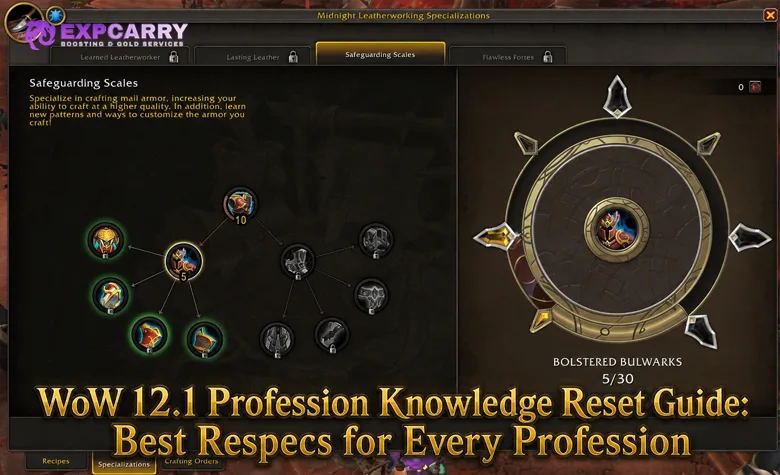
WoW Midnight Patch 12.1, Curse of Ula'tek, is now live and gives every eligible Midnight crafting and gathering profession a one-time Profession Knowledge reset. The feature refunds all Knowledge Points already spent in that profession and lets you rebuild its specialization trees from scratch. The reset is handled by Theremis in Silvermoon City, not Darla Fluxy from the earlier PTR information. The important restriction has not changed: each profession gets only one reset, so this is not a system for repeatedly switching between Auction House, Crafting Order and personal-use builds. Specialization recipes unlocked through Knowledge Points also disappear when their nodes are cleared and become available again only after you reinvest in the appropriate branches.
Short answer: talk to Theremis at approximately /way #2393 45.0 56.0 in Silvermoon City to refund the spent Knowledge Points of a Midnight profession. Plan the new specialization path before confirming because that profession cannot use the reset a second time.
How the Profession Knowledge Reset Works in Patch 12.1
The reset applies directly to Midnight profession specialization trees. Blizzard describes it as a one-time reset for each profession that refunds all spent Knowledge Points and allows them to be reassigned freely. You are not deleting the profession and you do not have to re-earn the Knowledge Points that were already spent; the refunded pool is immediately available for a new specialization path.
| Reset Element | What Happens |
|---|---|
| Spent Knowledge Points | Refunded and available to reassign |
| Specialization tree | Cleared so the refunded points can be spent again |
| Recipes unlocked by Knowledge nodes | Become unavailable until the required nodes are selected again |
| Trainer and other non-specialization recipes | Not removed by the Knowledge reset |
| Profession itself | Remains learned; this is not an unlearn/relearn process |
| Reset limit | Once per Midnight profession |
The feature applies to professions that actually use Midnight Knowledge and specialization trees. That includes the eight crafting professions—Alchemy, Blacksmithing, Enchanting, Engineering, Inscription, Jewelcrafting, Leatherworking and Tailoring—and the three gathering professions—Herbalism, Mining and Skinning. Cooking, Fishing and Archaeology do not use the same Knowledge specialization system and therefore do not need this type of reset.
Theremis Location in Silvermoon City
The live Patch 12.1 reset NPC is Theremis. You can find Theremis in Silvermoon City's Bazaar near the profession and Work Order area at approximately /way #2393 45.0 56.0. Interact with the NPC, choose the Midnight profession you want to reset and read the confirmation carefully before accepting.
This is one of the most important corrections to pre-release versions of the guide. Earlier PTR-era information pointed players toward Darla Fluxy, but live Midnight profession guides now direct players to Theremis. If you are searching Silvermoon for the old NPC, you are following outdated reset information.
One Reset Per Profession Means You Should Plan First
The one-time limit is the main reason not to treat Profession Knowledge reset as an experiment. If your character has two Midnight primary professions, each eligible profession has its own reset opportunity, but resetting one specialization tree does not give you an unlimited way to test several alternatives. Once that profession's reset has been consumed, future Knowledge decisions again become long-term progression choices.

Before resetting, write down the exact branch you want to reach and which recipes, profession stats or gathering bonuses you need from it. Also check any Crafting Orders you currently intend to complete. If an order depends on a recipe unlocked through your existing specialization, resetting before finishing that order can temporarily remove access to the recipe until you spend points back into the relevant node.
Explore services related to this guide, selected from our World of Warcraft catalog.
View All World of Warcraft Services


When a Profession Knowledge Reset Is Worth Using
The strongest reason to reset is not that another specialization looks slightly more profitable today. It is that your current allocation no longer supports what you actually use the profession for. A reset is most valuable when early Knowledge was spread across unrelated branches, your main crafting market has changed, you switched from personal gear to Crafting Orders, or a gathering character invested heavily in mechanics that do not match its normal farming route.
- Use it for a structural mistake: your points are scattered across several branches and you cannot efficiently reach the recipes or bonuses you actually need.
- Use it after your profession goal changes: for example, moving from personal armor crafting to a focused Crafting Order business.
- Use it when your gathering route changed: a general-yield build and a build targeting Infused nodes or rare creatures can require very different priorities.
- Wait if you are already close to the desired node: because Midnight continues to provide Knowledge through normal profession progression, earning the remaining points may be better than spending the only reset.
- Do not reset only because one item is expensive this week: regional commodity prices and Crafting Order demand can change faster than your Knowledge progression.
Best Respec Paths for Every Midnight Profession
There is no universal highest-profit specialization for an entire region or season. The practical way to use a reset is to match the new tree to one clear goal: personal equipment, Crafting Orders, commodity production, material processing or gathering. The paths below are therefore goal-based priorities rather than a fixed ranking of professions.
Alchemy
Alchemy has four trees: Potion Prowess, Fluent in Flasks, Transmutation Authority and Alchemical Mastery. Alchemical Mastery improves general Alchemy performance and is useful alongside a focused production tree, while the other three determine what type of products you want to specialize in.

- Potions: build around Potion Prowess if your main activity is producing Light and Void potions.
- Flasks and profession phials: use Fluent in Flasks when these are your primary consumable market or personal need.
- Transmutations: use Transmutation Authority when your plan revolves around material conversion and transmutation products.
- General efficiency: include Alchemical Mastery when you need broadly useful Skill and Resourcefulness rather than another narrow recipe branch.
A reset is particularly useful for an Alchemist who originally divided Knowledge between potions, flasks and transmutations without becoming efficient at any of them. Choose one production category first and expand only after that route is strong enough for your intended crafts.
Blacksmithing
Blacksmithing divides its major goals between Armorsmithing, Weaponsmithing, Craftsmithing and The Old Ways. A post-reset build should begin by deciding whether you want to fill equipment orders, produce profession equipment or focus on commodities such as alloys and weapon stones.
- Plate armor: Armorsmithing is the direct route for high-end plate Crafting Orders.
- Weapons: Weaponsmithing specializes by weapon family and is the correct direction for weapon orders.
- Profession tools and accessories: Craftsmithing supports profession equipment and related products.
- General crafting stats and alloys: The Old Ways provides broad Blacksmithing bonuses and supports alloy production.
Do not automatically switch from armor to weapons because one weapon currently has a high commission. Gear markets depend heavily on the current raid, Mythic+ gearing patterns and the crafters already established on your realm. Use the reset to specialize deeply enough to compete in the market you actually intend to serve.
Enchanting
Enchanting supports several very different businesses, making it one of the professions where a poorly focused Knowledge tree is easiest to notice. Elevating Equipment focuses on enchants, Transitories, Tonics, and Tools covers products such as oils, reagents, wands and profession equipment, Disenchanting Delegate improves disenchanting, and Spellbound Shatterer strengthens the profession's broader crafting foundation.
- Finished enchants: prioritize Elevating Equipment and then the enchant categories you actually craft.
- Disenchanting: use Disenchanting Delegate if material extraction is the character's main purpose.
- Oils, reagents, wands and tools: use Transitories, Tonics, and Tools.
- Broad crafting support: Spellbound Shatterer provides general value that can support a finished crafting build.
For an Enchanter, the reset is most useful when the old allocation mixes material farming and finished-product crafting without enough depth in either side.
Engineering
Engineering's four major trees are Combat Analytics, Market Mobility, Recycling and Bits and Bots. They cover combat equipment, profession equipment, material recovery and the profession's broader collection of utility products.
- Combat gear and guns: Combat Analytics is the direct equipment path.
- Profession equipment: Market Mobility is better suited to crafters targeting tools and accessories.
- Material efficiency: Recycling supports Engineers who want to recover and reuse profession materials.
- Utility products: Bits and Bots is the more specialized route for Engineering's gadgets and other non-standard crafts.
Engineering has too many unrelated products for a shallow build to perform every role equally well. A reset should reduce that spread rather than simply moving points from one collection of unfinished branches into another.
Inscription
Inscription was missing from the older version of this guide even though it uses Midnight Knowledge and can use the Patch 12.1 reset. Its four trees are Blueprints, Calm Hands, Perfected Products and Darkmoon Curiosity.
- Weapons and profession equipment: Blueprints is the main Crafting Order direction.
- General profession performance: Calm Hands improves broad Inscription crafting stats and supports the profession's own treatise progression.
- Reagents and milling: Perfected Products is the logical route for players focused on material processing and repeatable goods.
- Darkmoon products: Darkmoon Curiosity is the dedicated path for cards and related crafts.
Because these markets behave very differently, Inscription benefits from a reset when the original tree tried to cover equipment, reagents and Darkmoon production simultaneously.
Jewelcrafting
Jewelcrafting uses Thoughtful Throughput, Glamorous Gems, Alluring Accessories and Proficient Processor. The correct respec depends on whether you want to sell cut gems, complete jewelry orders, process ore or improve general crafting efficiency.
- Cut gems: use Glamorous Gems and commit to the gem cuts you actually intend to produce.
- Rings, amulets and profession equipment: use Alluring Accessories.
- Prospecting and processing: Proficient Processor is the relevant route for turning ore and gems into higher-value inputs.
- General crafting stats: Thoughtful Throughput supports the rest of the profession with broad crafting bonuses.
Avoid resetting purely to chase whichever gem is temporarily the most expensive. The better reason is that your current allocation cannot efficiently craft the categories your character or customers regularly request.
Leatherworking
Leatherworking separates leather armor, mail armor, general profession performance and non-armor products across Lasting Leather, Safeguarding Scales, Learned Leatherworker and Flawless Fortes. The first post-reset decision is therefore whether the profession exists mainly for armor orders or for its other products.
- Leather armor: choose Lasting Leather and specialize into the gear slots you intend to craft.
- Mail armor: choose Safeguarding Scales.
- Profession equipment, armor kits, reagents and similar crafts: Flawless Fortes supports the non-armor side of Leatherworking.
- General profession stats: Learned Leatherworker provides broad crafting benefits that can support a mature build.
Trying to fund both leather and mail armor immediately after a reset can recreate the same problem the reset was meant to solve. Start with the armor type or product group that matches your actual customers.
Tailoring
Tailoring uses Sin'dorei Finery, Nimble Needlework, Fabric Specialist and Fiber Arts. These cover cloth equipment, high-end cloth production, cloth gathering and broad profession efficiency.
- Cloth armor orders: Sin'dorei Finery is the primary equipment tree.
- Arcanoweave and Sunfire Silk production: Nimble Needlework is the important path for the profession's high-end bolt system.
- Cloth farming: Fabric Specialist improves the gathering side of Tailoring and also contributes useful general bonuses.
- General crafting efficiency: Fiber Arts improves broad Tailoring performance and supports other focused branches.
A Tailor who primarily farms cloth should not copy the Knowledge layout of a player whose entire business is maximum-quality armor orders. The one-time reset is a good opportunity to make the tree match which half of the profession you actually use.
Herbalism
Gathering professions can use the reset too. For Herbalism, the major decision is between travel convenience, broad herb yield and specialized Infused-node farming. Botany is especially important for players who value mounted gathering, Bountiful Harvests improves general yields, and Midnight Overload focuses on Infused herbs and the Overload mechanic.
- General farming route: Botany and Bountiful Harvests are the most broadly useful directions.
- Mounted gathering: the main Botany ring unlocks gathering Midnight herbs while mounted after the required investment.
- Infused herb and mote farming: Midnight Overload is the specialized route.
Druids and players whose movement setup already minimizes dismounting may value the mounted-gathering benefit differently from other characters, so do not spend the reset simply because another Herbalist follows a different route.
Mining
Mining follows the same basic choice between convenience, broad yield and Infused-node specialization. The current Midnight tree includes the mounted-mining path, Plentiful Ores for general ore performance and Over-LODED for themed deposits and Overload Infused Deposit.
- Frequent route farming: prioritize the mounted-mining path if reducing downtime between deposits is important to you.
- General ore yield: Plentiful Ores is the broad production route and can then be narrowed toward the ore types you farm most often.
- Infused deposits and motes: Over-LODED is designed around those nodes and their Overload interactions.
Choose according to what you actually mine. A character spending most of its farming time on normal ore routes gains little from rebuilding entirely around a specialized Infused-node strategy that it rarely uses.
Skinning
Skinning was also missing from the older article. Its Midnight trees serve distinct farming goals: Thorough Tanning improves normal leather and scale gathering and unlocks Sharpen Your Knife, Gainful Gathering expands species-specific and other side materials, and Talented Tracker focuses on Renowned Beasts and their rarer materials.
- General leather and scale farming: Thorough Tanning is the safest broad foundation.
- Rare side gathers and species-specific materials: Gainful Gathering is more appropriate.
- Renowned Beast farming: Talented Tracker is the dedicated route for players deliberately hunting those targets.
Skinning is a good example of why a reset should follow an actual farming plan. A Talented Tracker build can be useful when you regularly hunt Renowned Beasts, but it is much less relevant to a character that mostly skins ordinary creatures while questing or farming standard leather.
Knowledge Points After the Reset
The reset gives back the Knowledge you already spent; it does not force you to rebuild the same total from weekly sources. After reallocating those refunded points, you continue earning new Profession Knowledge normally through the sources available to that profession. Crafting and gathering professions do not all earn Knowledge in exactly the same way, so avoid using a single fixed weekly total for every profession.
Common Midnight sources include First Craft or first-gather bonuses where applicable, profession Knowledge treasures, weekly profession activities, Patron Work Orders for relevant crafting professions, treatises, gathering drops and other profession-specific catch-up sources. These systems are another reason to wait if your current build is only a small number of points away from its target: eventually you can develop more of the same profession without consuming the one-time respec.
Profession Knowledge Reset FAQ
The reset is simple to activate, but several edge cases matter when deciding whether to use it.
Can gathering professions use the Patch 12.1 Knowledge reset?
Yes. Herbalism, Mining and Skinning all use Midnight specialization trees and Knowledge Points, so they are part of the reset system. The feature is not limited to crafting professions.
Does unlearning and relearning a profession give another reset?
No. Unlearning a modern profession is not a workaround for its Knowledge allocation, and it should not be used as a way to try to create another respec. Use the Theremis reset when you genuinely want to rebuild the specialization tree.
Should you reset a profession only because Season 2 changed prices?
Usually not. A temporary price spike is weaker justification than a permanent mismatch between your Knowledge tree and your actual crafting or gathering goals. Check current demand, the recipes you already control and how many additional Knowledge Points you need before consuming the reset.
Conclusion
The Patch 12.1 Profession Knowledge reset is most valuable as a correction tool, not as a market-switching shortcut. Theremis gives each Midnight profession one opportunity to recover its spent Knowledge and rebuild around a clearer purpose. Decide what the profession is supposed to do, map the necessary specialization nodes before confirming, and make sure no important recipe or current Crafting Order depends on a branch you are about to remove. A planned reset can fix months of scattered Knowledge spending; an impulsive reset simply replaces one locked-in build with another.