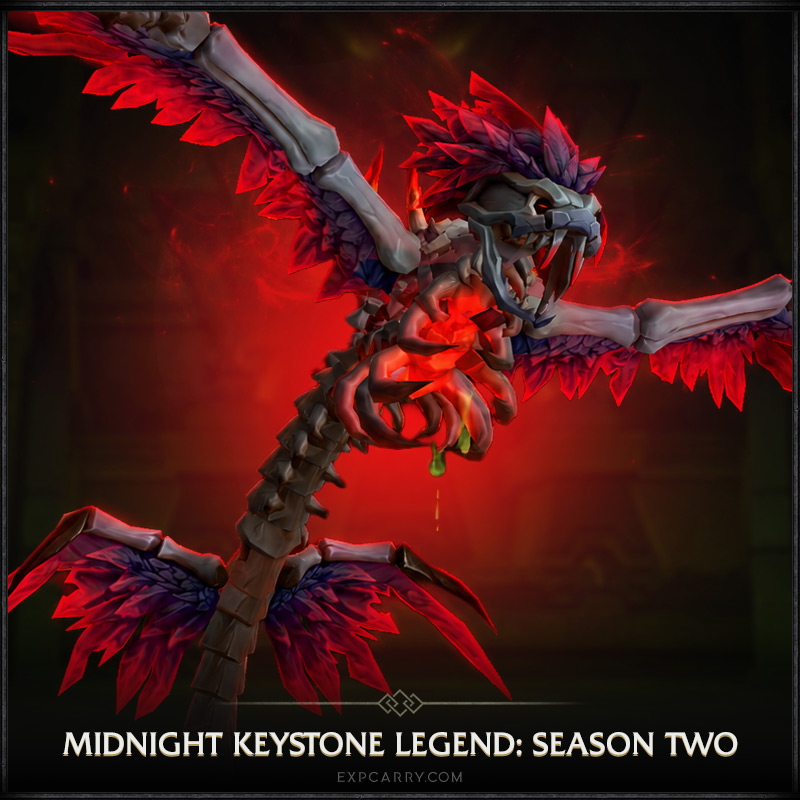
In Midnight Season 2, the fastest reliable route to Keystone Legend is to reach at least 3,000 Mythic+ Rating before the season ends. The achievement rewards the Breath of Ruin mount. Season 2 uses eight dungeons: Altar of Fangs, Murder Row, Den of Nalorakk, The Blinding Vale, Voidscar Arena, King’s Rest, Ruby Life Pools and Temple of Sethraliss.
If your goal is the full 3,000-rating milestone rather than individual keys, the WoW Keystone Legend carry is planned from your current Season 2 dungeon scores.
| Requirement | Reward or purpose |
|---|---|
| 3,000 Midnight Season 2 Mythic+ Rating | Midnight Keystone Legend: Season 2 and Breath of Ruin |
| Eight-dungeon Season 2 rotation | Rating is earned by improving timed and untimed runs across the seasonal dungeons |
| Mythic+ level 10 or higher within the timer | Dungeon-specific Keystone Hero teleport |
| Mythic+ level 12 and higher | High-end progression, Gilded Crests and the prestige portion of the seasonal rating climb |
What Keystone Legend Requires in Midnight Season 2
Midnight Keystone Legend: Season 2 requires a Mythic+ Rating of at least 3,000. Unlike Keystone Master or Keystone Hero, Legend is not earned by completing one fixed achievement in every dungeon. Your rating is calculated from your best performances across the seasonal rotation, including separate results for Fortified and Tyrannical weeks.
A practical target is to time most dungeons around Mythic 12 and improve selected dungeons to Mythic 13 or higher. The exact combination depends on your class, role, dungeon strengths and the current affix week. Do not treat “all +12s” as a guaranteed formula: the game’s rating system also considers the quality of individual runs and whether your best scores cover both seasonal affix types.
Midnight Season 2 Mythic+ Dungeon Rotation
Season 2 contains one new dungeon, four Midnight dungeons and three returning dungeons. Learn every dungeon before pushing high keys, because a single weak score can force you to overperform elsewhere.
| Dungeon | Category | Why it matters for Legend |
|---|---|---|
| Altar of Fangs | New Season 2 dungeon | Must be learned from the beginning because it has no previous-season route familiarity |
| Murder Row | Midnight dungeon | Part of the permanent Season 2 rating pool |
| Den of Nalorakk | Midnight dungeon | Part of the permanent Season 2 rating pool |
| The Blinding Vale | Midnight dungeon | Part of the permanent Season 2 rating pool |
| Voidscar Arena | Midnight dungeon | Part of the permanent Season 2 rating pool |
| King’s Rest | Returning dungeon | Returning mechanics make preparation and route study especially valuable |
| Ruby Life Pools | Returning dungeon | Requires careful planning around movement, interrupts and dangerous trash |
| Temple of Sethraliss | Returning dungeon | Older encounters still require role-specific mechanic knowledge |
How Mythic+ Rating Works for Keystone Legend
Your Mythic+ Rating improves when you complete a dungeon at a higher keystone level, beat your previous time or perform better on the opposite seasonal affix. A timed run normally provides a much stronger rating increase than an untimed completion, but an untimed high-level dungeon can still be useful when you are building a score or learning a route.
Each dungeon contributes its own rating. The game also values coverage across the two main seasonal conditions, so completing every dungeon only on one type of week can leave your total rating lower than expected.
Time both affix versions of your strongest dungeons
Do not stop after timing every dungeon once. After establishing a baseline, revisit your best dungeons during the opposite affix type. Improving one weak Fortified score or Tyrannical score can be more efficient than repeatedly farming a dungeon where your rating is already high.
Use your rating page instead of guessing
Open the Mythic+ section of the Group Finder interface and review each dungeon individually. Identify:
- your lowest dungeon score;
- the dungeons with no strong Fortified or Tyrannical result;
- runs that are close to a higher rating bracket;
- dungeons where a small time improvement would replace an older score.
Your next key should be selected from this information rather than from the dungeon you happen to enjoy most.
Explore services related to this guide, selected from our Mythic Dungeons catalog.
View All Mythic Dungeons Services
Build a Fast Keystone Legend Progression Plan
Step 1: Prepare your character before pushing
Enter Season 2 Mythic+ with a complete set of appropriate gear, upgraded consumables and a talent setup suited to the current dungeon. Keystone Legend is not the point at which to discover whether your character lacks defensive cooldowns, interrupt coverage or area damage.
- Use the highest item-level gear available from your main content sources.
- Complete your class set bonuses as soon as practical.
- Upgrade important pieces before spending time on high keys.
- Keep offensive and defensive consumables stocked.
- Prepare separate talent or equipment profiles for single-target and area damage.
- Use an interrupt tracker, enemy cast alerts and a reliable dungeon timer.
Gear alone does not replace dungeon knowledge. At Legend-level keys, deaths, missed interrupts and poor cooldown timing usually cost more time than a modest item-level difference.
Step 2: Learn every dungeon at lower levels
Run all eight dungeons at Mythic 0 or low Mythic+ levels before committing to high keys. Focus on boss abilities, dangerous trash casts, required dispels, route skips and the location of enemy forces needed to complete the count.
For Altar of Fangs, learn the dungeon early instead of relying on familiarity from the returning dungeons. For King’s Rest, Ruby Life Pools and Temple of Sethraliss, do not assume that previous expansion knowledge is sufficient: seasonal tuning, updated abilities and modern Mythic+ affixes can change the correct response.
Step 3: Climb in controlled key ranges
A practical progression pattern is to move through the key levels in blocks:
- Complete the full rotation at introductory Mythic+ levels.
- Push toward Mythic 7 to begin earning Gilded Crests from the Mythic+ reward structure.
- Build reliable Mythic 8–10 clears while learning the affix combinations.
- Use timed Mythic 10 runs to secure the dungeon teleports and establish a high-quality baseline.
- Push Mythic 11–12 once your group can complete lower keys without repeated deaths.
- Return to weak dungeons and improve the lowest scores before attempting only higher keys.
Do not raise the key level after every successful run automatically. A clean, repeatable Mythic 10 route is more valuable than repeatedly depleting Mythic 12 keys while learning basic mechanics.
Why Mythic 12 Is the Main Keystone Legend Breakpoint
Mythic 12 is the first major prestige tier in the Season 2 progression structure. The dungeon reward system reaches its upper crest bracket by Mythic 7, while Mythic 10 and above provide the highest standard Mythic+ Great Vault track. From Mythic 12 onward, the high-level affix structure creates a sharper execution test.
At this stage, groups should be able to:
- complete the enemy forces count without unnecessary pulls;
- handle the seasonal affixes without losing control of the route;
- plan defensive cooldowns for every dangerous trash pack;
- interrupt priority casts consistently;
- use bloodlust or equivalent major cooldowns according to the route;
- recover from a mistake without turning one death into a group wipe.
Once you can time Mythic 12 keys consistently, improving your rating is usually about coverage and precision rather than simply entering a higher key at random.
How to Choose the Right Keys for Fast Rating
Prioritize low-scoring dungeons
At the beginning of your push, the best key is usually the dungeon with your lowest rating. A new timed score can replace a weak result and improve your total immediately.
Before accepting a group, check whether the key is useful for your rating plan. A dungeon you have already completed at a strong level may offer little progress unless the new run is substantially faster or occurs under the opposite affix condition.
Use your own key when group quality is inconsistent
Running your own key gives you control over the dungeon, level and group composition. This is particularly useful when you need one specific dungeon to complete your rating profile.
When listing a group, state the goal clearly. “Learning,” “weekly completion,” “timed push” and “rating improvement” attract different players. A group formed for a timed Mythic 12 should not include members who are still unfamiliar with the boss mechanics unless everyone has agreed to that approach.
Build a stable group for the final push
Random groups can reach Keystone Legend, but a consistent team usually reduces wasted time. Keep players who communicate well, understand route adjustments and use cooldowns predictably. A balanced group should provide reliable interrupts, dispels, crowd control, defensive support and enough damage for both priority targets and large pulls.
Do not exclude a capable player solely because the group is not built around a popular composition. Meta choices can help, but execution, communication and dungeon familiarity remain essential.
Affixes and Route Planning in Season 2
Season 2 changes the Mythic+ affix structure compared with earlier Midnight progression. Lower keys are intended to provide a more accessible entry point, while higher keys add the affix combinations that make route planning and execution more demanding.
At high keys, study the week before forming a group:
- identify which trash packs become dangerous under the active affixes;
- adjust pulls so the group does not combine several avoidable mechanics;
- plan around Tyrannical or Fortified pressure rather than using one route blindly;
- reserve major cooldowns for bosses or trash packs that determine the timer;
- avoid unnecessary deaths, especially when the high-level affix increases the cost of mistakes.
Do not copy a route without understanding why it works. A route designed for a coordinated tournament-style group may fail in a normal group if it depends on precise skips, immunities or unusual cooldown assignments.
Role Priorities for Mythic 12 and Higher
Tank
- Know the intended pull size and enemy forces route before the key starts.
- Face dangerous enemies away from the group.
- Chain defensive cooldowns instead of using every defensive ability at once.
- Mark priority interrupts and dangerous casts.
- Communicate when a pull must be reduced or abandoned.
Healer
- Plan major healing cooldowns for predictable group damage.
- Use dispels and external defensives proactively.
- Help with interrupts, crowd control and damage when healing pressure allows.
- Identify which deaths are preventable before blaming throughput.
- Communicate mana, cooldown and movement limitations early.
Damage dealers
- Interrupt priority casts even when it lowers personal damage.
- Use defensive abilities before unavoidable damage occurs.
- Switch to priority targets quickly.
- Save burst for planned pulls rather than using every cooldown on cooldown.
- Maintain uptime while respecting mechanics and movement requirements.
Common Mistakes That Slow Keystone Legend Progress
Pushing too high before learning the route
High keys magnify route errors. Learn the required enemy forces, boss order and dangerous trash at a lower level first.
Ignoring the weakest score
Players often repeat their favorite dungeon while leaving one low score untouched. Review the rating page after every session and target the result that provides the largest improvement.
Leaving after an untimed run
An untimed run is not always wasted. It can provide a useful score, complete a dungeon for the Great Vault and teach the route. If the group can safely finish, complete the dungeon and use the information to prepare for the next attempt.
Changing the group after every failed key
First determine why the key failed. If the problem was a missed mechanic, changing players may not solve it. If the problem was communication, composition or repeated role errors, make a targeted change instead of rebuilding the entire group without analysis.
Overvaluing item level
A higher item level cannot compensate for missed interrupts, avoidable deaths or poor cooldown planning. Before raising the key level, make sure the group can execute the current level consistently.
Weekly Routine for Reaching 3,000 Rating
- Check the current affix week and identify the dungeons that need a stronger score.
- Complete the Great Vault activities that fit your normal schedule.
- Run lower keys to warm up and test the route before pushing.
- Use your own key when a specific dungeon is missing from your rating profile.
- Push the weakest dungeon first while the group is focused.
- Record or review failed runs to identify lost time.
- Return to dungeons with a large gap between Fortified and Tyrannical scores.
- Finish the week by securing reliable upgrades rather than gambling every remaining key on an unfamiliar level.
There is no guaranteed number of runs per week because rating gains depend on key level, completion time and your existing scores. Consistent improvement is more reliable than chasing a single unusually high key.
Keystone Legend Checklist
- Reach 3,000 Midnight Season 2 Mythic+ Rating.
- Complete all eight seasonal dungeons at least once.
- Build strong scores under both major seasonal affix conditions.
- Replace your lowest dungeon scores before endlessly farming completed dungeons.
- Time Mythic 10 or higher in each dungeon if you also want every dungeon teleport.
- Maintain a prepared gear, talent and consumable setup.
- Use dungeon-specific routes instead of one generic pull plan.
- Review every failed run and correct the actual cause.
- Claim the Keystone Legend achievement and verify the Breath of Ruin mount in your collection.