



 ExpCarry Blogger
WoW Tier Sets Are Getting Complicated Again
WoW tier sets are moving back toward a more active role in class gameplay. Blizzard has revealed the Midnight Season 2 tier bonuses in the current PTR feedback cycle, and the design goal is clear: these sets are supposed to be more complex than the Season 1 bonuses, more visible in moment-to-moment play, and more connected to how a specialization already works. These bonuses are still in testing and may change before Midnight Season 2 goes live. That does not mean every bonus suddenly becomes a mini talent tree. It means Blizzard is trying to move away from sets that only add passive damage and toward bonuses that can affect timing, resources, proc tracking, cooldown usage, and rotation priority.
This is an important shift because Midnight Season 1 was comparatively restrained. After major class updates, Apex Talents, new talents, and broad redesign work, Blizzard kept the first round of tier sets closer to the baseline. Season 2 appears to be where gear starts doing more of the seasonal work. Instead of asking every spec to relearn itself at expansion launch, Blizzard can use later gear to add complexity after players already understand the new foundation. That makes the Season 2 sets more than a power bump from the next raid. They are a test of how far tier gear can change gameplay without breaking the spec underneath it.
Midnight Season 2 Tier Sets Mark a Shift From Passive Power to Gameplay Hooks
The biggest difference between simple and complex tier sets is not the number of words in the tooltip. A simple set can have a long description and still play passively if the player never changes anything. A complex set creates a gameplay hook. It can make a player track a proc, hold a button for a better timing window, value a different talent, alter single-target or AoE priorities, or line up resources around a new effect. That is the direction Blizzard is signaling for Midnight Season 2.
Blizzard's own design goals are direct. The team wants Season 2 bonuses to be more complex than Season 1, introduce a variety of gameplay, use the Cooldown Manager where appropriate, and increase damage consistency instead of rebuilding the burst spikes that are being reduced elsewhere. That last part matters. If Blizzard is lowering large burst windows across the game, tier sets cannot simply hand every spec another oversized cooldown modifier. The new sets need to feel impactful without making damage profiles unstable again.
This creates a more difficult design target. A boring set is easy to balance because it can be tuned as a flat percentage. A gameplay-changing set is harder because it interacts with talents, cooldowns, secondary stats, encounter timing, and the difference between raid, Mythic+, and PvP. Blizzard's feedback guidelines show that the team is looking for exactly those problem points: cases where bonuses behave differently in single-target and AoE, push players toward strange rotational choices, flood a spec with more resources than it can spend, or create major upheaval in established talent builds.
Why Cooldown Manager Support Changes the Conversation
The Cooldown Manager detail is one of the clearest signs that Blizzard expects some bonuses to matter during play. A set bonus that only adds 8 percent damage to a core ability does not need special tracking. A set bonus that creates a timing window, a stacking effect, a proc, or a temporary state may need to be visible on the player's interface. Blizzard says tier set entries in the Cooldown Manager are not enabled by default, so players who want to track those effects will need to opt in.
This matters because it separates passive item power from rotational information. When a bonus becomes something players track, it becomes part of the spec's decision flow. That is where tier sets can start to feel like temporary class design. The player may still press the same core buttons, but the best order, timing, and value of those buttons can shift during the season. That is the real return of complicated tier sets: not complexity for its own sake, but gear that adds a seasonal layer to how a spec is played.
The New Set Design Tests the Line Between Rotation Change and Talent Disruption
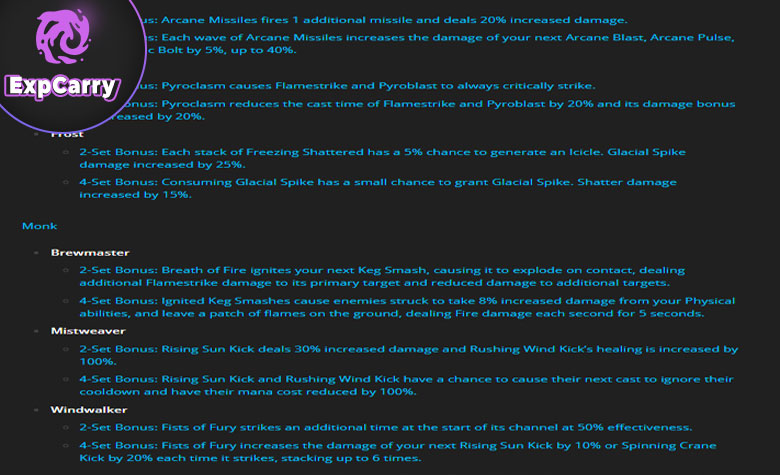
The strongest Season 2 bonuses are likely to be the ones that extend an existing spec pattern rather than forcing a completely alien one. Blizzard describes the bonuses as an extension of the spec currently being played, and that is the correct target. A good tier set should make the rotation feel sharper, not make the player feel like the spec has been borrowed from another class for one patch. The challenge is that the difference can be narrow. A proc that rewards normal play can feel good. A proc that makes players ignore established priorities can feel like a bug wearing a set bonus.
Several revealed bonuses show the type of design Blizzard is experimenting with. Frost Death Knight leans into Remorseless Winter and stacking attack-speed pressure. Havoc Demon Hunter connects Essence Break with Cycle of Hatred, which may affect cooldown flow and talent expectations. Balance Druid ties part of its output to Eclipse timing, creating a damage curve instead of a flat buff. Feral Druid rewards combo point spending during Berserk or Incarnation and extends those windows with the four-piece. Augmentation Evoker uses Upheaval and Fate Mirror interaction, which makes the set depend on a spec-defining support mechanic rather than only on personal damage.
These examples show why Season 2 is more interesting than a full class list. The question is not only which spec gets the biggest number. The question is whether a bonus changes what the player cares about during a fight. Does it make a cooldown more central? Does it make a resource window more valuable? Does it move a talent from optional to mandatory? Does it make a single-target ability appear in AoE or an AoE spell appear in single-target? Those are the questions that decide whether a tier set creates depth or creates friction.
Complex Does Not Always Mean Better
The early community reaction already shows the risk. Some players are asking whether several bonuses are still too passive for Blizzard's stated goals. Others are concerned that certain bonuses may push unpopular talents, desync cooldowns, or add tracking without adding satisfying decisions. Some early reactions also point to bonuses that look closer to passive throughput than real rotational changes, which is exactly the kind of issue PTR testing is meant to expose.
The important point is that complexity has to be felt in gameplay, not just written into a tooltip. A set that adds a conditional proc but never changes a decision is still passive. A set that changes every decision but feels awkward can be worse than a flat damage buff. The best tier sets usually sit between those extremes. They create a reason to pay attention without making the spec feel unstable. They reward good timing without punishing casual play too harshly. They make raid and Mythic+ rotations feel fresher without forcing every guide to rebuild the entire spec around one temporary item set.
Why Blizzard Is Bringing Back More Rotational Tier Sets Now
The timing is not random. Midnight Season 1 came after broad class design changes, and Blizzard needed a stable baseline. If the launch tier sets had also been highly experimental, it would have been harder to separate class problems from gear problems. A weak rotation could be blamed on the spec, the set, the talents, or all three at once. By keeping Season 1 simpler, Blizzard gave players time to learn the new version of their class before gear started adding more seasonal variation.
Season 2 is the natural place to raise the ceiling. Players already know the new talent trees, the basic damage profile, the raid and Mythic+ environment, and the early expansion meta. More complex tier bonuses can now serve as a seasonal refresh instead of a launch-day overload. This matches Blizzard's broader class-design logic: establish a baseline first, then use later patches and gear to add new interactions, new priorities, and new reasons to revisit a spec.
There is also a practical live-service reason. Tier sets need to make a season feel different. If every season only gives players a new raid skin and a passive 5 percent modifier, the gear chase becomes less exciting. Rotational bonuses give a season identity. They make players ask whether their opener changes, whether a cooldown should be tracked, whether a new talent build becomes viable, and whether the spec's damage profile becomes smoother across encounter types. That is what tier sets used to do when they were at their most memorable. They did not just raise output. They changed how a class felt for a patch.
| Tier Set Type | Player Experience | Design Risk |
| Flat damage bonus | Easy to understand and easy to tune | Feels invisible after the first equip |
| Proc-based bonus | Adds tracking and short-term decision points | Can become random or hard to notice |
| Cooldown-linked bonus | Can reshape burst windows and opener planning | Can fight against Blizzard's burst reduction goals |
| Resource-linked bonus | Changes pacing and ability priority | Can flood the spec or create waste |
| Talent-linked bonus | Can revive underused builds or reinforce class identity | Can force players into talents they dislike |
| Rotation-changing bonus | Makes the season feel different in raids and Mythic+ | Can disrupt established builds too heavily |
The Real Test Is Raid, Mythic+, and PvP Value
Tier sets do not exist in one type of content. A bonus that feels smooth on a raid boss can feel weak in Mythic+ trash. A bonus that creates excellent AoE can be hard to justify in single-target. A healing set that looks strong on paper can fail if it buffs a spell the spec does not actively choose to press. A tank set can be powerful but still feel poor if its defensive value appears at the wrong moment. Blizzard's own feedback instructions focus heavily on this split because Season 2 bonuses have to work across content types without turning into mandatory gimmicks.
This is why the return of complex tier sets should not be judged only by damage rankings. The best bonus is not always the one with the largest sim result in the first PTR build. A good Season 2 set should make the spec feel more complete in real encounters. It should interact with the gameplay loop players already use, give them something meaningful to optimize, and avoid creating degenerate behavior. If a set encourages a player to spam one button, ignore another core spell, or pick a talent only because the four-piece makes everything else worse, the design has missed the target.
The PTR phase is therefore especially important for this round of bonuses. These bonuses are not only numbers. They are temporary class mechanics. Blizzard can tune a flat damage bonus late, but a rotational set needs earlier feedback because the problem may be structural. If the set changes the wrong button, rewards the wrong timing, or conflicts with popular builds, increasing the coefficient will not fix it. The set has to be fun before it is balanced.
Final thoughts
Midnight Season 2 tier sets are important because they show Blizzard moving gear back into class gameplay. Season 1 established a simpler baseline after major class changes. Season 2 is where tier gear starts adding more complexity, more tracking, and more rotational identity. That is a healthier direction if Blizzard can keep the bonuses tied to existing spec logic instead of forcing awkward temporary builds.
The return of more complex tier sets is not automatically a win. Some bonuses will probably need tuning, some may need redesigns, and some may still feel too passive despite the stated goal. These are PTR bonuses, so the final version may not look exactly like the first reveal. But the broader direction is clear. Blizzard wants tier sets to do more than add hidden damage. The best Season 2 bonuses will be the ones players can feel in their rotation without feeling controlled by them. If that balance holds, Midnight Season 2 could make tier gear feel like seasonal class design again instead of just another item-level checkpoint.