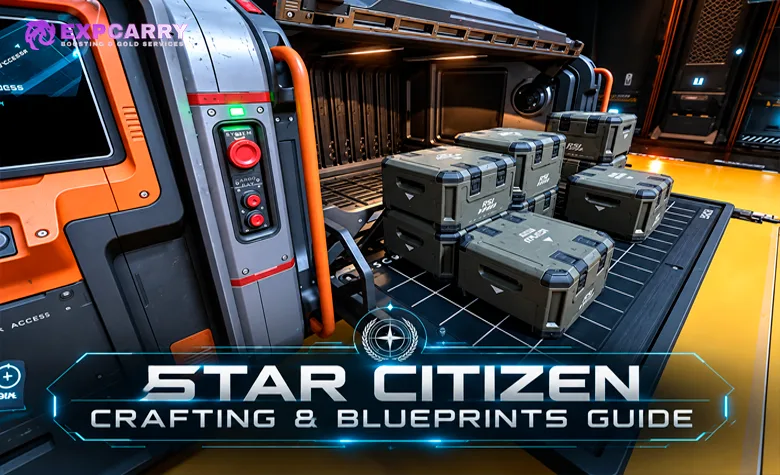
Star Citizen crafting lets players manufacture weapons, armor, ammunition, ship components and industrial equipment using unlocked blueprints and gathered resources. In Alpha 4.10.2 LIVE, the system revolves around the Item Fabricator, mission-earned recipes and material quality, which directly influences the performance of many finished items. Players can start with basic blueprints, unlock additional recipes through contracts and reputation progression, and use mining, refining or other supported sources to supply the required materials. However, blueprint availability depends on current mission reward pools, while individual recipes can have different quality requirements. The most effective approach is to choose useful equipment first, identify its blueprint source and gather the exact materials needed before beginning production.
Short answer: To craft in Star Citizen, obtain an Item Fabricator, unlock the required blueprint, gather compatible materials and submit the recipe through the Fabricator interface. Start with available weapon or ammunition recipes, then prioritize blueprints for frequently used armor, ship components and specialized equipment. Higher-quality materials can improve crafted stats, but each ingredient affects specific properties and some recipes require a minimum quality.
How Crafting Works in Star Citizen Alpha 4.10.2
Crafting became playable with Alpha 4.7, which introduced the Item Fabricator, material quality and mission-based blueprints. Subsequent updates expanded the available equipment categories and reward pools, including ship components, additional weapons and specialized industrial hardware. The current Alpha 4.10.2 LIVE build retains this system, although recipes, mission rewards and component balance remain subject to change during development.
A complete crafting operation involves obtaining the recipe, securing its materials, manufacturing the item and collecting the finished product. Players can gather materials themselves or acquire them through other supported methods, but the Fabricator still requires the correct resource types and quantities. The quality of those resources determines whether the finished item receives beneficial, neutral or potentially negative stat adjustments where the recipe supports quality modifiers.
The main parts of the crafting system are:
- Blueprints: Recipes that define the item, required ingredients, material slots and production process.
- Item Fabricator: A deployable machine used to manufacture and dismantle supported equipment.
- Crafting materials: Minerals and other accepted resources obtained through mining, salvaging, refining or trading where supported.
- Material quality: A property of individual resources that can influence the crafted item's statistics.
- Mission rewards: Additional blueprints earned from specific contract reward pools, sometimes behind reputation or story requirements.
- Crafting queue: The Fabricator system that manages ongoing production, pending jobs and completed items.
Crafting an item does not consume its unlocked blueprint under the current system. Once unlocked, the recipe remains available for subsequent production, provided the player supplies fresh materials. The finished equipment is a separate physical item and must still be delivered, stored and managed normally.
Alpha 4.10.2 LIVE context: Cloud Imperium Games released this branch on October 9, 2026, as build 4.10.2-LIVE.12881860, with Long Term Persistence preserved. The operational crafting system described here is based on official Alpha 4.7 release mechanics and current 4.10.2 equipment records. Future features such as large-scale ship fabrication, dedicated fabrication hangars and advanced blueprint research should not be confused with capabilities already available in the current LIVE build.
How to Get and Set Up an Item Fabricator
The Item Fabricator is the central workstation for current crafting and dismantling. According to CIG's official crafting release notes, Fabricators can be purchased from participating Kel-To and Dumper's Depot shops in Stanton and refinery shops in Pyro. They are physical deployable equipment rather than a permanent crafting interface available from every station terminal.
After purchasing a Fabricator, retrieve it through the freight elevator and move it to a suitable working location. CIG supports placement in personal hangars or on sufficiently large ship cargo grids, allowing players to establish stationary or transportable crafting setups. The machine requires enough physical space for placement and interaction, so its position should provide clear access to the crafting interface and finished-item handling.
Where to Place the Fabricator
A personal hangar is a practical starting location because it provides space for the machine, resource cargo and storage management. A ship with a sufficiently large compatible cargo grid offers a more mobile alternative, although equipment positioning and safe transport become more important. The machine's door must be closed before moving it with a tractor beam, as specified in the official release notes.
Fabricator availability at individual shops may change with stock and patch updates. If your intended shop does not list one, check another supported vendor rather than assuming the crafting system has been removed. Once the machine is positioned, confirm you can open its interface and access the materials intended for production.
How to Craft an Item Step by Step
Crafting begins from the Fabricator's blueprint library. The interface displays available recipes and the materials required for each one, including separate input slots and the characteristics affected by material quality. Follow this process for a normal production job:
- Open the Item Fabricator: Interact with the deployed machine and access its crafting interface.
- Select a blueprint: Choose a default or previously unlocked recipe from the available list.
- Check the ingredients: Review each required resource, quantity and minimum-quality restriction before proceeding.
- Assign materials: Select the appropriate resources manually or use the available auto-fill options.
- Inspect the predicted result: Compare the material qualities and displayed stat adjustments, especially when using valuable resources.
- Choose the delivery location: Select a supported local inventory or the machine's cargo grid for the finished item.
- Start production: Confirm the job and monitor its progress through the crafting queue.
- Collect the result: Retrieve the completed equipment from the selected destination and inspect its characteristics.
The interface includes auto-fill options that can select higher- or lower-quality available materials. This is convenient for routine manufacturing, but automatic selection is not always appropriate for valuable blueprints. Before confirming a high-value craft, inspect every assigned resource to avoid spending premium materials on a stat that provides little benefit.
Crafting Queue, Production Time and Delivery
Fabricators maintain separate crafting and dismantling queues containing ongoing and pending jobs. The interface also supports delivery-location management and a history of completed operations. Production time depends on the recipe, meaning ammunition can be manufactured much faster than many large weapons or ship components.
Choose the delivery destination before confirming a job and ensure that the intended storage location can accommodate the result. The selected destination is retained when moving between blueprints under the documented Fabricator behavior, but it remains worth checking when switching between small personal equipment and bulkier components.
For repeated production, organize resources before starting multiple jobs. Keeping compatible materials accessible reduces unnecessary transfers and makes it easier to confirm that every queued recipe can be completed.
How to Unlock Blueprints in Star Citizen
Blueprint ownership determines which items a player can manufacture. Players begin with a small collection of default recipes, while additional designs must be earned through supported gameplay. CIG's official Alpha 4.7 release notes establish mission rewards as the principal route for acquiring new blueprints and explain that individual missions can have their own designated blueprint pools.
When a qualifying mission awards a blueprint, the unlocked recipe becomes available in the Fabricator. This is different from receiving a finished weapon, armor piece or ship component as an ordinary mission reward. A blueprint provides repeatable manufacturing access, but every subsequent craft still consumes materials.
Starting Blueprints and Basic Crafting
Default blueprints allow players to learn the manufacturing process without first completing a long reputation chain. Current 4.10.2 crafting records identify the standard P4-AR Rifle as an available-by-default recipe, making it a useful example of weapon construction with separate frame, stock and barrel materials.
Starting with an accessible recipe allows you to understand material assignment, quality effects, delivery locations and production timing before investing in specialized equipment. Basic ammunition recipes are also useful for learning the system because they generally involve smaller material quantities and shorter production times.
Do not assume every variant of a default weapon is automatically unlocked. Named variants, attachments and matching magazines may have separate blueprint records or different acquisition requirements.
Mission Blueprint Rewards and Reputation Requirements
Additional blueprints are associated with contracts and mission reward pools. A mission may reward a specific recipe or draw from a larger group of possible blueprints, while access to the mission itself can depend on faction reputation, certifications or prior story progression.
The important distinction is between reaching a mission and obtaining a particular reward. Unlocking a higher reputation tier may give access to contracts containing desirable blueprints, but it does not automatically grant every recipe in those pools. Repeated completions may be required when rewards are selected from multiple possible outcomes.
| Progression Source | Blueprint Focus | Important Requirement |
|---|---|---|
| Default Blueprint Library | Starting weapons and other basic recipes | Available recipes can be inspected directly in the Fabricator |
| Citizens for Prosperity | FPS weapons, armor and ammunition | Match the desired blueprint to the applicable contract reward pool |
| Headhunters and Related Combat Contracts | Weapons, specialized armor and combat equipment | Access to eligible missions and their current reward pools |
| Bounty Hunters Guild | Selected armor and equipment blueprints | Appropriate bounty contracts and reputation progression |
| Recco Battaglia | Mining modules, ore pods and specialized equipment | Story missions, reputation ranks and later contracts |
| Siege of Orison | BUL-H4-related armor and equipment blueprints | Completion of the relevant instanced mission and reward selection |
| Defend Location Missions | Blueprint rewards tied to higher-tier completion | Access to the relevant mission and completion tier |
These are documented progression categories, not a promise that every associated blueprint is obtainable from every mission in the category. Individual contract pools and availability can change between patches. For a specific recipe, verify the exact current mission and any reputation requirement before committing to repeated farming.
Do Blueprint Unlocks Survive Death and Wipes?
CIG's official Alpha 4.7 notes state that earned blueprints are bound to the player's account and retained through death. This means losing a crafted rifle or armor set does not remove the corresponding recipe, provided the blueprint was successfully unlocked.
Blueprint persistence was also confirmed during the Alpha 4.8 comprehensive wipe. CIG reset ordinary in-game progression and resources while explicitly preserving earned blueprints. However, that particular wipe does not guarantee that all future development resets will follow identical rules. Always check the published wipe instructions for the relevant update rather than treating current persistence behavior as an unconditional permanent guarantee.
Explore services related to this guide, selected from our Star Citizen catalog.
View All Star Citizen Services


Crafting Materials and Quality Explained
Material quality is one of the defining features of Star Citizen crafting. Resources are not interchangeable merely because they have the same name: different batches can carry different quality values, and those values influence the final equipment's performance when the recipe supports quality-based modifiers. A recipe can therefore produce different results depending on the ingredients selected.
Alpha 4.7 introduced quality values for gathered mineables and made them visible in the mining interface, inventory and Fabricator. CIG also confirmed that material quality is preserved through supported refining operations, allowing higher-quality ore to remain valuable after processing. The broader Star Citizen Mining Guide explains resource extraction, while the Star Citizen Refinery Guide covers processing methods, output quantities and material handling.
How the 0–1000 Material Quality Scale Works
Current 4.10.2 crafting databases represent material quality on a scale running from 0 to 1000, commonly displayed using the Q prefix. The blueprint's individual input slots determine how those quality values influence the finished item's statistics. A high-quality ingredient can improve one characteristic without changing unrelated attributes.
Community-maintained blueprint calculators use Q500 as the neutral baseline for many recipes. At this reference point, the modeled stat receives no quality-derived improvement, while inputs below the baseline can produce negative adjustments and higher-quality inputs can improve relevant characteristics. Q500 is a calculation reference, not a universal minimum material requirement, because individual recipes may enforce different quality thresholds.
Quality 1000 also does not mean every possible statistic receives the same improvement. A high-quality barrel may improve a weapon's damage-related behavior, while a frame can affect recoil instead. The relevant values must be checked for each material slot in the actual blueprint.
Why Different Material Slots Affect Different Stats
Crafting recipes divide an item into functional material inputs. A firearm may require separate resources for its frame, stock and barrel, while armor can use different materials for protection, insulation and structural support. Ship components follow their own slot arrangements depending on the component family.
The P4-AR Rifle is a useful current example because its 4.10.2 blueprint data identifies three material slots with separate stat relationships:
| Crafting Slot | Required Material | Quantity | Quality-Dependent Properties |
|---|---|---|---|
| Frame | Aluminum | 0.04 SCU | Recoil smoothness, handling and kick |
| Stock | Hephaestanite | 0.02 SCU | Recoil smoothness, handling and kick |
| Barrel | Iron | 0.02 SCU | Impact force and fire rate |
This recipe demonstrates why blindly assigning the highest-quality material to every slot is inefficient. A player prioritizing firearm handling should examine the frame and stock quality, while someone optimizing offensive performance should pay particular attention to the barrel. Using a premium frame does not automatically provide the same benefit as using a premium barrel.
The current P4-AR recipe lists a production time of two minutes and thirty seconds. Its materials and quality behavior can be examined in the P4-AR Blueprint Database, which provides individual material-slot details and dismantling information.
Minimum Quality Requirements and Failed Material Selection
Some crafting recipes require materials to meet a minimum quality threshold. The Fabricator will not accept an ingredient that fails the applicable requirement, even when the resource type and quantity are otherwise correct.
Check the minimum quality displayed for every material slot before collecting or transporting resources. A rare blueprint can remain unusable until you obtain a sufficiently good batch of the required material, so low-quality stockpiles are not always suitable substitutes.
Minimum quality should also be separated from optimization. A resource may satisfy the recipe and successfully produce the item without providing the strongest possible stat result. Meeting the threshold makes the craft possible; choosing better materials determines whether the additional investment is worthwhile.
Which Crafting Resources Should You Keep?
The most useful resource stockpile depends on the blueprints you own or intend to farm. Current recipes draw from a wide variety of metals, minerals and specialized materials, including Iron, Aluminum, Hephaestanite, Copper, Tungsten, Laranite, Agricium, Ouratite, Aslarite, Torite and Corundum.
Ballistic weapons commonly use metals for frames and barrels, while armor recipes may require materials associated with protective layers and insulation. Ship components can combine structural materials with minerals related to their functional systems. For example, current crafting records list Iron, Corundum and Glacosite for the 5CA 'Akura' shield generator blueprint.
Rather than collecting everything indiscriminately, choose your intended recipes and create a resource checklist from their current requirements. This prevents valuable cargo space from being occupied by materials that cannot contribute to your immediate crafting goals.
What Can You Craft in Star Citizen?
The current Fabricator system includes personal equipment, ship equipment and specialized industrial recipes. The available catalog is considerably broader than the initial crafting release, but individual blueprints have different acquisition requirements and not every record found in a database is necessarily accessible through a currently available mission.
The major categories are summarized below:
| Category | Examples | Main Crafting Consideration |
|---|---|---|
| FPS Weapons | Rifles, pistols, shotguns and sniper rifles | Material effects on damage-related and recoil statistics |
| Armor and Personal Equipment | Helmets, torso armor, arms, legs and selected undersuits | Protection, environmental resistance and component-specific recipes |
| Ammunition and Attachments | Magazines, batteries and compatible weapon equipment | Repeatable production and resource efficiency |
| Ship Components | Power plants, coolers, shield generators, quantum drives and selected radar equipment | Component compatibility and quality-dependent performance |
| Ship Weapons | Selected cannons, repeaters and other ship weapon types | Weapon size, availability and current quality modifiers |
| Industrial Equipment | Mining modules, ore pods and other supported industrial components | Specialized blueprint unlocks and equipment compatibility |
Equipment in these categories should not be treated as having identical quality scaling. Each recipe defines its own material slots, stat adjustments and minimum requirements. The item descriptions and current Fabricator data take priority over generalized assumptions about its category.
FPS Weapon and Ammunition Crafting
FPS weapons are accessible early examples of the crafting system because their components and performance characteristics are relatively straightforward to compare. A rifle blueprint can use different ingredients for its frame, stock and barrel, allowing material quality to affect handling and offensive properties separately.
Current crafting records include familiar weapons such as the P4-AR alongside numerous mission-earned designs. Specialized weapon progression can involve the FS-9, BR-2, Gallant, P8-SC, C54 and various sniper rifles, depending on the relevant mission pools and current availability.
Ammunition production is especially useful when maintaining a repeatable combat loadout. However, obtaining a weapon blueprint does not necessarily unlock every compatible magazine or battery recipe. Check whether the matching ammunition blueprint is available separately and whether its ingredients are economical enough for regular production.
Unlike many weapon recipes, some ammunition blueprints do not expose meaningful quality-dependent stat improvements. For example, current P4-AR magazine records list Hephaestanite and Iron as inputs without adjustable output-quality modifiers. Reserve premium materials for recipes where their higher quality actually changes the resulting item.
Armor Blueprints and Full Equipment Sets
Armor crafting commonly uses separate recipes for helmets, torso protection, arm pieces and leg pieces. Unlocking one section of an armor family does not automatically mean that every matching item or color variant becomes available. Players seeking a complete set should inspect the blueprint reward pool and identify which individual pieces remain missing.
Material quality can affect defensive performance, including relevant mitigation and environmental characteristics when those modifiers are supported by the recipe. Current blueprint records associate different resource roles with armor structure, protective layers and insulation, making material selection important for the particular environment or combat activity the player expects to face.
Armor progression is especially useful for players who regularly participate in bunker contracts, bounty missions or dangerous FPS encounters. The best recipe is not necessarily the rarest armor design: a frequently used and affordable set can provide more practical value than expensive equipment that requires difficult material collection after every loss.
Ship Component Blueprints: Shields, Power Plants, Coolers and Quantum Drives
Ship component crafting adds another layer to equipment optimization because the finished item can influence vehicle performance. Current blueprint records contain recipes for shield generators, power plants, coolers, quantum drives and related equipment. The important decision is not simply whether the component can be crafted, but whether its quality-dependent properties improve the ship's intended loadout.
For shield generators, current records identify quality modifiers related to shielding performance and component integrity. Power plants can have quality-dependent output characteristics, while coolers and quantum drives use their own performance modifiers. The exact results depend on component size, blueprint and current balance.
The 5CA 'Akura' shield generator is an example of a component with a current crafting record. Its recipe identifies structural and functional material inputs rather than treating the entire shield as one generic resource requirement. Before manufacturing it, confirm that the finished component fits the target ship and offers a useful improvement over existing equipment.
These details make ship components attractive long-term blueprint targets, especially for players who rely on the same ship frequently. However, do not apply old Alpha 4.8 preview bonuses universally to Alpha 4.10.2 components. The earlier Star Citizen 4.8 Blueprints Guide provides historical context for the expansion into ship equipment, but current recipes and stat values should take priority.
Ship Weapons and Industrial Blueprints
Ship weapon crafting covers selected weapon families with individual size and compatibility requirements. A crafted cannon or repeater must still fit the intended hardpoint, and any quality advantage needs to be compared with the actual performance of the installed alternative.
Industrial crafting follows a different priority. Mining equipment is valuable when it improves material collection, operating convenience or storage capacity rather than direct combat output. Alpha 4.10 expanded this area through Recco Battaglia's blueprint progression, which includes mining modules and several ore-pod designs.
Current records identify craftable recipes for Clearcut, Stampede, Deluge, Overrun and Torrent III, alongside ore pods associated with Drake, Argo, MISC and the Golem. These blueprints have their own unlock conditions, and a completed industrial item must still be compatible with the intended ship or mining head. The Recco Battaglia Guide explains the relevant mission chain, reputation requirements and equipment rewards.
Best Blueprints to Farm First in Star Citizen
Blueprint priority should reflect how frequently an item will be used, how difficult its materials are to obtain and whether the recipe offers a meaningful improvement over equipment already available. A rare blueprint is not automatically a strong investment when its ingredients are expensive or its finished item does not support your current activity.
A practical progression starts with basic equipment and expands into specialized blueprints once a reliable material supply and suitable mission access are available. The following priorities are recommendations based on repeatable usefulness and resource planning, not an officially established ranking of blueprint drop rates.
| Priority | Blueprint Target | Reason to Pursue It | Main Consideration |
|---|---|---|---|
| Starter | Available basic weapons and ammunition | Learn the full crafting process with accessible recipes | Confirm existing unlocks before farming |
| High for FPS Players | Frequently used rifles, magazines and armor pieces | Replace commonly consumed equipment through repeatable production | Find the correct mission pool and material supply |
| High for Ship Optimization | Compatible shields, power plants, coolers and quantum drives | Improve frequently used ship equipment where quality modifiers are meaningful | Verify component fitment and actual stat changes |
| High for Mining Specialists | Recco mining modules and ore pods | Support mining loadouts and material logistics | Story, reputation and equipment compatibility requirements |
| Specialized | Rare sniper rifles, heavy weapons and combat armor | Support demanding FPS content and specialized loadouts | More demanding missions or resource requirements |
| Conditional | Expensive or unusual ship weapon blueprints | Provide additional loadout options when their modifiers justify crafting | Current balance and recipe availability |
Players should adjust this order to match their activities. Someone primarily completing FPS contracts may benefit more from reliable weapon and armor production, while a dedicated miner could gain greater value from ore-pod recipes and mining modules. A ship-focused player should compare the actual advantages of craftable components before selecting a reputation grind.
Best Beginner Blueprint Path
Begin by checking the Fabricator's default recipes and manufacturing a relatively inexpensive item. The P4-AR is a useful example because its material slots demonstrate how quality influences different firearm statistics. This first craft should establish that you understand resource selection, production timing and delivery before you begin pursuing specialized rewards.
Once basic production is familiar, select a weapon or armor recipe aligned with your normal missions. Citizens for Prosperity and other combat-related contract networks provide possible progression paths, but the precise blueprint source must be verified in the current mission pool. Prioritize a design you will actually manufacture repeatedly instead of collecting recipes without the materials to use them.
Best Combat Blueprint Targets
For regular FPS combat, practical rifles and matching ammunition are useful targets because they support repeated deployments. Blueprint databases and existing ExpCarry research identify several weapon families associated with Citizens for Prosperity and Headhunters reward pools, including P8-SC, C54, S71, FS-9, BR-2 and selected sniper rifles. The exact availability of a particular variant should still be checked against current 4.10.2 mission data.
Players specializing in heavy FPS missions can also pursue armor families such as ADP, ORC-mkX and other contract-linked sets. These are best approached as multiple individual blueprint goals, since obtaining a helmet recipe alone does not guarantee the corresponding torso, arm and leg recipes.
The Citizens for Prosperity Blueprints Guide covers reported weapon, ammunition and armor reward pools in more detail. For Headhunters-related equipment, check the currently available contracts and their individual blueprint rewards rather than assuming that every contract in the faction shares the same pool.
Best Industrial Blueprint Targets
Industrial players should prioritize equipment that improves a loop they already perform regularly. For miners, Recco Battaglia's module and ore-pod blueprints are more immediately relevant than unrelated FPS equipment. A module can support a particular mining-head configuration, while a compatible storage upgrade can change how mineral collection and transportation are organized.
Recco's opening story mission, Welcome to the System, awards the Clearcut module blueprint according to current 4.10 mission records. Later progression includes Deluge, Overrun and ore-pod recipes, with story and reputation gates determining when those rewards become available. Complete the required stages in sequence rather than assuming every blueprint can be farmed from the first contract.
The MISC Enhanced Ore Pod is a higher-progression example connected to Idea for Isaac. Current Alpha 4.10 records identify a minimum quality requirement of Q800 for its Iron crafting input, demonstrating why industrial blueprint planning needs both the unlock route and a suitable high-quality resource supply.
Siege of Orison and BUL-H4 Blueprint Farming
The reworked Siege of Orison offers a separate path to specialized combat equipment. Current Alpha 4.10 reward data associates the instanced operation with BUL-H4 armor-related blueprints, including the one-piece armor suit, helmet and H4-PBF Ammo Carrier. These are separate possible rewards, so obtaining one does not complete the entire equipment collection. The Vendetta HMG and its reusable blueprint follow a different acquisition path.
The base BUL-H4 reward pool is associated with Retake Platforms From Nine Tails. Current mission records indicate that a successful completion awards one blueprint from the pool, meaning repeat clears may be necessary to obtain all three pieces. There is no established guarantee that every successive reward will be a previously missing design.
The Star Citizen BUL-H4 Armor Guide explains the armor components, Vendetta HMG acquisition and ammunition logistics in greater detail.
How to Farm Specific Blueprints Efficiently
Efficient blueprint farming starts with identifying the exact recipe rather than repeating an entire mission category without a target. The correct route may require reputation progression, a story mission or a repeatable contract tied to a particular blueprint reward pool.
Use the following process before beginning a farming session:
- Select the desired item: Record the exact name, variant, equipment size and blueprint identity.
- Check the current source: Identify the applicable contract, reward pool and game version in a current blueprint database.
- Verify mission access: Check whether the contract requires reputation, an introduction, certification or prior story completion.
- Complete prerequisites: Progress through the necessary missions before farming the target pool.
- Run the correct contract: Concentrate on missions confirmed to contain the desired recipe instead of farming unrelated rewards.
- Check the reward: Verify whether the unlocked recipe appears in the Fabricator after successful completion.
- Prepare production materials: Gather the required quantities and quality grades so the blueprint can be used immediately.
- Repeat only when necessary: If the contract uses a multi-blueprint reward pool, continue while the desired recipe remains missing.
For multi-item armor sets, identify every required blueprint before starting. A route that awards several useful pieces can be more efficient than focusing on a single rare reward, particularly when you are also building the reputation needed for later contracts.
Reputation progression is explained in the Star Citizen Reputation Guide. For more specialized unlawful contract rewards, the Vaughn Blueprints Guide explains the relevant mission progression, equipment blueprints and material requirements.
Using Blueprint Finders and Crafting Calculators
Current community tools can make blueprint planning easier by combining recipe requirements with available mission data. The Star Citizen Blueprint Finder provides an Alpha 4.10-focused interface for checking recipes, mission associations, faction requirements and simulated material-quality effects. The Star Citizen Fabricator Database also lists current recipes and material inputs.
These databases are especially useful for comparing equipment before spending high-quality resources. However, their blueprint counts and acquisition records may differ because of data extraction methods, classifications or update timing. A recipe appearing in extracted game data does not independently prove that the corresponding mission is active or currently awards it.
Use tools to identify candidate rewards, but confirm the mission and recipe in the LIVE client whenever possible. Avoid publishing a universal number of available blueprints or guaranteed farming attempts when the current catalogs do not agree.
How Dismantling Works in Star Citizen
The Item Fabricator supports dismantling eligible equipment as well as manufacturing it. Under the official Alpha 4.7 rules, items associated with crafting recipes can be dismantled to recover materials. This creates a connection between recovered equipment and future production, but dismantling should not be mistaken for a full refund of everything used to manufacture the original item.
Items crafted by players return materials at the quality used during their production. Items found in the world instead return materials at a default quality value, according to CIG's original system description. The amount recovered is determined by the applicable dismantling rules and should be checked before processing an item.
Current P4-AR blueprint data illustrates this difference between consumption and recovery. A standard craft uses 0.04 SCU of Aluminum and 0.02 SCU each of Hephaestanite and Iron, while its recorded dismantling output returns half those quantities. This is a specific recipe example, not a guaranteed universal dismantling percentage for every item.
Dismantling is useful when an unwanted eligible item contains materials that support a planned craft. However, an item with valuable equipment performance or difficult replacement requirements may be worth keeping. Compare the expected recovered resources against the item's existing usefulness before dismantling it.
Best Way to Gather Materials for Crafting
Material collection should be organized around specific recipes rather than maximum commodity resale value alone. A resource that is relatively ordinary on the trading market can become important when its quality meets the requirements of a difficult blueprint. Conversely, expensive ore may provide little crafting value if none of the selected recipes require it.
Mining and refining form the main supply chain for many mineral-based recipes. Salvaging, recovered resources and player trading can provide additional inputs where supported. These methods involve different equipment, transport requirements and risks, so the best supply route depends on the material and how much of it the recipe consumes.
Mining and Refining High-Quality Materials
When mining for crafting, inspect the actual quality and composition of deposits instead of selecting rocks solely by expected selling price. High-quality batches of the required material may be more useful than larger quantities that do not meet a blueprint's threshold. CIG's mining changes introduced visible quality information and preserved it during supported refining, making resource selection a meaningful part of the crafting process.
At the refinery, compare processing time, material yield and fees before submitting a work order. A high-yield method can help conserve valuable ore, but the appropriate choice depends on how urgently you need the finished materials and how much processing loss you can accept. The actual resource quality and expected output should be verified before the work order is confirmed.
For resource-specific locations and priorities, the Star Citizen Best Ore Guide compares minerals, deposit characteristics and mining opportunities across the available systems.
Storing Materials Without Losing Useful Quality
Resource organization matters because a blueprint may require several different materials at specific quantities and quality grades. Mixing production planning across too many unrelated recipes can result in large stockpiles that still cannot complete a single valuable craft.
Separate resources by their intended use and record the quality of the batches being reserved. Materials suitable for ordinary ammunition should not automatically consume the same premium stock earmarked for a quality-sensitive weapon or ship component. Before moving cargo to a Fabricator, confirm that the actual amounts and grades match the selected blueprint.
For group crafting, a shared material checklist also helps prevent duplicated collection efforts. One player can focus on a difficult mineral while another supplies more common resources, with production beginning only after all required ingredients are accounted for.
Common Star Citizen Crafting Problems and Fixes
Crafting failures often come from material restrictions, incorrect inventory assumptions or confusion between blueprint ownership and physical rewards. Alpha 4.10.2 also has a confirmed display issue involving the statistics of manufactured items.
A Blueprint Is Missing From the Fabricator
First confirm whether the recipe is a default unlock or requires a specific mission reward. Completing a faction mission does not necessarily unlock every blueprint associated with that organization, especially when the contract uses multiple possible rewards.
Check the mission's actual reward outcome and the Fabricator library before assuming the unlock failed. If the recipe appears only in a community database, verify that its mission source is currently available and that you have satisfied the relevant progression requirements. Do not confuse an item received as ordinary loot with an account-bound crafting blueprint.
The Fabricator Will Not Accept Materials
Check the exact resource identity, quantity and minimum quality shown in the blueprint. A material may be the correct mineral but still fail a recipe because its quality is too low or because the required processed form is different from the resource currently stored.
Also confirm that the materials are available through an inventory source supported by the Fabricator. Use manual assignment to identify the specific slot that cannot be filled, and avoid relying on auto-fill until the missing or incompatible ingredient has been identified.
Crafted Items Do Not Show Improved Stats
This is a confirmed issue in Alpha 4.10.2. CIG's current Known Issues documentation states that a crafted item's modified characteristics may not display correctly while the item remains in inventory and is not equipped. This means the absence of visible bonuses in that inventory state does not necessarily indicate that the crafting process ignored material quality.
The official workaround is to equip the finished item and inspect its description again. Check the statistics after equipping before concluding that the item was manufactured without its expected modifiers.
The issue is documented in the official Alpha 4.10.2 Known Issues. Recheck the status after subsequent updates rather than assuming the workaround will always be necessary.
A Crafted Item Has Worse Stats Than Expected
Material quality affects each applicable recipe slot independently, and some blueprints can produce negative stat adjustments when input quality is below the relevant baseline or threshold. A successfully completed craft is therefore not guaranteed to outperform a standard version of the same item.
Inspect which material controls the disappointing statistic and compare the selected quality against the recipe's expected modifiers. For example, improving a rifle's frame quality may help recoil behavior without solving a problem caused by a low-quality barrel. Use the current blueprint data to plan the next craft rather than repeatedly manufacturing the same ineffective combination.
Confusing Current Crafting With Future Ship Fabrication
CIG has described broader plans involving advanced crafting progression, research and facilities capable of manufacturing vehicles and ships. These features belong to the game's longer-term development direction and must not be presented as fully operational through the current deployable Item Fabricator.
Alpha 4.10.2 supports the existing item-based blueprint and fabrication loop. A database entry for future equipment or a roadmap description of fabrication hangars does not automatically establish a live method for constructing an entire ship. Keep current item crafting separate from announced 1.0-scale manufacturing systems.
Star Citizen Crafting and Blueprints FAQ
These answers cover additional questions about fabrication requirements, blueprint ownership, quality and current manufacturing limits.
Where can you buy an Item Fabricator in Star Citizen? CIG identifies participating Kel-To and Dumper's Depot stores in Stanton and refinery shops in Pyro as sources. The Fabricator can be placed in a personal hangar or on a sufficiently large compatible ship cargo grid. Check the current store inventory before traveling specifically to purchase one.
Are Star Citizen blueprints reusable? Yes. An unlocked blueprint provides repeatable access to its crafting recipe, but each manufactured item still requires the appropriate resources. CIG also confirms that earned blueprints are account-bound and retained through death.
Does material quality matter when crafting ammunition? Material requirements still apply, but not every ammunition recipe has adjustable output-stat modifiers. Some current magazine blueprints use ordinary resource inputs without meaningful quality-based tuning. Check the specific recipe before spending premium materials.
Can you craft entire ships in Alpha 4.10.2? The current Item Fabricator supports eligible equipment and component recipes, not the complete future ship-manufacturing system described in CIG's longer-term crafting plans. Do not treat planned fabrication hangars or ship-construction blueprints as currently operational without a corresponding LIVE release.
Conclusion
Star Citizen crafting is most effective when blueprint farming, material collection and equipment priorities are planned together. Start with accessible recipes to learn the Fabricator, then pursue mission rewards for equipment you actually use. High-quality resources are worth preserving when their specific material slots improve important stats, while reputation-gated blueprints require a confirmed mission path before extended farming. In Alpha 4.10.2 LIVE, focus on repeatable weapon and armor production, compatible ship components and specialized industrial recipes, while checking current reward pools and equipment data before investing valuable materials.