
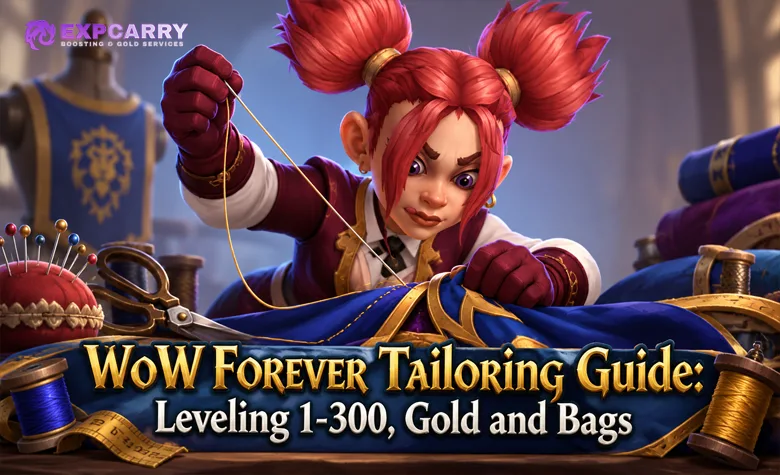
Tailoring in World of Warcraft: Forever is a primary crafting profession that turns cloth from humanoid enemies into cloth armor, bags, reagent bags, shirts, profession materials and high-level caster gear. It still progresses to 300 skill, but Forever expands the profession with new role-specific equipment, specialized storage, Camping objects and Legacy milestones. The best way to level Tailoring is to process cloth into bolts, use those bolts on recipes that still give efficient skill gains, preserve expensive Mageweave and Runecloth for useful crafts, and treat bags, Mooncloth and rare patterns as long-term markets rather than disposable leveling steps.
What is the best profession to pair with Tailoring in WoW Forever?
Enchanting is the most natural partner. Tailoring does not need a dedicated gathering profession because cloth comes primarily from humanoid enemies, and eligible unwanted crafted gear can become an additional source of enchanting materials through Disenchant.
How do you level Tailoring from 1 to 300?
Start with Linen Cloth and bolts, move through Wool and Silk, then use Mageweave and Runecloth for the upper ranges. Craft in smaller batches and switch when recipe difficulty changes because Forever adjusts many skill thresholds compared with old Classic routes.
How does Tailoring make gold?
Bags are the broadest market because every class needs inventory space. Forever also adds reagent bags for profession materials, while Mooncloth, spell-school gear, rare patterns and customer-material endgame crafts create higher-skill income options.
Does Tailoring have a specialization choice in WoW Forever?
No mutually exclusive Tailoring specialization comparable with Gnomish versus Goblin Engineering or the three Leatherworking branches is confirmed in current Forever data. Tailors differentiate themselves through pattern access, school-specific gear, rare recipes, Mooncloth and high-level crafting instead.
What does Tailoring add to Camping?
Current Forever data lists Faction Banner at 20 Tailoring, Spinning Wheel at 140 and Loom at 300. The line progresses from a Spirit benefit to reagent crafting and finally a portable Tailoring workspace.
As of September 21, 2026, WoW Forever is in beta, with the current playable progression still far below the full level-60 game. Blizzard began the beta with a level cap of 20 and plans to raise it to 30 later in testing. The beta runs through October 21 ahead of the November 4 launch. Low-level Tailoring can therefore be checked directly, while much of the 150-300 economy, Mooncloth demand and endgame pattern market still depends on current database information rather than a mature live economy. High-level recipes, acquisition sources and prices should be rechecked after major beta updates and again at launch.
WoW Forever Tailoring at a Glance
Tailoring has one major advantage over most crafting professions: its main raw material does not require a gathering profession slot. Cloth drops from humanoid enemies during normal leveling, so a Tailor can collect materials while questing and still pair the profession with Enchanting or another primary profession. Blizzard's WoW Forever Deep Dive also confirms more than 600 new profession recipes across the game, advanced Blueprint recipes and three Camping objects per profession, which gives Tailoring more value than simply crafting robes for cloth classes.
| Skill Range | Main Cloth | Recommended Focus | Practical Value |
|---|---|---|---|
| 1-75 | Linen Cloth | Bolts, simple cloth gear, Linen Bag and first reagent storage | Cheap skill gains, early bags, Faction Banner at 20 |
| 75-150 | Wool Cloth, Silk Cloth | Wool and Silk gear, bags, new Filigreed caster pieces | Leveling gear, reagent bags, Spinning Wheel preparation |
| 150-225 | Silk Cloth, Mageweave Cloth | Silk and Mageweave gear, larger bags, school-specific patterns | Caster gearing, storage market, Enchanting synergy |
| 225-300 | Mageweave Cloth, Runecloth, Felcloth, Mooncloth | Runecloth bags, high-level gear, Mooncloth and rare patterns | Level-60 crafts, premium storage, rare recipe services, Loom requirement at 300 |
The table is a material framework rather than a fixed shopping list. A recipe that looks efficient on paper can become expensive if the relevant cloth tier spikes on the Auction House. Tailoring is cheapest when you keep several recipes available, use naturally collected cloth and stop mass crafting once an item becomes an inefficient skill-up.
What Changed for Tailoring in WoW Forever
Forever expands Tailoring in three directions: more targeted caster equipment, more storage options and more open-world utility. The profession still makes familiar bags and cloth armor, but current beta and database information adds gear for particular spell schools and character roles instead of forcing every caster through the same generic stat package.
- More profession recipes: Blizzard has announced more than 600 new recipes across all professions and level ranges.
- School-specific cloth gear: current Forever data includes new Arcane, Fire, Frost, Shadow, healing and hybrid-oriented pieces.
- Reagent bags: Forever adds specialized bags for crafting materials, creating a new storage market alongside ordinary inventory bags.
- Camping begins at 20 Tailoring: Faction Banner adds a Spirit-focused campsite benefit during normal leveling.
- Spinning Wheel and Loom add profession functionality: the higher Camping tiers support reagent creation and recipes that require a Tailoring workspace.
- Legacy rewards profession milestones: current beta challenge data awards Legacy Points for reaching 150, 225 and 300 Tailoring for the first time.
- Rare pattern access matters more: expanded itemization gives a Tailor more ways to build a niche around particular caster roles or storage products.
One useful example is Filigreed Pristine Leggings, a new Forever cloth piece with Stamina, Intellect, Spirit, spell damage and increased healing. It illustrates the broader design: Tailoring can fill specific gearing gaps instead of producing only generic cloth armor.
How Cloth and Bolts Work
Tailoring converts raw cloth into bolts that become the main building blocks for armor and bags. Because cloth drops from humanoid enemies, your leveling route naturally affects profession supply. A character spending several levels in humanoid-heavy zones may build a large stock without a dedicated farming session, while beast-heavy routes can leave Tailoring behind.
| Cloth Tier | Typical Progression Stage | Main Uses | Economic Advice |
|---|---|---|---|
| Linen | Early game | Bolts, starter gear, Linen Bag, Faction Banner | Keep enough for the opening route; sell excess only after checking bag demand |
| Wool | Low-mid leveling | Wool gear, bags and early reagent bags | Often scarcer than Linen, so compare cloth price before mass crafting |
| Silk | Mid-level | Silk gear, bags, Spinning Wheel and caster pieces | Useful across many recipes; avoid converting the whole stock at once |
| Mageweave | Mid-high leveling | Bags, gear and higher profession progression | Can become expensive during profession rushes because multiple recipes compete for it |
| Runecloth | High level | Large bags, high-level armor, Loom and endgame patterns | Preserve for recipes with clear sale or self-use value |
| Felcloth and Mooncloth | Endgame | Premium patterns, bags and caster gear | Treat as high-value materials, not generic leveling cloth |
Do not turn every raw cloth stack into bolts immediately. Raw cloth can be more liquid on the Auction House, while bolts lock the material into Tailoring demand. Convert enough for the next group of crafts, then reassess before processing the rest.
Players who want help completing the profession without manually managing every cloth tier, trainer stop and crafting batch can use the WoW Forever Tailoring leveling service for selected ranges up to 300. The self-play route below remains a data-based planning route for players who prefer to craft everything themselves.
Explore services related to this guide, selected from our Professions catalog.
View All Professions Services

WoW Forever Tailoring Leveling 1-300
The route below uses current Forever recipe information but stays flexible where high-level beta testing is not yet possible. Recipe difficulty matters more than memorizing one old Classic list. Craft in smaller batches, use items you can equip or sell, and switch when the expected cloth cost per skill point becomes worse than another available recipe. Because the current beta cannot directly test the full 150-300 progression in a level-60 economy, treat the upper ranges as launch planning rather than a proven cheapest route.
Tailoring 1-75: Linen, Early Bags and Faction Banner
Begin by turning Linen Cloth into Bolt of Linen Cloth. Current Forever data keeps the basic two-Linen conversion, making bolts the natural opening step. After that, use simple Linen gear and bags while the recipes remain efficient.
- 1-20: make Linen bolts and low-cost starter gear. Keep bolts because they are used by both equipment and Camping recipes.
- At 20: current beta data lists Faction Banner. The recipe uses a Bolt of Linen Cloth and Coarse Thread.
- 20-45: use inexpensive Linen gear instead of forcing a bag recipe before it becomes available in the current profession window.
- At 45: current Forever data lists Linen Bag as a six-slot bag recipe. It creates something every class can use instead of vendor-only skill output.
- 45-75: compare Linen Bag, simple cloth gear and the first Wool preparation crafts. Move away from green Linen recipes when the skill-up rate becomes poor.
Early bags are useful but not automatically profitable. If vendor bags are cheap or every Tailor floods the Auction House with Linen Bags, the finished bag can sell for less than its cloth. Craft enough for your own inventory and skill, then check real demand before producing a large stock.
Tailoring 75-150: Wool, Silk, Reagent Bags and Filigreed Gear
The second range is where Forever Tailoring begins separating from a familiar Classic route. Wool and early Silk remain the material backbone, but current data adds reagent bags and Filigreed caster equipment with role-specific stat packages.
- 75-100: use Wool-based recipes and bolts while their skill value is reliable. Do not overbuy Wool if your current questing route is already producing Silk.
- At 70 or later: current pattern data includes Woolen Reagent Bag, an eight-slot bag dedicated to profession reagents. The pattern requires 70 Tailoring in current data.
- 75 onward: new Filigreed patterns enter the profession. Choose them for self-use or sale when their extra reagents are justified, not merely because they are new.
- 100-125: shift into Silk as recipes become efficient. Silk Reagent Bag gives profession-focused characters a ten-slot reagent option.
- 125-140: compare Silk gear, role-specific Filigreed patterns and useful bags. Preserve enough Bolt of Silk Cloth for the next Camping object.
- At 140: current data lists Spinning Wheel with a 140 Tailoring requirement. It uses five Bolts of Silk Cloth, two Simple Wood and three Fine Thread. Unlike the first profession Camping object learned at skill 20, Blizzard says advanced Camping objects come from Blueprint recipes, so reaching 140 is a skill requirement rather than proof that the recipe is learned automatically.
- 140-150: finish the range with whichever Silk or current trainer recipe gives the best balance of skill chance and finished value.
Reagent bags create a different market from ordinary bags. They appeal primarily to players carrying profession materials, so demand can rise when crafting activity increases even if ordinary bag prices remain flat.
Tailoring 150-225: Silk, Mageweave and School-Specific Gear
This range is where Mageweave begins to matter and where Tailoring gains more identity as a caster profession. Forever's new recipe pool includes pieces designed around particular spell schools and healing roles, so a craft can be valuable even if it is not the cheapest possible skill-up.
- 150-175: finish efficient Silk recipes and transition into Mageweave only when the cloth price makes sense.
- 175-190: use Mageweave gear and bags that produce something players can wear or store rather than dumping cloth into an obscure trainer item.
- At 190: current Azeroth Commerce Authority reward data lists Pattern: Mageweave Reagent Bag. Treat it as a specialized storage market rather than a guaranteed cheapest leveling craft.
- 190-215: compare Mageweave armor, bag recipes and any school-specific patterns you have unlocked.
- At 215: current Azeroth Commerce Authority reward data lists Pattern: Runecloth Reagent Bag, giving profession-heavy characters a larger specialized storage option before maximum Tailoring.
- 215-225: begin preserving Runecloth and expensive secondary reagents for the Artisan range rather than consuming them immediately.
Blizzard's beta announcement confirms that testing opens progression in stages. As of September 21, the playable cap still prevents the full middle- and high-level Tailoring economy from being tested in a complete level-60 population. Recipe requirements can be present in current data without launch profitability or acquisition routes being fully proven in play.
Tailoring 225-300: Runecloth, Mooncloth and Endgame Patterns
The final range is where Tailoring becomes a pattern-collection profession. Runecloth supports bags and general high-level gear, Felcloth feeds Mooncloth production, and rare patterns open caster, healing, resistance and class-specific markets. Preserve expensive cloth for items that provide real progression or sale value.
- 225-250: move from Mageweave into early Runecloth recipes as their skill value becomes efficient. Avoid burning Felcloth for ordinary skill-ups.
- At 230: current Forever data lists Mooncloth production through Pattern: Mooncloth. The conversion uses two Felcloth at a moonwell and has a four-day cooldown in current data.
- At 255: current data includes the pattern for Mooncloth Bag, a sixteen-slot bag that turns time-gated Mooncloth into a broad storage product.
- At 260: Runecloth Bag becomes available through its current pattern and provides fourteen ordinary inventory slots.
- 260-275: use Runecloth gear, bags and school-specific patterns according to material cost. Preserve Mooncloth for premium recipes when its cooldown value is high.
- At 275: current Forever data includes high-level Runecloth patterns such as Runecloth Gloves alongside specialized caster recipes.
- 280-300: use late Runecloth, Felcloth and class-specific patterns when they beat available trainer crafts on cost or finished value. Frostweave recipes can begin earlier: for example, Pattern: Frostweave Robe requires 255 Tailoring, so Frostweave should not be treated as a 280-300 unlock.
- At 300: current data lists Loom with a 300 Tailoring requirement. Pattern: Bottomless Bag also requires 300 Tailoring in current data. As with other advanced Camping objects, the skill requirement should not be confused with automatic recipe acquisition.
Players who prefer to perform the crafts themselves but do not want to source every Linen, Wool, Silk, Mageweave and Runecloth stack manually can use the WoW Forever Profession Kits page for self-play material packages. Mooncloth cooldowns, rare patterns and reputation unlocks still need to be handled separately.
Bags and Reagent Bags: Tailoring's Broadest Market
Bags are one of Tailoring's strongest economic products because every class needs storage. A Mage may care about Tailored robes, but a Warrior, Rogue or Hunter can still buy a bag. Forever expands that advantage by adding reagent bags, which serve players carrying large amounts of profession materials.
| Bag | Slots | Main Buyer | Market Role |
|---|---|---|---|
| Linen Bag | 6 | Early leveling characters | Cheap first storage upgrade |
| Woolen Bag | 8 | Low-level characters and alts | Early general inventory market |
| Woolen Reagent Bag | 8 reagent slots | Profession-focused characters | New Forever specialized storage |
| Silk Reagent Bag | 10 reagent slots | Mid-level crafters and gatherers | Larger specialized storage |
| Mageweave Bag | 12 | Mid-high characters | Durable general inventory upgrade |
| Runecloth Bag | 14 | High-level characters and alts | Strong general-purpose bag market |
| Mooncloth Bag | 16 | Players investing in premium storage | Time-gated material market |
| Bottomless Bag | 18 | Endgame players and wealthy alts | Premium storage with expensive material requirements |
Do not assume the largest bag gives the best profit. A Runecloth Bag can move faster than a Bottomless Bag because the price is easier for more players to accept. Reagent bags also create a second demand curve: profession-focused players may pay for specialized storage even when their normal inventory bags are already adequate.
Mooncloth and the High-Level Cloth Economy
Mooncloth is one of Tailoring's most important economic tools because production is time-gated. Current Forever data for Pattern: Mooncloth requires 230 Tailoring, converts two Felcloth into one Mooncloth at a moonwell and allows the process once every four days. That cooldown gives the material a scarcity mechanism beyond raw farming time.
The correct decision is not automatically to sell Mooncloth. Compare three values: the price of two Felcloth, the market price of Mooncloth and the value of what your Mooncloth can become. Mooncloth Bag, Bottomless Bag and high-level caster patterns can create a larger margin than selling the raw cloth, but they also require additional materials and buyers.
- Sell Mooncloth directly: lowest crafting risk and easiest way to monetize the cooldown.
- Turn it into bags: broader customer base, but calculate all supporting materials before assuming the bag is more profitable.
- Use it for rare armor: potentially higher margin when you own a sought-after pattern and can find the correct buyer.
- Use customer materials: removes most of your capital risk while monetizing pattern access and the Tailoring skill itself.
Do not let a four-day cooldown sit unused if Mooncloth is part of your economic plan. A time-gated profession resource only creates value when you remember to produce it consistently.
How to Make Gold with Tailoring in WoW Forever
Tailoring has a wide customer base because storage products are class-neutral, while caster armor creates more specialized high-margin markets. A mature launch economy does not exist yet, so fixed gold-per-hour claims would be speculative. Use material margin, sale speed and recipe access instead.
- Sell ordinary bags: every class needs inventory space, and alts create recurring demand as the playerbase matures.
- Sell reagent bags: Forever adds a separate storage category for crafting materials, giving profession-heavy characters another reason to buy Tailored storage.
- Use Mooncloth cooldowns: time-gated production can support direct material sales or premium crafted products.
- Target school-specific caster gear: Fire, Frost, Shadow, Arcane and healing-oriented pieces can serve buyers whose dungeon drops do not match their build.
- Collect rare patterns: the value of a Tailor at 300 depends heavily on recipes other Tailors do not know.
- Sell leveling gear selectively: useful Intellect, Spirit, spell damage or healing pieces can fill a real gear gap, while generic low-stat cloth armor often has weak resale.
- Craft with customer materials: expensive endgame robes and resistance gear are safer to make for a fee when the buyer provides Mooncloth, Felcloth or other rare reagents.
- Watch cloth versus bag prices: if the raw cloth sells for more than the finished bag after fees, sell the cloth instead of crafting out of habit.
Tailoring profit is often about turnover. A rare robe can produce a large single margin but sell infrequently, while bags may move every day. Maintaining several markets protects you when one cloth tier becomes too expensive.
Players comparing different profession routes can use the WoW Forever professions page to see Tailoring alongside the other crafting and gathering professions. The article route remains designed for self-play and does not depend on a service.
Tailoring and Enchanting: Why the Pairing Works
Tailoring plus Enchanting is a strong combination because neither profession requires a dedicated gathering profession slot. Humanoid enemies provide cloth, Tailoring turns cloth into useful or eligible magical gear, and Enchanting can turn suitable unwanted items into dust, essences and shards.
That does not make every Tailored item a profitable disenchant. Compare the value of the cloth and thread against the expected enchanting materials. If a crafted item costs 3 gold in cloth and produces 2 gold in dust, destroying it is still a loss even when you farmed the cloth yourself.
- Use the item: best when the craft improves your own cloth character.
- Sell the item: best when another player values the stats more than the disenchant materials.
- Disenchant the item: best when enchanting materials exceed the item's vendor or market value.
- Sell the cloth: best when a profession rush pushes raw cloth above the value of anything you can efficiently craft from it.
The pairing is especially natural for Mage, Priest and Warlock because both professions can support the same character directly, but it also works on a dedicated crafting alt whose only job is controlling cloth and enchanting-material markets.
Does Tailoring Have a Specialization Choice?
Current Forever data does not show a mutually exclusive Tailoring specialization choice comparable with Engineering or Leatherworking. Instead, Tailors differentiate themselves through their pattern collection. A player can focus economically on bags, reagent bags, Fire gear, Frost gear, Shadow gear, healing gear, resistance equipment or premium endgame robes without formally locking the profession into one branch.
Examples of high-level pattern niches include Frost-oriented gear, Felcloth Shadow gear and class-specific robes. Pattern: Frostweave Robe requires 255 Tailoring in current Forever data, Pattern: Felcloth Robe requires 300, and Pattern: Robe of the Archmage is a Mage-focused 300 Tailoring recipe.
This is economically important because two Tailors at 300 can have very different businesses. One may control bag supply, another may have rare caster patterns, and another may focus on Mooncloth. Maximum skill is only the foundation; pattern access determines the actual service you can offer.
Tailoring Camping: Faction Banner, Spinning Wheel and Loom
Camping turns Tailoring into an open-world support profession. The first object provides a Spirit-focused group benefit, the second allows the creation of certain reagents and the third becomes a Tailoring workspace for recipes that specifically require it. Blizzard's profession design states that campsite features share a one-hour cooldown and that each nearby player can contribute only one object. The WoW Forever Camping guide covers camp capacity, placement and the wider profession-object rules.
- Faction Banner - 20 Tailoring: current data allows nearby rested members of the same faction to gain a Spirit benefit exclusive with the equivalent Divine Spirit effect. It requires a Bolt of Linen Cloth and Coarse Thread.
- Spinning Wheel - 140 Tailoring: allows creation of certain reagents and provides all benefits of a Faction Banner. Current materials are two Simple Wood, five Bolts of Silk Cloth and three Fine Thread.
- Loom - 300 Tailoring: enables recipes that specifically require a Loom and provides all benefits of a Faction Banner. Current materials include Bottled Screams, four Bolts of Runecloth and four Simple Wood.
Use the object that solves the current group problem. The Faction Banner is most useful when the Spirit effect benefits nearby players, the Spinning Wheel matters when someone needs reagent production, and the Loom matters when a Tailor actually needs the workspace. Do not consume a shared one-hour Camping cooldown simply because a campfire is available.
Tailoring and the Legacy System
Tailoring also contributes to account-wide Legacy progression. Current beta challenge data lists Journeyman Tailor at 150, Expert Tailor at 225 and Artisan Tailor at 300, each awarding one Legacy Point the first time the account reaches that milestone. This gives the full 1-300 climb value even beyond the current character's recipe book.
Profession-focused Legacy perks can also improve later crafting routes. Increased skill-up chance can reduce the number of materials needed when a recipe is no longer guaranteed, while account-wide progression lets later Tailors benefit from points earned elsewhere. The first Tailor still has to build that account foundation before alts can take advantage of it.
The WoW Forever Legacy System guide tracks the current point structure and profession perks. Blizzard's What's Next recap positions Legacy and profession systems as part of long-term Forever progression rather than a temporary seasonal mechanic.
Which Classes Benefit Most from Tailoring?
Tailoring gives the most direct personal gear value to Mage, Priest and Warlock, but bags and reagent bags make the profession useful to every class. The best class match depends on whether you care more about wearing your own crafts or selling class-neutral storage.
- Mage: gains direct value from Arcane, Fire and Frost-oriented cloth gear, bags and high-level caster patterns.
- Priest: benefits from healing, Shadow, Intellect and Spirit-oriented equipment alongside bag utility.
- Warlock: gains direct value from Shadow and Fire-oriented gear plus high-level Felcloth patterns.
- Other classes: usually gain less from personal cloth armor but can still use ordinary bags, reagent bags, shirts and class-neutral Tailoring products.
- Crafting alts: can focus entirely on Mooncloth, bag production, rare patterns and customer crafts without needing Tailoring gear for combat.
Choose Tailoring for the long-term combination of storage, caster gear and recipe access rather than one beta item. Bags and Mooncloth markets can remain useful even when your character replaces every piece of crafted leveling armor.
Tailoring Mistakes to Avoid
Tailoring looks simple because cloth drops naturally, but the profession can still destroy value quickly if you process every material without checking what the market wants. The most expensive mistakes usually come from overcrafting and misusing high-value cloth.
- Do not buy an old Classic 1-300 shopping list blindly. Forever changes recipe difficulties and adds new gear, bags and reagent storage.
- Do not convert every cloth stack into bolts immediately. Raw cloth can be more valuable or more liquid than bolts.
- Do not mass-craft bags without checking sale speed. Every Tailor may target the same obvious bag recipe during a profession rush.
- Do not craft only to disenchant without doing the math. Cloth cost can exceed the enchanting materials you receive.
- Do not waste Felcloth or Mooncloth on meaningless skill-ups. Time-gated and premium materials belong in recipes with real value.
- Do not let the Mooncloth cooldown sit unused if it is part of your business plan. Time-gated production only matters when used consistently.
- Do not assume Tailoring has a mutually exclusive specialization branch. Current Forever differentiation comes from patterns and product niches rather than a confirmed branch system.
- Do not assume rare means profitable. An expensive pattern can take a long time to repay itself if few players want the finished item.
- Do not waste Camping cooldowns. Faction Banner, Spinning Wheel and Loom solve different problems.
The efficient Tailor stays liquid. Keep enough cloth for the next profession tier, preserve premium materials, use bags as a broad market and invest in rare patterns only when the likely customer base justifies the cost.
WoW Forever Tailoring FAQ
These answers cover the main current searches around Tailoring leveling, bags, reagent bags, Mooncloth, Enchanting, Camping and gold making.
What is the maximum Tailoring skill in WoW Forever?
300. Current Forever data retains the 1-300 profession progression through the traditional Tailoring ranks.
What is the cheapest way to level Tailoring 1-300?
Use naturally collected cloth when practical, craft in small batches, change recipes when their skill-up chance falls and avoid spending Felcloth or Mooncloth on weak skill-ups. The cheapest exact route changes with cloth prices, and the full 150-300 economy cannot yet be verified in the current low-level beta.
What profession pairs best with Tailoring?
Enchanting is the most natural pairing because Tailoring needs no dedicated gathering profession and eligible unwanted crafted items can become an additional source of enchanting materials.
Can Tailoring make good gold in WoW Forever?
It has several potential markets: ordinary bags, reagent bags, Mooncloth, school-specific caster gear, rare patterns and customer-material crafts. Exact profitability cannot be established until a mature launch economy exists.
Are reagent bags new in WoW Forever?
Current Forever data includes dedicated reagent bags such as Woolen Reagent Bag and Silk Reagent Bag, with higher-tier patterns also appearing through Azeroth Commerce Authority profession rewards.
How often can you make Mooncloth?
Current Forever data for Pattern: Mooncloth says the conversion can be performed at a moonwell once every four days.
Does Tailoring have a specialization?
No mutually exclusive Tailoring specialization is confirmed in current Forever data. Tailors differentiate themselves through patterns, school-specific gear, bags and high-level recipe access.
What Tailoring skill is required for the Spinning Wheel and Loom?
Current data lists Faction Banner at 20 Tailoring, Spinning Wheel at 140 and Loom at 300. Blizzard states that advanced Camping objects come from Blueprint recipes, so the skill requirement does not necessarily mean automatic recipe acquisition.
Does Tailoring give Legacy Points?
Current beta challenge data awards one Legacy Point for the first account-wide Tailoring milestones at 150, 225 and 300.
Conclusion
WoW Forever Tailoring is easiest to plan when you treat cloth as flexible capital rather than something that must immediately become gear. Process enough Linen, Wool, Silk and Mageweave for the next profession band, preserve Runecloth and premium endgame materials, and use bags or useful caster gear whenever the finished product offsets part of your leveling cost. Enchanting is the cleanest profession partner because both skills can progress without a dedicated gathering profession slot.
At 300, Tailoring becomes a pattern and storage business as much as an armor profession. Ordinary bags serve every class, reagent bags add a new Forever market, Mooncloth creates time-gated material value, and rare caster patterns differentiate one Tailor from another. Faction Banner, Spinning Wheel and Loom also give the profession a permanent role in Camping, although the high-level economy and acquisition routes should still be rechecked as beta testing expands and again at launch.