
World of Warcraft: Forever makes professions part of the 1-60 journey instead of something most players can safely postpone until level 60. Blizzard has announced more than 600 new profession recipes, every profession connects to Camping, profession progress feeds into the Legacy System, and the current beta already shows major role changes such as First Aid taking over healing potions from Alchemy. The best profession choice therefore depends on what you want from your first character: self-supplied gear, consumables, open-world income, PvP utility, or a pair that supports your class without forcing constant Auction House purchases.
What are the best professions in WoW Forever?
There is no single best pair for every character. Herbalism plus Alchemy is the cleanest consumable pair, Mining plus Blacksmithing supports metal gear, Mining plus Engineering favors utility, Skinning plus Leatherworking supports leather and mail users, and Tailoring plus Enchanting is the most natural cloth-caster pair. Double gathering is the safer launch-economy choice if your priority is selling raw materials rather than crafting for yourself.
How many professions can you learn in WoW Forever?
The current beta keeps the Classic-style structure: a character can hold two primary professions from the crafting and gathering groups, while Cooking, Fishing, and First Aid are secondary professions that do not consume those two primary slots.
What is the profession skill cap?
The current Forever beta uses profession progression up to 300 skill, with high-end profession and Camping features tied to later skill milestones. Beta values and individual recipe requirements can still change before the November 4 launch.
Should you level professions while leveling to 60?
Yes. Gathering converts normal travel and kills into materials, crafting professions now receive many more level-relevant recipes, Camping begins interacting with professions early, and profession milestones can contribute to Legacy progression. Waiting until 60 gives up materials and utility you could have collected naturally on the way.
Which WoW Forever professions are best for gold?
Gathering professions are the safest early-economy option because they sell inputs instead of betting on one crafted market. Herbalism, Mining, Skinning, and Fishing can all turn normal play into sellable materials. Crafting can become more profitable when rare recipes, dungeon Blueprints, consumables, bags, gear, or specialized utility are in demand, but there is no reliable live gold-per-hour ranking before launch.
Last updated: September 21, 2026. The WoW Forever beta is live and runs through October 21. Its opening phase is capped at level 20, with Blizzard planning to raise the cap to 30 later in testing. Early profession behavior can be checked now, but level-60 demand, final recipe balance, 1-300 material costs, and the launch economy cannot yet be measured as finished LIVE systems.
WoW Forever Professions at a Glance
The table below is a selection guide rather than a final profitability ranking. Leveling value reflects how naturally a profession helps during the 1-60 journey, level-60 value reflects its likely long-term role based on confirmed systems and current beta design, and income describes the economic model rather than an invented gold-per-hour number.
| Profession | Type | Leveling Value | Level 60 Role | Gold Route |
|---|---|---|---|---|
| Alchemy | Primary crafting | Consumables and self-sufficiency, especially with Herbalism | Consumables, utility, specialized recipes, and Camping workspace progression | Sell frequently consumed crafts and recipe-dependent products |
| Blacksmithing | Primary crafting | Weapons and metal armor for characters that can use the upgrades | Gear, specialized crafts, and advanced forge-dependent recipes | Sell useful leveling gear, endgame crafts, and rare-recipe products |
| Enchanting | Primary crafting | Turns unwanted magical gear into materials and improves equipment | Gear enhancements, disenchanting, and advanced profession utility | Sell enchants and convert unwanted magical items into useful materials |
| Engineering | Primary crafting | Strong utility for players who actively use gadgets and crafted tools | PvP, open-world, dungeon, and profession-workspace utility | Specialized devices and utility crafts rather than simple raw-material sales |
| Leatherworking | Primary crafting | Natural gear path for leather and mail users when paired with Skinning | Armor, gear improvements, reagents, and advanced workstation recipes | Sell armor, useful upgrades, and recipe-gated crafts |
| Tailoring | Primary crafting | Cloth armor and bags without requiring a dedicated gathering profession | Caster gear, bags, cloth crafts, and advanced workspace recipes | Sell storage, caster gear, and rare or high-demand cloth crafts |
| Herbalism | Primary gathering | Gather while questing with little interruption to the route | Supplies Alchemy and other herb-using recipes while supporting Camping | Sell herbs, scarce materials, and other gathered resources |
| Mining | Primary gathering | Collect ore and stone during normal travel | Feeds Blacksmithing, Engineering, and metal-heavy crafting demand | Sell ore, stone, bars, and other mined materials |
| Skinning | Primary gathering | Very low route friction because materials come from eligible kills | Feeds Leatherworking and creature-material demand | Sell leather, hides, scales, and scarce creature materials |
| Cooking | Secondary | Food, recovery, experience-oriented food effects, and early Camping access | Consumables, group preparation, and upgraded camp capacity | Sell useful food when recipe and ingredient demand supports it |
| Fishing | Secondary | Slower to level actively, but supplies Cooking and can be done independently | Food materials, special catches, and Camping fishing utility | Sell useful fish and scarce catches when demand is strong |
| First Aid | Secondary | Healing and recovery without using a primary profession slot | Bandages, healing potions in the current beta, curatives, and Camping support | Consumable demand may matter, but launch pricing is not yet established |
For a first character, the safest decision is usually a pair that either feeds itself or earns money without extra setup. A gathering plus crafting pair lowers material dependence, while two gathering professions maximize sellable inputs at the cost of giving up a primary crafting profession. Because all three secondary professions can be learned alongside your primary pair, Cooking, Fishing, and First Aid should be treated as additional progression rather than competitors for the same two slots.
What Changed for Professions in WoW Forever
Forever keeps the recognizable Classic profession foundation but adds enough new systems that old Vanilla advice is not sufficient by itself. Blizzard's Forever Deep Dive confirms more than 600 new recipes across professions and level ranges, updated crafted food, dungeon-linked Blueprint recipes, profession-specific Camping features, and Legacy progression that rewards skill milestones and can improve profession efficiency.
- More than 600 new recipes: professions receive new crafts throughout the leveling range rather than only a small endgame layer.
- More leveling-relevant crafting: Forever adds hundreds of recipes and revises existing crafts so professions remain more meaningful throughout the journey to level 60.
- Crafted food was expanded: Blizzard says food can provide a small experience bonus as well as stat benefits, making Cooking relevant during leveling rather than only before difficult group content.
- Dungeon Blueprints matter: advanced profession features and recipes can come from specific dungeon bosses, connecting crafting progression to group content.
- Camping gives every profession a visible role: early features provide buffs or practical utility, while later features can become workspaces or unlock additional profession functions.
- Legacy rewards repeated progression: profession-related challenges award account-wide Legacy Points, and profession perks can improve gathering or skill progression depending on the current tree.
- First Aid has a larger beta role: current beta data places healing potion crafting in First Aid and adds additional medical curatives, so players should not assume every Classic Alchemy recipe remains in the same profession.
The important status distinction is that Blizzard's broad design goals and systems are confirmed, while many recipe lists, exact materials, profession balance decisions, and individual beta tooltips can still change. This guide uses beta behavior where it is useful, but it does not turn a September test build into a permanent level-60 ranking.
Best Professions for Leveling, Gold, and Level 60
Your goal should decide the profession before your class fantasy does. Forever makes most professions more useful, but the opportunity cost of two primary slots still matters. A pair that is excellent for a first character may be inefficient on a well-funded alt that can buy every material from another character.
- Best for simple self-sufficiency: Herbalism plus Alchemy, Mining plus Blacksmithing, Skinning plus Leatherworking, or Tailoring plus Enchanting. Each pair creates a natural material loop.
- Best for low-friction leveling income: Skinning is the easiest to fold into normal killing because you harvest eligible corpses instead of routing toward map nodes. Herbalism and Mining are also strong if you gather while traveling instead of detouring for every node.
- Best for launch raw-material sales: two gathering professions reduce your exposure to recipe costs and uncertain crafted demand. The tradeoff is losing a primary crafting profession on that character.
- Best for PvP and active utility: Engineering remains the obvious profession to watch because its value comes from devices and situational tools, but a final Forever PvP profession ranking needs level-60 testing.
- Best for cloth casters: Tailoring plus Enchanting has strong internal synergy because Tailoring can create usable cloth pieces and unwanted magical crafts can help feed Enchanting.
- Best secondary setup: learn Cooking, Fishing, and First Aid on characters you plan to keep. They do not consume primary slots and all three interact with the wider Forever profession and Camping ecosystem.
Players who want the profession progression handled separately from their normal questing route can use the verified WoW Forever profession leveling options. The selection advice in this guide does not depend on using a service, and the better first choice is still the profession pair that matches how you intend to play the character.
Explore services related to this guide, selected from our Professions catalog.
View All Professions Services


Best Profession Pairs by Class
The pairings below are practical starting combinations, not final raid-mandatory recommendations. The current beta cannot test level-60 raids, the final economy, or every Blueprint recipe, so each row explains the reason for the pair and an alternative rather than pretending there is one permanent answer for every specialization.
| Class | Practical Starting Pair | Why It Fits | Useful Alternative |
|---|---|---|---|
| Warrior | Mining plus Blacksmithing | Feeds weapons and metal armor while leveling a gear-dependent class | Mining plus Engineering for utility and PvP-oriented tools |
| Paladin | Mining plus Blacksmithing | Supports weapon and armor crafting for a heavily gear-aware hybrid | Herbalism plus Alchemy for consumable self-sufficiency |
| Hunter | Skinning plus Leatherworking | Uses materials from normal beast kills and supports leather or mail gear progression | Mining plus Engineering for ranged and utility-focused crafting |
| Rogue | Skinning plus Leatherworking | Low-friction gathering and a direct leather gear path | Mining plus Engineering if PvP and active utility matter more than self-crafted armor |
| Priest | Tailoring plus Enchanting | Cloth gear, bags, and disenchanting fit a caster that naturally values magical upgrades | Herbalism plus Alchemy for consumables and gathering income |
| Shaman | Skinning plus Leatherworking | Supports leather and later mail gearing while gathering from normal creature kills | Herbalism plus Alchemy for healer or caster consumable support |
| Mage | Tailoring plus Enchanting | Creates cloth upgrades and provides a natural source of disenchantable crafted gear | Herbalism plus Alchemy for consumables and open-world income |
| Warlock | Tailoring plus Enchanting | Cloth gear and enchanting form a self-contained caster progression loop | Herbalism plus Alchemy for consumables and material sales |
| Druid | Herbalism plus Alchemy | Open-world mobility suits gathering and the pair supports multiple roles with consumables | Skinning plus Leatherworking for self-crafted leather gear |
Do not read this table as a profession tier list. A Warrior who cares mostly about battleground utility can rationally choose Engineering over Blacksmithing, and a Mage on a dedicated gold character may prefer two gathering professions. The existing WoW Forever class tier list can help with class-role context, but profession selection should still be based on your own gearing, economy, and PvP priorities.
Crafting Professions: What Each One Is For
The six primary crafting professions turn gathered materials into equipment, consumables, enhancements, or utility. Forever gives them more leveling relevance through new recipes and Camping, but exact endgame winners should not be declared while the beta is limited to low levels.
Alchemy
Alchemy is still the natural partner for Herbalism because herbs become consumables and other useful crafts without forcing you to buy every input. It remains attractive for players who want recurring-use products rather than a profession centered mainly on equipment upgrades. The major beta warning is that healing potions are currently crafted through First Aid rather than Alchemy, so an old Classic recipe expectation can be wrong even when the profession itself still looks familiar.
Camping adds another reason to keep Alchemy progressing: the profession gains mana-oriented utility early and advanced workspace functionality later. The current beta includes an Alchemy Laboratory at 300 Alchemy. For a first character, Herbalism plus Alchemy minimizes material purchases; for a funded alt, Alchemy can stand alone if another character supplies herbs.
Blacksmithing
Blacksmithing is the direct crafting choice for players who want metal weapons and armor and are willing to invest heavily in ore, stone, and additional reagents. Warrior and Paladin are the most obvious self-crafting users, but its actual endgame value will depend on the final level-60 recipes and how those pieces compare with dungeon, raid, PvP, and reputation rewards.
Mining is the cleanest partner because it supplies the materials that would otherwise become a major gold expense. Blacksmithing also contributes an offensive melee-oriented Camping benefit from early skill levels and later develops into forge functionality. Current beta data should be treated as a snapshot because individual stat values and advanced recipe requirements can still move before launch.
Enchanting
Enchanting has a different material loop from most crafting professions: unwanted magical equipment becomes enchanting materials, which can then be turned into permanent gear improvements and profession crafts. This makes the profession especially comfortable on a character that sees a steady flow of quest and dungeon gear or on an alt supported by a main character.
Tailoring is the classic partner because cloth comes from humanoid enemies rather than a primary gathering profession, allowing crafted magical cloth items to contribute to your equipment or disenchanting supply. Forever Camping also expands Enchanting into camp-wide defensive and profession utility. Because enchant demand depends on how quickly players replace gear, do not assume launch-week prices will remain representative at level 60.
Engineering
Engineering is the utility profession. Its value comes less from wearing a full set of self-crafted gear and more from having access to devices, explosives, ranged equipment, profession tools, and situational answers that can matter in PvP, open-world play, and difficult group content. That makes it harder to value with a simple gold-per-hour comparison.
Mining is the natural partner because Engineering consumes metal and stone heavily. Its Camping progression follows the same utility identity, beginning with reagent access and later adding repair and advanced workspace functions in the current beta. Engineering has a long Classic history of being valuable for competitive players, but Forever changes every profession enough that the final level-60 opportunity cost must be tested rather than inherited from old metas.
Leatherworking
Leatherworking is the equipment-focused partner to Skinning. It is most immediately attractive to Druids and Rogues for leather gear and to Hunters and Shamans as their armor progression develops. The pairing is convenient while leveling because the gathering side happens directly from eligible creature kills instead of requiring long node-hunting detours.
Forever also gives Leatherworking strong Camping identity. Current beta data includes rested-experience utility early and reagent or workspace functionality later, including the Tanning Rack at 140 Leatherworking for reagent crafting and camp utility. The profession should be judged by the strength and accessibility of its actual recipes, not by the assumption that every crafted piece will automatically beat dungeon loot.
Tailoring
Tailoring is unusually easy to pair with another crafting profession because its basic material flow comes from cloth dropped by humanoid enemies rather than Herbalism, Mining, or Skinning. Mage, Priest, and Warlock characters can use its cloth gear directly, while bags and other utility crafts can remain useful to a much wider audience.
Enchanting is the most natural partner because unwanted magical Tailoring crafts can become disenchanting material. Tailoring also adds Spirit-oriented Camping utility and later profession workspaces. Players who want to level a crafting profession themselves without spending the same time gathering every input can compare the verified WoW Forever profession material kits, while players who gather or buy materials normally can follow the same profession progression without them.
Gathering Professions: Herbalism, Mining, and Skinning
Gathering professions are the most reliable first-character choices when the economy is unknown because raw materials can be used by your own crafting profession or sold to other players. The current beta also introduces an early starting-zone path that can teach one of the gathering professions, reinforcing Blizzard's goal of getting professions into the leveling journey quickly.
Herbalism
Herbalism is strongest when you already travel through herb-dense quest routes and collect nodes that are close to your path. It directly supports Alchemy, but Forever also expands herb demand through new recipes and scarce material systems visible in beta. For a first character, the key is to gather opportunistically instead of crossing half a zone for one node and losing more leveling time than the herb is worth.
Camping gives Herbalism group utility rather than making it a purely economic skill. Blizzard's early example is the Incense Candle, which provides an Intellect-style benefit that is exclusive with the equivalent class buff. Current beta progression later adds ways to grow herbs and interact with seeds, but those higher-skill details should still be rechecked at launch.
Mining
Mining is the material engine for Blacksmithing and Engineering. Ore and stone can be sold directly, smelted where appropriate, or kept to reduce the cost of a paired crafting profession. It is especially attractive on a first character if you expect metal-heavy professions to be popular at launch, although actual prices will vary by ruleset and demand.
The tradeoff is travel friction. Mining is excellent when veins are on the route and inefficient when every node becomes a long detour. Its current Camping path adds melee-oriented utility, resource generation, and eventually advanced forge-style functionality, so the profession is no longer only a supplier for another trade.
Skinning
Skinning is the easiest gathering profession to integrate into a combat-heavy leveling route because eligible materials come from creatures you or nearby players are already killing. That makes it a strong choice for players who dislike tracking map nodes and for classes that naturally spend a large part of leveling fighting beasts.
Leatherworking is the obvious pairing, but Skinning can also be kept purely for income while the second primary slot goes to another gathering profession. Current beta Camping gives Skinning combat-oriented and tracking utility at different stages. The final value of its scarce materials and high-skill crafts will depend on live recipe demand rather than a pre-launch price estimate.
Secondary Professions: Cooking, Fishing, and First Aid
Cooking, Fishing, and First Aid do not compete for your two primary profession slots in the current beta, which makes the decision much simpler: if the character is meant to be played long term, there is little reason to ignore them permanently. Forever gives all three stronger links to leveling and Camping than a player returning from later versions of WoW may expect.
Cooking
Cooking matters immediately because the entire Camping system starts from a cooking fire and Blizzard has expanded crafted food. The confirmed design includes food that can grant a small experience bonus alongside stat benefits, giving levelers a reason to care about recipes before raid preparation becomes relevant.
Cooking also controls camp capacity as the skill progresses. The current beta begins with a Basic Campfire Kit at Cooking skill 1 that supports up to three additional camp features. Journeyman Campfire at skill 90 expands that to five features, while Expert Campfire at skill 200 expands it to ten. Fishing is the natural secondary partner because many fish become cooking inputs.
Fishing
Fishing is slower than passive gathering because you must stop and fish, but it supplies Cooking, creates its own market for useful catches, and can be leveled independently of combat progression. That makes it well suited to players who want a deliberate break from questing or who plan to support a cook with their own materials.
Forever gives Fishing direct Camping value as well. Current beta data includes a stat-oriented early camp contribution and later fishing features that can improve access to uncommon or rare catches for a limited period. Those mechanics make Fishing more than a source of cooking ingredients, but exact high-skill profitability will not be clear until the live economy develops.
First Aid
First Aid is one of the most important profession changes to understand before launch. It remains a secondary profession, so every class can learn it without sacrificing a primary slot, but the current beta expands it beyond bandages. Healing potions are currently made through First Aid instead of Alchemy: examples include the Healing Potion at skill 110 and the Major Healing Potion at skill 275. First Aid also gains additional curatives for diseases and bleeds.
This is particularly valuable for classes without reliable self-healing, although healers also benefit from having an emergency consumable layer. Camping begins with the First Aid Kit at skill 20 for Stamina support, followed by the Toxin Study at 140 and the Plague Doctor's Laboratory at 300. The current item data gives the latter two practical medical functions, but beta tuning and exact contents can still change before launch.
How Professions Work with Camping
Camping turns profession choice into group utility. Blizzard confirms that the first profession-specific campsite objects generally unlock at skill 20, while Cooking can create the Basic Campfire from skill 1. A Basic Campfire accepts up to three special crafted objects, each nearby player can contribute one, and profession camp features share a one-hour cooldown. Advanced profession objects can come from Blueprint recipes dropped by specific dungeon bosses.
| Profession | Current Camping Role | What the Progression Adds |
|---|---|---|
| Alchemy | Mana-oriented support | Reagent creation and advanced Alchemy workspace functionality |
| Blacksmithing | Offensive melee-oriented support | Portable anvil and advanced forge functionality |
| Enchanting | Defensive and stat-oriented support | More efficient disenchanting and advanced Enchanting workspace functionality |
| Engineering | Reagent access | Repairs and advanced Engineering workspace functionality |
| Herbalism | Intellect-oriented support | Herb-growing and seed-processing functions in current beta data |
| Leatherworking | Rested-experience support | Reagent creation and advanced Leatherworking workspace functionality |
| Mining | Melee-oriented support | Resource generation and advanced foundry functionality |
| Skinning | Critical-strike-oriented support | Tracking and trap-oriented utility in current beta data |
| Tailoring | Spirit-oriented support | Reagent creation and advanced Tailoring workspace functionality |
| Cooking | Creates the campsite itself | Larger camps, food utility, and advanced cooking functionality |
| Fishing | Stat-oriented support | Fishing access and lure-style utility for higher-quality catches |
| First Aid | Stamina-oriented support | Medical supplies and higher-tier First Aid Camping functions |
Camp buffs are not simply extra copies of class buffs. Blizzard says equivalent effects do not stack, so a profession contribution can fill a missing group benefit without automatically doubling a buff your party already has. The exact object list, beta values, placement rules, upgrades, and cooldown interactions are tracked separately in the WoW Forever Camping guide so this profession hub can focus on choosing and progressing trades rather than duplicating an entire system guide.
Legacy System Profession Perks and Alt Progression
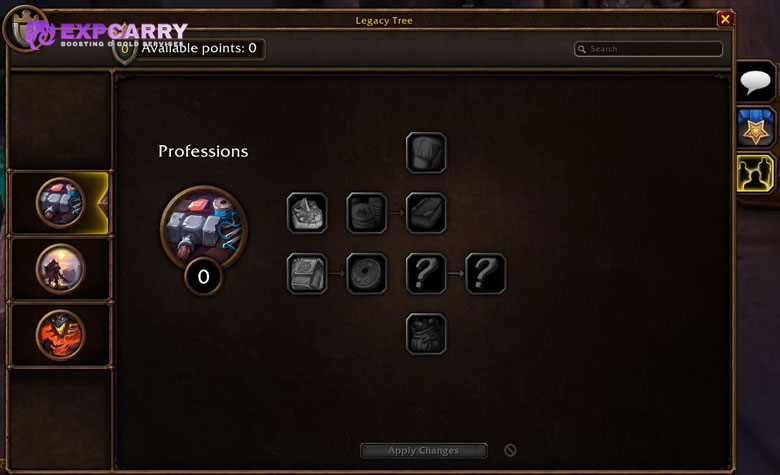
Professions also feed the account-wide Legacy System. Current beta data awards profession-related Legacy Challenges when a tradeskill reaches 150, 225, and 300 for the first time. Legacy Points are shared across alts, while each character can spend those points independently in its own Legacy trees. The Professions tree includes Bountiful Harvest, which increases the amount of Scarce materials gathered through Mining, Herbalism, and Skinning, alongside other profession-oriented perks whose exact ranks and percentages can still change.
This matters most when planning several characters. A first character may value a self-sufficient gathering and crafting pair, while later alts can use shared Legacy progress and materials from the account to choose two crafting professions or a specialized PvP setup without repeating the same economic constraints. The current WoW Forever Legacy System guide tracks the beta-confirmed tree structure and changing perk values separately.
Do not choose a profession only because one beta Legacy value looks unusually strong. Blizzard has already framed Legacy as a system that will expand over time, and beta percentages are exactly the kind of numbers that can be tuned. Choose the profession for its core material, crafting, or utility loop first, then use Legacy perks to improve a playstyle you already want.
How to Level WoW Forever Professions Efficiently
The efficient route is to grow professions alongside the character instead of treating 1-300 as a separate grind that begins after level 60. Because the beta currently reaches only the early leveling game, exact full shopping lists and final 1-300 recipe routes should be built from later beta and LIVE data rather than copied from old Classic guides.
- Choose the pair before leaving your early quest route. A gathering plus crafting pair lets the first materials you see contribute immediately instead of sitting unused in the bank.
- Learn secondary professions early. Cooking, Fishing, and First Aid do not consume primary slots, and Forever gives them direct leveling and Camping relevance.
- Gather along your route, not against it. Take nearby herbs, veins, and skinnable corpses, but do not turn one distant node into several minutes of empty travel.
- Keep crafting skill close enough to use level-relevant recipes. Falling far behind can turn a self-sufficiency profession into a bank full of outdated materials.
- Reach the early Camping milestones. Cooking accesses the Basic Campfire immediately, while most profession-specific Tier 1 camp objects begin at skill 20.
- Watch for recipe and Blueprint sources. Trainer recipes are only part of Forever profession progression; dungeon-linked Blueprints and other recipe sources can unlock utility or advanced crafting functions.
- Do not overbuy for a beta route. Recipe colors, material counts, trainer breakpoints, and high-skill recipes may change before launch, so a fixed 1-300 shopping list should be rechecked against the live client.
Blizzard's Forever roadmap places the global launch on November 4, 2026 at 3:00 p.m. PST. That is the point when complete 1-60 routes, real material competition, and level-60 demand can begin replacing beta projections with measurable profession data.
Making Gold with Professions
Profession gold in Forever should be approached as a market problem, not a permanent tier list. A gathering profession earns by supplying inputs other players consume, while crafting earns by converting those inputs into something with enough demand to cover materials, training, recipe access, and Auction House risk. The strongest market can change by ruleset, launch phase, dungeon progression, and which recipes players have actually discovered.
- Launch and early leveling: raw herbs, ore, stone, leather, cloth-adjacent crafting inputs, fish, and other commonly consumed materials can be easier to price than rare finished crafts.
- Mid-level progression: useful gear, bags, consumables, enchants, and profession-specific utility can gain value when players reach new brackets faster than supply catches up.
- Blueprint markets: dungeon-linked recipe access can create temporary scarcity, but a recipe being rare does not guarantee that its output is profitable.
- Level 60: repeat-demand consumables, useful enhancements, gearing crafts, rare recipes, and profession workspaces may become more stable markets once raids and endgame routes are active.
- Double gathering: this is the lowest-complexity economic setup because you can sell materials directly, but you give up the ability to turn them into higher-margin crafts on the same character.
No honest September guide can provide a permanent gold-per-hour table for a game that has not launched. Realm-equivalent ruleset populations, material supply, recipe discoveries, and player demand are still unknown. Players planning profession expenses can reference the verified WoW Forever Gold page, which is currently a pre-order before November 4; its existence is not evidence for a launch gold-per-hour estimate.
WoW Forever Profession Mistakes to Avoid
The largest profession mistakes usually come from following a Classic checklist without checking whether Forever changed the recipe, profession owner, or reason to level the skill. The beta already proves that familiar profession names do not guarantee an identical recipe map.
- Do not copy a Vanilla 1-300 guide blindly. Forever adds hundreds of recipes and changes existing profession roles, so old material lists can waste gold.
- Do not assume Alchemy owns every familiar potion. Healing potions are currently part of First Aid in the beta.
- Do not ignore secondary professions. Cooking, Fishing, and First Aid do not use primary slots and now interact directly with Camping or leveling utility.
- Do not chase every gathering node. A material is not profitable if the detour destroys your leveling route and the market price does not compensate for the time.
- Do not pick two crafting professions on an unfunded first character without a plan. Buying both material streams can become expensive during launch scarcity.
- Do not treat beta campsite numbers as final. Use current tooltips for testing, but expect tuning before launch and recheck high-skill effects later.
- Do not assume one class requires one profession forever. Gear goals, PvP, group composition, alts, and the economy can all make a different pair more useful.
- Do not drop a high-skill profession casually. Relearning a primary profession can require rebuilding progress, recipes, and materials, so switching should solve a real long-term problem.
A strong first-character plan is simple: take professions that naturally fit what you already do, keep them near your character's progression, use secondary professions instead of ignoring free utility, and delay expensive optimization until the live economy shows which recipes actually matter.
WoW Forever Professions FAQ
These answers cover the main current searches around profession limits, best starting pairs, gold, First Aid, Camping, and whether beta profession rankings can be trusted at level 60.
What is the best profession in WoW Forever?
No single profession is best for every goal. Gathering is safest for a first-character economy, gathering plus crafting is best for self-sufficiency, Engineering is a strong utility candidate, and specific crafting professions become better when their gear or consumables match your class and activity.
Can you learn every profession on one character?
No. The current beta keeps two primary profession slots. Cooking, Fishing, and First Aid are secondary professions and can be learned without using those primary slots.
What is the best WoW Forever profession for gold?
There is no verified permanent winner before launch. Herbalism, Mining, Skinning, and Fishing have the simplest raw-material model, while crafting profits depend more heavily on recipe access, input prices, and demand.
Are professions worth leveling before level 60?
Yes. Forever adds more than 600 recipes, level-relevant crafting, Camping features that begin early, updated Cooking benefits, and Legacy interactions. Gathering while leveling also prevents a large catch-up farm later.
Does First Aid make healing potions in WoW Forever?
In the current beta, yes. Healing potions have been moved into First Aid, which remains a secondary profession. This is beta-state information and should be rechecked at launch in case Blizzard adjusts the recipe distribution.
Do profession Camping buffs stack with class buffs?
Equivalent effects do not stack. Blizzard describes profession camp effects as variants of existing class buffs, so they can cover a missing benefit but do not automatically double the matching class effect.
Should I use two gathering professions at launch?
It is a sensible first-character strategy if your priority is raw-material income and low crafting costs. If you care more about self-crafted gear, consumables, or Engineering utility, one gathering plus one crafting profession is usually the cleaner setup.
Conclusion
WoW Forever professions should be chosen around a complete character plan rather than an inherited Vanilla ranking. Use Herbalism plus Alchemy for a self-fed consumable route, Mining plus Blacksmithing for metal gear, Mining plus Engineering for active utility, Skinning plus Leatherworking for a low-friction armor loop, or Tailoring plus Enchanting for cloth-caster progression. Double gathering is the safer economy-first option, while Cooking, Fishing, and First Aid are secondary skills worth progressing because they do not compete for your two primary slots.
The beta already confirms that professions matter earlier through new recipes, Camping, First Aid changes, and Legacy progression, but the final level-60 economy is still unknown. Level professions alongside normal questing, reach the early Camping unlocks, avoid overcommitting gold to temporary beta routes, and reevaluate advanced recipes when the level cap rises and again after the November 4 launch. For now, choose a pair that fits your character and keep exact high-skill material lists flexible until later beta phases and live data reveal the final leveling routes and economy.