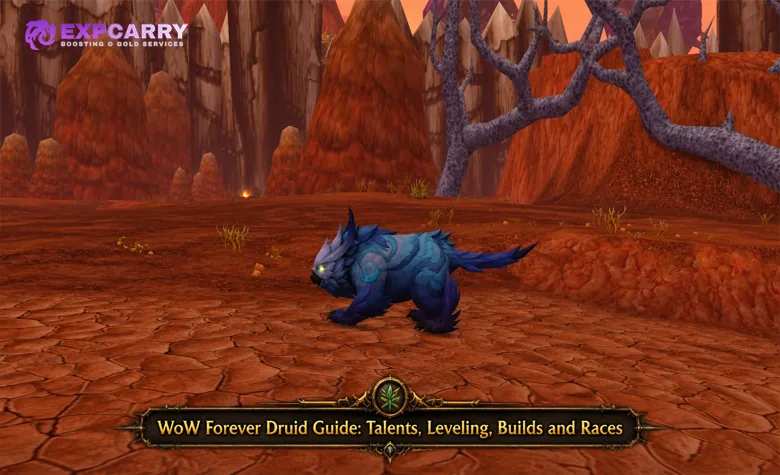
Druid in World of Warcraft: Forever can tank, heal, deal melee damage and fight as a ranged spellcaster on the same character. Forever keeps that flexibility while changing several important mechanics: Cat and Bear scale with weapon DPS, weapon effects work in shapeshift forms, Nature's Grasp and Omen of Clarity are baseline, and Feral has new talents for both Cat and Bear gameplay. World of Warcraft: Forever launched on November 4, 2026, with leveling available through level 60. The biggest correction to older Druid builds is that Berserk has been removed, while Primal Bite and Shifting Power are now separate deep-Feral talents. Balance also gains Eclipse, and Restoration receives Swiftmend, Bloom and Wild Growth. This guide covers the live class design, practical leveling choices, talent milestones, rotations, forms, stats, races and professions without treating untested raid rankings as settled results.
Short answer: Feral is a practical default for leveling a Druid from 1 to 60 because Cat Form handles ordinary enemies efficiently and Bear Form gives you a durable alternative. Build toward the current Feral talents, choose Shifting Power for Cat-focused play or Primal Bite for Bear-focused play at the deep-tree milestone, and switch to Balance or Restoration if ranged damage or healing is the role you actually want.
For comparisons with every other class, see our WoW Forever Class Guides and WoW Forever Class Tier List. Those broader comparisons serve a different purpose from this Druid-specific explanation of forms, talent choices and gameplay.
WoW Forever Druid at a Glance
The best Druid direction depends on what you want to do. Feral is convenient for a first leveling character, but a player who enjoys healing or ranged spellcasting has good reasons to commit to a different tree.
| Goal | Recommended Druid direction | Why |
|---|---|---|
| Solo leveling | Feral Cat | Energy-based attacks, stealth, movement speed, self-healing and a Bear fallback. |
| Dungeon tanking | Feral Bear | Armor, improved threat, Swipe, Growl, Lacerate and later Primal Bite. |
| Dungeon and raid healing | Restoration | Healing-over-time effects, Swiftmend, Nature's Swiftness, Bloom and Wild Growth. |
| Ranged spellcasting | Balance | Wrath, Starfire, Insect Swarm, Eclipse and Moonkin Form. |
| PvP | Feral or Balance | Shapeshifting, stealth, roots, healing, mobility and objective control. |
| First profession pair | Skinning and Leatherworking | Materials from leveling enemies can support useful Leather equipment. |
What Changed for Druid in WoW Forever?
Druid is not simply its original Classic version with new graphics. Forever updates the rules of shapeshifting, weapon damage, support spells and talent progression. Blizzard describes the class's broader direction in its official Druid class deep dive, while the final pre-launch development notes contain later changes that override older beta builds.
| Change | Current WoW Forever behavior | Why it matters |
|---|---|---|
| Weapon scaling in forms | Cat, Bear and Dire Bear attacks derive their DPS from the equipped weapon while each form retains its own attack speed. | Weapon DPS matters for Feral damage instead of the weapon functioning mainly as a collection of stats. |
| Weapon effects | Relevant weapon enchants and procs can function while shapeshifted. | Weapon effects and suitable group buffs contribute to Feral gearing decisions. |
| Consumables in forms | Many potions and comparable consumables can be used without leaving form. | Cat and Bear lose less momentum when responding to a dangerous pull. |
| Racial abilities | Relevant racials, including Shadowmeld, War Stomp and Skyborne movement tools, can be used while shapeshifted. | Race choice can affect actual combat and movement in Feral forms. |
| Nature's Grasp | Baseline from level 10, with use indoors and in shapeshift forms. | Its control does not require spending points in Balance. |
| Omen of Clarity | Baseline from level 20; Wrath does not consume Clearcasting. | All Druid builds receive the resource-saving effect. |
| Revive | Normal out-of-combat resurrection learned at level 12. | Druid healers can resurrect after a wipe without relying on Rebirth. |
| Tiger's Fury and Berserk | Both removed. Shifting Power and Primal Bite occupy the current deep-Feral talent choices. | Old rotations built around either removed ability need replacing. |
| Lacerate | A Feral talent in the fourth row, not a baseline ability automatically trained at level 42. | Bear builds must invest the appropriate points to obtain this Bleed and threat tool. |
| Bear threat | Bear and Dire Bear generate 115% additional threat through their form bonus. | The final launch tuning substantially improved tank threat. |
| Bear critical Rage | Critical strikes generate 100% additional Rage. | Critical Strike also helps Bear resource generation. |
| Shapeshift protection | Shapeshift forms are immune to Disarm effects while active, but shifting does not remove a Disarm already applied beforehand. | Timing a form change matters against enemies that can disarm you. |
Best Druid Spec in WoW Forever
There is no single best Druid specialization for every activity because the class covers four combat roles. For a first character, Feral is our most flexible leveling recommendation, but that does not make it automatically the strongest damage dealer, healer or tank in every level-60 encounter. Choose the role first and then build around the tools it needs.
Feral
Feral is best suited to leveling, melee gameplay, dungeon tanking and players who enjoy using Cat and Bear for different situations. Cat handles routine kills and stealth routes, while Bear can survive dangerous pulls and hold enemies for a group. Its deeper talent choices now separate Cat-focused Energy recovery from Bear-focused attacks rather than revolving around the removed Berserk talent.
Balance
Balance is the natural choice if you want ranged spellcasting. Forever gives the tree a more developed progression through Wrath, Insect Swarm, Eclipse and Moonkin Form. Mana and cast time still matter, especially during long fights, so it is worth learning when a target deserves damage-over-time effects and when a quicker spell is enough.
Restoration
Restoration is best for dedicated healing. Its healing-over-time effects can critically heal, Swiftmend is available earlier in the tree, Bloom adds another interaction with Rejuvenation and Regrowth, and Wild Growth provides group healing at the 31-point milestone. The final pre-launch changes also gave Wild Growth a three-second base cast time, so it should not be treated as an instant emergency button.
Explore services related to this guide, selected from our WoW Forever catalog.
View All WoW Forever Services


Best Druid Leveling Build 1-60
Our default 1–60 recommendation is Feral Cat with enough Bear utility to tank when needed. From level 20 onward, using Energy for ordinary damage lets your Mana recover while fighting, although repeated form changes, healing and Shifting Power can still empty that Mana bar if you are careless.
There is no single mandatory final talent allocation for every leveling route. A Cat-focused character can aim for Shifting Power, while a player tanking frequently may value Primal Bite. Some level-60 Feral allocations invest enough points to reach both deep talents, but that choice competes with useful points in Balance and Restoration. A practical 51-point example is 9/32/10, not the obsolete 0/37/14 build based on the earlier talent layout. In the current tree, Furor is in Feral and Heart of the Wild is in Restoration.
The final Blizzard development notes are especially important when planning Feral. They moved Shifting Power and Primal Bite into separate 31-point talent positions, removed Berserk, changed Lacerate's location and added Predatory Discipline. These are substantial changes, not minor numerical adjustments.
Levels 1-9: Caster Druid
Before Bear Form, fight with Wrath, Moonfire and auto-attacks while using Rejuvenation or Healing Touch to reduce downtime. You can still play aggressively, but spending every point of Mana on an ordinary enemy usually means more time drinking after the pull.
Do not empty your Mana bar unless the situation justifies it. Finishing a weak enemy with a weapon attack can be faster overall than casting one more spell and drinking afterward. Practice using roots and healing safely, because those habits remain useful after you gain additional forms.
Levels 10-19: Bear Form
Bear Form becomes your main physical-combat form at level 10. It uses Rage rather than Mana, allowing your Mana to recover while you fight. Its defensive value is useful against several enemies, although a Bear can still run out of Rage when attacks are not landing or the target dies too quickly.
Use Maul against a single target, Swipe when several enemies are active and Demoralizing Roar when reducing physical damage is worthwhile. Growl becomes important when you are actually tanking a group. Avoid queuing too many Mauls if doing so leaves you unable to respond with another ability when needed.
Level 20+: Cat Form
Cat Form changes the pace of Druid leveling. Energy-based attacks, Prowl and Feral Swiftness improve your ability to choose fights, move between targets and recover Mana while dealing damage. You can avoid an unnecessary enemy rather than fighting everything between two quest objectives.
From this point onward, Cat should handle most ordinary solo enemies while Bear remains your answer to dangerous pulls, elites and dungeon tanking. The exact mix depends on your talents and equipment. If you are following a 1–60 leveling route, use Cat mobility to reduce unnecessary travel and combat time rather than relying on a single fixed rotation for every enemy.
Level 30: Travel Form
Travel Form provides a 40% outdoor movement-speed increase. Together with Feral Swiftness in Cat Form, it gives Druids excellent mobility before and between mount-related progression milestones. Use the appropriate form for the terrain and situation rather than staying in Cat solely for its movement benefit.
Level 40+: Dire Bear and Deep Feral Talents
Dire Bear Form significantly improves your tank durability at level 40. Deep-Feral talents are also reachable around this stage through normal progression: Primal Bite supports Bear damage and threat, while Shifting Power converts Mana into Energy for Cat. Both are 31-point talents with different prerequisites, and full Talented Legacy progression can provide earlier access to the required talent depth.
These abilities replace the old idea of building toward Berserk. Primal Bite is a direct Bear attack, not a Fear-breaking burst cooldown. Shifting Power is a Cat-only resource tool, not a general damage buff. Pick talents based on how you actually play, and remember that your Mana must still cover shapeshifting and emergency healing.
Best Level 30 Feral Talent Build
Level 30 is no longer the end of the game, but it remains a useful checkpoint for a 21-point Feral build without additional Talented Legacy points. The current tree allows a strong mixture of Cat movement, Bear control, efficient attacks and Leader of the Pack. The following allocation follows the updated talent layout rather than the earlier beta table that incorrectly included Shifting Power and Primal Bite at this level.
| Talent | Points | Purpose |
|---|---|---|
| Ferocity | 5/5 | Reduces the cost of important Cat and Bear attacks. |
| Furor | 3/5 | Supports resource management when changing forms; now belongs to the Feral tree. |
| Feral Swiftness | 2/2 | Improves Cat movement and contributes avoidance. |
| Feral Charge | 1/1 | Provides an approach and control option in Bear gameplay. |
| Savage Fury | 2/2 | Improves relevant Feral attacks. |
| Sharpened Claws | 2/2 | Improves critical strike chance while fighting in Feral forms. |
| Predatory Discipline | 1/1 | Changes Ferocious Bite's use of excess Energy and is a prerequisite for later Shifting Power. |
| Blood Frenzy | 2/2 | Supports resource generation through appropriate critical strikes. |
| Lacerate | 1/1 | Adds a Bear Bleed and threat ability before the late-game Primal Bite talent. |
| Predatory Strikes | 1/3 | Improves physical damage potential and advances the build. |
| Leader of the Pack | 1/1 | Provides a critical strike aura for nearby allies while in the appropriate Feral form. |
| Total | 21 | All standard points invested in Feral at level 30. |
Continue deeper into Feral for talents such as Natural Instinct and Rend and Tear, then choose the deep-tree path that serves your role. Primal Bite requires Leader of the Pack, while Shifting Power requires Predatory Discipline. With enough points, a hybrid Feral allocation may include both, but doing so leaves fewer points for supporting talents outside Feral.
Feral Cat Rotation
Cat does not follow a rigid one-button rotation. Target lifespan, positioning, Energy, Combo Points and Mana determine whether a Bleed or direct damage attack is worthwhile. A normal quest enemy may die before a full Rip matters, while an elite can justify maintaining several effects.
- Keep Mark of the Wild active before starting your route.
- Use Faerie Fire when its armor reduction will meaningfully help your damage or the group.
- Use Prowl to bypass unnecessary enemies or approach for a strong opener.
- Open with Ravage when available and when you can attack from behind.
- Use Shred from behind; choose Claw when you cannot meet the positioning requirement.
- Maintain Rake when the enemy will survive long enough for the Bleed to deal useful damage.
- Spend Combo Points on Rip against durable targets.
- Use Ferocious Bite when immediate finishing damage is more useful than a long Bleed.
- Use Omen of Clarity's Clearcasting effect on an expensive eligible ability such as Shred.
- After learning Shifting Power, activate it when its Energy gain will not be wasted and you can afford the Mana cost.
- Use Poised from level 32 when starting a fight with full Energy; it reduces the Energy cost of your next Energy ability.
Do not include Tiger's Fury or Berserk in a current Forever Cat rotation. Both were removed. Shifting Power is a deep-Feral talent that converts Mana into 40 Energy; it does not appear automatically at level 20 or in a normal 21-point build at level 30. Its baseline cooldown is 16 seconds, and its Mana cost is substantial, so using it when Energy is almost full wastes much of its value.
Feral Bear Tank Build and Rotation
Bear is a practical leveling and dungeon tank rather than simply an emergency defensive form. Weapon scaling, improved threat and Lacerate give it more complete tools, while Primal Bite becomes a major addition for a deep-Feral tank build. Blizzard raised the Bear and Dire Bear threat bonus to 115% in its final pre-launch changes, partly because Salvation was removed from Paladin threat management.
| Ability | When to use it |
|---|---|
| Primal Bite | A deep-Feral Bear attack costing 20 Rage with a six-second cooldown; generates strong threat once the talent is learned. |
| Swipe | Multi-target damage and threat; its scaling now includes an Attack Power contribution. |
| Maul | Spend excess Rage on the next melee swing without starving more important abilities. |
| Growl | Single-target taunt when an enemy needs to return to you. |
| Demoralizing Roar | Reduce incoming physical damage while generating threat. |
| Feral Charge | Close a gap and interrupt or immobilize an eligible active target. |
| Faerie Fire | Apply armor reduction in form without consuming Rage. |
| Lacerate | A fourth-row Feral talent that supplies stacking Bleed damage and threat; not a baseline spell automatically learned at level 42. |
Basic pull: Use Feral Charge when its movement or interrupt is needed, apply Faerie Fire, establish the main target with Lacerate or Primal Bite once learned, use Swipe when several enemies are present, and maintain Demoralizing Roar when physical damage matters. Queue Maul when you have Rage to spare, not when it would prevent your next higher-priority ability.
Critical strikes also have resource value because Bear criticals generate 100% additional Rage. That does not make Critical Strike a universal replacement for Stamina, Armor or other tank survival stats. Dungeon pulls are easier when you build threat early, keep dangerous enemies in front of you and coordinate with the group's damage dealers. Players arranging dungeon progression should account for their current Bear talents rather than assuming every leveling Druid already has Primal Bite.
Balance Druid Build and Rotation
Balance is substantially more developed than original Classic. It still has to manage Mana, but Forever gives the tree meaningful interactions instead of relying on the same few spells for most of the leveling journey. Wrath and Starfire remain central, while Insect Swarm, Eclipse and Moonkin Form create additional priorities as talent points become available.
Important talents include:
- Improved Wrath: reduces Wrath cast time and Mana cost.
- Genesis: improves periodic damage and healing by 2/4/6/8/10% across its five ranks.
- Nature's Majesty: increases critical strike potential.
- Nature's Reach: supports range and hit-related casting benefits.
- Nature's Splendor: extends the duration of important damage-over-time and healing-over-time effects.
- Insect Swarm: adds another damage-over-time option through Balance talents.
- Eclipse: links Wrath casts with faster Starfire opportunities.
- Moonkin Form: a 31-point talent that provides spellcasting benefits and an allied critical strike aura.
Balance Priority
Think of Balance as a priority system rather than a sequence that must be followed on every enemy. When a target will die to a small number of Wrath casts, applying every possible damage-over-time effect can spend more Mana than the fight deserves.
- Apply Faerie Fire when its armor reduction is useful to your group.
- Maintain Moonfire when the target will live long enough for the duration to matter.
- Maintain Insect Swarm on durable enemies after learning it.
- Use Wrath as an efficient primary cast and to generate Eclipse value.
- Convert Eclipse opportunities into faster Starfire casts.
- Use Omen of Clarity naturally; Wrath does not consume Clearcasting.
- Use Entangling Roots when control provides more value than another damaging cast.
Moonkin Form in Forever
Moonkin Form increases the Armor contribution from equipment and improves Omen of Clarity interactions. The final pre-launch tuning changed its aura back to a bonus affecting all critical strike types rather than only spell critical strikes, and made it mutually exclusive with Leader of the Pack. Do not use the old description that presents Moonkin as providing only a spell-critical-strike aura.
Moonkin Form still restricts healing spells, so form management matters for a Balance Druid who wants to heal an ally in an emergency. Leaving form to heal costs time and Mana, but that can still be the correct decision when another damage cast would not save the group.
Restoration Druid Build and Healing
Restoration remains the Druid's healing-over-time specialization, but Forever addresses several limitations of the original Classic toolkit. Rejuvenation and Regrowth provide the familiar foundation, while Swiftmend, Bloom and Wild Growth add different ways to respond to incoming damage.
- Rejuvenation's healing-over-time ticks can critically heal.
- Regrowth's periodic healing can critically heal.
- Swiftmend is available earlier in Restoration and does not consume Rejuvenation or Regrowth; the healing effect must have been placed by the casting Druid.
- Bloom is a third-row talent that heals when your Rejuvenation or Regrowth expires naturally, with a smaller effect if it is dispelled.
- Wild Growth is the 31-point Restoration talent and now has a three-second base cast time.
- Revive provides a normal out-of-combat resurrection from level 12.
- Improved Tranquility can substantially reduce Tranquility's cooldown.
Restoration Healing Priority
Use Rejuvenation proactively on targets expected to take continued damage. Use Healing Touch for efficient, predictable healing, Regrowth when immediate recovery plus a healing-over-time effect is useful, and Swiftmend when a target carrying one of your eligible healing effects suddenly needs a fast heal. Swiftmend does not consume the effect, despite an outdated tooltip description noted by Blizzard.
Nature's Swiftness combined with Healing Touch gives Restoration an emergency instant direct heal. Wild Growth later adds healing for several allies, but its three-second cast means you should anticipate sustained group damage rather than expecting it to solve an unavoidable spike instantly. Naturalist also affects Wild Growth's cast time after the final talent redesign.
Do not import a Retail Restoration rotation into Forever. The current toolkit does not revolve around Lifebloom, Nourish, Efflorescence or Tree of Life Form. Judge healing equipment and talents by the damage pattern of the encounter, your Mana sustainability and how much time you have to cast safely.
Druid Forms and Unlock Levels
Each form serves a different purpose, and knowing when it becomes available helps you plan your route. Some forms are learned through ordinary progression, while Moonkin requires deep Balance talent investment. Earlier Legacy talent access does not automatically grant trainer abilities before their required character level.
| Form | Level or source | Main purpose |
|---|---|---|
| Bear Form | Level 10 | Tanking, survival and Rage-based combat. |
| Aquatic Form | Level 16 | Swimming and underwater travel. |
| Cat Form | Level 20 | Fast leveling, melee DPS and stealth. |
| Travel Form | Level 30 | 40% outdoor movement-speed increase. |
| Dire Bear Form | Level 40 | Higher-level tanking and durability. |
| Moonkin Form | 31-point Balance talent | Ranged spellcasting and an allied critical strike aura. |
| Caster Form | Baseline | Healing and unrestricted spellcasting. |
Shapeshifting also helps Druids escape Polymorph and applicable movement-impairing effects according to each form's rules. That makes changing forms an important part of PvE and PvP rather than a cosmetic role switch. Remember that entering a form does not remove a Disarm effect already applied to you, even though active forms now protect against new Disarm effects.
Feral Weapon Scaling: Weapon DPS Matters Now
This is one of the biggest differences for players returning from original Classic. Cat, Bear and Dire Bear auto-attacks now derive their DPS from the equipped weapon while the form keeps its own attack speed. Abilities using weapon damage also benefit from the form's weapon-based scaling.
Weapon procs and appropriate enchants can function while shapeshifted. This means you should no longer evaluate a Feral weapon purely as a source of Strength or Agility. A weapon with better damage can be a meaningful upgrade even when its attributes look less impressive at first glance.
For Feral, weapon DPS is an actual upgrade statistic. It still needs to be compared with your role, stats, effects and survivability, especially for Bear. When working toward level-60 equipment, separate Cat damage requirements from Bear tanking requirements instead of assuming the same weapon and armor set will optimize both.
Druid Stat Priorities
Druids need different stats depending on their role. A leveling Cat wants quick kills and manageable downtime, while a Bear responsible for a dungeon must survive incoming damage and generate enough threat. Balance and Restoration care more about spell output and Mana sustainability.
| Build | Useful priorities |
|---|---|
| Feral Cat leveling | Weapon DPS, Strength, Agility and Stamina; compare Hit, Critical Strike and other useful stats as gear improves. |
| Feral Cat level 60 | Weapon DPS, appropriate Hit and other offensive requirements, Strength, Agility and Critical Strike according to the encounter. |
| Bear | Stamina, Armor and relevant defensive stats, alongside weapon DPS, Agility and threat-related offensive stats. |
| Balance | Spell Damage, appropriate Hit, Critical Strike and Intellect or Spirit depending on Mana needs. |
| Restoration | Healing and Spell Power, Intellect, Spirit, Critical Strike and sustainable Mana usage. |
Do not treat this as a fixed mathematical best-in-slot order for every character. Item budgets, encounter length, enemy level and whether you are leveling, tanking or preparing for raids change the value of individual stats. A current dungeon upgrade can be useful without becoming a permanent raid best-in-slot piece.
Leader of the Pack and Moonkin Form Are Raid Auras
Late pre-launch changes expanded the reach of important Druid critical strike auras to nearby party or raid members. The final tuning also changed their critical strike coverage, so descriptions that distinguish a Feral-only physical Crit aura from a Moonkin-only spell Crit aura are outdated.
- Leader of the Pack: provides a critical strike bonus to nearby party or raid members while the Druid uses an appropriate Feral form, and its current effect applies to all critical strike types.
- Moonkin Form: provides its critical strike aura to nearby party or raid members, also affecting all critical strike types after the final talent changes.
The two auras are mutually exclusive rather than stacking together. This makes both Feral and Balance useful to a group, but does not prove that either specialization will lead every personal-DPS ranking. Their value is part of the full group composition, not just the damage number beside one player's name.
Best Druid Race in WoW Forever
Druid has four race-and-faction options in Forever. Racial abilities can now be used in shapeshift forms where applicable, so consider how you actually use stealth, control, movement and defensive tools. Blizzard's race and class overview explains the broader character choices in Forever.
| Faction | Race | Best fit |
|---|---|---|
| Alliance | Night Elf | Flexible Feral and PvP choice with Shadowmeld and useful offensive or defensive racial abilities. |
| Alliance | High Order Skyborne | Flexible option with Haste-oriented and movement or utility racials. |
| Horde | Tauren | Strong Bear and Feral choice with extra durability, War Stomp and movement utility. |
| Horde | Windshaper Skyborne | Alternative with Haste benefits and movement-focused utility. |
Our default picks: Night Elf for Alliance and Tauren for Horde if you want a straightforward Feral or Bear starting point. Skyborne remains worth considering, particularly if you value Haste or movement utility. No racial choice automatically replaces the importance of talents, gear and knowing your role.
Race differences are smaller than the effect of choosing the right specialization and equipment for your activity. Do not reroll a Druid you enjoy playing just to chase a small theoretical racial advantage that may not matter in your actual content.
Skyborne Druid Forms
Both Alliance High Order Skyborne and Horde Windshaper Skyborne can play Druid. Forever includes Skyborne-specific appearances for important shapeshift forms, giving these characters a different visual identity while using the familiar Druid role system.
The visuals do not create separate Skyborne specializations. A Skyborne Cat or Bear uses the same Druid abilities, talent trees, form mechanics and resource rules as other races. Choose the appearance you enjoy without assuming it changes damage or tanking mechanics.
Best Professions for Druid
Profession choice depends on whether you want to craft your own gear, supply consumables or gain active utility in PvP. A gathering-and-crafting pair is convenient for a first character, but it is not automatically the strongest endgame setup for every Druid specialization.
| Profession pair | Best for |
|---|---|
| Skinning and Leatherworking | First characters, Feral leveling and crafting useful Leather gear. |
| Herbalism and Alchemy | Balance, Restoration, consumable preparation and flexible endgame play. |
| Mining and Engineering | PvP and practical gadget-based utility. |
For a first Druid, Skinning and Leatherworking is the simplest recommendation because you naturally kill skinnable creatures and can turn their materials into useful equipment. If you prefer healing or casting, Herbalism and Alchemy may fit your regular activities better. Consider recipes, gathering time and the materials required before choosing a profession purely for one item.
See our WoW Forever Professions Guide for the wider profession system. When comparing profession progression routes, remember that the value of a crafting pair depends on which recipes and materials your character can actually use.
Druid Strengths and Weaknesses
Druid's main advantage is flexibility. Its limitations come from needing different gear, talents and resource decisions for different roles. Understanding both sides will help you decide whether you want one adaptable main character or a more specialized class.
| Strengths | Weaknesses |
|---|---|
| Can tank, heal, deal melee DPS and cast ranged damage spells. | One equipment set and talent allocation cannot optimize all four roles. |
| Strong mobility through Cat, Feral Swiftness and Travel Form. | Repeated shapeshifting still costs Mana. |
| Prowl gives stealth and flexible routes through hostile areas. | No universal baseline interrupt comparable to a standard short-cooldown kick. |
| Strong self-healing and hybrid utility. | Balance still needs careful Mana management in longer encounters. |
| Feral damage benefits directly from weapon DPS and effects. | Feral depends more on meaningful weapon upgrades than original Classic players may expect. |
| Bear has considerably stronger threat tools. | Threat alone does not establish a final raid-tank ranking or guarantee survival. |
| Restoration receives improved healing-over-time and emergency tools. | Healing-over-time gameplay rewards prediction rather than pure reaction. |
| Feral and Balance contribute useful raid critical strike auras. | The auras are mutually exclusive and do not replace an entire group's other buffs. |
Is Druid Good in WoW Forever?
Yes, particularly if you value flexibility. Druid can level efficiently as Feral, tank dungeons in Bear, heal as Restoration and play a ranged damage role as Balance. Dual Specialization from level 40 also makes maintaining separate role-focused setups more practical, although a second specialization does not provide a second complete set of equipment.
The biggest improvement over original Classic is not that every Druid build automatically becomes top DPS. It is that the four roles have more coherent tools. Feral weapons matter, Bear generates substantially more threat, Balance has meaningful interactions between its spells, and Restoration receives additional healing-over-time and group-healing options.
For your first Druid, Feral remains a sensible starting point. At level 60, choose the role you enjoy rather than blindly keeping a leveling build. The first new raids are scheduled to open on December 9, 2026, so early simulations and expert expectations should not be confused with complete live raid results.
If you want to plan the whole journey, use our WoW Forever Leveling Guide. The choice between questing, dungeons and more structured leveling progression depends on your preferred pace and the role you want to practice on the way to 60.
WoW Forever Druid FAQ
These answers address a few important questions that can be confusing when comparing the live game with older beta builds or original Classic guides.
Is Berserk still available to Feral Druids?
No. Berserk was removed before launch. Primal Bite and Shifting Power are now the separate deep-Feral talents, serving Bear and Cat gameplay respectively.
Is Lacerate learned automatically at level 42?
No. Lacerate is now a fourth-row Feral talent. You must invest in the relevant tree to use it, and its later ranks depend on the normal ability-training rules.
Can a Druid use both Shifting Power and Primal Bite?
Both are deep-Feral talents with different prerequisites. A build investing enough points in Feral can potentially select both, but that leaves fewer points for Balance and Restoration utility.
Can Druids resurrect other players after a dungeon wipe?
Yes. Revive is a normal out-of-combat resurrection learned at level 12. Rebirth remains the separate combat-resurrection tool.
Conclusion
Feral is a reliable route through WoW Forever leveling, but Druid's real strength is choosing the form and specialization that fit the situation. Learn the updated Feral tree instead of following obsolete Berserk builds, treat weapon DPS as a meaningful upgrade, and keep your healing and control tools accessible. At level 60, build around the role you actually play and judge endgame recommendations against real encounters as more live data becomes available.