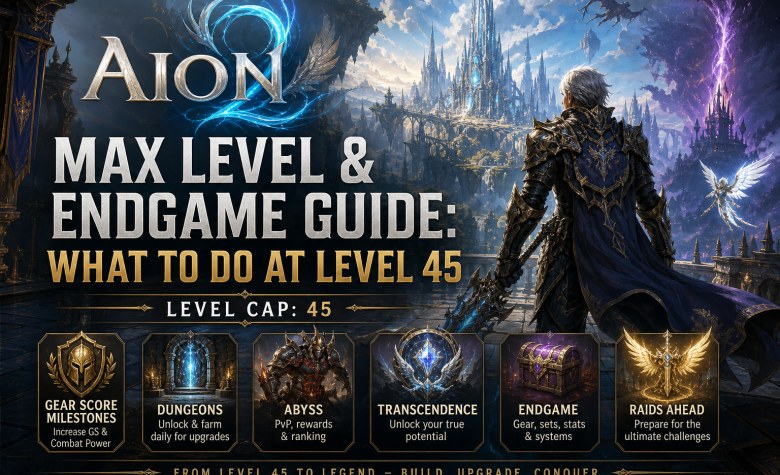
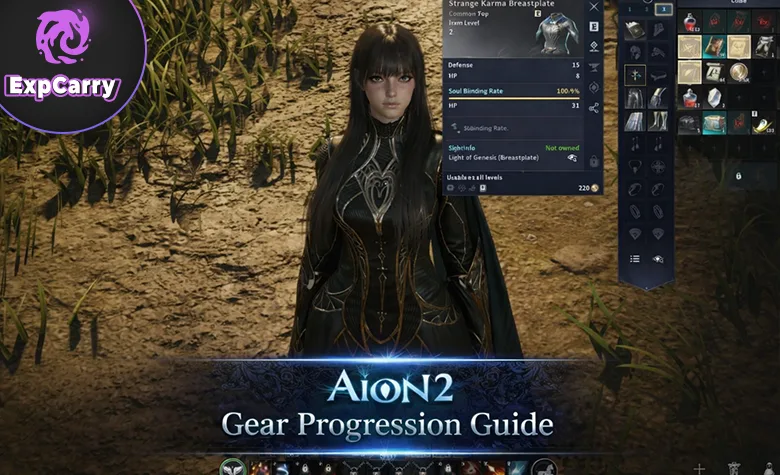
AION 2 gear progression at Level 45 is built around Item Level, enhancement and preserving valuable investment when you replace equipment. The Global launch client currently progresses from early Unique gear through Item Level 54, 70 and 86 dungeon tiers to Item Level 102 raid and crafted equipment.
The most important post-launch rule is simple: do not throw away an upgraded Unique item before checking Gear Transfer or Transfer Crafting. Enhancement and Soul Binding can survive certain upgrades, while Manastones, Theostones, Potential and Soul Fuse require more caution.
Short answer: reach Level 45, use Item Level to unlock the next useful content tier, push temporary gear only as far as necessary, and transfer investment into stronger Unique gear when possible. Regular Gear Transfer and Transfer Crafting are different systems and do not preserve the same things.
AION 2 Gear Progression Roadmap
| Stage | Typical Item Level | Main Gear Source | Goal |
|---|---|---|---|
| Fresh Level 45 | Below / around 54 | Story, quests, early Exploration and first Conquest content | Reach the first stable Unique set |
| Early endgame | 54 | Krao Cave / Draupnir progression | Build the first reliable Unique setup |
| Mid endgame | 62–70 | Dragon Lord crafting, Urugugu Canyon, Vakron Sky Island | Replace weak slots and prepare for higher Conquest |
| Advanced endgame | 78–86 | Dragon Lord upgrades, Fire Temple, Ferocious Horn Den | Build long-term Unique pieces |
| Current top tier | 94–102 | High Dragon Lord crafting and Abyssal Forge: Ludra | Endgame optimization |
For exact dungeon requirements and which instance drops which slots, use our AION 2 Dungeons Guide.
Gear Score vs Item Level vs Combat Power
Players often use Gear Score as a general term, but AION 2 Global tracks different progression values.
| Term | What It Measures | Use It For |
|---|---|---|
| Item Level | Equipment-based progression | Dungeon and endgame entry requirements |
| Combat Power | Broader total character strength | Comparing full builds and permanent progression |
| Gear Score | Community shorthand | Usually means Item Level or general gearing progress |
If an activity requires a specific number, always use the Item Level displayed by the Global client.
AION 2 Gear Grades and Enhancement Caps
| Grade | Current Global Item Level Range | Normal Enhancement Cap | Manastone Slots |
|---|---|---|---|
| Common | 1–20 | +5 | 1 |
| Rare | 9–35 | +5 | 2 |
| Epic | 23–45 | +10 | 3 |
| Unique | 36–102 | +15 | 4 |
Heroic and Mythic equipment are not currently present as usable weapon, armor or accessory tiers in the Global launch client. Some unused client strings and transfer materials reference future grades, but they should not be treated as current progression.
Belts and amulets are exceptions: they use their own enhancement structure and do not follow the normal Manastone-slot pattern.
Explore services related to this guide, selected from our Aion 2 catalog.
View All Aion 2 Services

AION 2 Enhancement: When Should You Upgrade Gear?
Common and Rare gear are guaranteed through their +5 cap. Epic gear is guaranteed to +10, while Unique gear is guaranteed through +10 and can continue to +15 with decreasing success rates.
For Unique gear, the recorded Global rates after +10 are:
| Upgrade | Base Success Rate |
|---|---|
| +10 → +11 | 65% |
| +11 → +12 | 50% |
| +12 → +13 | 35% |
| +13 → +14 | 25% |
| +14 → +15 | 20% |
Each failed attempt adds a pity bonus to the next attempt. Normal weapon, armor and accessory enhancement failures do not destroy the item or reduce its level.
Practical rule: +10 is a natural low-risk stopping point on useful Epic/Unique gear. Pushing +11 to +15 makes more sense once the item is strong enough to keep or transfer.
AION 2 Gear Transfer: What Carries Over?
Gear Transfer moves investment from one existing Unique item into another compatible Unique item.
This is the system behind queries such as “AION 2 gear transfer”, “transfer enhancement” and “what do I do with old gear?”.
| Old Item Investment | Regular Gear Transfer |
|---|---|
| Enhancement level | Transfers |
| Soul Binding lines | Transfer |
| Amplified Enhancement | Do not assume it transfers through normal Gear Transfer |
| Manastones | Do not transfer |
| Theostone | Does not transfer |
| Potential | Does not transfer |
| Soul Fuse effect | Does not transfer |
Gear Transfer Requirements
The Global client currently applies several important rules:
- the transfer material must be eligible Unique equipment;
- the source item must be Soul Bound;
- the target must be a compatible equipment slot;
- equipped or preset gear cannot be used as the transfer material;
- the old source item is consumed by the transfer;
- higher-grade gear cannot be transferred into a lower-grade target;
- Transfer Stones are required.
Before confirming: remove or account for expensive Manastones and Theostones. Do not assume that every system attached to the old item follows Enhancement and Soul Binding.
What Happens to the Old Item After Gear Transfer?
The source item is consumed.
That is why the transfer preview matters. Check the destination piece, transferred Enhancement, Soul Binding result and any systems that will be lost before pressing confirm.
If the old item contains expensive Manastones, a valuable Theostone or a Soul Fuse effect, treat those separately before sacrificing the item.
What Is a Transfer Stone?
Regular Unique Gear Transfer uses Transfer Stone (Unique) (Bound).
The number required can increase for higher transfer tiers. Global-client cost data currently uses one stone for several lower transfers and two for higher Tier 3 transfers.
Do not dismantle or sacrifice valuable gear only because you think you need another Transfer Stone until you have checked the current Substance Morph and transfer interface.
Gear Transfer vs Transfer Crafting
These are separate systems.
| Gear Transfer | Transfer Crafting | |
|---|---|---|
| Where? | Equipment / Enhancement system | Crafting Table |
| Purpose | Move investment to another existing item | Craft the next item in a gear line |
| Enhancement | Transfers | Transfers |
| Soul Binding | Transfers | Transfers |
| Amplification | Not the normal carry-forward category | Transfers |
| Old item | Consumed on successful transfer | Used as transfer material in the recipe |
How Transfer Crafting Works
Crafted Dragon Lord equipment has upgrade chains where the previous item becomes transfer material for the next recipe.
The current Global crafting tooltip explicitly carries:
- Enhancement level;
- Amplification level;
- Soul Binding level.
The resulting crafted item becomes Soul Bound to the character who crafts it.
If the craft itself fails, the crafting materials are lost, but the transfer-material gear is retained. That makes upgrading an existing crafted line very different from sacrificing a dungeon item through normal Gear Transfer.
Crafted Gear Progression
The Dragon Lord line is particularly important because it reaches the same current top Item Level band as raid progression.
| Crafting Stage | Typical Item Level |
|---|---|
| True / Star Dragon Lord | 62 / 70 Splendent |
| White / Dark Dragon Lord | 78 / 86 Splendent |
| Wise / Ebony Dragon Lord | 94 / 102 Splendent |
At Item Level 102, crafted equipment becomes particularly important for armor and accessories while Abyssal Forge: Ludra covers major weapon/guard progression.
Soul Binding: What It Does
Soul Binding is available on Unique equipment and unlocks random item effects.
The system includes several different actions:
- Bind — develops the existing Soul Binding effects;
- Sync — rerolls an individual line;
- Rebind — rerolls the full set of lines;
- Soul Fuse — adds an additional effect once the required Binding progression is reached.
One key transfer rule:
regular Soul Binding lines can move through Gear Transfer, but Soul Fuse effects do not.
Manastones, Theostones and Potential
These systems are more replacement-sensitive than ordinary Enhancement.
Manastones
Manastones add socketed stats. A replacement item does not automatically inherit your socketed Manastones through normal Gear Transfer.
Use cheaper functional stones on gear you still expect to replace and reserve expensive optimization for long-term Unique pieces.
Theostones
Theostones can provide powerful weapon/guard effects, but they do not follow your item through regular Gear Transfer.
This makes an expensive Theostone a poor investment on gear you know you will replace soon.
Potential
Potential is another item-specific progression layer and should not be assumed to carry through Gear Transfer.
Deep Potential investment makes more sense on long-term PvP or endgame gear.
What Should You Do With Old Gear?
Before deleting or dismantling an old item, check the following order:
- Can it be used for Gear Transfer?
- Is it part of a Transfer Crafting chain?
- Does it contain expensive Manastones or a Theostone?
- Does dismantling return something you currently need?
- Is the replacement actually stronger after lost item-specific investment?
The common mistake is looking only at the new item's base Item Level and forgetting the investment stored in the old piece.
Best Upgrade Priority at Level 45
A good general priority is:
- Reach the next useful Item Level gate.
- Upgrade your weapon if damage is the current bottleneck.
- Fix the weakest armor/accessory slot if survival or Item Level is blocking progression.
- Take useful Unique gear to the safe Enhancement range.
- Confirm the next transfer path before going deeper.
- Invest in Soul Binding once the item has enough lifespan.
- Add expensive Manastones, Theostones and Potential only to keeper gear.
For the full Level 45 activity order, see our AION 2 Max Level & Endgame Guide.
PvE vs PvP Gear
PvE and PvP gearing should not be treated as one identical path.
For PvE, prioritize Item Level, dungeon access and stats that improve consistent boss clears.
For PvP, evaluate Abyss equipment, PvP-oriented stats, Potential and the actual Global item lines before spending large amounts of AP or upgrade resources.
Our AION 2 Abyss Guide covers AP and PvP gear acquisition.
Common Gear Progression Mistakes
- Enhancing every temporary item equally.
- Destroying a Soul Bound Unique before checking Gear Transfer.
- Assuming Manastones and Theostones transfer.
- Confusing Gear Transfer with Transfer Crafting.
- Spending heavily on Soul Fuse before replacing the item.
- Using Item Level alone to judge whether a fully invested old item is worse.
- Copying Heroic/Mythic gearing advice even though those tiers are not live Global gear yet.
AION 2 Gear Progression FAQ
Does enhancement transfer to new gear?
Yes, through eligible Gear Transfer and Transfer Crafting paths.
Does Soul Binding transfer?
Regular Soul Binding effects can transfer. Soul Fuse effects do not carry through normal Gear Transfer.
Do Manastones transfer?
No. Do not assume socketed Manastones follow the old item's Enhancement.
Do Theostones transfer?
No through normal Gear Transfer.
Does Potential transfer?
Do not treat Potential as a normal transferable category.
Is the old gear destroyed during Gear Transfer?
Yes. The source item is consumed, so inspect the preview first.
What is the current highest equipment Item Level?
The current Global client contains usable Unique equipment up to Item Level 102.
Is Heroic or Mythic gear available?
Not as usable Global-launch weapons, armor or accessories at the moment.
Conclusion
AION 2 gearing is much less wasteful once you separate transferable investment from item-specific investment. Enhancement and Soul Binding can survive the right upgrade path, while Manastones, Theostones, Potential and Soul Fuse require more careful timing.
Build toward the next Item Level gate, use Gear Transfer for stronger drops, use Transfer Crafting for crafted progression chains and save expensive optimization for gear you actually expect to keep.