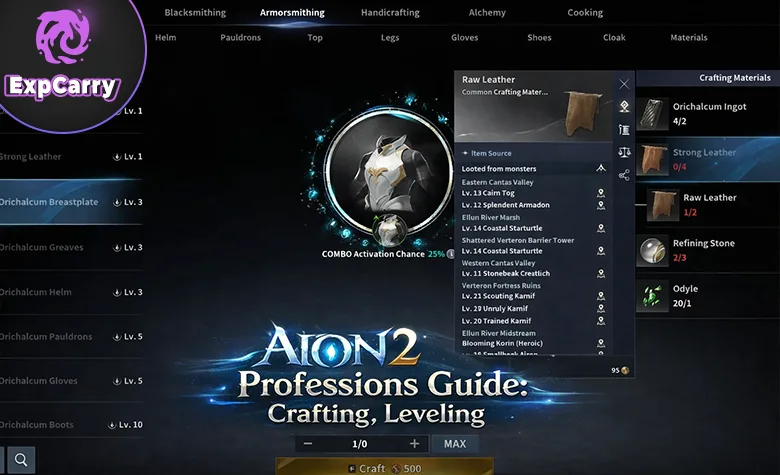
AION 2 has five crafting professions — Blacksmithing, Armorsmithing, Handicrafting, Alchemy and Cooking — plus a separate gathering skill called Essence Extraction. Crafting is not just a side activity: it can produce weapons, armor, accessories, consumables and upgrade materials that remain relevant through endgame progression.
The Global client contains 512 crafting recipes across both factions, while profession Mastery runs from 1 to 100. The first 50 levels are Novice; reaching Professional requires a profession-specific upgrade quest before you can continue from 51 to 100.
Short answer: choose the profession that solves a real progression problem. Armorsmithing is the safest general gear profession, Blacksmithing / Handicrafting / Alchemy are better if you specifically want to craft your own class weapon, Alchemy is strong for repeat-use utility, and Cooking is the easiest consumable-focused option.
Updated: October 5, 2026 for AION 2 Global.
AION 2 Professions at a Glance
| Profession | Main Products | Best For |
|---|---|---|
| Blacksmithing | Longswords, greatswords, daggers, maces, guards and materials | Gladiator, Templar, Assassin, Cleric weapon crafting |
| Armorsmithing | Helms, pauldrons, chest, gloves, legs, cloaks and boots | Universal armor progression |
| Handicrafting | Bows, staffs, rings, earrings, necklaces and accessories | Ranger, Chanter and accessory crafting |
| Alchemy | Orbs, spellbooks, Manastones, potions, scrolls and materials | Sorcerer, Spiritmaster and utility crafting |
| Cooking | Food and temporary buff consumables | Recurring self-use across every class |
| Essence Extraction | Ore, gems, wood, herbs, ingredients and Odyle | Gathering materials for all professions |
What Is the Best Profession in AION 2?
There is no single best profession for every player. Your class and your reason for crafting matter more than a generic profit ranking.
| Your Goal | Best Starting Profession | Why |
|---|---|---|
| Most universal equipment value | Armorsmithing | Every class uses armor and the profession covers seven equipment slots. |
| Gladiator / Templar / Assassin / Cleric weapon | Blacksmithing | Produces the relevant melee weapons and guards. |
| Ranger / Chanter weapon | Handicrafting | Produces bows and staffs and also covers accessories. |
| Sorcerer / Spiritmaster weapon | Alchemy | Produces spellbooks and orbs plus useful consumables. |
| Consumables and general utility | Alchemy | Potions, Manastones and other repeat-use products remain useful beyond one gear slot. |
| Simple recurring self-use | Cooking | Food remains useful regardless of class or weapon type. |
For a completely undecided player, Armorsmithing is the safest general-purpose gear choice. It has the widest equipment coverage and does not depend on your weapon type.
However, if your goal is to build your own weapon progression, choose the profession that actually crafts your class weapon instead.
Best Crafting Profession for Each Class
| Class | Weapon Profession | Useful Alternatives |
|---|---|---|
| Gladiator | Blacksmithing | Armorsmithing, Alchemy |
| Templar | Blacksmithing | Armorsmithing, Alchemy |
| Assassin | Blacksmithing | Armorsmithing, Alchemy |
| Ranger | Handicrafting | Armorsmithing, Alchemy |
| Sorcerer | Alchemy | Armorsmithing, Handicrafting |
| Spiritmaster | Alchemy | Armorsmithing, Handicrafting |
| Cleric | Blacksmithing | Armorsmithing, Alchemy |
| Chanter | Handicrafting | Armorsmithing, Alchemy |
This table is about self-crafting your weapon, not a mandatory profession choice. A Ranger can still make good use of Armorsmithing or Alchemy, for example.
Explore services related to this guide, selected from our Aion 2 catalog.
View All Aion 2 Services

How Crafting Works in AION 2
Crafting is station-based. You use the appropriate Crafting Table, select a recipe, supply the required materials and attempt the craft.
Current Global data shows crafting stations for all five professions in the main early faction regions:
- Elyos: Verteron, including Dawn Legion Base and Zumion Village.
- Asmodians: Altgard, including Safe Haven and Nornir Assembly.
Recipes require a combination of gathered materials, processed components, vendor ingredients and, at higher tiers, materials connected to combat and dungeon progression.
AION 2 Crafting Mastery: 1–100
Every crafting profession has its own Mastery.
| Rank | Mastery | What Happens |
|---|---|---|
| Novice | 1–50 | Early recipes, processed materials and the first equipment lines. |
| Upgrade Quest | 50 | Your profession stops progressing until its specialty upgrade is completed. |
| Professional | 51–100 | Balaur materials, Dragon Lord progression and higher crafting tiers. |
Reaching Mastery 50 is therefore not the end. It is a progression gate.
How to Upgrade a Profession to Professional
At Mastery 50, take the profession's Upgrade: [Profession] Specialty Skill quest and complete its crafting test.
Once completed, your profession cap rises and you can continue through Professional Mastery.
If your profession is stuck at 50: do not keep crafting expecting the bar to move. Find and complete the profession upgrade quest first.
How to Level Crafting Fast
The fastest route is not simply to spam the cheapest item in the list. Materials become the real bottleneck very quickly.
- Gather while leveling your character. Do not wait until endgame to begin Essence Extraction.
- Process raw materials. Ingots, powders and other intermediate materials provide progression while remaining useful later.
- Craft useful gear tiers. Prefer recipes that can feed your own equipment progression.
- Keep Splendent results. They can be required for the next step in an equipment chain.
- Complete the Mastery 50 upgrade quest.
- Move into Balaur materials after 50.
- Avoid wasting rare materials purely for Mastery XP.
What Is a Splendent Craft?
Some successful crafts can produce an improved Splendent result instead of the normal item.
For equipment progression, this matters because a Splendent version can become the required input for the next recipe in the crafting chain.
Do not automatically sell a Splendent weapon or armor piece before checking the next recipe.
Crafted Gear Progression
Crafted equipment follows a progression ladder rather than one isolated recipe.
| Stage | Approx. Mastery Gate | Purpose |
|---|---|---|
| Orichalcum line | Early Mastery | Entry crafted equipment |
| Expert line | 15+ | Intermediate progression |
| Artisan line | 30+ | Higher Novice gear |
| Balaur materials | 51+ | Professional crafting materials |
| Dragon Lord equipment | 55–60+ | High-end gear progression |
| Top crafted upgrades | Later chain | Can reach Unique Item Level 102 |
The important detail is that high-end crafting does not remove the need to play PvE. Advanced recipes require materials connected to dungeon and combat content.
Crafting therefore works alongside the AION 2 dungeon progression instead of replacing it.
What Is Succession Crafting?
Higher equipment chains can use an existing crafted piece as an input for its next upgrade.
This matters because the crafting system is designed around improving an existing line rather than throwing every previous item away and starting from zero.
Always inspect the next recipe before selling or dismantling a Splendent piece used in that chain.
AION 2 Essence Extraction Guide
Essence Extraction is the gathering profession. Mining, herbs, wood and similar resources are not separate professions in Global.
The current Global client contains 27 gathering node types, covering groups such as:
- ore;
- gems;
- logs;
- herbs;
- cooking ingredients;
- Odyle.
Essence Extraction has its own Mastery and its own skill tree.
Best Essence Extraction Skills
Your gathering skill points can improve how efficiently you find and harvest specific materials.
| Skill Type | What It Does |
|---|---|
| Seeker | Helps reveal the selected resource type on your compass. |
| Plentiful Harvest | Improves the amount gathered from the relevant resource family. |
| Appraiser | Improves the chance of obtaining higher-grade materials. |
| Proficient Handling | Improves progress toward successful extraction. |
| Delicate Touch | Helps control failure progression. |
| Lady Luck | Can provide a larger success boost during extraction. |
Seeker is usually the best early quality-of-life investment for whichever material your primary crafting profession consumes most.
How to Upgrade Essence Extraction to Professional
Essence Extraction also reaches a progression gate at Mastery 50.
The Professional upgrade test requires you to gather Ruby until you obtain the required Splendent Ruby, then complete the specialty upgrade.
If searches such as “Essence Extraction stuck at 50” brought you here, this upgrade quest is usually the missing step.
Where to Get Crafting Materials
| Source | Main Use |
|---|---|
| Essence Extraction | Ore, gems, wood, herbs, ingredients and Odyle |
| Monster drops | Recipe-specific combat materials |
| Dungeons | Higher progression and Balaur-related materials |
| Processed crafting | Ingots, refined materials and intermediate components |
| NPC vendors | Solvents and basic recipe ingredients where applicable |
| Server Market | Tradeable materials supplied by other players |
Crafting and the AION 2 Market
Direct player-to-player trading is disabled in Global, so the Server Market is central to selling tradeable crafted items and materials.
Do not calculate profit only from the current listing price. Include:
- all raw materials;
- processed intermediate materials;
- vendor ingredients;
- failed crafting attempts where relevant;
- the opportunity cost of rare dungeon materials;
- whether the final item is actually tradeable.
Free and subscribed players also have different Market permissions. See our AION 2 Free-to-Play & Membership guide before planning a crafting business around Market access.
Is Crafting Worth It?
Yes, but not because crafting replaces dungeon gear.
Crafting is strongest when it does one of three things:
- fills a weapon or armor slot that refuses to drop;
- provides repeat-use consumables;
- turns materials you already gather into a useful or tradeable product.
The weakest strategy is spending large amounts of Kinah on speculative production simply because an item currently has a high listing price.
What Should You Craft First?
For a new Global character:
- Start Essence Extraction immediately.
- Choose a profession that supports your class.
- Process gathered resources rather than selling everything raw.
- Progress through useful Novice recipes.
- Save Splendent equipment required by later crafts.
- Complete the Professional quest at 50.
- Only then begin committing expensive dungeon materials to high-end gear.
AION 2 Crafting FAQ
How many professions are in AION 2?
There are five crafting professions plus Essence Extraction gathering.
Can you level more than one profession?
Each crafting skill has its own Mastery progression. The main limitation is the time and materials required to develop multiple professions efficiently.
What is the best profession?
Armorsmithing is the safest general gear profession, but crafting your class weapon can make Blacksmithing, Handicrafting or Alchemy the better personal choice.
What happens at Mastery 50?
You must complete the profession's specialty upgrade quest before progressing into Professional Mastery.
What is Essence Extraction?
It is AION 2 Global's gathering skill for resources such as ore, gems, wood, herbs, ingredients and Odyle.
Can crafted gear reach endgame Item Level?
The recorded Global crafting chain reaches Unique Item Level 102, although obtaining the materials requires substantial progression and does not eliminate the need for dungeon content.
Conclusion
The best AION 2 crafting strategy is to connect profession progression to the character you are already building. Gather from the beginning, pick a profession that supports your gear or consumable needs, complete the Mastery-50 upgrade and save valuable Splendent components for later recipes.
Do not treat crafting as a replacement for PvE. The strongest crafting paths eventually depend on dungeon materials, which makes gathering, crafting and dungeon progression parts of the same endgame loop.