AION 2 solo farming is about matching a repeatable activity to your equipment, not forcing a difficult dungeon because a guide calls it the best gold spot. Before Global opens, the reliable choices to plan around are accessible field enemies, available character progression objectives and content explicitly marked for solo play. The Korean and Taiwanese versions also have private Expedition farming, but that does not make every Expedition or Transcendence dungeon an automatic solo route. Global Advanced Access begins September 30, and the free-to-play launch follows October 5, 2026. The completed level 37 Launch Scale Test cannot establish final endgame routes or retail Kina per hour.
Short answer: Farm enemies you can defeat consistently in your current progression area, complete eligible solo objectives and move to dedicated solo instances when unlocked. Treat private Conquest runs such as Krao Cave as a conditional advanced option only after checking the Global entry menu and your own clear capability.
| Your progression | Primary solo activity | What makes it worthwhile | What to verify |
|---|---|---|---|
| Early gear | Enemies along your active faction story route and eligible solo objectives | Less travel, steady progression and manageable recovery costs | Actual enemy rewards and available quest currency |
| Developing gear | Repeatable field circuits plus accessible Sealed Dungeons or Strongholds where available | Combines farming with character upgrades | Whether an activity is one-time, repeatable or even present in Global |
| Established solo build | Dedicated solo activities such as Nightmare and Ascension Trial in the regional system | Progression rewards without depending on a full dungeon party | Global availability, stage rules and reward limits |
| Advanced equipment | A stable field route and, if supported, a private Conquest attempt such as Krao Cave | Tests whether tougher content improves the actual return | Private entry, boss clear, currency type and reward eligibility |
Before using regional farming numbers: NCSOFT introduced a distinction between regular Kina and Kina (Bound) in Korea on March 25, 2026. A reward that increases your bound balance is useful for progression, but it is not automatically regular currency for the player Market.
Best AION 2 Solo Farming Spots by Gear Level
Your first farming location should be an area where your current character can finish a short circuit without repeatedly stopping to heal, revive or travel. The categories below describe where to look at each stage, not invented Global coordinates or fixed item-level thresholds.
Early Gear: Farm Around Your Current Story Area
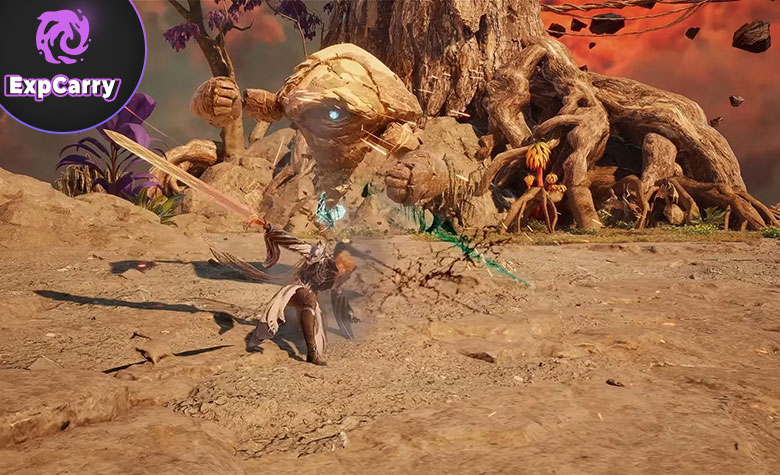
Stay close to the enemies and objectives already opened by your faction progression. Select a compact cluster of ordinary enemies you can kill cleanly, then use nearby story or optional objectives when they overlap with the route. This reduces travel without promising that a low-level field has a particular drop table.
- Choose ordinary enemies near a convenient return point before testing dangerous named targets.
- Measure the currency actually awarded by kills, not only the number of items collected.
- Complete a nearby objective once if its reward advances your character, but do not count a one-time quest as repeatable hourly income.
- Reduce pull size when recovery time becomes longer than the advantage from fighting multiple enemies.
Do not make gathering a mandatory early-game step based on an old KR route. NCSOFT raised the Korean gathering requirement to level 45 in its January anti-bot update; the initial Global requirement must be read from the actual client.
Developing Gear: Combine Field Farming With Solo Progression
As your character improves, test enemies in the next accessible field area and compare complete circuits rather than individual kills. The regional game also offers Sealed Dungeons and Strongholds as character-progression activities. Check them if they appear in Global, but separate their first-clear rewards from anything the game allows you to repeat.
- Maintain one safe field circuit as your baseline.
- Clear eligible solo progression locations for their actual displayed rewards.
- Return to an older circuit if a higher-level location increases deaths or consumable spending.
- Replace weak equipment when it is the reason you cannot keep a route stable.
The existing AION 2 Gear Progression guide explains the broader equipment decisions. This page stays focused on where an individual player can spend farming time.
Endgame Solo: Nightmare and Ascension Trial
NCSOFT explicitly identifies Nightmare and Ascension Trial as solo dungeons in its July Korean Chapter 1 announcement. Those names are better evidence for an intended solo progression lane than calling every Expedition a solo dungeon. Their late Korean stages, rewards and entry scores are not confirmed Global launch values.
Use the highest eligible stage that you can clear consistently if these modes exist in your current build. Check its reward preview, remaining allowance and reset rules first; completion alone does not establish that every stage can be farmed repeatedly for the same payout.
Advanced Option: Private Krao Cave Conquest
Krao Cave deserves a more precise explanation than the original article gave it. NCSOFT's Global preview presents it as an Expedition for up to five players. A documented September Taiwanese client guide and community reports show that its Conquest version could also be entered or cleared privately by a solo character. These statements are compatible: a dungeon supporting a party does not prove that the current regional mode requires a full party.
However, that Taiwanese observation is not proof that a Global solo player can enter every difficulty or earn the same Kina. If the Global Expedition interface supports a private entry, test its lowest eligible Conquest option, identify which rewards are actually claimable and stop if the boss mechanics make the run unreliable. Do not treat this as a beginner farming spot or import a Taiwanese Kina-per-run estimate.
Which AION 2 Dungeons Can Actually Be Farmed Alone
Several names from the old article were real AION 2 dungeons but had the wrong default recommendation. The official Global preview lists Krao Cave, Fire Temple and Draupnir under Expedition, each described as content for up to five players. That label does not prohibit every possible private attempt, but it also does not guarantee an easy or profitable solo clear.
| Dungeon or activity | Known classification | How to use it in a solo plan |
|---|---|---|
| Krao Cave | Global Expedition; private Conquest solo attempts documented in TW | Conditional advanced test, not guaranteed Global solo income |
| Fire Temple | Global Expedition for up to five players | Do not label normal-mode speed runs a proven beginner solo farm |
| Draupnir | Global Expedition for up to five players | Assess its available mode and private-entry rules before attempting alone |
| Deus Research Base | Transcendence; documented TW guide describes a two-to-five-player mode | Not an established default one-player route |
| Nightmare and Ascension Trial | Explicitly identified by NCSOFT as solo dungeons in KR Chapter 1 | Consider once present and unlocked in the Global client |
Dungeon completion, monster drops and reward Cube claims are different things. NCSOFT's later Korean Chapter 1 update revised Expedition and Transcendence rewards around Odyle Energy. A successful clear alone therefore does not justify counting every possible Cube or item as earned income. Consult the official Global dungeon preview for the published Expedition names and the live client for individual entry conditions.
Regular Kina and Bound Kina From Solo Farming
A solo route is easier to evaluate once rewards are separated by currency type. In the Korean March update, NCSOFT named monster hunting and Odyle Energy Cubes as regular Kina sources. It listed quests, Duties, NPC shop sales, Sealed Dungeons and Strongholds among sources of Kina (Bound).
| Solo activity | Official regional category | What the player should record |
|---|---|---|
| Eligible monster kills | Regular Kina | Currency received after each completed route |
| Eligible Odyle Energy Cube | Regular Kina | Claimed reward, energy spent and applicable limits |
| Quests and Duties | Kina (Bound) | Reward type and whether it is one-time or repeatable |
| Sealed Dungeons, Strongholds and NPC sales | Kina (Bound) | Actual reward and any completion restriction |
These source categories come from NCSOFT's March Korean update. Use them to understand the split, then confirm the currency icons, earning caps and available content in Global. Combining regular and bound balances into one supposed Market-ready profit figure would be misleading.
Explore services related to this guide, selected from our Aion 2 catalog.
View All Aion 2 Services


Solo Material Loops and Gathering
Materials become useful when they improve your own equipment or can be sold through an eligible in-game system. A good solo circuit combines accessible monster targets with any gathering nodes the live client lets your character use. A rare material with no buyer is not necessarily a better result than a modest resource needed by active crafters.
- Pick an accessible area containing enemies or nodes that your character can interact with reliably.
- Time one complete circuit, including travel, combat and inventory handling.
- Keep materials needed for your next real upgrade before deciding what counts as surplus.
- Check whether each surplus item can actually be listed on the Market.
- If gathering is locked in your regional build, use an eligible monster circuit instead of copying an obsolete node route.
The separate AION 2 Professions Guide covers crafting and life-skill progression. Exact Global node maps need live screenshots and should not be invented from a different regional season.
Selling Loot and Measuring Real Solo Profit
Do not count an item as income simply because someone listed a similar one at a high asking price. The relevant measures are currency already received, confirmed completed sales, resources consumed and the full time needed for a route.

| Track separately | Include | Do not count as earned profit |
|---|---|---|
| Regular Kina | Actual monster rewards and collected sale proceeds | Unclaimed rewards or uncompleted Market listings |
| Kina (Bound) | Confirmed bound rewards | The equivalent amount of tradable currency |
| Costs | Repair, consumables, crafting and applicable selling charges | A duplicated fee already deducted from a displayed net payout |
| Time | Travel, combat, recovery and selling | Only the fastest individual pull from a lucky run |
For a comparison, divide your realized net regular Kina by the time actually spent, then record bound Kina and kept materials separately. The completed Global Launch Scale Test had its Market disabled, so it cannot establish opening-week sale prices or reliable buyer demand. NCSOFT also announced that direct player-to-player trading is disabled for Global, leaving the Market as the central trading hub. Check your account's current Market access and item restrictions before relying on sales.
Does Your Class Change the Best Solo Farm
It can change which route is comfortable, but it does not create a universal best dungeon. Compare how your own character handles sustained pulls, recovery and movement. Durable builds may accept more incoming pressure, while ranged and pet-based builds may perform better with smaller, controlled engagements. A stronger paper damage result is not useful when deaths or long recovery repeatedly interrupt the session.
For class selection rather than farming locations, see the existing AION 2 Class Tier List. Do not use an unverified Global solo ranking to justify fixed Kina-per-hour claims.
A Practical Solo Farming Routine
Use a sequence that protects limited rewards, makes room for actual character improvement and leaves an alternative when one location is busy or too difficult.
- Check the available solo activities and current reward allowances.
- Complete useful one-time objectives separately from your repeatable farm.
- Choose a field circuit that fits the equipment you currently have.
- If unlocked, complete an eligible Nightmare or Ascension Trial stage under the current client rules.
- Only test private Conquest when the actual entry interface permits it and your baseline remains stable.
- Review regular Kina, bound Kina, kept upgrade materials and realized selling proceeds separately.
- Use the measured result to choose the next session's route.
Solo Farming Mistakes That Waste Time
A route loses value when it is built around an incorrect mode, an inaccessible reward or a gross price that never becomes currency. Avoid these errors before optimizing minute-by-minute clear speed.
- Treating a dungeon advertised for up to five players as guaranteed easy solo content.
- Copying Taiwanese private Conquest payout figures into Global without checking currency and rewards.
- Counting one-time Sealed Dungeon or Stronghold progression as repeatable hourly farming.
- Farming materials before checking both gathering eligibility and item tradeability.
- Assuming every dungeon clear awards a reward Cube without an additional condition.
- Adding Kina (Bound) to regular Kina as if both balances had identical uses.
- Measuring the fastest lucky attempt instead of several complete sessions.
AION 2 Solo Farming FAQ
These answers cover common access and account questions beyond the route choices above.
Can I farm solo without buying Membership?
Eligible gameplay rewards and Market selling are separate systems. Monster and activity rewards can be earned through play where the current client permits them; do not assume your account can list the resulting items without the required Market entitlement. The September Global notice also removed direct player-to-player trading as an alternative.
Does a private Expedition automatically give better Kina rewards?
No additional solo reward multiplier is established by the sources used here. A private attempt may let you avoid relying on a party, but it does not prove that every boss, Cube or payout will be accessible at the same difficulty. Compare only rewards actually received, with the regional currency split in mind.
Does clearing a higher Nightmare stage grant all earlier stage rewards?
NCSOFT described cumulative preceding-stage rewards in the July Korean Chapter 1 changes. That is a regional feature, not proof of the initial Global stage or reset structure. Read the current reward preview before using a higher-stage clear as a replacement for earlier ones.
Conclusion
Start with a stable field circuit and available solo objectives, then promote harder activities only when they improve realized rewards without increasing failures. Keep party-oriented Expeditions separate from explicitly solo content and treat private Conquest as a version-specific option to verify. After Global opens, the right route is the one that actually fits your equipment, reward access and time, not the one carrying the largest unverified Kinah estimate.