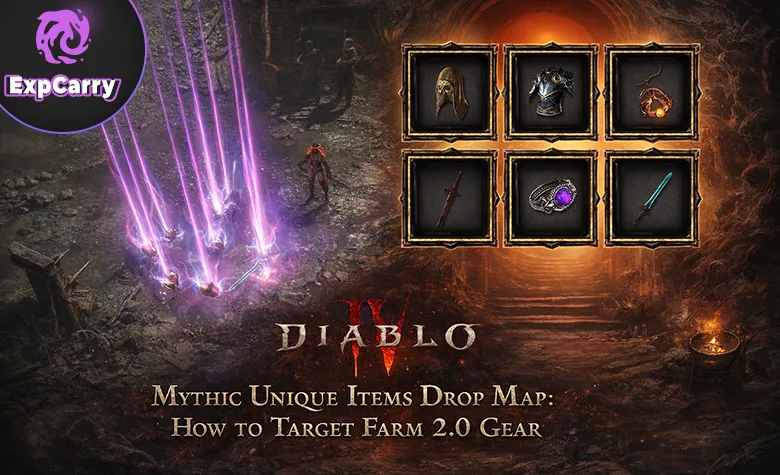
Mythic Unique items are not meant to be common, but they are meant to be targetable. For broader gearing context, Diablo IV Unique Items covers the item type this route is built around. In Season 11, the most reliable way to chase Mythics and specific Uniques is not “random grinding”, it is building a repeatable boss ladder: generate the right keys, open the right Lair Boss Hoards, and stack enough attempts per hour that variance stops mattering.
Last updated: January 2026 (Season of Divine Intervention is live; The Tower and Leaderboards Beta arrive with Patch 2.5.2 on January 12, 2026). This guide is a practical Mythic Unique Items drop map for Season 11. It explains where Mythics realistically come from, how Belial fits into target farming, how to sustain hoard-opening keys, and how to convert good drops into finished “2.5.x era” gear with the updated item journey systems. For that part of the ladder, Belial, Lord of Lies is the relevant boss target.
Important note: “target farm” in Diablo 4 does not mean guaranteed drops. It means you choose the best source for the item category you want, increase attempt volume, and reduce wasted time between kills. Your goal is not one lucky run, it is an efficient loop you can repeat until the drop happens.
How This Drop Map Works: Sustainable Target Farming
Season 11 farming succeeds when your loop is sustainable, because your progress is measured in Hoards opened, not in minutes spent “being busy.” You can have the best boss in the world, but if you cannot keep generating the keys to open Hoards, your Mythic farm becomes a slow key farm. This drop map is built to keep your session flowing: fewer dead minutes, fewer detours, more attempts per hour. The goal is not perfection, it is repeatability.
Core principles: attempts, keys, and speed
These principles stay useful across hotfixes because they describe what actually drives results in Diablo 4 endgame farming. Attempts per hour is the real multiplier: it smooths variance and makes your outcomes feel consistent over time. Keys are the constraint that controls how many real attempts you can convert into loot. Speed is the filter that decides which difficulty and which route you should run today, not on paper.
- Attempts per hour beats theory. The best farm is the one you can repeat quickly and safely.
- Hoard-opening keys are the real bottleneck. Plan your playtime around generating them efficiently.
- Farm the highest difficulty you can clear fast. If access is the blocker, Difficulty Tiers Unlock is the relevant progression step before farming higher tiers. Higher tiers help, but not if they cut your kill count in half.
Season 11 Snapshot: Why Target Farming Feels Better After 2.5.0
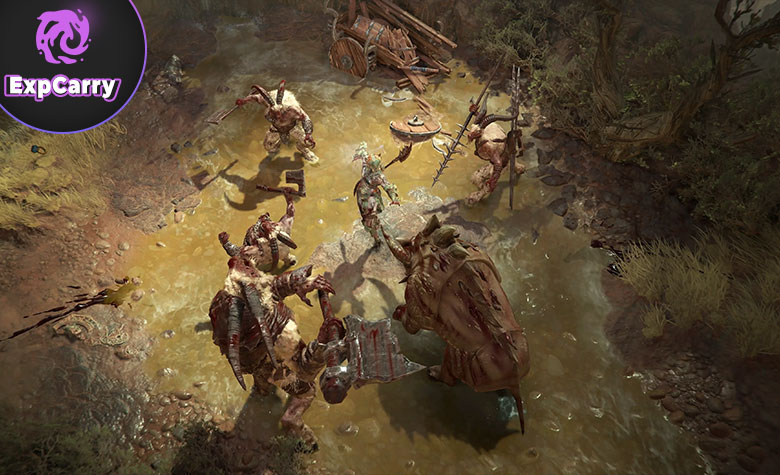
Players often describe the current loop as “2.0 gear” because the item journey changed so much, but the more accurate description is “post 2.5.0 item journey reworks.” The reason target farming feels better now is that good drops are more salvageable: you can take a strong base and reliably turn it into power. That makes the farming loop emotionally and practically cleaner: you farm, you hit a base, you convert it. It is less about waiting for a miracle and more about stacking attempts and finishing the right pieces.
What changed: item journey reworks and Season 11 loop rewards
Tempering became more directed, which reduces the number of runs where a good base dies to bad crafting outcomes. Masterworking and Quality scaling reward steady investment into the correct item, so your upgrades are more plannable instead of being purely luck-driven. Season 11 progression also tends to reward activity-driven play, which matches the ideal farming structure: you are moving, completing loops, and opening Hoards at a steady cadence. Taken together, these systems increase the value of every hour you spend farming, even when the exact Mythic you want does not drop yet.
- Tempering: more directed crafting. You can work toward the affixes your build needs with fewer dead ends, which makes good bases easier to convert into usable items.
- Masterworking and Quality: finishing a great base is more about consistent investment than perfect luck, so your farming loop converts into power more reliably.
- Season 11 systems: Divine Gifts and seasonal progression reward activity-driven loops that keep you moving and keep you opening Hoards.
- Competitive endgame timing: The Tower and Leaderboards Beta arrive with Patch 2.5.2 on January 12, 2026, so “best farm” remains the farm that builds your character fastest now, then pivots cleanly when competitive modes arrive.
Mythic Unique Items Drop Map: What Actually Drops Mythics Reliably
Mythics can technically appear outside bosses, but “reliably” is the keyword. If your goal is Mythic Uniques, the practical map is simple: Lair Boss Hoards first. Hoards concentrate rewards into a repeatable opening action that you can schedule, chain, and measure. The entire target-farm mindset in Season 11 is about turning playtime into as many quality Hoard openings as possible.
Primary Mythic sources: Lair Boss Hoards, with Belial as the control tool
For serious Mythic chasing, the most common approach is to build around Greater and Exalted Lair Boss attempts, because they fit the “volume per hour” model. Duriel and Andariel are usually treated as the core streak bosses because they are efficient to chain and provide strong Hoard value. If you have Vessel of Hatred access, the Urivar to Harbinger of Hatred chain becomes an additional top-end lane, especially when you need expansion-specific Uniques. Belial is the special case: he is not only another boss, he is a targeting lever, because his Hoard lets you select another boss’s loot pool while still keeping strong Mythic upside.
- Lair Boss Hoards are the practical Mythic source: Mythics are most efficiently chased from endgame Hoards, not from general overworld grinding.
- High-volume Greater Lair Boss targets: Duriel and Andariel are commonly treated as core Mythic farming bosses because they are efficient to chain and reward high-end Hoards.
- Expansion ladder (if applicable): the Urivar → Harbinger of Hatred chain adds another high-value top-end route for accounts with Vessel of Hatred access, especially if you need expansion-specific Uniques.
- Belial (Exalted Lair Boss) is the control tool: Belial does not use a fixed loot table. His Hoard rewards let you select another boss’s loot pool, adding real targeting control for boss-specific Uniques while keeping strong Mythic upside.
Practical takeaway: if you are serious about Mythics, split your playtime into two jobs only. First, generate keys to open Lair Boss Hoards. Second, spend those keys in streak sessions on the best-value boss route for your goal.
Explore services related to this guide, selected from our Diablo IV catalog.
View All Diablo IV Services

Season 11 Reality Check: Boss Loot Pools Matter
Target farming specific non-Mythic Uniques in Season 11 is mostly loot table routing, not “just run harder content.” Each Lair Boss has boss-specific Uniques plus a broader general pool, and the boss-specific pool is what makes targeting meaningful. The trap is spending hours on the wrong boss because the run “feels good” even though the table is wrong. Your plan should begin with the correct pool, then commit to enough attempts for variance to play out.
Loot table routing: pick the right pool, then commit to volume
Boss farming works when you stop treating all bosses as equal. Your route should be built around the one boss table that can actually produce your target, then executed in streaks that reduce travel and setup overhead. Random off-table drops can happen, but they are a bonus, not a strategy. Belial is valuable here because pool selection lets you roll the exact boss table you need without forcing you to rebuild your whole ladder for the day.
- Each Lair Boss has a boss-specific Unique pool plus general Unique drops.
- Random off-table drops can happen, but you cannot build a reliable target plan around them.
- Belial is especially valuable because choosing a loot pool lets you roll the exact boss table you need without rebuilding your entire route.
Key Map: What Opens Which Hoard and Where Keys Come From
In the current system, the bottleneck is Hoard-opening keys, not “summoning the boss.” After the boss dies, a Hoard spawns, and each player pays their own keys to open it. That detail changes how you should plan sessions: the metric that matters is how many Hoards you can afford to open, not how many bosses you can kill. If you run out of keys, your loop stops being Mythic farming and turns into forced currency farming.
Keys are the bottleneck: plan around Hoards opened, not bosses killed
Keys are your fuel. If you spend keys as soon as you can open one Hoard, you pay maximum overhead in travel and setup for minimum attempt volume. Banking keys until you can do a real streak is what makes target farming feel consistent, especially in groups where everyone needs their own keys to open rewards. Also remember the safety valve: Stygian Stones can be converted 1:1 into any Greater Lair Boss key you are missing, so they help smooth shortages without breaking your streak plan. Think in blocks: farm keys, then burn keys in streaks.
| Boss | Hoard keys | Where keys come from (practical) | Why it matters in the ladder |
| Varshan | 12 Malignant Hearts | Tree of Whispers (Grim Favors), plus open-world drops during endgame loops | A main step toward Duriel keys |
| Grigoire | 12 Living Steel | Helltides (Living Steel chests and efficient chest routes) | A main step toward Duriel keys |
| Lord Zir | 12 Exquisite Blood | Legion Events, Helltides, and World Bosses (focus on elite-heavy routes) | A main step toward Andariel keys |
| The Beast in the Ice | 12 Distilled Fear | Nightmare dungeons-services">dungeons-service">dungeons-services">Dungeons and consistent dungeon loops | A main step toward Andariel keys |
| Duriel | 3 Shard of Agony | Dropped by Varshan and Grigoire (and Stygian Stones can be converted 1:1 into missing Greater keys) | Core Mythic volume target and efficient streak boss |
| Andariel | 3 Pincushioned Dolls | Dropped by Lord Zir and Beast in the Ice (and Stygian Stones can be converted 1:1 into missing Greater keys) | Core Mythic volume target plus strong boss-specific Uniques |
| Belial (Exalted) | 2 Betrayer's Husk | From Belial ambushes that can occur after killing other Lair Bosses | Control boss: choose another boss loot pool, strong Mythic upside |
| Urivar (Vessel of Hatred) | 12 Judicator's Mask | Open-world endgame activities, especially Helltides, Whispers, and World Bosses | Start of the expansion ladder |
| Harbinger of Hatred (Vessel of Hatred) | 3 Abhorrent Heart | Dropped by Urivar (and Stygian Stones can be converted 1:1 into missing Greater keys) | Expansion-specific Unique targeting and top-end bases |
One Page Drop Map: Goal to Boss Route
This table is your session selector. Use it to pick one clean plan and run it as a focused block instead of mixing five half-loops. The route you can repeat the fastest will outperform a “perfect route” you cannot sustain. When you keep the plan simple, it becomes easier to evaluate results and adjust: you either need more keys, more attempts, or a better speed tier.
Session planning: pick one goal and run it in blocks
Run your day as a sequence: key generation block, then boss streak block, then a short conversion block to upgrade. This structure prevents the common problem where you do a little of everything and end with too few Hoards opened to feel progress. Belial fits best when you have Husks banked and a clear reason to use pool selection, not as the first thing you do every time you log in.
| Your goal | Primary boss route | When to add Belial | Your real bottleneck |
| Mythics per hour | Duriel and Andariel streak sessions (plus Harbinger of Hatred if you have Vessel of Hatred and need his drops) | When you already have a stack of Betrayer's Husks for multiple runs and you want to combine Mythic upside with loot-pool selection | Hoard keys and session flow, not raw damage |
| One specific non-Mythic Unique | Farm the boss loot pool that contains your target Unique, then commit to enough attempts | When you want to stay on one route but still access the needed boss pool via selection | Correct loot pool, then attempt volume |
| Best upgrade bases (Ancestral Uniques, Greater Affixes) | Fastest Lair Boss you can reach and kill repeatedly on your highest stable Torment | When pool control and base quality matter more than pure key efficiency | Kill speed, reset speed, and travel time |
Torment Tier Reality Check: Why Speed Wins
Higher Torment tiers can increase the value of each Hoard, but only if they do not slow your loop. In target farming, speed is not just comfort, it is math: more total openings usually beats slightly better single rewards. Your best Torment is the tier where you kill fast, reset fast, and rarely die. If pushing up a tier makes your run unstable, you are often losing Mythic chances overall.
Speed test rule: more total Hoards beats prettier single runs
If moving up a Torment tier drops your attempts per hour, you are usually losing Mythic chances even if individual Hoards look better. Time the full cycle, including travel, kill, and reset. If the cycle time jumps, drop back down and farm the faster tier until your build catches up. Consistency is what makes your results feel real instead of random.
- Rule of thumb: if moving up a Torment tier cuts your attempts per hour dramatically, you are usually losing Mythic chances even if individual rewards look better.
- Optimize for consistency: stable clears and fast resets create more total Hoards opened, which is what matters for Mythics.
Belial Target Farming: Why He Matters and How to Run Him Efficiently
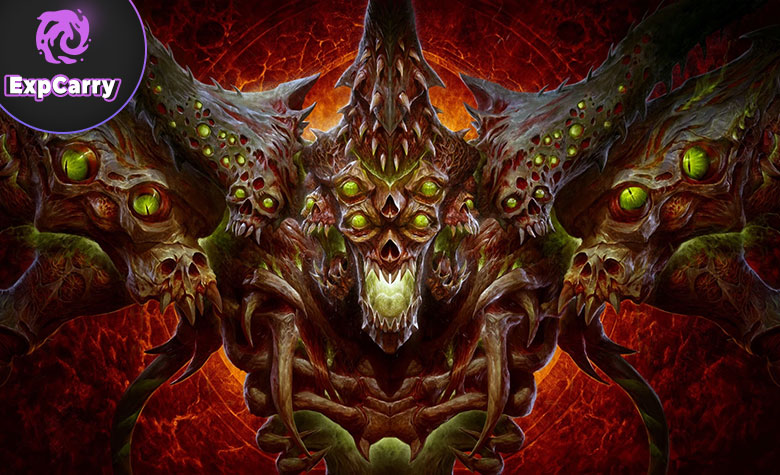
Belial matters because he turns boss farming into a more controlled system. Instead of being locked into one fixed loot table, Belial lets you select another boss’s loot pool when you open his Hoard. That flexibility is a major advantage when your target is boss-specific, because it reduces the need to rebuild your entire route. Belial also fits the Mythic chase mindset, because he still rewards endgame Hoards with strong upside when you chain attempts.
Efficient Belial usage: bank Husks, then chain pool-selected opens
Belial works best as a planned block, not a constant detour. Betrayer's Husks come from Belial ambushes that can trigger after killing other Lair Bosses, so you want Husks to accumulate naturally while you do other streak sessions. Then you schedule Belial as a finisher when you can run multiple opens in a row. When you open his rewards, treat loot-pool selection as your targeting lever: pick the pool that contains your target and commit to enough attempts to let variance work.
- To open Belial’s Hoard, you need Betrayer's Husks.
- Betrayer's Husks come from Belial ambushes that can trigger after killing other Lair Bosses, which is why Belial works best as a “session finisher” after other boss streaks.
- Belial is a session boss: he is best when you have Husks banked so you can chain attempts without constant detours.
- When opening Belial rewards, treat the loot-pool choice as your targeting lever for boss-specific Uniques. Choose the pool that contains your target item.
Practical takeaway: Belial is not only a Mythic farm. He is a control tool. Use him when you want to compress your targeting into fewer, more focused routes.
Season 11 Seasonal Layer: Divine Gifts and Lesser Evils
Season 11 adds a seasonal layer that can sit on top of your key-generation time: Divine Gifts and the Lesser Evils loop. Your first kill of each Lesser Evil awards its Corrupted Essence, which you deliver to Hadriel to unlock related Divine Gifts. Those Gifts progress further as you continue fighting that Evil’s forces and repeating seasonal objectives. The best way to use this layer is not to replace boss farming, but to make your “between streaks” time pay you back.
How to overlap seasonal progress with key generation
The seasonal layer is most valuable when it is not competing with your boss ladder. Use it to make key generation feel aligned: overlap Whispers, Helltides, Nightmare Dungeon loops, or other routes with objectives that advance Divine Gifts. In short sessions, keep goals separate in blocks so you do not lose attempt volume. In longer sessions, you can weave seasonal tasks into key generation as long as your key income stays stable.
- This does not replace Lair Boss Mythic farming, but it helps your “between boss streaks” time feel productive and reward-aligned.
- If your playtime is limited, try to overlap key generation with activities that also advance Divine Gifts.
- Keep goals separate inside short sessions: either generate keys, spend keys on boss streaks, or push seasonal tasks. Do it in blocks to stay efficient.
How to Sustain the Boss Ladder: A Repeatable Key Loop
If you cannot sustain Hoard keys, you are not farming Mythics, you are farming keys. The good news is that sustainability is mostly about structure, not about perfect knowledge. When you pick one key activity and commit, you stabilize your income. When you bank keys and then run real streaks, you stabilize your attempt volume. That is what turns the ladder into a repeatable system instead of a frustrating shuffle.
Repeatable session structure: bank keys, run streaks, upgrade in layers
Use this structure for your play sessions to keep the ladder sustainable. The biggest efficiency gain is not spending keys the moment you can open one Hoard, but banking enough to run a real streak with minimal downtime. Then convert drops into upgrades without burning deep resources too early. This keeps your gear improving at a steady pace even when your “dream drop” refuses to appear.
- Step 1: Pick one key-generation activity and commit to it for the session (Whispers, Helltides, Nightmare Dungeons, World Boss and Legion loops).
- Step 2: Bank keys until you can run a real streak. Do not spend the moment you get enough for one Hoard, because single attempts waste time on travel and setup.
- Step 3: Run your boss streak in one uninterrupted chain. This is where your Mythic odds actually show up, because you generate a real sample size of Hoards.
- Step 4: Convert drops into upgrades in layers. Do not burn deep resources on “almost” items early.
Practical sustain tip: Lair Boss keys are about opening Hoards. After the boss dies, a Hoard spawns, and each player pays their own keys to open it. Plan your farming around how many Hoards you can afford per session. If you want Belial in your plan, schedule him after other Lair Boss streaks when you have already stacked Husks. If you are short on Greater-boss keys, Stygian Stones can be converted 1:1 into the missing Greater key type to keep your streak session moving.
Target Farm Discipline: One Clean Loop Instead of Five Half-Loops
If you want better results, stop mixing goals. Build one primary loop, run it until you have enough keys for a real boss session, then convert that session into upgrades. This is the simplest way to keep your season moving forward without feeling stuck. The discipline is not about grinding harder, it is about wasting less time between meaningful attempts.
Solo rhythm vs group rotations
Solo players should focus on banking keys for meaningful streaks, because streaks reduce overhead and boost attempts per hour. Groups can improve efficiency through rotations, but only if everyone shares the same target and agrees on the plan beforehand: which boss pool you are targeting, how many Hoards each player will open, and when the session ends. This prevents the classic group problem where people are together, but not actually aligned on what they are doing. When the plan is aligned, groups feel faster because you remove hesitation and downtime.
- Solo plan:
- Bank keys until you can run meaningful streaks. Streaks reduce overhead and boost attempts per hour.
- If you want Belial, treat him as a finisher after other boss kills so you naturally accumulate Husks.
- Group plan:
- Boss rotations help when everyone shares the same goal and route.
- Agree ahead of time: which boss pool you are targeting, how many Hoards each player will open, and when you end the session. That saves more time than almost any build tweak.
From Drop to Finished Gear: The Season 11 Upgrade Plan
Target farming gets you the item. The item journey systems turn it into finished gear. The fastest way to improve is to upgrade in layers instead of burning resources on items that are not long-term bases. This matters in Season 11 because directed crafting and plannable upgrades reward patience and correct sequencing. Your goal is to turn each good base into a power spike, not to gamble your best resources on an item you will replace tomorrow.
Upgrade plan: base first, function second, heavy investment last
The goal is to turn drops into power efficiently. Get the correct base from the correct pool first. Then Temper to hit functional breakpoints. Masterwork only pieces that already fit your build direction. Apply Sanctification late on gear you expect to keep, treating it as finishing rather than an early gamble. This keeps your resource curve healthy and prevents “almost items” from draining your season.
- Phase 1: Get the correct base item from the correct boss pool. Do not “hope” for it in random content if a loot table can target it.
- Phase 2: Temper for the affixes your build requires. Your goal is functional breakpoints first, not perfect rolls.
- Phase 3: Masterwork the items that already fit your build direction. Quality scaling rewards consistent investment into the right piece.
- Phase 4: Apply Sanctification late, on gear you expect to keep. Treat it like a finishing step, not an early gamble.
Practical takeaway: a slightly weaker drop that aligns perfectly with your upgrade path often becomes stronger than a higher-roll item that fights your build needs.
Common Target Farming Traps and How to Avoid Them
Most target farming mistakes are not about game knowledge, they are about session structure. If your attempts per hour are low, your results will feel random no matter what you do. If your goals change constantly, you will never build a meaningful sample size on one boss table. If you push difficulty until your clear speed collapses, you will open fewer Hoards and see fewer high-end drops. The fixes are simple and repeatable, which is why they matter.
The traps: low attempt volume, mixed goals, and early resource burn
These traps show up in almost every season because they feel “active” even when they are inefficient. Farming “anything” feels productive but does not concentrate Mythic attempts. Switching goals feels flexible but destroys volume. Upgrading too early feels exciting but drains resources that should be reserved for true keeper bases. A clean loop solves all three: keys, streaks, upgrades in that order.
- Trap: farming “anything” and calling it Mythic farming. Fix: spend most of your time either generating Hoard keys or spending them on high-value boss streaks.
- Trap: switching goals every hour. Fix: choose one target for the session and commit until you have a real sample size of attempts.
- Trap: pushing difficulty so high that your clear speed collapses. Fix: farm the highest tier you can clear fast and consistently.
- Trap: upgrading the wrong items too early. Fix: upgrade in layers and save deep investment for items that are already correct for your build.
- Trap: forcing Belial first. Fix: treat Belial as a session finisher after you have already built keys and stacked Husks.
Conclusion
Mythic Unique target farming in Diablo 4 Season 11 is a ladder, not a lottery ticket. The practical drop map is built around Lair Boss Hoards: you generate keys efficiently, you spend them in streak sessions, and you measure progress by Hoards opened rather than by vague grinding time. Duriel and Andariel remain the core volume bosses for Mythic chasing, boss loot tables remain the foundation for targeting specific non-Mythic Uniques, and Belial remains the control tool when you want pool selection without rebuilding your entire route.
The key mindset shift is that “target farm” means choosing the best source for your goal and then stacking enough attempts that variance stops owning your mood. One night of dry runs does not mean the strategy failed, it usually means the sample size is still small. When you keep the loop clean and sustainable, your results become predictable in the only way Diablo farming can be predictable: you are consistently creating real chances.
Finally, do not forget the conversion step. Season 11’s item journey systems reward upgrading in layers: get the correct base, make it functional with Tempering, invest with Masterworking when it is truly a keeper, and apply late finishing systems when you are confident the item will stay. That is how your farming time turns into finished 2.5.x era gear instead of a stash full of “almost upgrades.”