
Demonology Warlock is one of the strongest all-round ranged DPS specializations in WoW Midnight Season 2. The current Patch 12.1 build revolves around generating Soul Shards, summoning Wild Imps and other demons, and converting those resources into powerful Summon Demonic Tyrant and Dominion of Argus windows. Demonology performs especially well in Mythic+, stacked cleave, raid progression, Delves, and solo content.
Diabolist is the current default Hero Talent for both Raid and Mythic+. Soul Harvester can still be competitive in specialized pure single-target setups, but current live Raid and Mythic+ data overwhelmingly favors Diabolist because it combines strong boss damage with far better cleave and AoE flexibility.
Updated: September 11, 2026 for Patch 12.1 and Midnight Season 2. This version includes the August 25 Demonology buffs, the updated Season 2 tier-set Implosion values, current Hero Talent recommendations, and revised Raid and Mythic+ builds.
For a comparison with Affliction and Destruction, see our best Warlock spec guide.
Best Demonology Warlock Build in Midnight Season 2
| Content | Best Hero Talent | Recommended Build | Main Strength |
|---|---|---|---|
| Raid | Diabolist | Single Target / Raid | Strong boss damage with useful passive cleave and reliable Tyrant windows. |
| Mythic+ | Diabolist | AoE / Cleave | Excellent stacked damage, priority-target pressure, and powerful demon cycles. |
| Pure Single Target | Diabolist / Soul Harvester | Encounter dependent | Soul Harvester can compete in Patchwerk-style simulations, while Diabolist is the safer live-content choice. |
| Delves / Solo | Diabolist | Mythic+ baseline with utility flex | Felguard tanking, strong survivability, and excellent sustained damage. |
| PvP | Matchup dependent | Arena / Solo Shuffle | Pet pressure, control chains, mobility, and Tyrant kill windows. |
Best Demonology Warlock Talents: Quick Answer
For most players in Midnight Season 2, the answer is simple: play Diabolist for Raid and Mythic+. It is currently the dominant Hero Talent in live endgame content and avoids the major cleave limitations of Soul Harvester.
The core Demonology talents you should understand are:
- Hand of Gul'dan — your primary Soul Shard spender and source of Wild Imps.
- Call Dreadstalkers — an important demon summon that forms part of your normal damage cycle.
- Demonic Core — enables instant Demonbolt casts for movement and fast Soul Shard generation.
- Implosion — converts Wild Imps into burst AoE and now gains additional importance from the Season 2 set.
- Summon Demonic Tyrant — starts your most important damage window.
- Dominion of Argus — the Demonology Apex Talent that extends the Tyrant cycle with additional summoned demons.
Diabolist vs Soul Harvester: Which Hero Talent Is Best?
Diabolist is the best general Demonology Warlock Hero Talent in Patch 12.1. It is used by the overwhelming majority of current Raid and Mythic+ players because it provides excellent single-target damage without sacrificing Demonology's strongest cleave profile.
| Hero Talent | Best For | Strength | Weakness |
|---|---|---|---|
| Diabolist | Raid, Mythic+, cleave, general PvE | Reliable demon cycles, strong stacked AoE, excellent live-content performance. | Requires good timing of demon and Tyrant windows. |
| Soul Harvester | Specialized single-target or PvP setups | Can remain competitive when the encounter strongly favors sustained single-target damage. | Substantially weaker cleave profile than Diabolist. |
Pure single-target simulations can sometimes place Soul Harvester slightly ahead, but that does not automatically make it the best raid build. Real encounters include movement, adds, target swaps, and cleave. For the current Season 2 raid, Diabolist is the practical default.
Explore services related to this guide, selected from our World of Warcraft catalog.
View All World of Warcraft Services
What Changed for Demonology Warlock in Patch 12.1?
Demonology received another major tuning pass after Season 2 launched. Blizzard specifically increased the contribution of core spells and demons to improve both single-target performance and the value of the specialization's summoned army.
- Shadow Bolt damage increased by 35%.
- Demonbolt damage increased by 30%.
- Wild Imp damage increased by 20%.
- Summon Felguard damage increased by 20%.
- Demons summoned by Dominion of Argus deal 20% more damage.
- Call Dreadstalkers damage increased by 30%.
- Burning Cleave from Antoran Armaments now strikes in a circular area instead of a cone.
You can verify the current tuning in the official World of Warcraft hotfix notes.
Best Demonology Warlock Raid Build
Diabolist is the recommended Demonology Warlock raid build for general Season 2 progression. The build below provides strong boss damage while retaining significantly better cleave than a specialized Soul Harvester setup.
Best Demonology Warlock Raid Talents
CoQAAAAAAAAAAAAAAAAAAAAAAwMzMzoZjxmZGzyAAAAAAAAGzYYBGYb0GNsYwMLzyMzMmBAmhZmZmZAGzYMbAAgZmZmZGzwyMGwA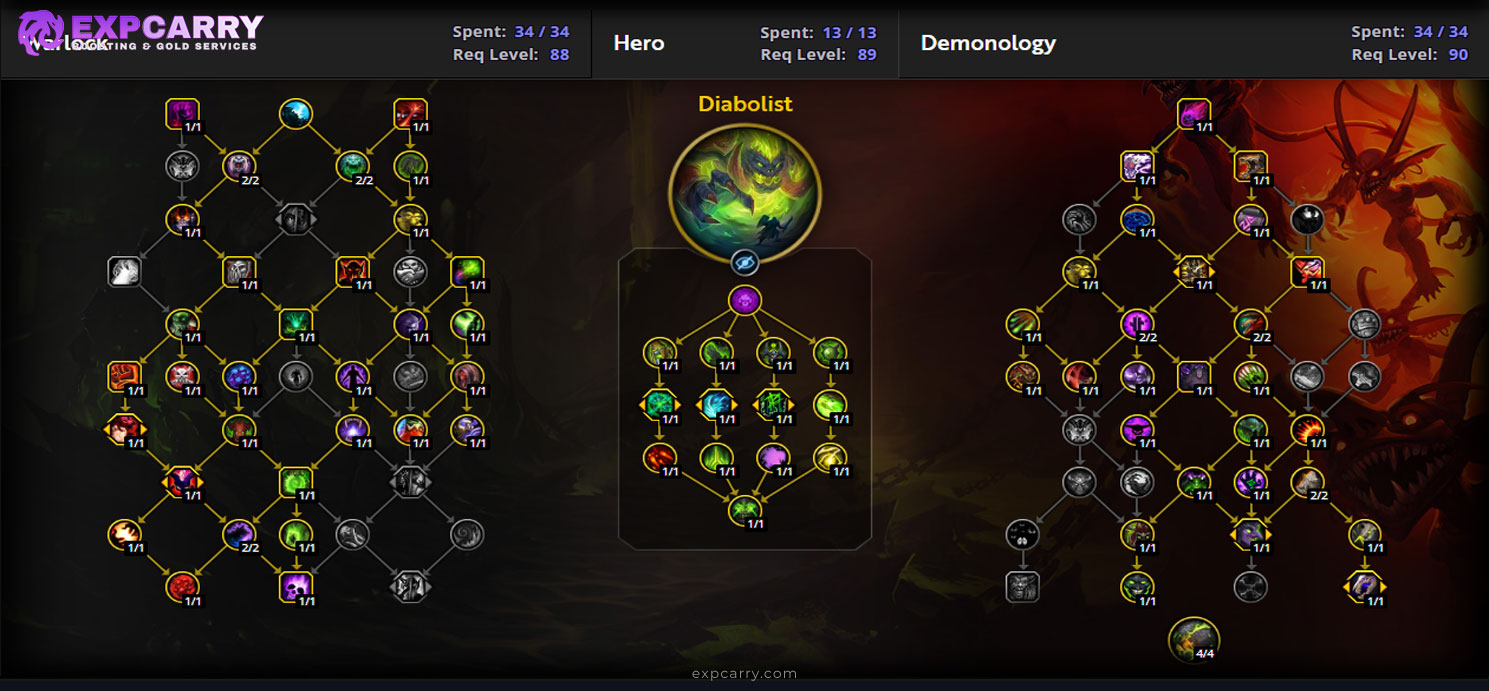
Hero Talent: Diabolist
Best for: Raid progression, single target with cleave, most Venomous Abyss encounters
Alternative: Soul Harvester only when an encounter strongly favors pure single-target damage and your own simulation supports the swap.
Key Demonology Raid Talents
- Summon Demonic Tyrant — triggers your Dominion of Argus damage cycle.
- Hand of Gul'dan — converts Soul Shards into Wild Imps and continues feeding Dominion after Tyrant.
- Call Dreadstalkers — important demon damage and part of normal Tyrant preparation.
- Demonic Core — provides instant Demonbolt casts and rapid shard generation.
- Implosion — important for adds and cleave and increasingly valuable because of the Season 2 set.
- Dominion of Argus — creates the post-Tyrant portal cycle that defines current Demonology burst.
Demonology Warlock Single-Target Rotation
Demonology uses a priority system rather than one rigid rotation. Your main objective is to avoid wasting Soul Shards or Demonic Core charges while entering each Tyrant window with enough resources to take full advantage of Dominion of Argus.
- Keep Soul Shards below the cap and avoid wasting Demonic Core charges.
- Use Call Dreadstalkers on schedule unless a short delay creates a clearly better Tyrant window.
- Spend Soul Shards with Hand of Gul'dan, normally at efficient shard counts.
- Prepare your active demons before Summon Demonic Tyrant.
- Cast Summon Demonic Tyrant to activate Dominion of Argus.
- Continue casting Hand of Gul'dan aggressively during Dominion to summon additional Argus demons.
- Use Demonbolt with Demonic Core for fast shard generation and movement.
- Use Shadow Bolt when no higher-priority resource action is available.
How Dominion of Argus Works
Dominion of Argus turns Summon Demonic Tyrant into the beginning of an extended damage window. After Tyrant is summoned, a portal to Argus remains active. Every second Hand of Gul'dan cast summons an additional subjugated demon, and the final Apex rank causes Hand of Gul'dan to refund a Soul Shard while Dominion is active.
The practical mistake to avoid is treating the moment after Tyrant as downtime. You want enough resources and Demonic Core generation to continue feeding Hand of Gul'dan throughout the Dominion window.
Best Demonology Warlock Mythic+ Build
Diabolist is clearly the preferred Demonology Warlock Mythic+ Hero Talent. It combines powerful stacked cleave with strong priority-target damage and has become the standard setup across current high-key data.
Best Demonology Warlock Mythic+ Talents
CoQAAAAAAAAAAAAAAAAAAAAAAwMzMzoZjxmZGzyAAAAAAAAGzYYBGYb0GNsYYmZZ2mZmxMAwMMmZmZAGzYMbAAgZmZmZGzwyMGwA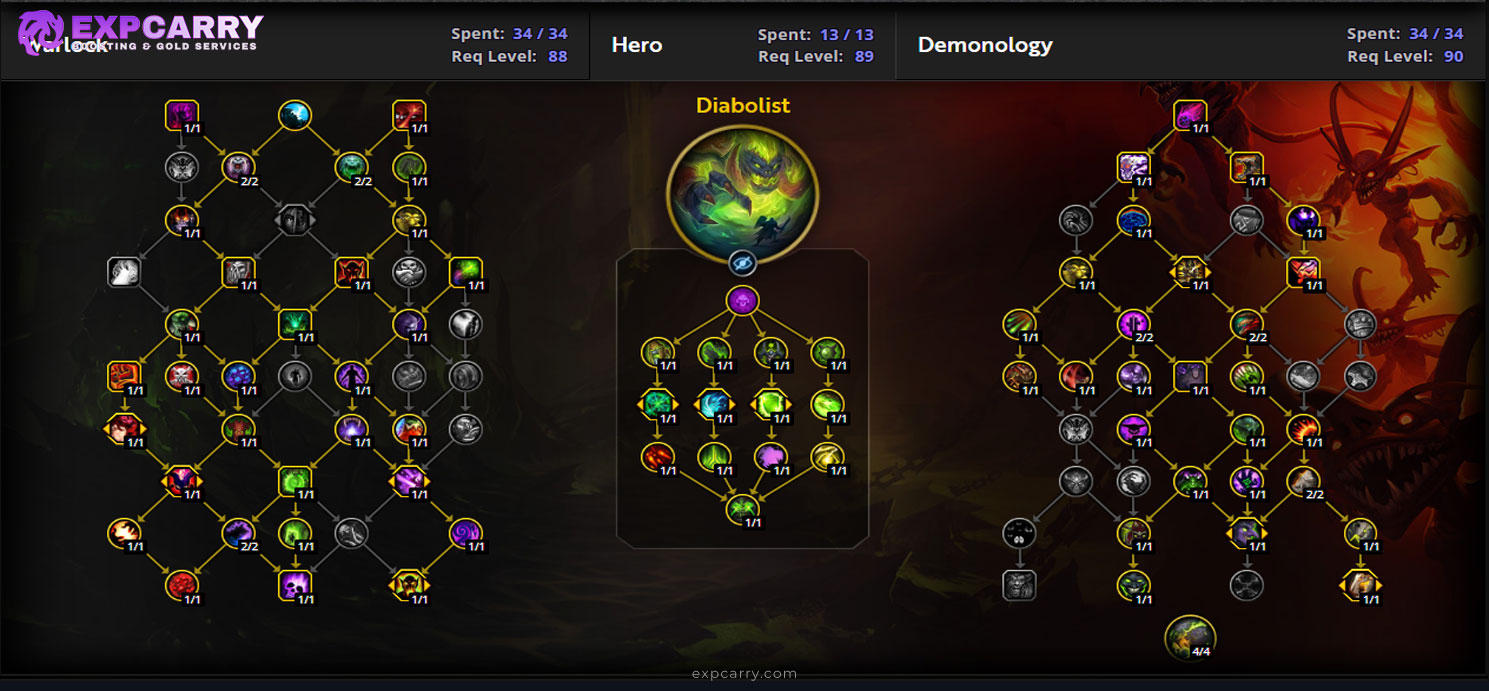
Hero Talent: Diabolist
Best for: Mythic+, stacked cleave, priority-target damage and dungeon bosses.
Demonology Warlock Mythic+ Rotation
- Do not cap at five Soul Shards.
- Keep Call Dreadstalkers active without delaying it unnecessarily.
- Use Hand of Gul'dan to continuously generate Wild Imps.
- Use Implosion when your active Imps and the remaining pack lifetime justify consuming them.
- Plan Tyrant and Dominion of Argus around durable pulls instead of using the cooldown into enemies that are already dying.
- Maintain pressure on the priority target while passive demon damage and Implosion handle surrounding enemies.
- Use Shadowfury, Mortal Coil, curses, Demonic Circle, and Demonic Gateway proactively instead of treating utility as an emergency-only tool.
Demonology AoE and Implosion
Implosion is one of the defining Demonology AoE tools, but it should not be pressed automatically every time several enemies appear. The value depends on your current Wild Imp count, how tightly the enemies are stacked, and how long the pack will remain alive.
The Season 2 set makes Wild Imp management even more important because depleted Imps can automatically trigger an additional Implosion effect. This gives Demonology meaningful passive cleave even while maintaining priority-target damage.
Demonology Warlock Delve Build
Demonology is one of the safest Warlock specializations for Delves and solo content. The Felguard can hold enemies while you build resources from range, and Warlock's defensive toolkit provides multiple ways to survive elite abilities and large pulls.
The Mythic+ Diabolist build is a strong baseline for Delves. You can then move utility points toward additional control or survivability depending on the specific encounter.
Use Fear, Mortal Coil, Dark Pact, Demonic Circle, and Demonic Gateway before a dangerous situation becomes an emergency. Let the Felguard establish control, avoid pulling more than your defensive plan can support, and save major demon windows for elites or the most dangerous part of a pull.
Demonology Warlock Stat Priority
| Content | Stat Priority |
|---|---|
| PvE | Intellect / Item Level → Critical Strike → Haste → Mastery → Versatility |
| PvP | Intellect → Versatility → Haste → Mastery → Critical Strike |
Critical Strike and Haste are strong general secondary stats for current PvE builds, but Demonology's values are close enough that you should not sacrifice a significant item-level upgrade simply to follow a static priority. Weapon power, Intellect, tier-set completion, trinkets, and special effects can outweigh small secondary-stat differences.
Demonology Warlock Season 2 Tier Set
The Demonology set from The Venomous Abyss is Damned Necrolyte's Shattered Restraints.
| Bonus | Effect | Impact |
|---|---|---|
| 2-Piece | Wild Imp damage increased by 10% and Implosion damage increased by 20%. | Improves both normal Imp damage and active AoE conversion through Implosion. |
| 4-Piece | When Wild Imps deplete their energy, they have a 20% chance to fling themselves at their target and automatically Implode. | Adds passive single-target and cleave damage without requiring an additional rotational button. |
The automatic Wild Imp Implosion effect is currently tuned to 350% effectiveness on the primary target and 315% effectiveness on other targets, increased from the original 250% / 225% launch values.
Four-piece is a major gearing target. See our Midnight Season 2 Tier Set Guide and Season 2 Gearing Guide for acquisition and upgrade priorities.
Demonology Warlock Gear and BiS Priorities
Do not sacrifice major item-level upgrades only to force a theoretical secondary-stat combination. Your general Season 2 gearing priorities are:
- High-item-level weapon and Intellect upgrades.
- Complete the Season 2 four-piece set.
- Acquire strong caster trinkets and special-effect items.
- Use the Catalyst strategically on strong eligible base items.
- Craft long-term pieces after your tier and weapon situation is clear.
- Sim close upgrades after major weapon, trinket, or tier changes.
For current raid drops, use our Venomous Abyss Loot Table.
Demonology Warlock Enchants, Gems, and Consumables
| Weapon | Jan'alai's Precision or the current highest-simming caster enchant for your gear. |
|---|---|
| Chest | Mark of the Worldsoul |
| Legs | Sunfire Silk Spellthread |
| Rings | Silvermoon's Alacrity unless your personal simulation favors another secondary stat. |
| Weapon Oil | Thalassian Phoenix Oil |
| Health Potion | Concentrated Silvermoon Health Potion |
| Augment Rune | Void-Touched Augment Rune |
Consumable and gem choices are secondary to correct talent selection and gear quality. Re-sim after obtaining your four-piece or replacing major trinkets.
Demonology Warlock PvP Build
Demonology PvP focuses on pet pressure, repeated crowd control, survivability, and protected Tyrant windows. Unlike PvE, there is no universal three-talent package that should be used into every composition.
Build Soul Shards safely, maintain Dreadstalker and Felguard pressure, and use Fear, Axe Toss, Mortal Coil, and Shadowfury to create a window where Summon Demonic Tyrant cannot simply be interrupted, line-of-sighted, or crowd controlled.
Best Demonology Warlock PvP Talents
- Impish Instincts — especially valuable against melee pressure.
- Soul Rip — provides both defensive and offensive value.
- Call Fel Lord — strong against melee teams and in confined areas.
- Nether Ward — valuable into caster-heavy teams and important magical spells.
Demonology PvP Priority
- Place Demonic Circle and Gateway before heavy pressure begins.
- Generate Soul Shards with Shadow Bolt and Demonic Core Demonbolt procs.
- Maintain Dreadstalkers and Wild Imp generation.
- Create cross-control on the healer or off target.
- Commit Summon Demonic Tyrant when enemy interrupts and defensive answers are limited.
- Use Dark Pact proactively rather than after most of the damage has already landed.
Demonology Warlock Utility and Defensives
| Ability | Best Use |
|---|---|
| Demonic Gateway | Group movement and encounter positioning. |
| Demonic Circle | Pre-planned movement and avoiding mechanics without losing long casting windows. |
| Soulstone | Combat resurrection and wipe recovery. |
| Healthstone | Emergency healing for you and your group. |
| Shadowfury | Ranged AoE stun for dangerous dungeon casts or PvP control chains. |
| Mortal Coil | Instant control combined with self-healing. |
| Dark Pact | Use before predictable damage to absorb the mechanic. |
| Unending Resolve | Major damage reduction and cast protection for dangerous situations. |
Useful Demonology Warlock Macros
Focus Fear
#showtooltip Fear
/cast [@focus,harm,nodead][] Fear
Cursor Shadowfury
#showtooltip Shadowfury
/cast [@cursor] Shadowfury
Focus Axe Toss
#showtooltip Axe Toss
/cast [@focus,harm,nodead][] Axe Toss
Mouseover Banish
#showtooltip Banish
/cast [@mouseover,harm,nodead][] Banish
Best Addons and WeakAuras for Demonology Warlock
- WeakAuras: track Soul Shards, Demonic Core, Wild Imp count, Dreadstalkers, Tyrant, and Dominion of Argus.
- BigWigs or DBM: plan Tyrant, Gateway, Circle, and defensive timings around encounter mechanics.
- Details!: analyze priority-target damage, deaths, interrupts, and cooldown usage.
- Plater: highlight priority enemies and dangerous casts in Mythic+.
- OmniCD: track group interrupts and defensive cooldowns in higher keys.
Demonology Warlock FAQ
What is the best Demonology Warlock build in Patch 12.1?
Diabolist is the best general build for Raid and Mythic+ in current Midnight Season 2 content. It combines excellent single-target performance with much stronger cleave and AoE flexibility than Soul Harvester.
What are the best Demonology Warlock talents for Mythic+?
Use a Diabolist build focused on Wild Imp generation, Implosion, Dreadstalkers, and efficient Tyrant/Dominion of Argus cycles. The Mythic+ import string above is the recommended general baseline.
Is Diabolist or Soul Harvester better for Demonology Warlock?
Diabolist is currently the better all-round choice and dominates live Raid and Mythic+ usage. Soul Harvester can remain competitive in specialized pure single-target situations but gives up substantial cleave flexibility.
What stats are best for Demonology Warlock?
Prioritize Intellect and item level first, then generally Critical Strike and Haste, followed by Mastery and Versatility. Always sim close gear choices because Demonology secondary-stat values can move with your current equipment.
What is the best Demonology Warlock rotation?
Generate Soul Shards without capping, maintain Dreadstalkers and Wild Imp generation, prepare your demon package before Summon Demonic Tyrant, then continue spending Hand of Gul'dan aggressively throughout Dominion of Argus.
Is Demonology Warlock good in Midnight Season 2?
Yes. Demonology is currently a strong choice for Raid, Mythic+, Delves, and solo play. Its combination of boss damage, stacked cleave, survivability, and Warlock utility makes it one of the safest ranged DPS choices in Patch 12.1.
For the complete Season 2 dungeon environment, see the Midnight Season 2 Mythic+ guide. For wider class comparisons, browse our WoW Midnight class guides.