

Devastation Evoker in WoW Midnight Season 2 is a mobile ranged DPS specialization built around Dragonrage, Deep Breath, Fire Breath, Eternity Surge, Disintegrate, Pyre, and the Rising Fury Apex talent. Scalecommander is the recommended PvE Hero Talent tree for both single-target raid encounters and Mythic Plus, with a dedicated single-target build for bosses and a cleave build for dungeons. Delves use the same Scalecommander build as Mythic Plus in this guide. For gearing, prioritize item level and Intellect first, then Critical Strike, followed by Mastery and Haste, with Versatility last. Echo of Calamity 4-piece is a major Season 2 gearing priority, and Patch 12.1 significantly strengthens Deep Breath, Pyre, Disintegrate, and Living Flame while redesigning Rising Fury Rank 3 around the new Unbound Flame gameplay loop. Season 2 begins with the August 18 regional reset in North America and the August 19 reset in Europe, so the recommendations in this version are based on live Patch 12.1 data and current pre-season theorycrafting and may shift with post-launch tuning.
Is Devastation Evoker Good in Midnight Season 2?
Based on current Patch 12.1 tuning and pre-season theorycrafting, Devastation Evoker is positioned as a strong ranged DPS option for Midnight Season 2. The specialization offers strong boss damage, useful cleave, excellent mobility through Hover, frequent Deep Breath access with Scalecommander, and group utility through Rescue, Zephyr, Cauterizing Flame, Tail Swipe, Wing Buffet, and Fury of the Aspects. Its main weaknesses are the 25-yard range of several offensive abilities, sensitivity to poor movement during Disintegrate channels, and the need to keep empowered spells and Dragonrage windows on schedule. For a wider comparison with other damage specializations, see the Midnight Season 2 DPS tier list.
| Area | Devastation Evoker Profile | What Matters Most |
|---|---|---|
| Raid | Strong boss damage with useful cleave and high mobility | Keeping Dragonrage, Deep Breath, Fire Breath, and Eternity Surge aligned efficiently |
| Mythic Plus | Strong priority damage and multi-target pressure | Deep Breath usage, Mass Disintegrate, Pyre thresholds, and frequent control |
| Delves | High burst, mobility, self-healing, and control | Front-loading damage while using defensives before dangerous elite mechanics |
| PvP | Mobile burst caster with strong disruption | Positioning, Time Stop, Hover, Sleep Walk, and correct defensive trading |
Devastation Evoker PvE Setup in Midnight Season 2
Raid, Mythic Plus, and Delve gearing share the same broad Devastation fundamentals, so the common stat, enchant, gem, and consumable recommendations are collected here instead of repeated almost identically in every PvE section. Individual content sections below focus only on the differences that affect talents, gear targets, rotation, and encounter priorities.
What Is the Best Devastation Evoker Stat Priority?
| Content | Stat Priority | Notes |
|---|---|---|
| Raid | Item Level and Intellect > Critical Strike > Mastery > Haste > Versatility | Critical Strike is the strongest broad secondary target, followed by Mastery and Haste. Exact values still depend on your character, so item level and personal simulations should take priority over forcing a generic secondary-stat order. |
| Mythic Plus | Item Level and Intellect > Critical Strike > Mastery > Haste > Versatility | Mastery currently has slightly higher generic value than Haste for Scalecommander, while Haste still improves rotational speed and responsiveness. Evaluate individual gear as a complete package and sim meaningful sidegrades. |
| Delves | Item Level and Intellect > Critical Strike > Mastery > Haste > Versatility | The same broad PvE profile works well for solo content without creating a separate Delve gearing set; use simulations for close item-level sidegrades. |
Do not sacrifice a substantial item-level upgrade only to obtain a preferred secondary stat. Devastation's secondary stats are close enough that additional Intellect frequently outweighs a cleaner secondary-stat distribution.
Best Devastation Evoker Consumables, Enchants, and Gems
| Slot or Type | Recommended Choice | Alternative or Note |
|---|---|---|
| Weapon | Enchant Weapon - Acuity of the Ren'dorei | Recheck secondary-stat weapon enchants as gear improves |
| Head | Enchant Helm - Empowered Rune of Avoidance | Default PvE choice |
| Shoulders | Enchant Shoulders - Amirdrassil's Grace | Default PvE choice |
| Chest | Enchant Chest - Mark of the Worldsoul | Default PvE choice |
| Legs | Sunfire Silk Spellthread | Default caster leg enchant |
| Boots | Enchant Boots - Lynx's Dexterity | Default PvE choice |
| Rings | Enchant Ring - Nature's Fury | Default PvE choice |
| Diamond | Indecipherable Eversong Diamond | Use one Eversong Diamond |
| Other Gems | Flawless Quick Garnet and Flawless Masterful Garnet | Use a mix that fits the current stat distribution |
| Flask | Flask of the Shattered Sun | Flask of the Magisters can also be useful depending on stats |
| Combat Potion | Potion of Recklessness | Light's Potential is slightly weaker but has no special stat requirement |
| Health Potion | Silvermoon Health Potion | Use as the main personal healing potion |
| Weapon Buff | Thalassian Phoenix Oil | Standard PvE weapon consumable |
| Augment Rune | Void-Touched Augment Rune | Optional additional primary stat |
| Food | Harandar Celebration or Quel'dorei Medley | Both are valid feast options |
| Tea | Sanguithorn Tea | Stacks with the normal food buff and provides movement speed rather than a direct damage stat |
Potion of Recklessness performs best when your secondary-stat distribution satisfies its requirements. Flask of the Shattered Sun is the normal flask choice, while Flask of the Magisters can help adjust the character's secondary-stat balance. Gems should also be treated as part of the full gear profile rather than forcing every socket into a single stat.
Devastation Evoker Raid Guide in Midnight Season 2
The Venomous Abyss is the eight-boss Season 2 raid containing Nek'zali the Soulcoiler, Entombed Sentinels, The Lost Explorers, Vashnik the Malignant, Sszorak, The Twin Fangs, The Coiled Altar, and Ula'tek. Devastation fits the raid well because Scalecommander provides strong single-target damage, useful cleave, frequent Deep Breath access, and excellent movement through Hover. Encounter mechanics and loot are covered in the Venomous Abyss raid guide.
Best Talents for Devastation Evoker Raids
Use the Scalecommander single-target build for raid bosses where boss damage is the primary requirement. The build centers on Dragonrage, Rising Fury, Tyranny, Causality, Animosity, Deep Breath, Strafing Run, Mass Disintegrate, Fire Breath, Eternity Surge, and Disintegrate. Scalecommander also handles incidental cleave effectively without giving up the specialization's core boss-damage profile.
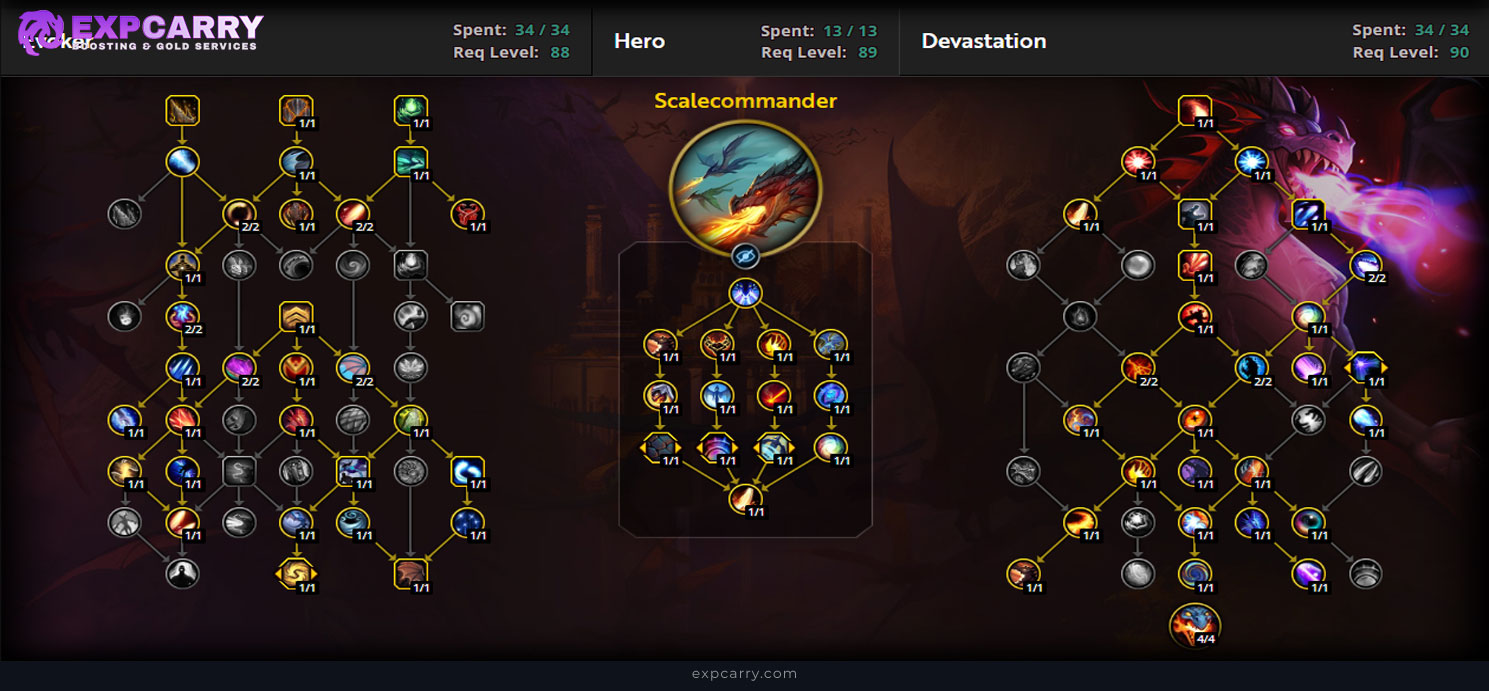
Flameshaper remains viable and can compete in some higher-target-count situations, but Scalecommander is the preferred general raid setup and the default Mythic Plus recommendation. The import above is the single-target Scalecommander setup rather than the dungeon cleave build.
How Does Rising Fury Work for Devastation Evoker?
Rising Fury uses four talent points across three Apex ranks. Rank 1 builds stacking Haste during Dragonrage, Rank 2 uses two points to strengthen the damage bonus at maximum stacks, and Patch 12.1 redesigns Rank 3 into a post-Dragonrage phase built around Unbound Flame.
| Apex Point | Effect |
|---|---|
| Rank 1 | Dragonrage starts you with 1 stack of Rising Fury, and while it remains active you gain another stack every 6 seconds. Each stack grants 4% Haste, stacking up to 5 times for a maximum of 20% Haste. |
| Rank 2 (1/2) | At 5 stacks of Rising Fury, all damage dealt is increased by 8%. |
| Rank 2 (2/2) | Upgrades the 5-stack damage bonus from 8% to 15%. The bonuses are not added together. |
| Rank 3 | When Dragonrage ends, Rising Fury persists for 4 seconds per stack and Dragonrage becomes Unbound Flame. Unbound Flame can be cast 4 times before Dragonrage finishes its cooldown. Each cast critically strikes the target and nearby enemies, deals reduced damage beyond 5 targets, and grants 1 Essence Burst. |
Tyranny also affects Unbound Flame in Patch 12.1, causing it to receive the maximum benefit of Mastery: Giantkiller regardless of the target's current health. At five Rising Fury stacks, the post-Dragonrage buff lasts 20 seconds. Use the four Unbound Flame casts efficiently and do not allow the next Dragonrage cooldown to arrive with charges still unused.
What Changed for Devastation Evoker in Patch 12.1?
Patch 12.1 includes both a redesign of the final Rising Fury point and a major tuning pass for Devastation. The July 31 tuning reduced the excessive value of the Season 2 2-piece while moving substantial damage back into the specialization's baseline abilities.
| Ability or Effect | Patch 12.1 Change | Gameplay Impact |
|---|---|---|
| Rising Fury | Rank 3 redesigned around 4 Unbound Flame casts after Dragonrage | Adds an active post-Dragonrage damage phase |
| Shattering Star from Scintillation | Now receives Scintillation's 40% effectiveness multiplier | Fixes the interaction that made the Season 2 set substantially stronger than intended |
| Echo of Calamity 2-piece | Shattering Star damage bonus reduced from 150% to 50% | Moves more power away from the set bonus and back into core spells |
| Deep Breath | Damage increased by 30% | Strengthens a core Scalecommander ability in both single-target and multi-target combat |
| Pyre | Damage increased by 10% | Improves larger multi-target spender value |
| Disintegrate | Damage increased by 40% | Substantially strengthens the main single-target and priority-target Essence spender |
| Living Flame | Damage increased by 50% | Improves filler damage and Burnout value |
| Wingleader | Mass Disintegrate reduces Deep Breath's remaining cooldown by 1 second for each target struck | Provides frequent Deep Breath access without the previous Bombardment-spreading gameplay |
Best Gear for Devastation Evoker Raids
The main Season 2 gearing objective is four pieces of Echo of Calamity. The Devastation 2-piece increases Shattering Star damage by 50% and makes Shattering Star behave as if it was released at maximum empower. The 4-piece causes every Causality activation to reduce the remaining cooldown of your empower spells by an additional 0.1 seconds and increases Eternity Surge damage by 10%.
Where Does Echo of Calamity Drop?
Echo of Calamity has five functional tier slots from The Venomous Abyss, while Ula'tek can provide the flexible Slumbering Coil Curio. Only four functional pieces are required to activate the complete set bonus, so one tier slot can remain an off-piece when another item provides a stronger overall upgrade.
| Tier Slot | Venomous Abyss Source |
|---|---|
| Head | The Twin Fangs |
| Shoulders | The Lost Explorers |
| Chest | Vashnik the Malignant |
| Hands | Entombed Sentinels |
| Legs | Sszorak |
| Flexible Tier Piece | Slumbering Coil Curio from Ula'tek |
The complete raid token structure is covered in the Venomous Abyss tier token guide.
Which Items Should You Catalyst?
The Season 2 Catalyst changes the normal tier-conversion logic because converted class-set armor inherits the secondary stats of the original eligible item and retains supported cantrip effects. Complete the 2-piece and 4-piece bonuses first. After four-piece is secured, favor high-track source items with strong Critical Strike, Haste, or Mastery combinations and useful eligible effects instead of converting the first available item in every slot.
Crafted Gear and Embellishments
Season 2 high-end crafting uses Spark of Tides together with the appropriate Mistcrests. The current recommended embellishments for Devastation are Hunter's Ritual Stone on a crafted weapon or off-hand and Arcanoweave Lining on crafted armor. A crafted weapon with Hunter's Ritual Stone can be worthwhile when you do not expect to obtain a strong raid weapon early, but it carries opportunity cost if raid weapons are accessible. If you obtain a strong main-hand such as Jan'thrazet, the Soul Fang, a crafted Aln'hara Lantern with Hunter's Ritual Stone is a strong off-hand option. After the weapon setup is established, use Arcanoweave Lining on a low-stat-budget armor slot such as wrists or waist, then consider unembellished crafted jewelry to fine-tune secondary stats. The full system is covered in the Midnight Season 2 crafting guide.
Weekly Gearing Plan
Devastation gearing should combine raid, Mythic Plus, Catalyst, crafting, and Great Vault rewards rather than committing all upgrade resources to a single path. Secure Echo of Calamity four-piece first, then optimize weapon, trinkets, embellishments, and high-track off-pieces.
| Activity | Priority | Season 2 Goal |
|---|---|---|
| The Venomous Abyss | High | Target Echo of Calamity pieces, raid weapons, trinkets, and Raid Great Vault progress |
| Mythic Plus 10 or Higher | High | Earn item level 311 Hero 3/6 end-of-dungeon gear and item level 318 Myth 1/6 Great Vault gear |
| Catalyst | High until 4-piece | Complete Echo of Calamity using strong eligible source armor |
| Crafting | As Sparks allow | Use Spark of Tides on long-term weapon or embellishment upgrades |
| Delves | Supplemental | Fill weak slots and progress the World section of the Great Vault |
Use the Midnight Season 2 gearing guide when planning upgrade tracks, Great Vault choices, Catalyst conversions, and Mistcrest spending. Players targeting organized raid clears can also use Venomous Abyss raid runs for additional weekly raid progression.
Rotation and Ability Priority for Devastation Evoker Raids
Scalecommander Devastation uses a priority system built around frequent Deep Breath casts, efficient Dragonrage windows, Rank 1 Fire Breath and Eternity Surge casts, Mass Disintegrate, Disintegrate, situational Pyre usage through Charged Blast, and the new post-Dragonrage Unbound Flame phase. Avoid delaying empowered spells without a specific encounter reason because Causality, Animosity, Rising Fury, and the Season 2 set all reward maintaining a clean cadence.
Single Target
- Use Deep Breath on cooldown and end the flight shortly after passing through the target when there is no reason to remain airborne.
- Use Dragonrage on cooldown unless a short delay aligns it with an important boss damage window.
- Use Tip the Scales according to the planned empower sequence.
- Use Eternity Surge at Rank 1.
- Use Fire Breath at Rank 1.
- Use Mass Disintegrate when available.
- Spend Essence and Essence Burst on Disintegrate.
- After Dragonrage ends, use Unbound Flame during the remaining Rising Fury window. If Mass Disintegrate is ready but you do not have Essence Burst and Essence is not capped, use Unbound Flame to generate Essence Burst; otherwise spend higher-priority resources first and use the remaining Unbound Flame casts before Dragonrage becomes available again.
- Use Living Flame as the primary filler.
- Use Azure Strike when movement prevents a better cast.
AoE Rotation
- Use Deep Breath as a high-priority damage ability on meaningful packs.
- Use Dragonrage on pulls that will live long enough to benefit from the complete cooldown window.
- Use Tip the Scales with the appropriate empowered spell for the pull.
- Use Fire Breath at Rank 1 unless a specific timing requirement calls for another empower rank.
- Use Eternity Surge at Rank 1.
- At 3 targets, Pyre becomes worthwhile at roughly 12 Charged Blast stacks. Avoid spending Charged Blast on Pyre in roughly the last 5 seconds before Dragonrage so Dragonrage's three Pyres can benefit from the stored stacks.
- Prioritize Mass Disintegrate when available.
- When Mass Disintegrate is unavailable, continue using Disintegrate as the default Scalecommander spender and use Pyre when target count and Charged Blast value justify it.
- Use Disintegrate when priority damage is more important than additional Pyre cleave.
- Use Azure Strike as movement and multi-target filler.
Cooldowns and Utility
- Dragonrage is the main damage cooldown and should normally be used frequently rather than held through multiple possible uses.
- Deep Breath is a major Scalecommander damage ability and also resets Hover through Slipstream.
- Use Hover proactively so movement does not interrupt important casts or Disintegrate channels.
- Use Obsidian Scales before dangerous incoming damage. Renewing Blaze is not a separate active button in Midnight and instead improves Obsidian Scales.
- Use Cauterizing Flame to remove dangerous Bleed, Poison, Curse, or Disease effects when applicable.
- Use Zephyr before appropriate group-wide damage.
- Use Rescue when ally repositioning can prevent a death or solve a mechanic.
Opener
- Precast Living Flame when the encounter allows it.
- Use your combat potion immediately before or at the start of the primary burst window.
- Use Deep Breath.
- Activate Dragonrage.
- Use Tip the Scales.
- Cast Eternity Surge.
- Cast Fire Breath at Rank 1.
- On single target, delay the second Deep Breath from Strafing Run until the buff is close to expiring; in AoE, the two Deep Breath casts can be used back to back when positioning allows it.
- Spend Essence on Disintegrate and continue the normal priority.
- After Dragonrage, transition into the Unbound Flame phase instead of treating the end of Dragonrage as the end of the burst sequence.
Explore services related to this guide, selected from our World of Warcraft catalog.
View All World of Warcraft Services


Devastation Evoker Mythic Plus Guide in Midnight Season 2
Devastation Evoker brings strong priority damage, frequent cleave, mobility, crowd control, an interrupt, Cauterizing Flame, Rescue, Zephyr, and Fury of the Aspects to Midnight Season 2 Mythic Plus. Scalecommander is the recommended dungeon Hero Talent tree because Mass Disintegrate, Bombardments, Wingleader, and frequent Deep Breath casts fit multi-target dungeon combat well. The Season 2 pool is set to contain Altar of Fangs, Murder Row, Den of Nalorakk, The Blinding Vale, Voidscar Arena, Kings' Rest, Temple of Sethraliss, and Ruby Life Pools. See the Midnight Season 2 Mythic Plus dungeon guide for the full seasonal rotation.
Best Talents for Devastation Evoker Mythic Plus
Use the Scalecommander Mythic Plus and raid-cleave build. Compared with the single-target raid setup, this version places more emphasis on Mass Disintegrate, Charged Blast, Pyre, Bombardments, and repeated Deep Breath access without giving up strong priority damage.
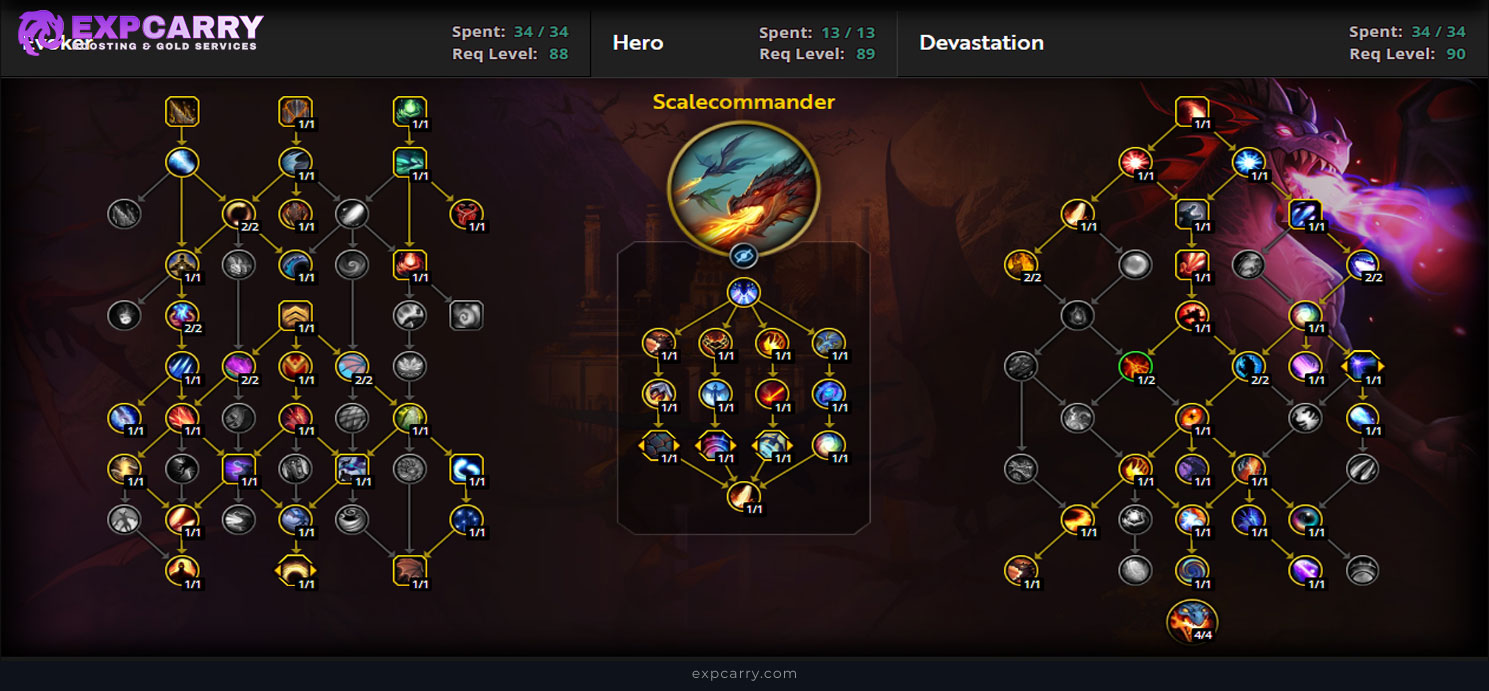
Class-tree utility can move between encounters when a dungeon requires a specific dispel or control effect, but the core Scalecommander damage package should remain intact.
Best Gear for Devastation Evoker Mythic Plus
Keep Echo of Calamity 4-piece active and prioritize meaningful weapon, trinket, and item-level upgrades. Critical Strike remains the strongest broad secondary target, followed by Mastery and Haste, while stronger high-item-level pieces frequently win over small secondary-stat differences. At Mythic Plus 10 and higher, end-of-dungeon gear reaches item level 311 Hero 3/6 and the corresponding Great Vault reward reaches item level 318 Myth 1/6.
Mythic Plus gear also creates strong Catalyst candidates because converted armor retains its original secondary stats and eligible cantrip effects. Players completing repeated weekly keys can use Mythic Plus runs for dungeon and Great Vault progression.
Rotation and Ability Priority for Devastation Evoker Mythic Plus
Dungeon Devastation rewards planning around pull length. Deep Breath should be used frequently, Dragonrage should be committed to meaningful pulls instead of held indefinitely, and Mass Disintegrate should be used without unnecessary pooling. Wingleader now reduces Deep Breath's remaining cooldown by 1 second for each target struck by Mass Disintegrate, reinforcing Scalecommander's multi-target cycle.
Single Target
- Use Deep Breath as a high-priority damage ability.
- Use Dragonrage for bosses and important priority targets.
- Use Eternity Surge at Rank 1.
- Use Fire Breath at Rank 1.
- Prioritize Mass Disintegrate when available.
- Spend Essence on Disintegrate.
- Use all 4 Unbound Flame casts after Dragonrage before the next Dragonrage becomes available, using Unbound Flame to generate Essence Burst when Mass Disintegrate is ready and you lack a proc, provided Essence is not capped.
- Use Living Flame as filler and Azure Strike when movement requires an instant cast.
AoE Rotation
- Use Deep Breath early on durable packs so its cooldown can begin recovering immediately.
- Use Dragonrage on dangerous pulls that will survive long enough for the cooldown to matter.
- Use Eternity Surge and Fire Breath at Rank 1.
- Use Mass Disintegrate quickly enough to benefit from Wingleader without wasting available casts.
- At 3 targets, use Pyre at roughly 12 Charged Blast stacks, while avoiding a Pyre shortly before Dragonrage so the stored Charged Blast stacks can amplify Dragonrage's three Pyres.
- When Mass Disintegrate is unavailable, keep Disintegrate as the default Scalecommander spender and use Pyre when Charged Blast and target count make it worthwhile.
- Use Disintegrate when a priority enemy must die faster.
- Use Unbound Flame after Dragonrage and avoid carrying unused casts into the next Dragonrage cooldown.
Cooldowns and Utility
- Use Quell on dangerous interruptible casts.
- Use Tail Swipe and Wing Buffet as additional stops when enemy displacement is safe.
- Use Cauterizing Flame when a Bleed, Poison, Curse, or Disease can be removed.
- Use Zephyr before applicable group-wide damage.
- Use Obsidian Scales before unavoidable personal damage.
- Use Hover to maintain damage while moving.
- Use Rescue to reposition allies during mechanics or dangerous ground effects.
Opener
- Enter the pull with the target pack grouped whenever possible.
- Use Deep Breath early.
- Activate Dragonrage on a pull worthy of the cooldown.
- Use Tip the Scales and empowered spells without unnecessary delay.
- Use Mass Disintegrate and the correct spender for the current target count.
- Transition into Unbound Flame after Dragonrage ends.
Devastation Evoker Delves Guide in Midnight Season 2
Devastation Evoker handles Delves well through high burst damage, Hover, self-healing through Living Flame, Obsidian Scales, crowd control, and the ability to remove dangerous effects with Cauterizing Flame. Season 2 adds The Ring of Glory and Gnarldor Isle as regular Delves plus Venomfall Deeps as the Nemesis Delve. The reward structure is covered in the Midnight Season 2 Delve loot guide.
Best Talents for Devastation Evoker Delves
Use exactly the same Scalecommander build as Mythic Plus. This keeps the stronger cleave package, frequent Deep Breath access, Mass Disintegrate, strong priority damage, and the defensive and mobility tools required for difficult elite encounters.
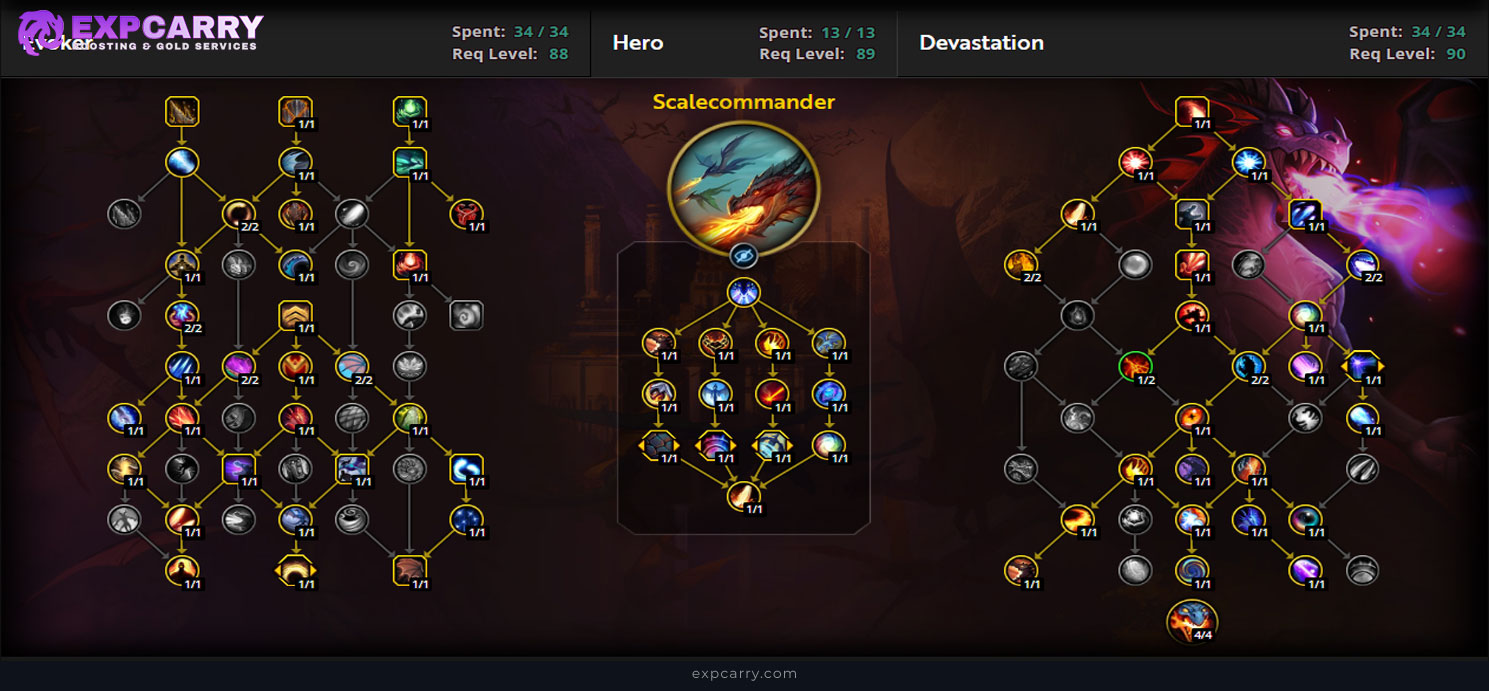
The Delve import is intentionally identical to the Mythic Plus import above.
Best Gear for Devastation Evoker Delves
Use the same core PvE gear rather than building a separate Delve set. Prioritize item level, Echo of Calamity 4-piece, a strong weapon, and reliable trinkets. Critical Strike, Mastery, and Haste all contribute useful offensive value in that general order, while additional Stamina from higher-item-level gear also improves solo survivability.
Rotation and Ability Priority for Devastation Evoker Delves
Delves reward killing dangerous enemies before they create a prolonged attrition fight. Use Dragonrage and Deep Breath aggressively against elites and large pulls, but keep Obsidian Scales, Hover, Living Flame healing, and crowd control available for mechanics that cannot simply be killed through.
Single Target
- Use Deep Breath against durable elites and bosses.
- Use Dragonrage on dangerous targets instead of saving it for an undefined later pull.
- Use Fire Breath and Eternity Surge at Rank 1.
- Use Mass Disintegrate when available.
- Spend Essence on Disintegrate.
- Use Unbound Flame after Dragonrage.
- Use Living Flame for filler damage or self-healing when survival requires it.
AoE Rotation
- Use Deep Breath early against large durable groups.
- Use Fire Breath and Eternity Surge without unnecessary delay.
- Use Mass Disintegrate when available.
- Use Pyre when the target count and Charged Blast stacks justify it; at 3 targets, roughly 12 stacks is the general breakpoint.
- Use Tail Swipe, Wing Buffet, and Landslide to reduce incoming pressure rather than absorbing every enemy ability.
Cooldowns and Utility
- Use Obsidian Scales before elite burst damage.
- Use Hover for kiting and movement without losing casting uptime.
- Use Cauterizing Flame when an applicable harmful effect can be removed.
- Use Rescue when playing with another player and repositioning is useful.
- Use Living Flame defensively when personal healing is more important than another filler attack.
Opener
- Precast Living Flame when possible.
- Use Deep Breath on a durable target or pack.
- Activate Dragonrage for dangerous elites.
- Use Eternity Surge and Fire Breath at Rank 1.
- Spend Essence immediately rather than allowing Essence or Essence Burst to cap.
- Use Unbound Flame after Dragonrage ends.
Common Devastation Evoker Mistakes
Most Devastation damage losses come from delaying high-value abilities, wasting resources, or moving at the wrong time. Season 2 adds another common failure point through Unbound Flame, because the Apex window continues after Dragonrage ends.
| Mistake | Why It Hurts | Correct Approach |
|---|---|---|
| Delaying Deep Breath for too long | Scalecommander receives substantial damage and cooldown value from frequent Deep Breath casts. | Use Deep Breath early and often unless an upcoming mechanic gives a clear reason to hold it. |
| Remaining airborne unnecessarily on single target | Extra travel time can create rotational downtime after the target has already been hit. | Pass through the target and end Deep Breath promptly when no additional targets or movement are required. |
| Capping Essence or Essence Burst | Wastes resources that should become Disintegrate, Mass Disintegrate, or Pyre casts. | Spend before reaching the cap while protecting the timing of higher-priority empowered spells. |
| Drifting Fire Breath or Eternity Surge | Reduces Causality, Animosity, tier-set, and Dragonrage value over the encounter. | Use empowered spells on schedule unless encounter mechanics justify a short delay. |
| Forgetting Unbound Flame after Dragonrage | The final Apex point provides 4 powerful casts that disappear when the next Dragonrage cycle arrives. | Transition directly into the post-Dragonrage Rising Fury window and spend all 4 Unbound Flame uses. |
| Using Pyre automatically without enough Charged Blast value | Disintegrate and Mass Disintegrate are central to Scalecommander, while Pyre needs sufficient target count and Charged Blast value to become worthwhile. | At 3 targets, use roughly 12 Charged Blast stacks as the general Pyre breakpoint, and avoid spending those stacks immediately before Dragonrage. |
| Treating Renewing Blaze as a separate cooldown | Renewing Blaze is no longer an independent active button in Midnight. | Plan personal defense around Obsidian Scales and its passive Renewing Blaze interaction. |
| Reacting to movement too late | Unplanned movement can interrupt Disintegrate and delay empowered casts. | Use Hover before movement begins and plan positioning around the next important cast. |
Best PvP Guide for Devastation Evoker in Midnight Season 2
Devastation Evoker is a viable burst ranged PvP specialization that relies heavily on positioning, mobility, crowd control, and correct defensive trades. It is more matchup and execution dependent than the most consistent PvP damage specializations, but it can create strong kill windows through Dragonrage, Fire Breath, Eternity Surge, Disintegrate, Sleep Walk, and Deep Breath. PvP gearing prioritizes Intellect and Versatility rather than the normal PvE secondary-stat profile. For the complete seasonal equipment system, see the Midnight Season 2 PvP gearing guide, and use the Midnight Season 2 PvP class guide for broader specialization comparisons.
Devastation Evoker Solo Shuffle Guide
Solo Shuffle rewards Devastation players who preserve mobility and defensive tools instead of spending everything during the first offensive exchange. Use Sleep Walk to create crowd-control windows, Time Stop to protect an ally during dangerous enemy burst, Hover to maintain distance and damage, and Obsidian Scales before opponents connect their major cooldowns.
Best Talents for Devastation Evoker Solo Shuffle
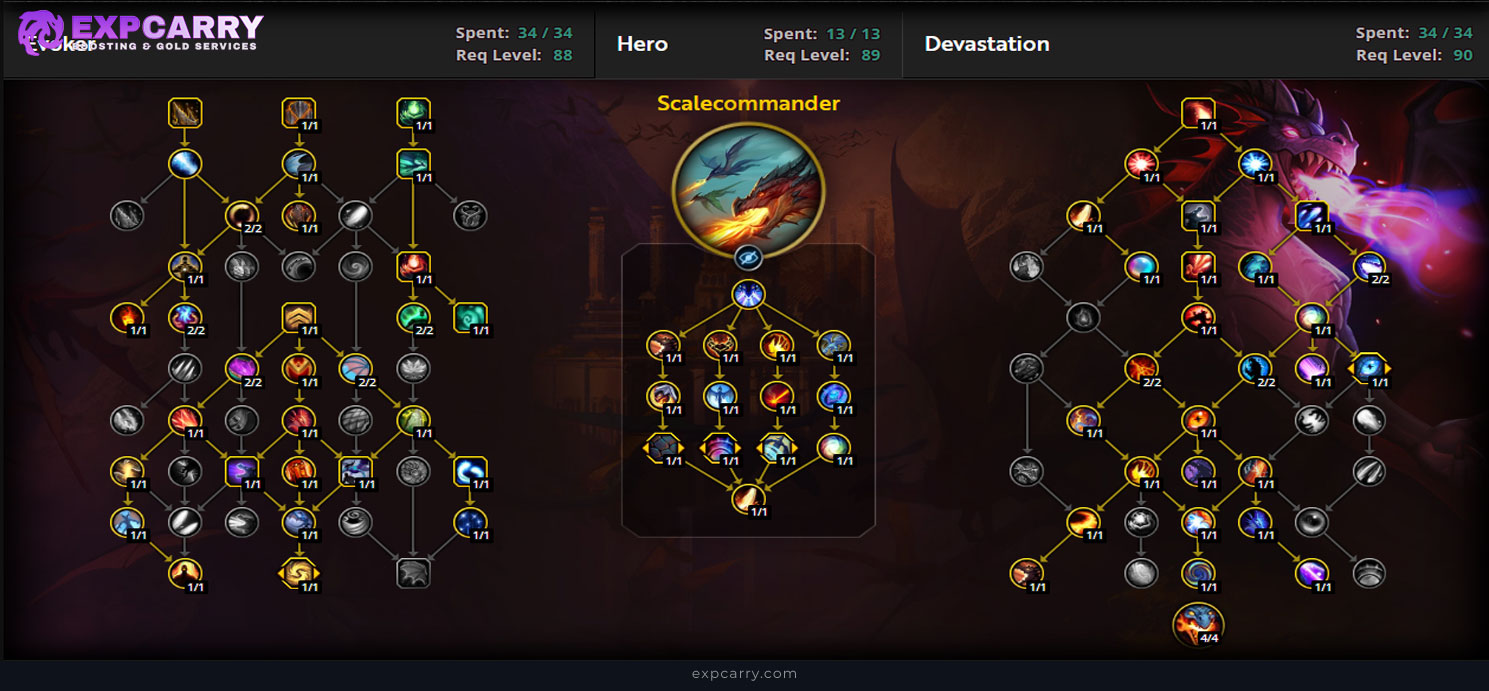
The import below configures the class, specialization, and Hero Talent tree. PvP talents are selected separately in the PvP interface. Unburdened Flight and Time Stop are the core Arena PvP talents. In Patch 12.1, Unburdened Flight causes Hover to prevent movement speed from being reduced below 100% rather than making you completely immune to movement-impairing effects. The third slot should change according to the lobby: use Nullifying Shroud against important crowd control, Obsidian Mettle when interrupts and silences are a major threat, or Scouring Flame when removing enemy Magic buffs creates offensive value.
Best Stats for Devastation Evoker Solo Shuffle
- Intellect
- Versatility
- Mastery
- Haste
- Critical Strike
Versatility is the main PvP secondary because it contributes to both offensive output and durability. Mastery follows for consistent Giantkiller value, while Haste improves global cooldowns and shortens Disintegrate channels.
Best Consumables, Enchants, and Gems for Devastation Evoker Solo Shuffle
Prioritize PvP item level and use two PvP trinkets. Build primarily around Versatility with Mastery or Haste according to available gear. Standard PvE food and flask recommendations are not part of an Arena loadout. Current PvP enchant recommendations include Empowered Blessing of Speed on the helm, Akil'zon's Swiftness on the shoulders, Mark of the Worldsoul on the chest, Sunfire Silk Spellthread on the legs, Farstrider's Hunt on boots, Silvermoon's Tenacity on rings, and Acuity of the Ren'dorei on the weapon. Use Cognitive Heliotrope in the meta slot and Flawless Masterful Amethyst in normal gem sockets.
Macros and Addons
Use a focus Quell macro to interrupt an enemy without changing your main target.
#showtooltip Quell
/cast [@focus,exists,harm,nodead][] Quell
Use focus Sleep Walk for crowd-control setups.
#showtooltip Sleep Walk
/cast [@focus,exists,harm,nodead][] Sleep Walk
Arena frames, cooldown tracking, and diminishing-return tracking help identify safe offensive and defensive windows.
Devastation Evoker 2v2 Guide
Devastation in 2v2 relies on short coordinated kill attempts rather than constant uncontrolled pressure. Use Sleep Walk on the off-target, create distance with Hover and racial displacement tools, and coordinate Time Stop with your partner when it can deny a complete enemy offensive setup.
Best Talents for Devastation Evoker 2v2
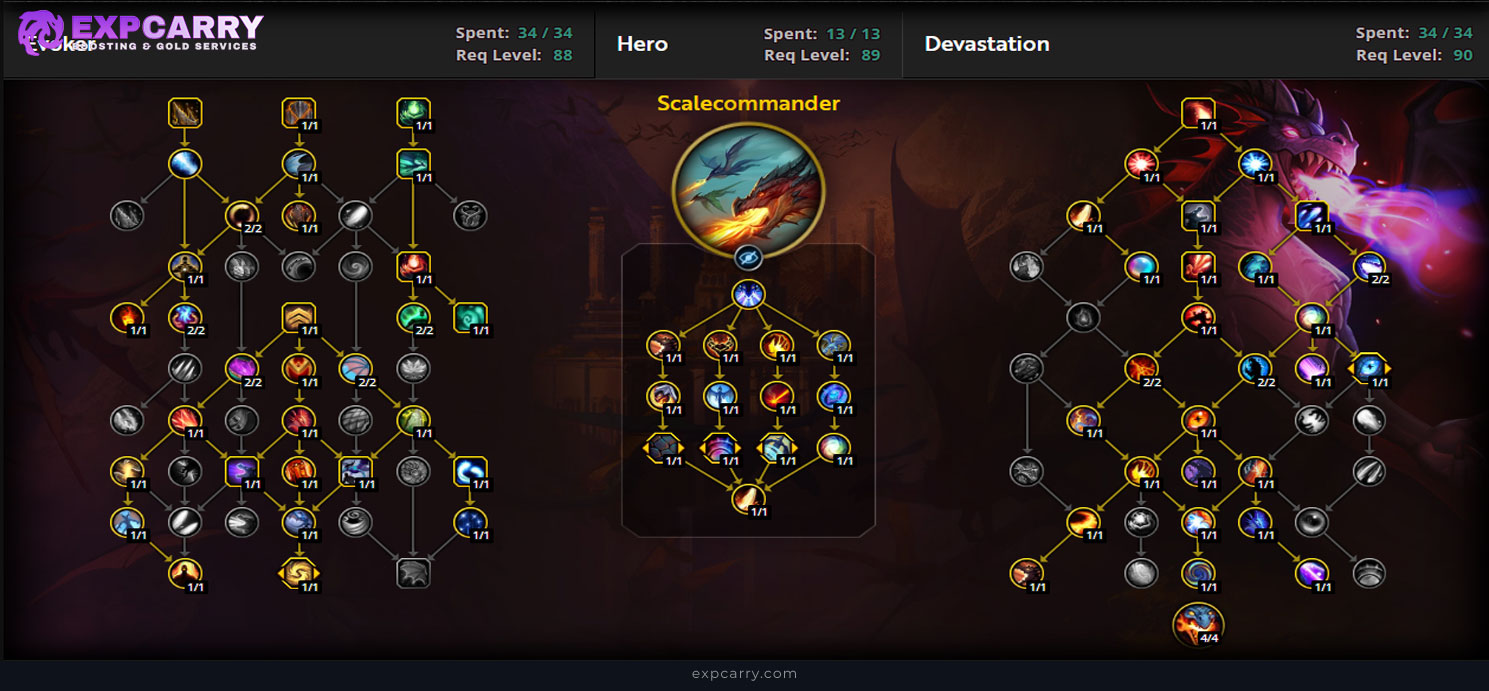
Unburdened Flight and Time Stop remain the core PvP talents. Nullifying Shroud is a strong third option against teams that need predictable crowd control to start their setup. Obsidian Mettle is better when interrupts and silences are the primary threat, while Scouring Flame can replace the defensive flex choice when Fire Breath can remove important Magic buffs from the enemy team.
Best Stats for Devastation Evoker 2v2
- Intellect
- Versatility
- Mastery
- Haste
- Critical Strike
Versatility provides the strongest general PvP foundation, while Mastery supports consistent pressure at higher target health. Haste remains useful for faster globals and Disintegrate channels.
Best Consumables, Enchants, and Gems for Devastation Evoker 2v2
Use PvP equipment with Versatility and appropriate Mastery or Haste pieces. Maintain both PvP trinkets and use PvP-oriented enchants and gems instead of copying the PvE Critical Strike profile into Arena.
Macros and Addons
Use focus Sleep Walk to control the enemy healer or off-target.
#showtooltip Sleep Walk
/cast [@focus,exists,harm,nodead][] Sleep Walk
Use a mouseover Rescue macro when fast ally repositioning can prevent a kill.
#showtooltip Rescue
/cast [@mouseover,help,nodead][] Rescue
Devastation Evoker 3v3 Guide
Devastation gains more setup opportunities in 3v3 because Sleep Walk, Time Stop, Deep Breath, and team crowd control can be layered into coordinated kill attempts. Do not overlap Time Stop with another major defensive unless the situation requires it, and preserve Hover charges for enemy melee connections or important repositioning.
Best Talents for Devastation Evoker 3v3
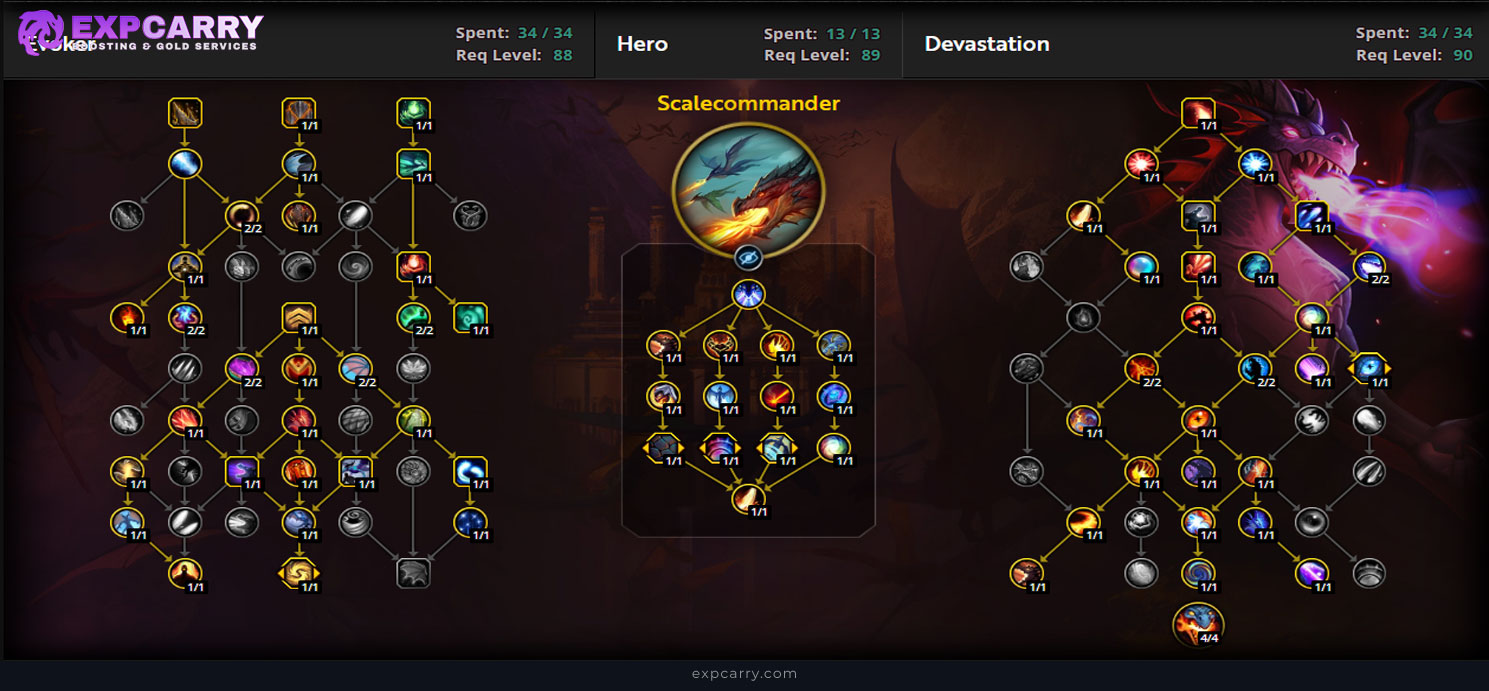
Use Unburdened Flight and Time Stop as the baseline Arena PvP talents. Nullifying Shroud is the normal anti-crowd-control flex choice, Obsidian Mettle is stronger when the enemy team intends to train or repeatedly interrupt the Evoker, and Scouring Flame is the aggressive option against compositions with valuable removable Magic buffs.
Best Stats for Devastation Evoker 3v3
- Intellect
- Versatility
- Mastery
- Haste
- Critical Strike
Versatility remains the main competitive secondary, with Mastery providing strong consistent damage and Haste supporting responsiveness. Do not sacrifice meaningful PvP item level to force a minor secondary-stat improvement.
Best Consumables, Enchants, and Gems for Devastation Evoker 3v3
Prioritize PvP item level, two PvP trinkets, and a Versatility-focused gear profile. Use Mastery and Haste as supporting secondary stats according to the available Season 2 PvP pieces.
Macros and Addons
Use focus Quell for coordinated interrupts.
#showtooltip Quell
/cast [@focus,exists,harm,nodead][] Quell
Use focus Sleep Walk during planned crowd-control chains.
#showtooltip Sleep Walk
/cast [@focus,exists,harm,nodead][] Sleep Walk
Devastation Evoker RBG Guide
In Rated Battlegrounds and Battleground Blitz-style large team fights, Devastation contributes strong single-target pressure, crowd control on healers, slows through Azure Strike and Disintegrate, and mobility for moving between objectives. The specialization should normally participate in important team fights rather than sitting isolated objectives where its damage and control package cannot create pressure.
Best Talents for Devastation Evoker RBG
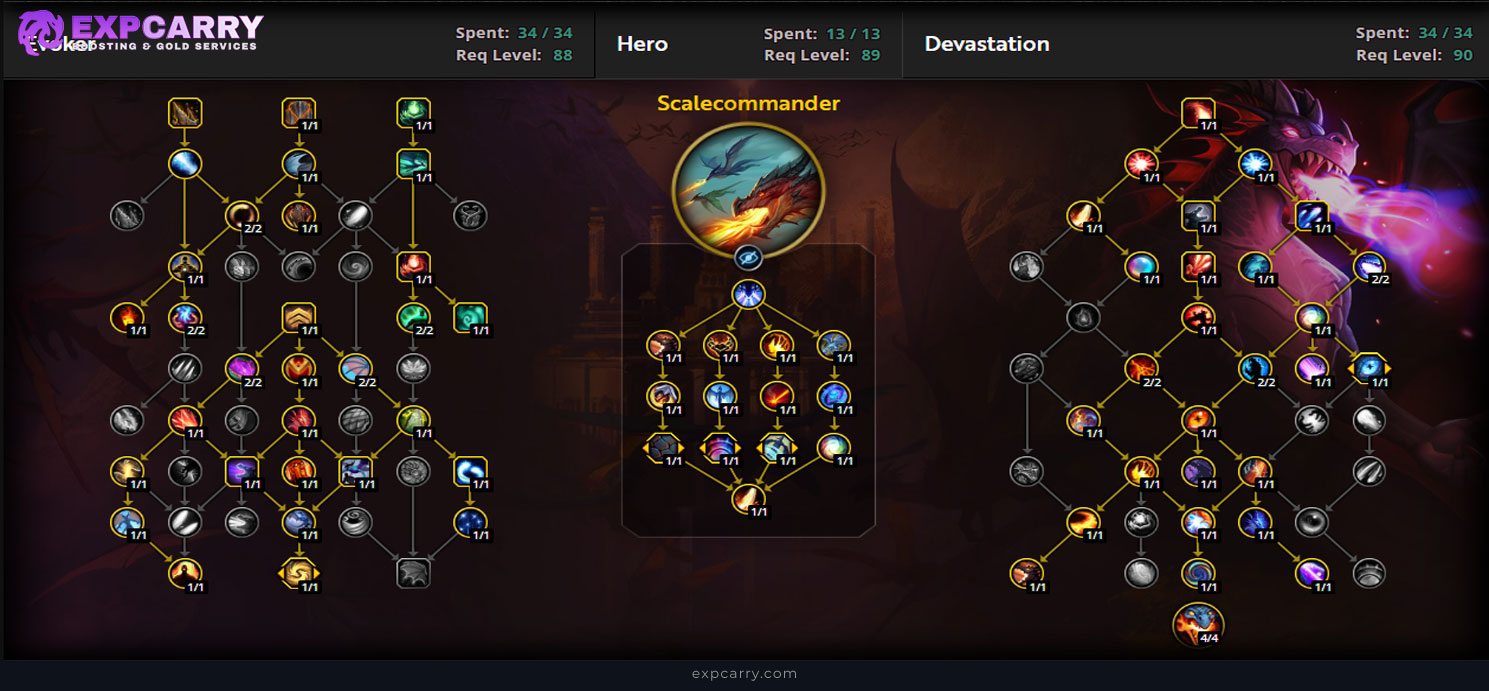
Nullifying Shroud, Unburdened Flight, and Obsidian Mettle form the recommended large-scale PvP package. Nullifying Shroud helps protect important casts from incoming crowd control, Unburdened Flight keeps Hover from being slowed below normal movement speed in Patch 12.1, and Obsidian Mettle prevents interrupts, silences, and pushback while Obsidian Scales is active.
Best Stats for Devastation Evoker RBG
- Intellect
- Versatility
- Mastery
- Haste
- Critical Strike
Versatility remains the primary PvP secondary for damage and durability, with Mastery next for consistent Giantkiller pressure and Haste following for responsiveness and faster Disintegrate channels.
Best Consumables, Enchants, and Gems for Devastation Evoker RBG
Use PvP gear with Versatility and Haste as the primary gearing direction for large-scale play. Keep the two-piece PvP trinket bonus active and use enchants and gems that reinforce survivability and consistent offensive uptime.
Macros and Addons
Focus Sleep Walk helps control priority healers during large team fights.
#showtooltip Sleep Walk
/cast [@focus,exists,harm,nodead][] Sleep Walk
Mouseover Rescue allows fast repositioning of an ally without changing your current enemy target.
#showtooltip Rescue
/cast [@mouseover,help,nodead][] Rescue
Devastation Evoker Frequently Asked Questions
This section answers the main Season 2 questions about Devastation Evoker Hero Talents, Rising Fury, stats, Echo of Calamity, Mythic Plus builds, PvP talents, and overall performance.
Is Devastation Evoker Good in Midnight Season 2?
Based on current Patch 12.1 tuning and pre-season theorycrafting, Devastation is positioned as a strong ranged DPS choice for Season 2, with good boss damage, useful cleave, frequent movement tools, and substantially stronger core abilities after the 12.1 tuning changes. It performs best when Dragonrage, Deep Breath, empowered spells, Essence spending, and movement are managed consistently.
What Is the Best Devastation Evoker Hero Talent for Raids?
Scalecommander is the recommended general raid Hero Talent. Use the single-target Scalecommander build for boss-focused encounters and the cleave variant when an encounter has enough additional targets to justify the dungeon-style setup.
What Is the Best Devastation Evoker Hero Talent for Mythic Plus?
Scalecommander is the recommended Mythic Plus Hero Talent because Mass Disintegrate, Bombardments, Wingleader, and repeated Deep Breath access provide strong priority damage and multi-target value.
What Is the Devastation Evoker Apex Talent?
Rising Fury is Devastation's Apex package, using four talent points across three ranks. Rank 1 builds Haste during Dragonrage, Rank 2 strengthens the damage bonus at maximum stacks, and Patch 12.1 Rank 3 keeps Rising Fury active after Dragonrage and replaces Dragonrage with four temporary Unbound Flame casts until its cooldown finishes.
What Stats Should Devastation Evoker Prioritize?
For PvE, prioritize item level and Intellect first, followed by Critical Strike, Mastery, Haste, and then Versatility. For PvP, prioritize Intellect, Versatility, Mastery, Haste, and Critical Strike.
What Does the Devastation Evoker Season 2 Tier Set Do?
Echo of Calamity 2-piece increases Shattering Star damage by 50% and makes it behave as if released at maximum empower. The 4-piece causes Causality to reduce empower cooldowns by an additional 0.1 seconds per activation and increases Eternity Surge damage by 10%.
What Are the Best Devastation Evoker PvP Talents?
For Arena, Unburdened Flight and Time Stop are the core PvP talents, while Nullifying Shroud, Obsidian Mettle, and Scouring Flame are matchup-dependent choices. For large-scale battleground play, Nullifying Shroud, Unburdened Flight, and Obsidian Mettle form the standard general-purpose setup.
Devastation Evoker Season 2 Changelog
This changelog records the major gameplay and editorial changes included in the current Season 2 version of the guide.
- August 16, 2026: Rebuilt the guide for Midnight Season 2 and Patch 12.1. Updated Scalecommander raid and Mythic Plus builds, Rising Fury and Unbound Flame, Echo of Calamity, Patch 12.1 tuning, PvE stats, consumables, Catalyst rules, crafting, Great Vault progression, Mythic Plus, Delves, PvP talents, macros, FAQ, internal links, and structured data. Corrected obsolete abilities and outdated recommendations while retaining the existing guide images and code.
Conclusion
Devastation Evoker in WoW Midnight Season 2 combines strong ranged damage, exceptional mobility, frequent Deep Breath casts, and a straightforward Essence-based rotation with a more active Apex cycle than before. Scalecommander is the recommended PvE Hero Talent for both raid and Mythic Plus, with separate single-target and cleave builds. Echo of Calamity strengthens Shattering Star and Causality interactions, while the July 31 Patch 12.1 tuning moves substantial damage back into Deep Breath, Pyre, Disintegrate, and Living Flame.
The most important gameplay priorities are keeping Dragonrage and empowered spells on schedule, spending Essence without capping, using Deep Breath frequently, prioritizing Disintegrate and Mass Disintegrate while using Pyre when Charged Blast and target count justify it, planning movement with Hover, and spending all four Unbound Flame casts after Dragonrage. Combined with correct Catalyst targets, Spark of Tides crafting, Great Vault progression, and matchup-specific PvP talents, Devastation has a complete Season 2 setup for raids, Mythic Plus, Delves, Solo Shuffle, Arena, and Rated Battlegrounds.