World of Warcraft PvP uses two related rating values: Matchmaking Rating (MMR) and Current Rating (CR). MMR helps the game decide who you should face and how strongly a result should affect your progression, while CR is the visible rating used for PvP ranks, achievements and seasonal rewards.
Each rated bracket has its own progression. Your 2v2, 3v3, Solo Shuffle and Battleground Blitz results do not combine into one universal PvP rating. A player can therefore be 2,100 in Solo Shuffle, 1,800 in 3v3 and unranked in Blitz at the same time.
If your goal is a specific PvP result rather than understanding the rating system, compare the available WoW PvP services. Arena, Solo Shuffle and Battleground Blitz should be treated as separate rating objectives because each uses its own ladder and matchmaking context.
MMR vs CR: What Is the Difference?
| Rating | What It Means | Primary Purpose | Visible? |
|---|---|---|---|
| CR | Current Rating | Ranks, seasonal milestones, leaderboard position and reward eligibility | Yes |
| MMR | Matchmaking Rating | Match quality and the expected result used by the rating system | Not always fully exposed |
Current Rating is the progression number players normally mean when they say they are 1,800, 2,100 or 2,300 rated. This is the value connected to standard PvP milestones such as Rival, Duelist and Elite.
Matchmaking Rating reacts more quickly to results and helps the system place you against players or teams it currently considers appropriate opponents.
The practical relationship is:
- If your MMR is substantially above your CR, the system is generally trying to move your visible rating upward toward that matchmaking level.
- If your CR is above the level suggested by recent matchmaking results, gains can become smaller and losses more significant.
- When CR and MMR are relatively close, rating changes usually become less dramatic.
This is why two players with the same visible rating can receive different CR changes after apparently similar results.
How WoW PvP Rating Changes After a Match
World of Warcraft does not use a universal rule such as “every win gives 20 rating.” The rating system evaluates the result in the context of the matchmaking values involved.
Rating changes can be influenced by:
- your current CR;
- your current matchmaking level;
- the matchmaking strength of the opposing players or team;
- whether the result was expected or unexpected;
- recent results while the system recalibrates your MMR;
- the rules of the specific rated bracket.
Beating stronger opposition is normally more valuable than beating opponents the matchmaking system already expected you to defeat. Likewise, one loss against stronger opponents is not necessarily equivalent to losing a match the system expected you to win.
Blizzard does not publish a simple live formula that allows players to calculate every rating change in advance. Avoid rating calculators that promise an exact number of required wins without accounting for MMR.
Why Early Rating Gains Can Be Very Large
When a character enters a rated bracket with little current-season data, its visible CR can initially be far below its matchmaking level.
During this period:
- MMR can move quickly;
- CR can gain large amounts after wins;
- winning streaks can rapidly increase opponent strength;
- a losing streak can bring matchmaking expectations back down;
- the gap between CR and MMR gradually becomes smaller.
This is often described as placement or calibration, although WoW does not need to present a separate traditional placement-match screen for the system to evaluate early results.
Do not judge the long-term difficulty of a bracket from the first several games. Rating changes normally become more stable once the system has more current results.
Explore services related to this guide, selected from our PvP catalog.
View All PvP Services


How Rating Works in 2v2 and 3v3 Arena
Rated 2v2 and 3v3 track progression separately. Your visible rating belongs to the specific bracket, while matchmaking evaluates the group entering the queue and the opposition it faces.
This means that:
- your 2v2 rating does not become your 3v3 rating;
- partners with different rating histories can create a different matchmaking environment;
- a newly started push can have low visible CR while facing stronger teams;
- rating is determined by winning or losing the Arena, not by damage, healing or killing blows.
2v2 Arena
2v2 has fewer players and is generally easier to organize, but individual composition matchups can have a large impact. Sustained pressure, defensive trading and coordination with one partner are especially important.
If your objective is specifically a 2v2 rating rather than learning the rating system, use the WoW 2v2 Arena Boost.
3v3 Arena
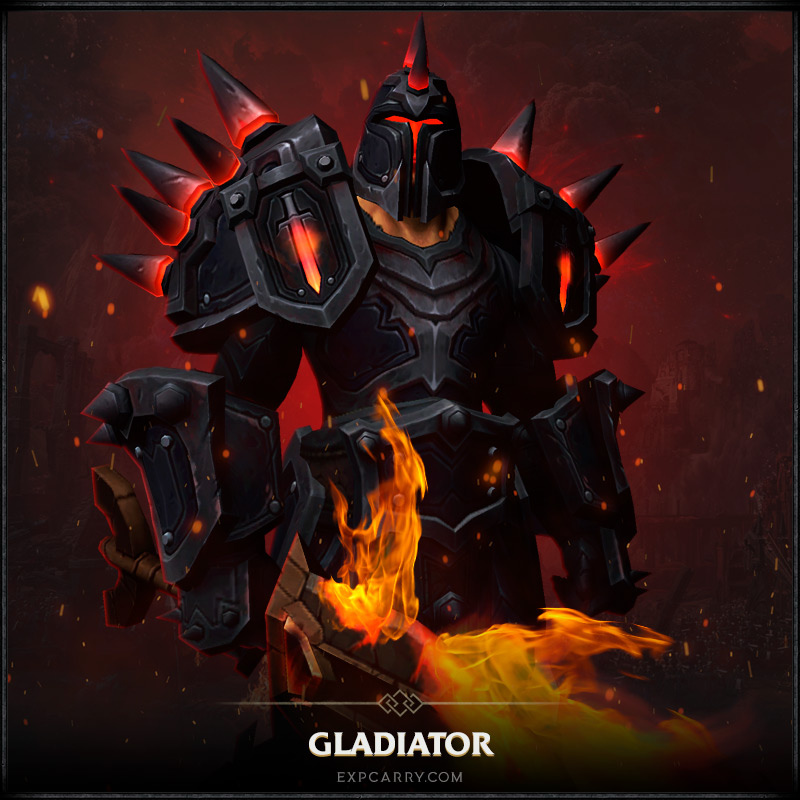
3v3 is the standard coordinated Arena bracket and has additional importance because the seasonal Gladiator achievement belongs to rated 3v3 rather than 2v2, Solo Shuffle or Battleground Blitz.
If you are targeting a fixed 3v3 rating, use the WoW 3v3 Arena Boost. For general Arena options, compositions and formats, see the WoW Arena services.
How Solo Shuffle Rating and MMR Work
Solo Shuffle is a six-player rated Arena format. Each lobby contains two healers and four damage dealers and plays six rounds while team combinations rotate.
Your result depends on how many rounds you win and how that performance compares with the matchmaking expectations of the lobby.
| Round Result | Typical Interpretation |
|---|---|
| 6–0 | Excellent result; normally strongly positive |
| 5–1 | Strong positive result |
| 4–2 | Usually positive |
| 3–3 | Often close to neutral, but not guaranteed to be exactly zero |
| 2–4 | Usually negative |
| 1–5 or 0–6 | Strong negative result in most normal matchmaking situations |
Why Can 3–3 Give Rating or Lose Rating?
A 3–3 result is an even round score, but the lobby is not necessarily made up of six players with identical MMR and CR.
If the matchmaking system expected a different result from you, even an apparently neutral 3–3 can produce a small rating adjustment. The exact result depends on the complete matchmaking context rather than a fixed “three wins equals zero” rule.
Solo Shuffle Rating Is Specialization-Specific
Solo Shuffle maintains specialization-based ladders. A character can therefore have different Solo Shuffle progression depending on the specialization being played.
This becomes especially important for:
- Elite progression;
- Legend;
- Venomous Legend;
- leaderboard comparisons;
- players switching between healer and DPS specializations.
If your goal is a fixed Solo Shuffle rating, use the WoW Solo Shuffle Boost.
How Battleground Blitz Rating and MMR Work
Rated Battleground Blitz uses its own personal rating and matchmaking environment, separate from Arena and Solo Shuffle.
Unlike Solo Shuffle, a Blitz match has one final team result rather than six rotating Arena rounds. Your team either wins or loses the battleground according to the map objective.
Individual statistics such as:
- damage;
- healing;
- killing blows;
- objective captures;
- flag returns;
can help produce a victory but are not converted directly into separate personal rating points after the match.
Why Blitz Rating Can Feel Less Predictable
An 8v8 battleground contains more independent variables than a 2v2 or 3v3 Arena:
- map type;
- team composition;
- objective decisions;
- rotations;
- healer matchups;
- late team fights;
- individual positioning mistakes by multiple players.
You can play a strong individual game and still lose the team result. Over a larger sample of matches, repeated good decisions should matter through their effect on win rate rather than through a separate performance-score bonus.
If Blitz is your target, use the WoW Battleground Blitz Boost for fixed rating progression.
Arena, Solo Shuffle and Blitz Ratings Are Separate
| Bracket | Match Format | Rated Result | Main Skill Profile |
|---|---|---|---|
| 2v2 Arena | 2-player coordinated team | Match win or loss | Small-team coordination and matchup management |
| 3v3 Arena | 3-player coordinated team | Match win or loss | Composition, CC chains, cooldown trading and team coordination |
| Solo Shuffle | Six-round rotating Arena lobby | Individual round results | Adaptation across changing teammates and opponents |
| Battleground Blitz | 8v8 objective battleground | Team win or loss | Map awareness, rotations, team fights and objectives |
A 2,000 rating in one mode does not mean exactly the same competitive percentile or skill profile as 2,000 in another. Population size, inflation, specialization distribution and match format differ between ladders.
Midnight Season 2 PvP Rating Thresholds
Midnight Season 2 uses the following standard personal-rating milestones:
| Rating | Rank | Important Season 2 Reward |
|---|---|---|
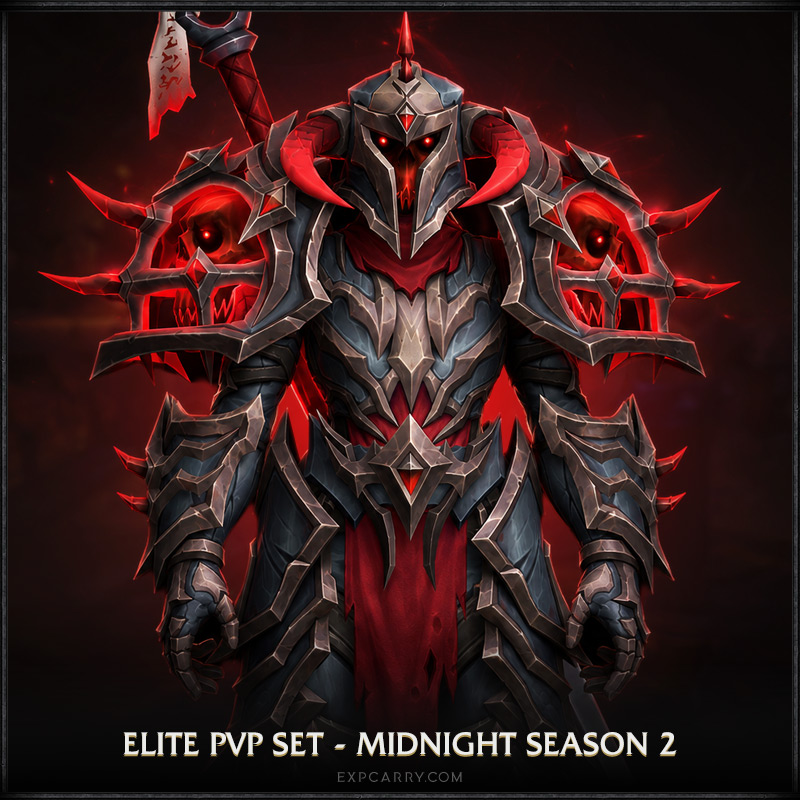
| 1000 | Combatant I | First Elite appearance milestone |
| 1200 | Combatant II | Additional Elite appearances |
| 1400 | Challenger I | Additional Elite appearances |
| 1600 | Challenger II | Additional Elite appearances + PvP route for Serpent Scion |
| 1800 | Rival I | Completes the main class-specific Elite armor appearance |
| 1950 | Rival II | Illusion: Venomcoil |
| 2100 | Duelist | Prestigious PvP cloak + Duelist title |
| 2300 | Elite | Season 2 Gladiator's Tabard + Elite title + Elite-based objectives |
Elite is 2300 in Midnight Season 2. Older 2400 references belong to previous reward structures and should not be used as the current Elite threshold.
Also note that the main class-specific Elite armor appearance is completed earlier at 1800 Rival I. Reaching 2300 is the Elite rank, not the point where the basic Elite armor appearance is completed.
For the full cosmetic and achievement breakdown, see the Midnight Season 2 PvP rewards guide.
Rating Alone Does Not Unlock Every High-End PvP Reward
Several important Midnight Season 2 rewards require additional victories after reaching the relevant rating.
| Objective | Requirement |
|---|---|
| Gladiator | 50 Rated 3v3 wins while at Elite rank |
| Legend | 100 Rated Solo Shuffle round wins while at Elite |
| Strategist | 25 Rated Battleground Blitz wins while at Elite |
This is why “reach 2300” and “complete Gladiator, Legend or Strategist” are different objectives.
Rank 1 Rating Cutoffs Are Dynamic
The highest seasonal PvP titles are based on the final ladder rather than one permanent rating number.
Midnight Season 2 includes:
- Venomous Gladiator in 3v3;
- Venomous Legend in Solo Shuffle;
- Venomous Marshal / Venomous Warlord in Battleground Blitz;
- separate Hero of the Alliance / Horde titles for traditional Rated Battlegrounds.
Solo Shuffle and Battleground Blitz cutoffs can differ substantially by specialization and region. A rating that currently appears sufficient can stop being sufficient as the ladder moves.
Do not publish one fixed “Rank 1 rating requirement” as though it were guaranteed for the entire season.
If the objective is final Rank 1 ladder placement rather than a fixed rating milestone, use the WoW Rank 1 PvP Boost.
How Seasonal Inflation Changes Rating
A PvP ladder is not static. Rating distribution changes as more matches are played and more characters enter each bracket.
Early in a season:
- the population can be more compressed;
- fewer players have completed large numbers of games;
- high-end rating can be harder to compare with previous seasons.
Later in a season:
- more characters enter the ladder;
- established players move upward;
- rating distribution can expand;
- end-of-season cutoffs become easier to estimate.
This is why an old screenshot saying “2,400 was Rank 1” or “2,700 was safe” should never be treated as a permanent requirement.
How to Interpret Your Rating Gains
Large Gains
Large positive gains usually indicate that your visible CR is still below the matchmaking level suggested by recent results.
Small Gains
Small positive gains can indicate that CR has moved closer to MMR or that you defeated opponents the system expected you to beat.
Large Losses
A substantial loss can occur when your current visible rating is ahead of your matchmaking position or when the system considered your team favored to win.
Repeated Small Gains and Large Losses
This pattern often means your recent results are not currently supporting the visible CR. The solution is not to search for a hidden fixed number of mandatory wins but to stabilize results against the opponents the matchmaking system is providing.
How to Improve Rating Without Chasing MMR
Use CR as the Reward Target
CR is the number you need for fixed seasonal rating milestones. If your objective is 1800, 1950, 2100 or 2300, track your visible rating rather than trying to manipulate an invisible matchmaking value.
Use MMR as Feedback
MMR is useful for understanding the direction of your results. Consistent success normally moves you into stronger matchmaking environments before your visible CR fully catches up.
Stay in One Bracket Long Enough to Evaluate Progress
Playing five Shuffle lobbies, three 2v2 games and two Blitz matches tells you very little about any individual ladder.
Choose the bracket connected to your actual reward objective and allow enough games for the rating environment to stabilize.
Review Repeated Mistakes Instead of Individual Losses
One match can be influenced by composition, map, disconnects or one bad decision. Look for repeated problems:
- dying with major defensives available;
- poor positioning;
- missed crowd control;
- bad objective rotations;
- uncoordinated offensive cooldowns;
- playing the wrong target;
- queueing in unsuitable gear.
Common WoW MMR and CR Misunderstandings
- “MMR and CR are the same number.” They serve different purposes.
- “Every win should give the same rating.” Rating change depends on matchmaking context.
- “3–3 always means exactly zero in Solo Shuffle.” It is often close to neutral but can vary.
- “Damage and healing directly award rating.” Rated results are based on wins, losses or Shuffle rounds.
- “2,000 rating means the same thing in every bracket.” Each ladder has its own population and distribution.
- “2400 is still Elite.” Midnight Season 2 moved the standard Elite threshold to 2300.
- “2300 automatically gives Gladiator, Legend or Strategist.” These objectives require additional qualifying wins.
- “Rank 1 has a fixed rating requirement.” End-of-season cutoffs move with the ladder.
- “Changing brackets keeps the same MMR.” Rated brackets maintain separate competitive progression.
Which Rated PvP Bracket Should You Play?
Choose the bracket that matches both your preferred playstyle and the reward you actually want.
| Goal | Best Starting Point |
|---|---|
| Coordinated play with one partner | 2v2 Arena |
| Standard coordinated Arena and Gladiator route | 3v3 Arena |
| Rated Arena without a permanent team | Solo Shuffle |
| Objective-based rated battleground progression | Battleground Blitz |
| General Arena services and format comparison | WoW Arena |
| End-of-season Rank 1 title | Rank 1 PvP |
MMR is a matchmaking tool, not the final objective. Use it to understand why your opponents and rating gains are changing, but use CR, achievements and the live seasonal ladder to measure progress toward the reward you actually want.