
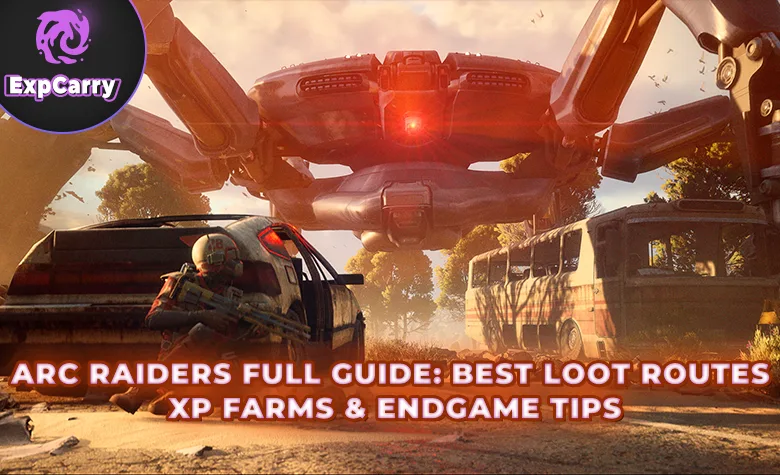
ARC Raiders progression is fastest when every deployment has one clear objective: collect dense loot, earn XP through searches and efficient ARC kills, then extract before the route expands beyond your available exits. This guide covers all six released maps, conditional loot routes, reliable XP farming, Blueprint priorities, Workshop progression, Trials Season 5, Expeditions, and the decisions that turn successful raids into long-term endgame progress.
Current status: ARC Raiders Live Update 1.39.0 released on July 28, 2026. Trials Season 5 runs from July 7 through September 30, 2026. The current map pool includes Dam Battlegrounds, Buried City, The Spaceport, The Blue Gate, Stella Montis, and Riven Tides.
The Best Progression Plan in ARC Raiders
The most efficient progression loop is not repeatedly visiting the richest room. It is choosing the map that matches your current need, entering with an affordable kit, searching a compact group of locations, earning additional XP from ARC targets along the route, and leaving through an extraction that does not require crossing the entire map.
| Progression goal | Recommended map or activity | Main advantage | Main risk |
|---|---|---|---|
| Learn extraction fundamentals | Dam Battlegrounds | Varied terrain and flexible route lengths | Central objectives can attract several squads |
| Run compact urban loot routes | Buried City | Dense interiors and short rotations between buildings | Streets and stairwells create third-party opportunities |
| Farm industrial and Exodus-related supplies | The Spaceport | Large specialist locations and valuable vertical buildings | Long exposed movement between major POIs |
| Farm mixed loot and condition objectives | The Blue Gate | Underground routes, surface structures, and varied terrain | Predictable chokepoints around valuable areas |
| Maximize loot density and search XP | Stella Montis | Compact interior zones with many searchable containers | Close-range PvP and limited disengagement space |
| Farm coastal, industrial, and commercial loot | Riven Tides | Hotel, port, shoreline, and Beachcombing options | Vertical fights and pressure from the ARC Turbine |
| Earn seasonal rank rewards | Trials Season 5 | Weekly objectives provide structured endgame goals | Poor objective selection can waste multiple deployments |
| Advance long-term progression | Expeditions | Stash expansion, cosmetics, and consecutive bonuses | Departure resets important parts of Raider progression |
How to Build a Loot Route That Survives Real Raids
A fixed line copied from a map is rarely a dependable route. Spawns, extraction availability, active Map Conditions, nearby gunfire, ARC movement, and competing Raiders can change the correct direction immediately. Treat each route as a decision tree with a primary objective, an extraction-side secondary stop, and a fallback exit.
- Check the Map Condition. Night Raid, Hurricane, Close Scrutiny, Beachcombing, Hidden Bunker, Harvester, and other conditions can change loot value, visibility, enemy pressure, or entry requirements.
- Read your spawn before moving. Start with the closest useful POI instead of crossing open ground to force a famous route.
- Confirm the available exits. Do not build the deployment around a Raider Hatch unless the hatch is usable and you have the required key.
- Select one loot objective. Choose commercial valuables, medical supplies, industrial materials, Exodus loot, Blueprints, ARC parts, or seasonal objectives.
- Set a pivot point. If the first area is open, empty, or actively contested, rotate toward the nearest secondary location instead of waiting for the situation to improve.
- Turn toward extraction early. The second half of a successful route should reduce the distance to an exit, not lead farther into the map.
Keys, Security Breach access, and mobility tools expand a route, but they should not be mandatory unless the entire deployment was prepared around them. A locked room located opposite every available extraction is usually a poor target after you have already secured a Blueprint, quest item, or high-value component.
Best Loot Routes for Every ARC Raiders Map
Dam Battlegrounds: The Best Map for Controlled Progression
Dam Battlegrounds is the most practical map for learning how loot categories, ARC patrols, vertical buildings, and extraction rotations connect. The map supports both short outskirts runs and more ambitious routes through Research & Administration, Power Generation, Hydroponic Dome Complex, and the Control Tower area.
Recommended route logic: if you spawn near Research & Administration, clear one compact section of the building before moving toward Power Generation or an extraction-side secondary location. If you begin closer to Hydroponic Dome Complex, use it as the route anchor and avoid crossing the whole map solely to reach the Control Tower.
- Primary objective: mixed supplies, searchable office containers, industrial loot, and nearby ARC targets.
- High-risk extension: Control Tower or an active condition objective.
- Fallback: outer structures and smaller locations leading toward the nearest extraction.
- PvP exposure: highest around central high-value buildings, condition objectives, and obvious crossing points.
During Hurricane, reduced visibility does not make open movement safe. The condition can conceal both Raiders and ARC threats while making late route changes harder. Hydroponic Dome Complex is a sensible anchor because it supports a compact objective rather than forcing a wide storm rotation. More condition-specific routing is covered in the ARC Raiders Shrouded Sky map guide.
Buried City: Best for Compact Building Chains
Buried City rewards players who chain nearby interiors instead of remaining exposed in the streets. Library, Hospital, Space Travel, Research Building, and Plaza Rosa are useful route anchors, but attempting to clear all of them in one deployment creates unnecessary backtracking and increases the chance of meeting squads rotating out of another building.
Recommended route logic: if the spawn favors the northern urban cluster, choose two of Hospital, Space Travel, and Research Building, then move toward an exit. If the spawn favors Plaza Rosa, clear the pharmacy and adjacent searchable interiors before deciding whether nearby combat makes a second stop worthwhile.
- Primary objective: commercial valuables, medical supplies, household resources, and dense search XP.
- High-risk extension: another multi-story building after gunfire has already revealed your position.
- Fallback: smaller residences, Raider Camps, and edge routes that preserve progress without entering the busiest blocks.
- PvP exposure: staircases, windows overlooking streets, rooftops, and narrow building entrances.
The common failure on Buried City is entering a second large building with a nearly full inventory. Multi-floor interiors take time to search and create predictable exits. Once the first building provides a Blueprint, valuable quest item, or several required upgrades, the correct next destination is normally an extraction-side location rather than another central landmark.
The Spaceport: Best for Specialist Materials and Long Routes
The Spaceport contains valuable locations such as the Arrival Building, Departure Building, Rocket Assembly, Launch Towers, Container Storage, and Vehicle Maintenance. Its major drawback is distance: a route that looks efficient on the map can require a long movement through exposed ground, especially when the extraction appears on the opposite side.
Recommended route logic: begin with Arrival or Departure when the spawn favors that side, then connect the two only if ARC and player activity remain manageable. Use Launch Towers or Rocket Assembly as a separate route from nearby spawns rather than an automatic third stop after clearing both terminal buildings.
- Primary objective: industrial supplies, Exodus-related resources, weapon containers, and ARC components.
- High-risk extension: upper levels of Launch Towers or an active Launch Tower Loot condition.
- Fallback: Container Storage, Vehicle Maintenance, watchtowers, and structures along the extraction line.
- PvP exposure: open approaches, rooftops, long sightlines, and the entrances to vertical POIs.
Carry enough ammunition for the route you selected, but do not overload the kit for an imagined full-map clear. The Spaceport punishes heavy inventories because the final movement to extraction can be longer than expected. Mobility and defensive utility often protect more value than an unnecessary second weapon or extra stacks of specialized ammunition.
The Blue Gate: Best for Flexible Surface and Underground Routing
The Blue Gate mixes elevated terrain, villages, underground passages, and condition-driven objectives. Its strongest routes are based on controlling transitions between surface and underground areas. Its weakest routes repeatedly enter predictable chokepoints without checking whether another squad has already taken control.
Recommended route logic: begin with the nearest village, maintenance area, or underground entrance. Continue through the tunnel network only when it moves you toward the available extraction or a specific objective. If combat blocks the main passage, return to the surface and use terrain to create a wider fallback rotation.
- Primary objective: mixed materials, Blueprints, weapon containers, and condition-specific rewards.
- High-risk extension: Harvester, Close Scrutiny, Locked Gate, or another active high-value condition.
- Fallback: surface buildings and side paths that avoid the most obvious underground lane.
- PvP exposure: tunnel entrances, narrow interiors, elevated crossings, and exits from condition objectives.
Do not confuse underground cover with safety. Sound travels through compact spaces, and a squad controlling the next doorway can remove every advantage gained from avoiding the surface. Keep a throwable, control tool, or alternate route available before committing to a deep tunnel push.
Stella Montis: Best Loot Density and Search XP
Stella Montis is the strongest choice when the goal is dense searching, high-value interior loot, and rapid XP accumulation without long outdoor rotations. Assembly Workshops, Medical Research, Seed Vault, Cultural Archives, and the Sandbox areas support compact routes, but the same density attracts Raiders who are prepared for close-range fights.
Recommended route logic: start with whichever of Assembly Workshops or Medical Research is closest. Move toward Seed Vault only when the route aligns with an extraction or the nearby corridors remain quiet. Do not force the full Assembly Workshops–Medical Research–Seed Vault chain from an unfavorable spawn.
- Primary objective: advanced materials, medical items, searchable containers, weapon opportunities, and Blueprints.
- High-risk extension: keyed rooms, Cultural Archives, or another floor after nearby fighting has begun.
- Fallback: side rooms and shorter loops around the current level before turning toward extraction.
- PvP exposure: doorways, stairwells, connecting corridors, and extraction approaches.
Stella Montis is also an efficient XP map because useful containers and ARC targets are located close together. The correct approach is deliberate rather than fast: search each compact room, clear ARC that can be destroyed without broadcasting a prolonged fight, and stop expanding the route once inventory value or seasonal progress is secured.
Riven Tides: Best for Mixed Coastal and Port Loot
Riven Tides combines the Panorama Azzurro hotel, Exodus port facilities, Port Authority, Stacking Yard, and an abandoned shoreline. The map supports commercial, residential, industrial, and Exodus-focused runs, while the Beachcombing condition adds a shoreline objective that requires the appropriate tool. The ARC Turbine provides an additional high-effort PvE target whose loot was improved in Update 1.36.0.
Recommended route logic: hotel-side spawns should use Panorama Azzurro as the primary route and leave through the nearest practical side instead of automatically crossing to the port. Port-side spawns should chain nearby industrial structures such as Port Authority and Stacking Yard. During Beachcombing, treat shoreline searches as the objective rather than an extra stop after clearing the hotel.
- Primary objective: hotel valuables, port materials, Exodus loot, or Beachcombing discoveries.
- High-risk extension: additional keycard rooms or an ARC Turbine fight after the inventory is already valuable.
- Fallback: smaller shoreline and port structures leading away from the active hotel or dock fight.
- PvP exposure: hotel stairwells, upper floors, port platforms, bridges, and vertical sightlines.
An ARC Turbine hunt should be prepared as an endgame objective, not added casually to a money run. The encounter creates noise, consumes resources, and can attract Raiders who wait for the target to weaken before engaging. Establish an exit direction and reserve enough ammunition and utility to survive the fight after the fight.
Explore services related to this guide, selected from our ARC Raiders catalog.
View All ARC Raiders Services


Fastest Reliable XP Farms
ARC Raiders XP farming works best when multiple sources overlap. Searching containers provides steady progress, ARC eliminations add combat XP, and active seasonal systems may convert ordinary gameplay XP into additional progression. Quests should be completed for their unlocks and rewards, but they should not be treated as the only leveling method.
Dense Search Runs
Stella Montis and Buried City are strong search-XP options because many containers can be opened without long travel between them. Search rooms methodically instead of touching only the most visually obvious container. Even when another Raider has reached an area first, remaining searchable objects can preserve the value of the route.
The best search route is usually a small loop that ends close to extraction. Repeatedly opening containers while moving toward an exit produces more dependable account progress than sprinting through dangerous central locations for a single rare spawn.
ARC Kill and Salvage Runs
ARC farming becomes efficient when targets are already positioned along the loot route. Destroy exposed weak points, collect the resulting parts, and avoid turning a simple patrol clear into a prolonged boss encounter. Weapons and throwables should match the target: a kit designed for ordinary ARC should not automatically be used against a Queen, Matriarch, or ARC Turbine.
Prioritize combat that creates at least two benefits, such as XP plus a needed crafting component, Trial progress, Expedition Challenge damage, or access to a blocked building. Killing every machine in hearing range is inefficient when the ammunition, healing, and noise cost exceeds the loot gained.
Map Condition Farming
Map Conditions concentrate objectives and can improve loot opportunities, but they also concentrate informed players. Check the official Map Conditions schedule before choosing a farm. Build the loadout for the actual condition instead of entering with a generic kit and hoping the objective is uncontested.
- Night Raid: prepare for reduced visibility and stronger competition around valuable rooms.
- Hurricane: shorten the route and avoid prolonged open-ground engagements.
- Close Scrutiny: bring a real loadout; free loadouts are not available for this high-value condition.
- Beachcombing: bring the required detection tool and focus the route on the Riven Tides shoreline.
- Hidden Bunker: expect player traffic around access steps and bunker loot.
- Harvester, Matriarch, and similar encounters: enter with dedicated anti-ARC damage and a post-objective extraction plan.
Trials Season 5
Trials Season 5 is active from July 7 to September 30, 2026. Trials rotate objectives that can involve searching, damaging specific ARC with selected weapons, surviving unusual interactions, or completing other weekly tasks. The efficient strategy is to choose Trials that overlap with a normal loot route rather than damaging account progress by forcing an expensive objective with the wrong inventory.
Review all available objectives before deploying, then combine compatible tasks. A Trial involving a specific ARC target can overlap with material farming, while a search objective can overlap with a Stella Montis or Buried City loot run. If an objective requires reckless repetition with little economic return, secure the easier placements first and return only with a purpose-built kit.
Blueprint, Workshop, and Inventory Priorities
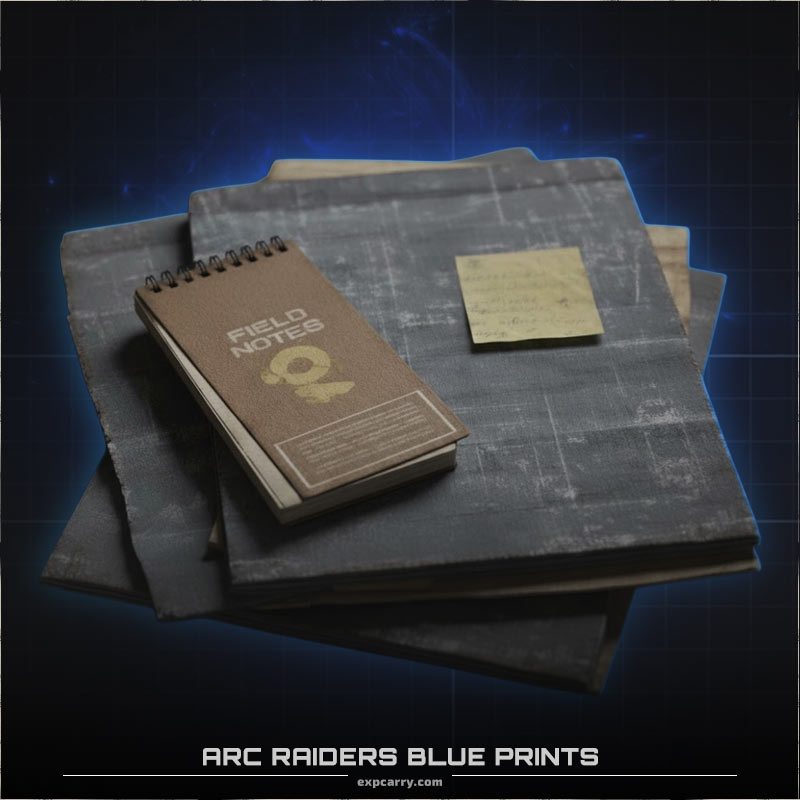
Blueprint farming should improve the kits you can reproduce, not merely increase the number of entries in the collection. Prioritize recipes that solve recurring problems: an affordable primary weapon, dependable anti-ARC damage, inventory protection, mobility, and extraction control.
- Secure one sustainable weapon line. A craftable weapon you can replace consistently is more useful than a rare weapon you refuse to deploy.
- Unlock practical utility. Mobility and defensive options such as Snap Hook, Powered Descender, Barricade Kit, and suitable Augments can protect more loot than another premium gun.
- Improve ammunition and parts access. Expensive weapons become unusable when their supporting components cannot be replaced.
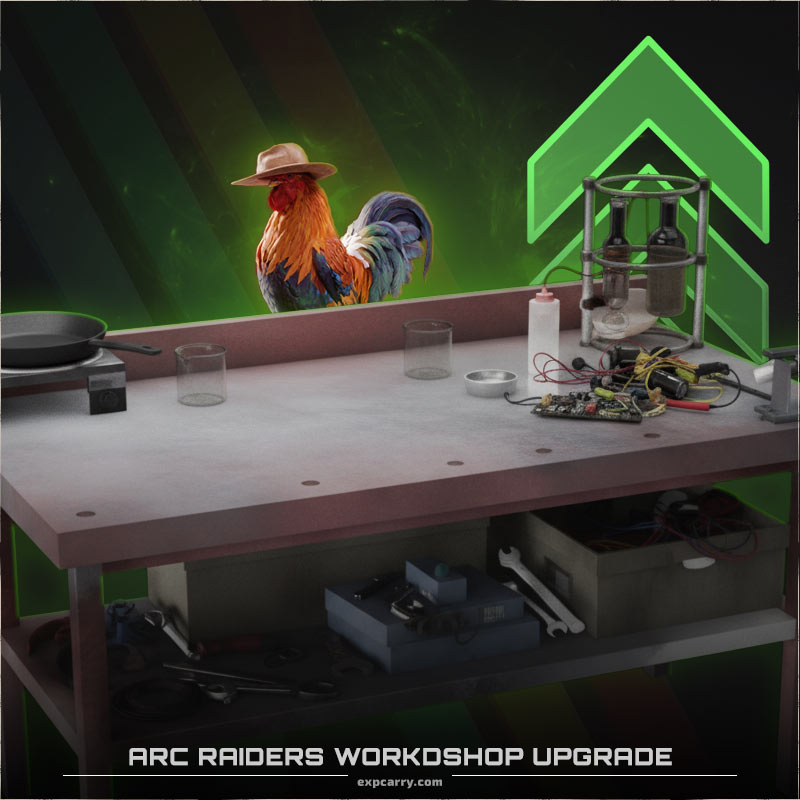
- Upgrade the Workshop around active recipes. Do not consume scarce materials on a bench tier that provides no immediate improvement to your standard kit.
- Protect important finds. After finding a needed Blueprint or quest item, rewrite the route toward extraction instead of continuing the original plan.
For a closer look at weapon roles, anti-ARC options, and loadout construction, use the ARC Raiders weapons and gadgets guide. Economy-focused players can also compare farming priorities in the Raider Coins farming guide.
Endgame Progression: Projects, Trials, and Expeditions
ARC Raiders endgame is a combination of repeatable loot optimization, Blueprint collection, Workshop development, Projects, seasonal Trials, condition objectives, and optional Expeditions. Endgame progress therefore requires two inventories: the equipment needed for current raids and the resources reserved for long-term goals.
Use Projects as Route Filters
Projects unlock after playing five rounds and provide multi-step contribution goals. Check active Project requirements before selling or recycling materials. When several required items belong to the same loot category, choose a matching map and route rather than hoping to find them through unfocused play.
A Project should influence the route without controlling every decision. If the required material is already secured, protecting it has higher value than searching another dangerous objective. Reserve stash space for the next Project contribution so required items are not accidentally consumed or sold.
Understand Expedition Timing and Resets
Expeditions are personal progression completed in order. A player builds the Caravan, waits for a scheduled departure window, signs up, completes any applicable challenge, and departs at the end of the window. Completing the Caravan alone does not automatically sign the Raider up for departure.
The fourth Expedition window ended on July 21, 2026, so it should not be treated as currently open. Its update established several important rules: Expedition Blueprints awarded through that cycle were temporary and could reset on the next departure, Raider Tokens were permanent, stash expansion was permanent, and consecutive XP, Scrappy material, and repair-value buffs depended on maintaining Expedition participation.
Before committing to a future departure, separate current inventory into four groups:
- Resources required to complete the Caravan.
- Items worth preserving through available Ermal’s Vault slots.
- Gear that should be deployed before departure rather than left unused.
- Replaceable materials that should not delay the Expedition.
The correct departure decision depends on account goals. Players who value permanent stash growth and long-term bonuses should prepare early. Players finishing a major quest chain or actively using rare temporary Blueprints may prefer to complete those objectives before signing up for the next available window.
Solo, Duo, and Trio Route Adjustments
Live Update 1.39.0 continues separate playstyle tracking for Solo, Duo, and Trio matchmaking. It also tests a system in which defensive PvP does not influence the playstyle estimate: the squad that damages, downs, or knocks out the other squad first is treated as starting the fight. Third-partying an existing battle counts as initiating PvP.
Solo Raiders
Solo routes should use compact interiors, edge approaches, and exits that do not require defending a large area. Carry one tool that creates separation or blocks pursuit. Avoid boss fights unless the loadout, extraction, and likely third-party angles were planned before deployment.
Duos
Duos can divide responsibilities without producing the noise and inventory demands of a full trio. One Raider searches while the other watches entrances, but both players should remain close enough to trade immediately. Do not split between floors of a large building merely to increase search speed.
Trios
Trios can clear major ARC targets and contest high-value conditions more effectively, but they create more footsteps, consume more loot, and are easier to track. Assign a route leader, an ARC-damage role, and a player responsible for rear security. Three independent looters moving through one building usually produce slower searches and weaker defensive positioning.
Loadout Rules for Farming and Endgame Runs
| Run type | Weapon priority | Utility priority | Inventory rule |
|---|---|---|---|
| Budget material run | Replaceable weapon with sustainable ammunition | Basic healing and disengagement utility | Leave room for bulky crafting materials |
| Dense interior farm | Controllable close- or mid-range weapon | Door, cover, or mobility tool | Protect Blueprints and rare components first |
| Condition objective | Weapon matched to the required ARC or engagement range | Objective-specific tool plus extraction utility | Do not fill the bag before reaching the objective |
| Boss or ARC Turbine hunt | Dedicated anti-ARC damage | Recovery, cover, and repositioning tools | Reserve ammunition and healing for third parties |
| Premium PvPvE run | Reliable primary plus complementary secondary | One mobility and one control option | Set an extraction threshold before entering |
A farming kit should be cheap enough to deploy repeatedly but strong enough to survive the route’s expected ARC pressure. Free loadouts are useful for rebuilding, but they are not available in Night Raid and Close Scrutiny. Entering those conditions requires a real investment, so the objective and extraction plan should justify the risk.
Common Mistakes That Destroy Progress
- Forcing a famous route from the wrong spawn. The extra travel exposes the Raider before any value has been collected.
- Ignoring the extraction list until the inventory is full. A profitable route can become impossible when the only practical exit is behind the player.
- Treating Raider Hatches as guaranteed. Hatch availability and the required key must be confirmed, and every hatch route needs a fallback.
- Crossing the map after finding a Blueprint. A Blueprint has no progression value until it is extracted successfully.
- Using premium weapons for low-risk searches. The loadout cost should match the objective, condition, and expected opposition.
- Starting an elite ARC fight without planning for Raiders. Boss noise advertises the encounter and creates a predictable ambush window.
- Keeping every item. Inventory slots should favor active Workshop upgrades, Projects, recipes, and valuable equipment rather than undefined future use.
- Completing Trials separately from normal progression. Compatible Trial, loot, Project, and ARC objectives should be stacked in the same deployment.
- Following outdated seasonal instructions. Trial seasons, Expedition windows, event rewards, and Map Conditions change; always verify their active dates.
Your Priority Plan
- Use Dam Battlegrounds to establish a sustainable kit and learn route-to-extraction discipline.
- Move to Buried City for compact search runs or The Spaceport for specialist industrial and Exodus loot.
- Use The Blue Gate when underground routes or active Map Conditions match a Project, Blueprint, or Trial objective.
- Farm Stella Montis for dense loot and search XP once close-range navigation and inventory decisions are reliable.
- Use Riven Tides for dedicated hotel, port, Beachcombing, or ARC Turbine runs instead of trying to clear every region.
- Build Workshop upgrades around recipes you will actually deploy and replace.
- Stack Trials, Projects, ARC kills, searches, and material goals whenever their requirements overlap.
- Prepare for future Expedition windows before they open, and verify exactly what will reset or remain before signing up.
If repeated deaths are blocking Workshop, Blueprint, or seasonal progress, the verified ARC Raiders assistance options provide a contextual alternative for specific farming and progression goals. Regardless of the route used, the core rule remains the same: choose one objective, collect value along a compact path, and make every second rotation lead closer to extraction.