
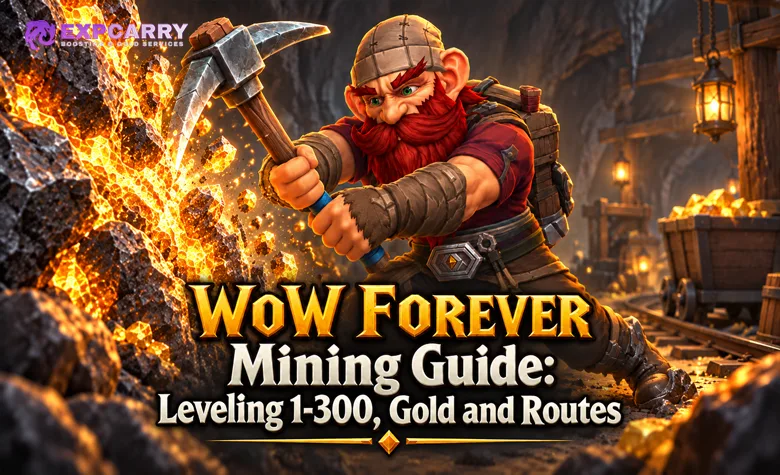
Mining in World of Warcraft: Forever is a primary gathering profession that turns open-world mineral veins into ore, stone, gems and bars used heavily by Blacksmithing and Engineering. The profession still progresses to 300 skill, but Forever gives Mining additional value through Camping, Legacy perks and new profession progression around the 1-60 journey. The most efficient route is to keep Find Minerals active, mine every appropriate node while leveling, use Smelting only where it helps, move zones before your current veins stop giving useful skill and treat ore, stone and gems as separate markets instead of automatically converting everything into bars.
What is the best profession to pair with Mining in WoW Forever?
Blacksmithing and Engineering are the strongest pairings. Blacksmithing consumes ore, bars and stone for weapons and armor, while Engineering uses the same material chain for explosives, guns, scopes, components and gadgets. A pure gathering character can also combine Mining with Herbalism, but current tracking rules require switching between Find Minerals and Find Herbs.
How do you level Mining from 1 to 300?
Mine Copper first, move into Tin and Silver, then Iron and Gold, followed by Mithril, Truesilver and Dark Iron, and finish with Thorium. Current Forever data retains the familiar gathering requirements of Copper at 1, Tin at 65, Silver at 75, Iron at 125, Gold at 155, Mithril at 175, Truesilver and Dark Iron at 230, Small Thorium at 245 and Rich Thorium at 275.
How does Mining make gold?
Sell ore, bars, stone, gems and scarce materials according to current demand. Lower-tier ore can be extremely valuable during profession rushes, while Mithril, Thorium, Truesilver and rare gems can support high-level crafting. Always compare raw ore with bar prices before smelting.
What does Mining add to Camping?
Current Forever data lists three Mining campsite objects: Lodestone at 20 skill, Rock Garden at 140 and Molten Foundry at 300. Lodestone provides a melee Attack Power benefit, Rock Garden spawns a common mining node over time and Molten Foundry becomes a profession workspace for recipes that require it. The advanced objects are tied to Blueprint recipes rather than skill alone.
WoW Forever is currently in beta from September 17 through October 21, 2026, and the first beta stage is capped at level 20; the full game launches globally on November 4, 2026 at 3:00 p.m. PST. A final live 1-300 economy therefore does not exist yet. The route below uses current Forever node requirements, recipe data and announced or database-supported profession systems while avoiding unsupported gold-per-hour claims or invented new mineral locations.
WoW Forever Mining at a Glance
Mining is one of the easiest professions to integrate into character leveling because every mineral vein you gather can improve the profession and produce tradeable materials at the same time. A Mining Pick is required, and Find Minerals should stay active while you travel. Blizzard's WoW Forever Deep Dive also makes Mining part of Camping and Legacy rather than leaving it as a simple ore-gathering side activity.
| Mining Skill | Main Nodes | Useful Zones | Main Goal |
|---|---|---|---|
| 1-75 | Copper, then Tin and rare Silver | Durotar, Mulgore, Tirisfal, Elwynn, Dun Morogh, Darkshore, Loch Modan, The Barrens | Build early skill and collect Copper, Rough Stone and Coarse Stone |
| 75-150 | Tin, Silver and Iron | Loch Modan, Redridge, Wetlands, Ashenvale, Hillsbrad, Thousand Needles, Arathi Highlands | Transition into Bronze and Iron markets while reaching Expert Mining |
| 150-225 | Iron, Gold and Mithril | Arathi Highlands, Desolace, Badlands, Stranglethorn, Tanaris, The Hinterlands, Searing Gorge | Build Mithril supply and move toward Artisan Mining |
| 225-300 | Mithril, Truesilver, Dark Iron, Small Thorium and Rich Thorium | Searing Gorge, Burning Steppes, Blasted Lands, Un'Goro, Silithus, Winterspring, Plaguelands | Reach 300 while building high-level ore, stone and gem inventory |
The best route is the one that keeps you moving between active nodes. A theoretically perfect zone can be terrible when several miners are running the same circuit. If your loop repeatedly returns empty, move to a neighboring zone instead of assuming another lap will fix the competition.
How Mining, Find Minerals and Smelting Work
Mining requires a Mining Pick and uses Find Minerals to display nearby mineral veins on the minimap. Current Forever Mining data still treats the profession as a gathering skill with 75, 150, 225 and 300 progression caps. Smelting converts ore into bars at a forge and can contribute skill in some ranges, but gathering remains the core progression method.
- Carry your Mining Pick: without the tool, you cannot mine normal mineral veins.
- Keep Find Minerals active: mineral nodes appear on the minimap only while the tracking effect is enabled.
- Remember tracking conflicts: a character using Mining and Herbalism must switch between Find Minerals and Find Herbs because only one tracking category is active at a time.
- Train the next Mining rank before capping: do not let a long gathering circuit end with your skill blocked at 75, 150 or 225.
- Use Smelting selectively: early ore can provide useful profession skill through smelting, but high-level progression eventually depends far more on mining actual nodes.
Current Forever data confirms Smelt Copper from the opening skill range and Smelt Bronze at 65 Mining. Smelting Bronze combines one Copper Bar and one Tin Bar into two Bronze Bars, which means the bar market can differ significantly from the raw ore market.
Players who want Mining leveled without manually running every route can use the verified WoW Forever Mining leveling service for selected ranges up to 300. The route below remains written for self-play.
WoW Forever Mining Leveling 1-300
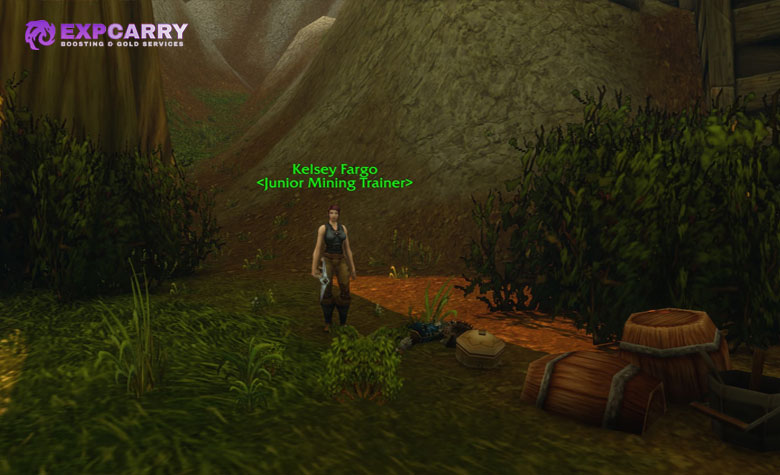
The route below follows current Forever node requirements and the classic Azeroth mineral ladder. Zone choice remains flexible because faction, character level, competition and travel time can matter more than one exact map circuit. Mine every yellow or orange node you pass and move on once your current veins become inefficient.
Mining 1-75: Copper and Early Tin
Start in your racial or nearby low-level zone and mine every Copper Ore node you see. Copper veins require only 1 Mining and remain useful deep into the opening profession range. Durotar, Mulgore, Tirisfal Glades, Elwynn Forest, Dun Morogh, Darkshore, Loch Modan and The Barrens all have strong Copper coverage in current Forever node data.
- 1-50: prioritize Copper loops along mountains, cave edges and rocky terrain. Save Rough Stone because Blacksmithing and Engineering both use it.
- 50-65: continue mining Copper while moving toward zones that also contain Tin. Copper becomes less reliable for skill after 50, but it can still be worth gathering for gold.
- At 65: Tin Ore becomes the next important node tier. Current Forever Tin Veins require 65 Mining.
- 65-75: gather Tin and Copper together in zones such as Loch Modan, Redridge, Wetlands, Ashenvale, Stonetalon or The Barrens.
- At 20: complete the Mining Camping introduction and learn Lodestone.
If Copper Ore sells higher than Copper Bar, sell the ore unless you specifically need Smelting skill or bars for another profession. Players leveling Mining, Blacksmithing and Engineering create different forms of demand, so one conversion is not always superior.
Mining 75-150: Tin, Silver and Iron
This bracket is easiest in zones where Tin and Iron overlap. Current Forever data places large numbers of Tin veins in Ashenvale, Redridge, Loch Modan, Duskwood, Wetlands, Hillsbrad and Thousand Needles, while Iron becomes especially common in Arathi Highlands, Desolace, Stranglethorn Vale, Thousand Needles and Badlands.
- 75-100: mine Tin and any Silver Ore that appears. Silver is rarer and should be treated as a bonus rather than the backbone of a route.
- 100-125: stay in mixed Tin routes until Iron becomes gatherable. Coarse Stone from this range can have independent demand from Blacksmithing and Engineering.
- At 125: current Forever Iron Deposits require 125 Mining. Start gathering Iron Ore in Arathi Highlands, Desolace, Stranglethorn, Thousand Needles or Badlands.
- 125-140: prioritize Iron while continuing Silver or Tin when they are directly on your path.
- At 140: current Forever database data lists Rock Garden as the next Mining campsite object; learning the advanced object also requires its Blueprint recipe.
- 140-150: keep a dense Iron route rather than traveling for rare Silver nodes.
Smelting can help here, but raw ore can also command a premium from players leveling their own professions. Before converting Tin and Copper into Bronze or Iron into bars, compare both sides of the market.
Mining 150-225: Iron, Gold and Mithril
The middle range moves into metals with much stronger crafting demand. Iron remains useful, Gold Ore appears as a rarer deposit in Iron-level zones, and Mithril becomes the central material for both Blacksmithing and Engineering.
- 150-155: continue mining Iron. At 155, add Gold Veins when you encounter them. Arathi Highlands and Badlands are practical because both can support mixed metal routes.
- At 175: current Forever Mithril Deposits require 175 Mining. Start prioritizing Mithril Ore.
- 175-200: Tanaris, Badlands, Searing Gorge, The Hinterlands, Desolace and Feralas all have current Mithril node coverage.
- 200-225: keep mining Mithril and Gold. Truesilver does not become gatherable until 230 Mining, so do not plan this bracket around it. Do not leave profitable Mithril behind merely because another node gives slightly better profession color.
- Before 225: prepare to train Artisan Mining so your next circuit is not capped.
Mithril is one of the most important profession-leveling metals because both Blacksmithing and Engineering consume it heavily in their upper-middle ranges. That makes it a strong material to bank during launch if current prices are weak and a strong material to sell when large numbers of crafters reach the same progression band.
Players who plan to consume their own ore through crafting can compare the Mining route with the verified WoW Forever Blacksmithing leveling service. Mining remains valuable even without Blacksmithing because raw ore, bars and stone can all be sold separately.
Mining 225-300: Truesilver, Dark Iron and Thorium
The final range introduces the materials that define high-level Mining. Current Forever data places Truesilver at 230 skill, Dark Iron at 230, Small Thorium at 245 and Rich Thorium at 275. The most efficient routes are usually mixed loops where Mithril, Truesilver and Thorium overlap rather than routes built around one rare spawn.
- 225-230: continue Mithril until Truesilver and Dark Iron become available.
- At 230: gather Truesilver Ore and, in appropriate Blackrock areas, Dark Iron Ore.
- 230-245: Searing Gorge, Burning Steppes, Badlands and other Mithril-heavy routes can bridge the skill gap while producing valuable ore.
- At 245: Small Thorium Veins become available. Begin collecting Thorium Ore in areas such as Blasted Lands, Burning Steppes, Searing Gorge and Western Plaguelands.
- 245-275: expand into Un'Goro Crater, Silithus, Winterspring and other high-level areas where Thorium coverage improves.
- At 275: Rich Thorium Veins become available. These are especially important because they can contain high-value gems and Arcane Crystal.
- 275-300: prioritize mixed Thorium routes that let you gather both Small and Rich Thorium instead of waiting at one rare spawn.
- At 300: unlock the Molten Foundry Camping tier and continue farming based on material value rather than skill points.
Blizzard's beta announcement confirms that testing is staged. The first stage is capped at level 20 and later testing raises the cap to 30, so the high-level requirements in this guide come from current Forever database records rather than complete 1-60 beta progression. Final route efficiency still needs launch population, competition and travel data.
Explore services related to this guide, selected from our Professions catalog.
View All Professions Services


Mining Node Requirements and What They Produce
Mining gets easier to plan when you know which nodes belong to each skill threshold. The table below uses current Forever node requirements rather than later-expansion values. Special quest-related veins such as Indurium are not part of the main leveling route and are intentionally excluded from the core progression table.
| Node | Required Mining | Main Materials | Why It Matters |
|---|---|---|---|
| Copper Vein | 1 | Copper Ore, Rough Stone, early gems | Opening profession tier and large low-level crafting market |
| Tin Vein | 65 | Tin Ore, Coarse Stone, low-mid gems | Feeds Bronze production and low-mid crafting |
| Silver Vein | 75 | Silver Ore | Rarer metal used by profession recipes and rods |
| Iron Deposit | 125 | Iron Ore, Heavy Stone, gems | Major Blacksmithing and Engineering progression metal |
| Gold Vein | 155 | Gold Ore | Rare metal with specialist recipe demand |
| Mithril Deposit | 175 | Mithril Ore, Solid Stone, mid-high gems | High-volume material for Engineering and Blacksmithing |
| Truesilver Deposit | 230 | Truesilver Ore | Specialist high-level profession component |
| Dark Iron Deposit | 230 | Dark Iron Ore and rare Blackrock materials | Special processing and Blackrock crafting economy |
| Small Thorium Vein | 245 | Thorium Ore, Dense Stone, high-level gems | Primary route into endgame mining |
| Rich Thorium Vein | 275 | Thorium Ore, Dense Stone, Arcane Crystal and high-level gems | Premium endgame gathering target |
Do not interpret a higher requirement as automatic higher profit. Tin can outperform Thorium when thousands of players are leveling professions, while Rich Thorium can outperform everything when Arcane Crystal demand surges. The market decides value; the skill requirement only decides whether you can gather the node.
Ore, Bars, Stone and Gems: What Should You Sell?
Mining produces several markets at the same time. Ore appeals to Miners and crafters who want to control their own smelting, bars appeal directly to Blacksmiths and Engineers, stone feeds both crafting professions and rare gems can become the most valuable part of a mining session.
- Sell raw ore when it carries a premium: players leveling Mining through Smelting may pay more for ore than bars.
- Sell bars when crafters need immediate materials: Blacksmiths and Engineers often want ready-to-use metal rather than another processing step.
- Keep stone separate: Heavy Stone, Solid Stone and Dense Stone have their own crafting demand and should not be treated as vendor trash.
- Price rare gems individually: a gem pulled from a high-level vein can be worth more than several ore stacks.
- Keep Arcane Crystals visible: they feed Arcanite production and high-level profession recipes, so dumping them without checking the market can destroy value.
- Do not smelt everything automatically: once ore becomes bars, you cannot reverse the conversion if raw ore was the stronger market.
The safest approach is to test both forms. List a small amount of ore and bars, watch which one sells faster and compare the net return after Auction House fees. Mining is flexible precisely because you can sell at several stages of the material chain.
Smelting and When It Helps Mining Progression
Smelting can accelerate the early and middle Mining ranges, but it is not a complete substitute for gathering. Current Forever data confirms normal ore-to-bar conversions, and some smelting recipes still provide profession skill over specific ranges. Once those recipes turn grey, actual mining nodes become the reliable path forward.
- Copper: Smelt Copper converts one Copper Ore into one Copper Bar and is useful in the opening skill range.
- Bronze: current Forever Smelt Bronze requires 65 Mining and combines one Copper Bar and one Tin Bar into two Bronze Bars.
- Silver and Gold: rare ores can provide additional smelting opportunities, but buying expensive ore purely for skill can be inefficient.
- Iron and Steel: Smelt Steel combines an Iron Bar with Coal. These bars are useful when your crafting plan needs them, but check whether raw Iron Ore sells at a premium first.
- Mithril and Truesilver: high-level crafters create bar demand, while ore can remain valuable to Miners and market speculators.
- Thorium: Smelt Thorium converts Thorium Ore into Thorium Bars at a forge and supports the endgame Blacksmithing and Engineering economy.
Smelting for skill only makes sense when the ore cost is lower than the time cost of gathering the same number of points. On a crowded launch server, buying cheap ore and smelting can be efficient; on another realm, the ore premium may make open-world gathering much better.
How to Make Gold with Mining in WoW Forever
Mining is one of the most direct gathering professions for gold because its output is immediately tradeable. The profession does not need a rare pattern or a long crafting chain to create value. Ore, stone, bars and gems can all be sold independently.
- Farm what crafters are currently leveling: Copper, Tin, Iron and Mithril can become premium materials when many players reach the same Blacksmithing or Engineering band.
- Watch Bronze demand: Copper and Tin interact through Bronze, so price changes in one metal can create demand in the other.
- Sell stone separately: Rough, Coarse, Heavy, Solid and Dense Stone feed important Blacksmithing and Engineering recipes.
- Farm Mithril during the midgame profession wave: both major metal crafting professions consume it heavily.
- Farm Thorium for multiple markets: Thorium itself, Dense Stone, high-level gems and Arcane Crystals all contribute to route value.
- Use Truesilver as a specialist market: it is less common than Mithril and can sell strongly when specific profession recipes are in demand.
- Do not ignore Dark Iron: it has specialized processing and recipe demand, although its value depends heavily on how much Blackrock content and Dark Iron crafting is active.
- Sell into scarcity, not habit: the most profitable material can be a low-level ore when the server is short on profession-leveling supplies.
There is no responsible fixed gold-per-hour figure before the live economy exists. Competition, faction, route, character level and server profession demand can change the value of the same circuit dramatically.
Players who need currency for mounts, profession materials or Auction House trading can compare gathering with the verified WoW Forever Gold page. Before release, the page is a pre-order and does not establish live ore prices or farming income.
Mining with Blacksmithing or Engineering
Mining is valuable on its own, but its strongest self-sufficient pairings are Blacksmithing and Engineering. The better option depends on what you want to do with the material chain after gathering it.
| Pairing | What Mining Supplies | Best For | Main Tradeoff |
|---|---|---|---|
| Mining + Blacksmithing | Ore, bars, stone and gems for weapons, Mail, Plate and profession components | Warriors, Paladins and players who want metal gear or weapon crafting | Consumes large amounts of ore that could otherwise be sold |
| Mining + Engineering | Ore, bars, stone and gems for explosives, guns, scopes, components and gadgets | Hunters, PvP players and utility-focused characters | Many finished gadgets serve a narrower market than raw materials |
| Mining + Herbalism | Two independent raw-material markets | Dedicated gathering characters | Requires switching between Find Minerals and Find Herbs tracking |
A first character usually benefits most from Mining plus the crafting profession it actually intends to use. A dedicated alt can instead gather for several characters and sell whatever the account does not need.
Mining Camping: Lodestone, Rock Garden and Molten Foundry
Camping is the main Forever-specific system that turns Mining into group utility. The verified WoW Forever Camping guide covers general camp placement, feature limits and shared cooldowns, while Mining contributes three distinct resource and combat functions. Blizzard's current profession rules state that the first campsite object arrives at profession skill 20, while more advanced objects are learned from Blueprint recipes associated with dungeon bosses.
- Lodestone - 20 Mining: current beta data gives nearby seated players a level-scaled melee Attack Power benefit that is exclusive with Blessing of Might. It currently costs Rough Stone and a Copper Bar.
- Rock Garden - 140 Mining: requires the corresponding Blueprint recipe, spawns a common mining node over time and retains the Lodestone benefit. Current materials include two Heavy Stone, one Iron Ore and one Silver Bar.
- Molten Foundry - 300 Mining: requires the corresponding Blueprint recipe, creates a campsite workspace for recipes that require it and retains the Lodestone benefit. Current materials include five Thorium Bars, two Dense Stone and one Truesilver Bar.
Rock Garden is particularly important because it directly creates an additional gathering opportunity rather than only providing a buff. Do not assume it replaces normal mining routes, but use it whenever your group is already stopping at a camp and the shared one-hour camping-feature cooldown is worth spending.
Mining and the Legacy System
Mining gains direct value from the Professions branch of the Legacy system. Current Forever data for Bountiful Harvest increases Scarce materials found through Mining, Herbalism and Skinning by 20%, 40%, 60%, 80% or 100% across its five ranks. Working Overtime increases the chance to gain profession skill by 4% per rank, up to 20% at rank five.
That can make a later Miner progress differently from the first character on the account. More Scarce-material output increases the expected value of ordinary mining routes, while better skill-up efficiency can reduce the number of attempts needed for profession skill gains.
The verified WoW Forever Legacy System guide tracks the current beta perk structure and account rules. Blizzard's What's Next recap positions Legacy and profession progression as long-term systems, so Mining remains relevant across repeat 1-60 progression and additional characters.
Dark Iron, Arcane Crystals and High-Value Mining Targets
Maximum Mining is not only about Thorium stacks. Several specialized materials can define the difference between an average route and a valuable one, especially once high-level Blacksmithing, Engineering and Alchemy markets develop.
- Dark Iron Ore: current Forever data requires 230 Mining. It has specialized smelting and crafting rules rather than behaving like a normal one-ore-to-one-bar metal.
- Truesilver Ore: also requires 230 Mining and can appear in high-level Mithril regions. It is useful for specialist crafting and the Molten Foundry recipe.
- Arcane Crystal: can come from high-level Thorium mining and feeds Arcanite production through Alchemy.
- Dense Stone: appears alongside Thorium and has direct crafting demand for sharpening stones, weightstones, Engineering and Camping.
- High-level gems: Rich Thorium can provide materials such as Star Ruby, Blue Sapphire, Huge Emerald, Large Opal and Azerothian Diamond. Their value depends on the recipes available on the live economy.
Do not calculate a Thorium route using ore price alone. The expected value includes Dense Stone, gems, Arcane Crystals and any Scarce materials affected by Legacy. That is why a high-level mining circuit can remain valuable even when raw Thorium prices temporarily fall.
Mining Mistakes to Avoid
Mining is mechanically simple, but route and market mistakes can waste large amounts of time. Efficient miners manage both the map and the material chain.
- Do not forget your Mining Pick: current Forever Mining requires the tool for normal gathering.
- Do not forget Find Minerals: inactive tracking can make a populated zone appear empty.
- Do not stay on Copper or Tin after the nodes stop giving useful skill if progression is your priority: move zones once a better tier is available.
- Do not ignore low-level ore after reaching 300: profession rushes can make Copper, Tin or Iron more profitable than high-level ore.
- Do not smelt every ore stack automatically: raw ore can sell higher because other Miners need Smelting skill.
- Do not vendor stone: Blacksmithing and Engineering consume large quantities at every tier.
- Do not chase only Rich Thorium: a mixed Small and Rich Thorium route can produce more total value and fewer empty minutes.
- Do not camp one rare node through heavy competition: switch zones when your circuit is repeatedly empty.
- Do not treat self-mined materials as free: every ore stack has an Auction House opportunity cost.
- Do not assume beta route performance equals launch: population and competition can change dramatically when the full game opens.
The strongest Mining strategy is adaptive. Gather what your current skill allows, move when node density falls, keep valuable side materials and sell the stage of the material chain that the market currently values most.
WoW Forever Mining FAQ
These answers cover the main current questions around Mining leveling, node requirements, Smelting, profession pairings, Camping and gold making.
What is the maximum Mining skill in WoW Forever?
300. Current Forever data retains the 1-300 primary gathering profession progression.
Do you need a Mining Pick?
Yes. Current Forever Mining requires a Mining Pick to gather standard mineral veins.
What profession pairs best with Mining?
Blacksmithing and Engineering are the strongest crafting partners. Blacksmithing uses ore and bars for weapons and armor, while Engineering uses them for gadgets, explosives and components.
What Mining skill is required for Mithril?
Current Forever Mithril Deposits require 175 Mining.
What Mining skill is required for Thorium?
Small Thorium Veins require 245 Mining, while Rich Thorium Veins require 275 in current Forever data.
Can you level Mining with Smelting?
Yes in some ranges. Copper, Bronze and several other smelting recipes can provide skill, but Smelting does not replace open-world gathering across the full 1-300 route.
Should you sell ore or bars?
Compare both prices. Ore can sell higher when players need Mining skill or prefer to control their own smelting, while bars can sell better to Blacksmiths and Engineers who want ready-to-use materials.
What Mining skill is required for Rock Garden?
Current Forever data lists Lodestone at 20 Mining, Rock Garden at 140 and Molten Foundry at 300. Rock Garden is an advanced campsite object and also requires its Blueprint recipe, so Mining skill alone is not the full unlock condition.
Can Mining make good gold?
Yes. Ore, bars, stone, gems, Arcane Crystals and Scarce materials create several independent markets. The best material depends on current realm demand rather than skill level alone.
Conclusion
WoW Forever Mining is best leveled as part of normal world progression whenever possible. Carry a Mining Pick, keep Find Minerals active, collect Copper and Tin while leveling through early zones, move into Iron and Mithril as soon as your skill supports them, and finish through mixed Truesilver and Thorium routes rather than waiting for one rare spawn. Smelting can help in selected ranges, but open-world nodes remain the backbone of the profession.
At 300, Mining becomes a material-market profession rather than a finished checklist. Thorium, Dense Stone, Truesilver, Dark Iron, gems and Arcane Crystals all serve different buyers, while Lodestone, Rock Garden and Molten Foundry give the profession ongoing Camping utility. Whether you pair Mining with Blacksmithing, Engineering or another gathering profession, the long-term value comes from adapting routes and deciding intelligently whether each material should be kept, smelted or sold raw.