

Delves in WoW Midnight are designed as repeatable endgame content you can run solo or in a small group for steady rewards. This guide focuses on the two things players actually want answered: what rewards Delves give you, and how Delve tiers translate into item level decisions and weekly Great Vault value.
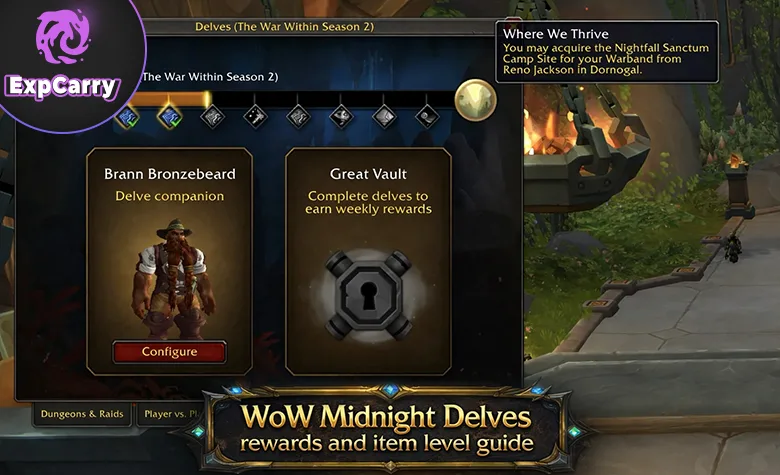
Midnight also changes how you track Delves. Delves progress is moved into the Journeys tab in the Adventure Guide, and Journeys includes a shortcut to check Great Vault rewards. Midnight adds ten new Delves plus one seasonal Nemesis Delve, and Valeera Sanguinar replaces Brann as the Delves companion.
How Midnight Delves work in practice
Delves are tiered. Higher tiers are harder and are designed to reward better gear. The important planning idea is that Delves are not only about end-of-run loot. They are also a weekly system because completed Delves contribute to the World category in the Great Vault.
That means Delves have two reward lanes you should plan around. One lane is immediate value: end-of-run rewards that help you fill weak slots. The second lane is weekly value: your Great Vault outcome, where a strong completion sets your ceiling and additional completions improve your odds by unlocking more choices.
- End-of-run rewards that scale with tier and help you fill weak slots.
- Great Vault rewards where quality is shaped by your best tier completion and weekly progress, while more completions increase your number of Vault options.
If you want Delves to feel efficient, treat them like a weekly routine: lock your ceiling early, then build completion count at a comfortable tier while you target real upgrades.
What rewards you get from Delves
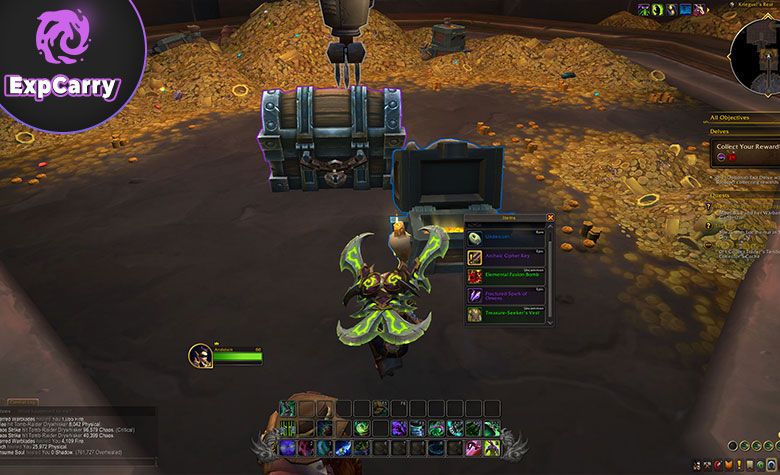
Delves rewards are best understood as a weekly engine with three practical outputs: immediate loot at the end of a run, weekly Great Vault value, and season-driven extras (such as cosmetics or progression systems tied to the Delves feature set). Seasonal extras can change, but the weekly structure stays consistent: tier difficulty, loot scaling, and a Vault payoff.
The biggest mistake is planning only around “what drops at the end.” If you do that, you often run fast low tiers all week and accidentally cap your weekly ceiling. The better method is to treat end-of-run loot as slot filling and the Vault as your guaranteed weekly power.
End-of-run loot and why tier matters
End-of-run loot scales with tier, but tier does not automatically mean faster gearing. The real question is upgrades per hour. A slightly lower tier that you clear quickly and consistently can produce more usable upgrades than a higher tier that slows your pace, forces extra defensives, or fails often. Consistency is also what makes keys (if used) and weekly milestones feel worth it.
Use this simple rule for farming:
- If you want slot filling, run the highest tier you can clear cleanly and repeatably.
- If your clear speed drops sharply, lower the tier and increase volume until your gear stabilizes.
- If you are chasing weekly power, prioritize at least one higher tier completion for Vault quality, then farm comfort tiers for volume.
This keeps Delves productive even in a gear gap, because you are optimizing for consistent completions and usable drops, not theoretical maximum item level you cannot sustain.
Great Vault targets and weekly completions
Delves contribute to the World category of the Great Vault. Two things matter: quality and choices. Your best completed tier for the week influences the weekly reward band you can earn, and completing more Delves unlocks more World-row options, improving your odds of seeing an actual upgrade.
The planning shortcut is simple: one good run sets your ceiling, then you buy better odds with additional completions. That is why a week with fewer total runs can still be “better” if you included one stable high-tier clear early.
How to plan around 2, 4, and 8 completions without overpromising exact numbers
Many recent Great Vault setups use milestone thresholds in the World category (commonly 2, 4, and 8 completions) to unlock additional choices, but the exact thresholds and tuning can change between seasons. The logic stays correct even if the numbers move: hit the first milestone for minimum weekly value, push higher for better odds, and do one strong tier to set your ceiling.
Use this planning logic:
- If you have limited time, prioritize reaching the first milestone and include one higher tier clear you can reliably finish. This locks a meaningful weekly result with low time investment.
- If you want consistent upgrades, push to the mid milestone. More choices reduces bad Vault weeks and increases the chance of a real upgrade.
- If Delves are your main weekly lane, push to the top milestone early, then stop unless you are farming end-of-run upgrades for specific slots.
A common mistake is doing only low tiers all week because they are fast. Fast clears are great for slot filling, but your weekly ceiling is still influenced by your best tier completion. The most efficient routine is usually one stable higher tier clear early, then volume at a comfortable tier to finish your weekly milestones.
Explore services related to this guide, selected from our World of Warcraft catalog.
View All World of Warcraft Services


Bountiful rewards and keys: where they fit in a Delves plan
Some Delves seasons use a “Bountiful” model where an extra reward chest at the end requires a key item. If Midnight keeps a similar model, it matters for one reason: it changes which runs are worth spending a limited key on. A key should upgrade a run that already matters for your week, not tempt you into low-impact spam.
The clean approach is to treat keys as a multiplier on planned value. If a run does not help your weekly ceiling, your milestones, or your current slot coverage, it is usually not a good key spend.
The clean way to use keys without wasting them
Use keys only when a run is doing at least one of these jobs:
- It is at a tier where the end-of-run reward band is meaningful for your current gear.
- It is a run you would do anyway to hit your weekly completion milestones, so the key upgrades a run already in your plan.
- It is early in the week when you are still shaping your weekly ceiling and filling multiple weak slots.
Three practical rules keep keys efficient:
- Do not spend keys while you are still learning a tier and failing runs. A failed run is the worst possible key value.
- Do not spend keys on comfort tiers if those tiers no longer upgrade you. Use those runs for completion count and save keys for tiers that still matter.
- If you are short on keys, prioritize key usage on runs that are already part of your weekly plan, not on extra runs that add time but do not raise your ceiling.
If you are searching for “how do I get more keys,” keep the answer simple inside this guide: keys are normally timegated and tied to weekly activities, so you plan your key spends around your weekly Delves schedule instead of trying to brute-force an infinite supply.
Item level planning: how to read Delves rewards without guessing
Delves item level tuning can change by season, so the safest approach is to rely on in-game previews instead of copying a static table from another season. This also keeps your guide accurate for alts, because the preview reflects the exact tuning and reward bands your character is bound to.
In practice, you only need two checks: the tier reward preview before you run, and the Great Vault preview after you complete your best tier for the week. Once you get used to doing these checks, you stop guessing and you stop wasting time on tiers that do not move you forward.
Use in-game previews so your plan stays correct even if tuning changes
Before you run, check the reward preview for the tier you are selecting and note what it would drop at the end of the run. After you complete your best tier for the week, check the Great Vault preview for the World category to see what weekly reward band you have locked in and how many choices you have unlocked. This stays correct even if tuning changes, because it uses the tooltips and Vault preview your character is actually bound to.
| Goal | What to run in Delves | What you are optimizing for |
|---|---|---|
| Fast early upgrades | Tiers you can clear quickly and repeatably | More end-of-run drops per hour and fewer dead runs |
| Weekly guaranteed power | At least one higher tier you can complete cleanly | Higher Great Vault reward band for the week |
| Better weekly odds | Enough total completions to unlock more Vault choices | More choices and fewer bad Vault weeks |
| Alt-friendly progress | Comfort tiers you can chain without downtime | Stable slot filling without needing a group |
A practical weekly Delves plan for best item level

Delves are most valuable when you split your week into two tasks: lock in reward quality, then build choice count and slot coverage. This routine stays efficient because it prevents the two most common time sinks: endlessly grinding after your weekly value is already secured, and pushing tiers that you cannot finish cleanly.
If you want the simplest weekly flow, do one stable high tier early, then run comfortable tiers until you hit your weekly completion goal. If you are still getting end-of-run upgrades, keep going; if not, stop and let the Vault do its job.
- Early week: complete your highest stable tier at least once. This anchors the quality of your weekly Great Vault reward.
- Midweek: add completions until you unlock the number of World-row Vault choices you want, then stop when your time-to-upgrade drops.
- Late week: only push higher tiers again if you can do it consistently, or if you are chasing seasonal goals that matter to you.
Journeys supports this planning style because it centralizes Delves progress and provides a direct shortcut to your Great Vault rewards.
What to do each week
Delves are easiest when you treat them as a weekly loop. One completion sets your ceiling, then you add runs to unlock more Vault choices and fill weak slots. The exact milestone counts can vary by season, so use your Vault preview to confirm the thresholds.
- Early week: clear your highest stable tier once.
- Then: chain a comfortable tier until you unlock the number of Vault choices you want.
- Use keys only on tiers that still matter for your current gear.
- Skip extra runs unless you are still getting real end-of-run upgrades.
Conclusion
WoW Midnight Delves rewards are easiest to understand as a weekly system: end-of-run loot that scales by tier, plus Great Vault rewards in the World category that depend on your best tier and your total completions. For item level progress, the most reliable approach is to use in-game reward previews and the Vault preview rather than relying on a fixed table from another season.
If you want the simplest weekly routine: complete one high, stable tier early to lock Vault quality, then do enough additional Delves to unlock more Vault choices and fill weak slots with repeatable clears. If Midnight keeps a Bountiful-style key model, use keys on runs that are already part of that weekly plan and at tiers that still upgrade you. Done this way, Delves become a predictable weekly upgrade lane instead of content you run without a plan.