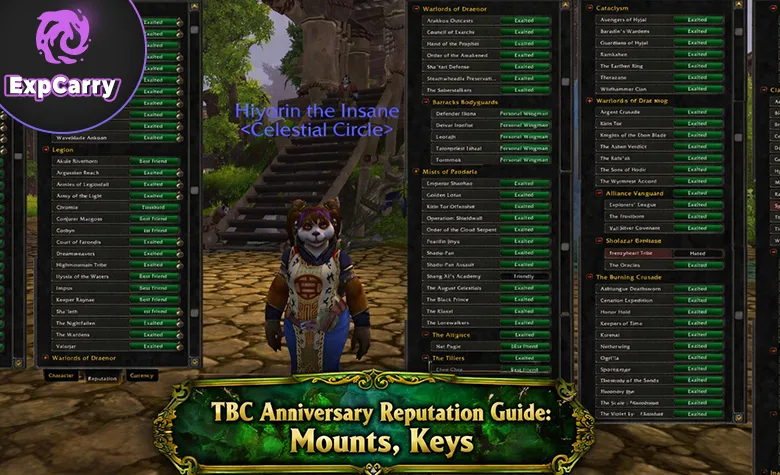
Reputation in Burning Crusade Classic Anniversary is not one universal grind. Some factions unlock Heroic dungeons, some provide raid rewards, and others lead to mounts, recipes, enchants, or powerful gear. The efficient approach is to identify the exact reward you need, stop at the required standing, and move to the next track instead of pushing every faction to Exalted.
This guide is updated for the current Anniversary progression schedule. Phase 2 is active, while Black Temple, the Battle for Mount Hyjal, the Netherwing daily hub, and Arena Season 3 are scheduled to unlock globally on August 27, 2026. That date matters because Netherwing, Ashtongue Deathsworn, and the Scale of the Sands are not ordinary launch reputations. Their main farming methods and rewards are tied to Phase 3 content.
How reputation works in TBC Anniversary
Every reputation track should be planned around a specific breakpoint. Friendly and Honored often unlock useful leveling rewards or preparation steps. Revered is the critical target for the five original Heroic dungeon keys on a character that has not unlocked them before. Exalted is usually a long-term target for mounts, top vendor rewards, raid reputation items, or completion goals. Reputation can come from quests, dungeon and raid kills, repeatable item turn-ins, and daily quests, but each faction uses a different combination of those sources.
| Reputation type | Main examples | Primary reason to farm it | Best planning rule |
|---|---|---|---|
| Heroic dungeon factions | Honor Hold or Thrallmar, Cenarion Expedition, Lower City, The Sha'tar, Keepers of Time | Heroic keys, gear, enchants, and recipes | Reach Revered on the first character, buy the key, and stop unless a later vendor reward matters |
| City and turn-in factions | The Aldor, The Scryers, The Consortium | Shoulder enchants, profession recipes, gear, and repeatable rewards | Choose rewards for your class and profession before buying or farming turn-in items |
| Raid factions | The Violet Eye, Ashtongue Deathsworn, Scale of the Sands | Raid-specific rings, trinkets, recipes, and resistance gear | Protect weekly lockouts because most progress comes from raid clears |
| Daily and mount factions | Netherwing, Sha'tari Skyguard, Ogri'la, Kurenai, The Mag'har | Flying or ground mounts and collector rewards | Use a fixed daily or open-world time block after essential access goals are complete |
Heroic keys and the Anniversary alt shortcut
On TBC Anniversary realms, the first character on your Battle.net account must reach Revered with the faction tied to a dungeon cluster and buy the relevant Heroic key. Every player entering a Heroic needs access to that dungeon family; one party member holding a normal door key does not replace the Heroic requirement for the rest of the group. The five main keys are sold by their faction quartermasters.
| Faction | Heroic key | Dungeons unlocked | First-character requirement |
|---|---|---|---|
| Honor Hold or Thrallmar | Flamewrought Key | Hellfire Ramparts, The Blood Furnace, The Shattered Halls | Revered |
| Cenarion Expedition | Reservoir Key | The Slave Pens, The Underbog, The Steamvault | Revered |
| Lower City | Auchenai Key | Mana-Tombs, Auchenai Crypts, Sethekk Halls, Shadow Labyrinth | Revered |
| The Sha'tar | Warpforged Key | The Mechanar, The Botanica, The Arcatraz | Revered |
| Keepers of Time | Key of Time | Old Hillsbrad Foothills, The Black Morass | Revered |
Anniversary adds an important account-friendly shortcut. After one character completes a specific Revered key unlock, the quartermaster can sell a Communal version of that key that is Bind-on-Battle.net-Account. Mail it to an alt and that alt can use it after reaching Friendly with the corresponding faction. The communal key is a physical account-bound item, so each alt still needs to receive and use the correct key; the unlock does not appear automatically on every character. The communal Flamewrought Key also works across factions as long as the receiving alt is Friendly with Honor Hold or Thrallmar as appropriate.
If repeated dungeon runs or group availability becomes the bottleneck, the TBC Heroic Dungeons Attunements service is the relevant option because it focuses on the five Revered key tracks rather than adding unrelated reputation goals. For players doing the route themselves, the same rule applies: finish one complete key track, buy its communal key, and only then split time across other reputations.
Normal dungeon reputation caps and the correct rotation
The most common reputation mistake is staying in a low-level Normal dungeon after its useful reputation range has ended. A dungeon can still be good for experience or a specific item while being a poor reputation farm. Watch your chat log and reputation bar after each clear. If ordinary enemies stop awarding reputation, move to the higher-level dungeon in the same cluster or use saved quests and repeatable turn-ins to close the remaining gap.
| Faction | Early efficient sources | Source after the early cap | Useful finishing tools |
|---|---|---|---|
| Honor Hold or Thrallmar | Hellfire Ramparts and The Blood Furnace on Normal until Honored | The Shattered Halls on Normal continues through Exalted | Hellfire Peninsula quests and faction quests inside the dungeons |
| Cenarion Expedition | Unidentified Plant Parts before Honored, then The Slave Pens and The Underbog on Normal until Honored | The Steamvault on Normal continues through Exalted | Zone quests and repeatable Coilfang Armaments after unlocking the turn-in |
| Lower City | Arakkoa Feather turn-ins before Honored, plus Auchenai Crypts and Sethekk Halls on Normal until Honored | Shadow Labyrinth on Normal continues through Exalted | Terokkar and Auchindoun quests, with Shadow Labyrinth used for the final push |
| The Sha'tar | Aldor or Scryer reputation gains also provide partial Sha'tar reputation until Honored | The Mechanar, The Botanica, and The Arcatraz on Normal continue through Exalted | Tempest Keep dungeon quests; Mechanar is usually the fastest repeatable clear |
| Keepers of Time | Old Hillsbrad Foothills and its quest chain | The Black Morass on Normal is the cleanest repeated farm and continues through Exalted | Complete every Caverns of Time dungeon quest before adding extra runs |
The optimal order is usually dungeons first while leveling, quests second when the early Normal cap is reached, and high-level Normal dungeons for the remaining distance to Revered. This preserves quest reputation for the expensive part of the bar. It is not mandatory to save every quest, especially on a first playthrough, but completing all zone quests before running any associated dungeon normally creates more repeated level 70 runs later.
Explore services related to this guide, selected from our Reputations catalog.
View All Reputations Services


Quest turn-ins and repeatables without wasted gold
Repeatable items are best used as control tools, not as an automatic first step. Unidentified Plant Parts are valuable for Cenarion Expedition before Honored, while Coilfang Armaments remain useful later. Arakkoa Feathers help Lower City before Honored. Marks of Sargeras, Fel Armaments, Sunfury Signets, and Arcane Tomes advance the Aldor or Scryers and indirectly help The Sha'tar before its early cutoff. Because many of these items are tradable, their Auction House price can rise sharply when players prepare alts or a new phase approaches.
- Check how much reputation remains before buying a full stack of turn-in items.
- Complete the prerequisite quest that unlocks a repeatable turn-in before purchasing materials for it.
- Stop at the exact breakpoint required for the key, recipe, enchant, or item you want.
- Use dungeon quests when they replace several repeated clears, especially after an early dungeon stops giving reputation.
- Do not spend raid preparation gold on Exalted reputation unless the Exalted reward is part of your actual build or collection plan.
Reputation priorities before Phase 3
Before August 27, the best use of reputation time depends on your Phase 3 goal. Players planning Black Temple should finish the Black Temple attunement chain, maintain a stable Tier 5 raid schedule, and decide whether Ashtongue crafting recipes or the Exalted class trinket matter to their character. Players planning Mount Hyjal should complete The Vials of Eternity by obtaining Vashj's Vial Remnant from Lady Vashj and Kael's Vial Remnant from Kael'thas Sunstrider. Completing that quest grants access to Hyjal and moves the character into the Scale of the Sands progression path.
Netherwing preparation is different because it is not a raid attunement. Reach level 70, learn flying, and budget for Artisan Riding if you do not already have it. The introductory Mordenai quest chain can begin with basic flying, but progression on Netherwing Ledge beyond Neutral requires Artisan Riding. Players with Mining, Herbalism, or Skinning should keep that profession in mind because the daily hub includes profession-specific reputation quests.
Netherwing reputation guide
Netherwing is the main flying-mount reputation arriving with Phase 3 on August 27, 2026. It begins at Hated, but the introductory chain is designed to move you directly to Neutral. At level 70 with at least Expert Riding, find Mordenai in the Netherwing Fields in southeastern Shadowmoon Valley, around coordinates 60, 59. Complete the chain that starts with Kindness and continues through Neltharaku's story, Dragonmaw Fortress, Netherwing Ledge, and Ally of the Netherwing. To continue into the daily hub and work beyond Neutral, you need Artisan Riding and access to Netherwing Ledge.
After joining the operation on the Ledge, you work under an Illidari disguise and unlock more one-time quests and dailies at each reputation rank. The fastest sustainable method is to complete every available one-time quest as soon as it appears, then run the current daily set in a compact loop. Additional dailies unlock at Friendly, Honored, and Revered, so reputation per day improves as the campaign advances. Do not follow a max-rank checklist at Neutral because several quest givers will not be available yet.
| Stage | Main objective | Efficiency note |
|---|---|---|
| Hated to Neutral | Complete Mordenai and Neltharaku's introductory chain | This is a one-time story chain, not a daily grind |
| Neutral to Friendly | Unlock the Ledge, complete one-time quests, and begin the first daily set | Pick up the Netherwing Egg quest as soon as it becomes available |
| Friendly to Honored | Add newly unlocked dailies and continue profession-specific tasks if eligible | Combine mine, ledge, and fortress objectives to reduce travel |
| Honored to Revered | Complete the next one-time chains and expanded daily rotation | Races and group objectives can add reputation but should not delay reliable dailies |
| Revered to Exalted | Use the full unlocked daily set and continue egg turn-ins | Consistency is more reliable than spending an entire session competing for rare egg spawns |
| Exalted | Complete the final quest sequence and choose a Netherwing Drake | The first drake is awarded through the final quest; the remaining colors can be purchased |
Netherwing Eggs are the main acceleration method because they can be turned in repeatedly after the introductory egg quest. The first quest awards more reputation, while later eggs provide 250 reputation each. Eggs can appear in the open world around Netherwing Ledge and the Dragonmaw area, inside the Netherwing mines, and from certain enemies or resource nodes. Treat every egg found during the daily route as bonus progress. Dedicated egg camping can be fast on a quiet layer, but it becomes poor reputation per hour when the zone is crowded.
Your daily route should begin at the Ledge, collect every quest currently available for your rank, and group objectives by location. Finish mine objectives together, complete gathering or collection tasks while moving through the same area, then handle Dragonmaw Fortress and any longer group or race quest separately. Keep an empty bag slot for eggs and quest items, and turn in before leaving the hub so you do not lose a day to an unfinished objective. If the required daily routine does not fit your schedule, the Netherwing Reputation service matches this specific goal and can be selected by reputation milestone up to Exalted and the drake unlock.
Ashtongue Deathsworn reputation guide
Ashtongue Deathsworn is the Black Temple raid reputation and becomes a major progression track when Black Temple opens on August 27, 2026. The faction is tied to Akama and his followers. It is not a daily reputation and cannot be efficiently completed through open-world farming. Meaningful progress comes from the Black Temple attunement quests, raid trash, bosses, and several raid-related quests, so your weekly Black Temple lockout is the central resource.
Black Temple access begins through the Aldor or Scryer version of The Tablets of Baa'ri chain in Shadowmoon Valley and continues through a long sequence involving Akama, Serpentshrine Cavern, Tempest Keep, the Battle for Mount Hyjal, and additional Black Temple preparation. Complete the chain before launch if its available stages are open on your character. Reputation earned during the chain is useful, but repeated full Black Temple clears are what carry the faction through the higher standings.
- Clear raid trash instead of joining groups that skip every optional pack, because trash contributes a large share of the weekly reputation.
- Prioritize full clears. Bosses provide reliable reputation and a complete clear is commonly worth several thousand reputation, often around 7,700 depending on the trash killed.
- Protect the weekly lockout. A partially cleared saved raid can block the most valuable bosses and trash for that reset.
- Track the next reward breakpoint before the run so you know whether you need recipes at an earlier standing or the class trinket at Exalted.
Okuno is the Ashtongue Deathsworn quartermaster inside Black Temple, reached after the early part of the raid. The reputation is especially valuable for profession recipes used to craft Shadow Resistance gear and for the class-specific Ashtongue Talismans sold at Exalted. The trinkets have different effects for each class, so Exalted is not equally urgent for every specialization. Check the effect for your class and compare it with your current trinkets before committing several weekly clears purely for reputation.
| Goal | Why it matters | Best approach |
|---|---|---|
| Early reputation ranks | Access to selected Black Temple and Shadow Resistance profession recipes | Complete attunement quests and do full early raid clears |
| Revered | Additional high-level crafting rewards and progress toward the final vendor tier | Maintain weekly full clears and avoid unnecessary trash skips |
| Exalted | Class-specific Ashtongue Talisman | Plan for multiple Black Temple lockouts and verify that the class trinket is worth the commitment |
Scale of the Sands reputation guide
The Scale of the Sands is the raid reputation for the Battle for Mount Hyjal, which also opens on August 27, 2026. Begin with Soridormi in the Caverns of Time and complete The Vials of Eternity by looting the vial remnants from Lady Vashj in Serpentshrine Cavern and Kael'thas Sunstrider in Tempest Keep. Turning in the quest grants 3,000 reputation, moves the character to Friendly, and completes the Hyjal access requirement. This makes successful Tier 5 progression the real preparation gate for the faction.
After access is complete, reputation comes primarily from Hyjal Summit trash waves and bosses. The raid's wave structure makes partial farming unreliable: progression, wipes, and resets affect which waves are available, while a full clear produces the most dependable weekly gain. Join a group that expects to clear as many bosses as possible, arrive with consumables and repaired gear, and avoid using a saved lockout that has already lost most of its reputation sources.
At Friendly, players choose one Band of Eternity quest reward from Indormi inside the Hyjal raid: caster damage, physical damage, healing, or tanking. The chosen ring upgrades at Honored, Revered, and Exalted, making this reputation valuable even before the final rank. Choose for the role you expect to play through Tier 6 rather than for a temporary off-spec. Indormi also sells high-level Jewelcrafting designs and other raid-oriented rewards as reputation increases.
| Standing | Main ring milestone | Planning note |
|---|---|---|
| Friendly | Choose the first Band of Eternity for caster damage, physical damage, healing, or tanking | The Vials of Eternity turn-in provides the reputation needed to reach this rank |
| Honored | Upgrade the selected ring | Regular Hyjal clears should be enough; do not change raid groups if it risks losing full clears |
| Revered | Upgrade the same ring again and unlock more vendor value | Review Jewelcrafting recipes if the character is a crafter |
| Exalted | Receive the final version of the selected ring | Continue full weekly clears until the reputation bar is complete |
Mount reputations after essential unlocks

Mount reputations remain optional and should not delay Heroic access, raid attunements, or a weekly gearing lockout. Netherwing is the largest Phase 3 commitment because its progress is built around staged dailies and rare egg turn-ins. Sha'tari Skyguard and Ogri'la are already available in Phase 2 and work well as shorter daily blocks. Kurenai for Alliance and The Mag'har for Horde provide Talbuk ground mounts through Nagrand quests, Warmaul Ogre kills, and Obsidian Warbead turn-ins.
- Use Netherwing when the Exalted drakes are the primary collection goal and you can maintain a daily routine.
- Use Sha'tari Skyguard for Nether Ray mounts and a daily route split between Terokkar Forest and Blade's Edge Mountains.
- Use Kurenai or The Mag'har for a predictable open-world grind that can be completed without a dungeon or raid group.
- Use mount reputations as fallback content when no raid or dungeon group is available, not before a time-sensitive weekly lockout.
Weekly reputation plan
A practical character does not farm every reputation every day. Start the week with locked content: raid clears, attunement boss kills, and any scheduled Heroics. Use the next play sessions for the Revered dungeon faction that blocks the key you need most. Complete daily factions after those fixed goals, then spend remaining solo time on tradable turn-ins, mount factions, or profession recipes.
- Check raid lockouts and complete the highest-value weekly reputation source first.
- Finish one Heroic key track instead of spreading runs across five incomplete factions.
- Buy the normal and Communal key as soon as the required standing is reached.
- Complete all available one-time quests before repeating a slower farm.
- Run Netherwing, Skyguard, or Ogri'la dailies in a fixed block that does not replace raid preparation.
- Stop at the reward breakpoint unless the next tier contains a confirmed upgrade, recipe, enchant, or mount.
Conclusion
The efficient TBC Anniversary reputation route is built around access first and collection goals second. Reach Revered for the five main Heroic keys on the first character, use Communal keys to reduce each alt's requirement to Friendly, and rotate away from low-level Normal dungeons when their reputation stops. Preserve quests and repeatable turn-ins for the expensive part of each bar instead of spending them automatically at Neutral.
For Phase 3, prepare three separate plans. Netherwing is a daily mount campaign that starts with Mordenai and requires Artisan Riding beyond Neutral. Ashtongue Deathsworn is a Black Temple raid reputation built around full weekly clears, crafting recipes, and Exalted class trinkets. The Scale of the Sands begins with The Vials of Eternity, continues through Mount Hyjal, and upgrades a role-specific ring at every major standing. Keeping those systems separate prevents wasted runs and makes every reputation session advance a clear reward.