
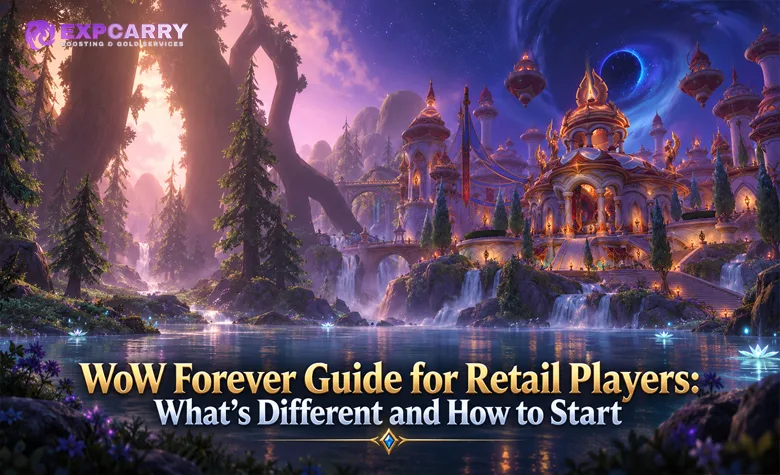
World of Warcraft: Forever feels familiar to a Retail player because it uses a modernized client, current interface technology, optional HD visuals, Transmog and official controller support, but the game underneath follows a very different set of rules. The launch level cap is 60, and Blizzard's announced roadmap continues progression around level 60 rather than raising it; leveling is a major part of progression, enemies and zones do not scale to you, there are no flying mounts, dungeon groups do not automatically teleport to the instance, professions matter during the journey and downtime between fights is deliberately more important. The easiest way to enjoy Forever after Retail is to stop treating level 60 as the point where the real game begins.
What is the biggest difference between WoW Forever and Retail?
Retail is built around fast access to current expansion and seasonal endgame content, while Forever makes the level 1-60 world itself a major part of the game. Travel, quest routing, gear upgrades, professions, grouping and resource management all matter much earlier.
Does WoW Forever have level scaling?
No. Blizzard has explicitly confirmed that Forever does not use level scaling. Zones and enemies have meaningful level ranges, so moving into content too early can make normal enemies dangerous while returning later can make an old area significantly easier.
Can you fly in WoW Forever?
No. Forever has no flying mounts. Ground mounts, flight paths, boats, zeppelins and other world travel remain important, which makes route planning much more significant than it is in modern Retail.
Does WoW Forever have Dungeon Finder?
The current system includes a Looking For Group interface for discovering and organizing groups, but it does not automatically assemble the party and teleport everyone into the dungeon like Retail's queued Dungeon Finder. Players normally travel to the entrance themselves, with Warlock summoning remaining an alternative when available.
Is WoW Forever harder than Retail?
It is difficult in a different way. Normal leveling asks more from preparation, resource management, travel and recovery, while high-end Retail encounters such as difficult Mythic+ and Mythic raids can be mechanically much more complex. A Retail player is more likely to notice Forever's friction and consequences than an overall increase in mechanical difficulty.
Do Retail players need Classic experience before playing Forever?
No. Forever retains several modern accessibility and interface features, and Blizzard is designing it as a permanent WoW experience rather than a museum version of 2004. Understanding a few Classic-style habits before starting simply removes most of the initial frustration.
Updated September 22, 2026. WoW Forever is currently in beta. The opening test is capped at level 20, Blizzard plans to raise the beta cap to level 30 later in the test, the beta is scheduled to run through October 21, and the full game launches November 4, 2026. The systems discussed below combine Blizzard's confirmed Forever design with behavior already visible in the current beta, while avoiding assumptions about untestable level-60 balance.
WoW Forever vs Retail at a Glance
Retail and Forever share the World of Warcraft foundation but prioritize different parts of it. Retail Midnight currently builds toward a level-90 seasonal endgame with modern travel and matchmaking conveniences, while Forever launches with a level-60 cap and an announced roadmap that continues expanding the level-60 world, making world progression, travel and player interaction part of the long-term game.
| Feature | Retail WoW | WoW Forever |
|---|---|---|
| Maximum level | 90 in Midnight | 60 at launch; no higher cap has been announced |
| Leveling role | Primarily a path toward current expansion/endgame | Core long-term part of the game |
| Level scaling | Used extensively across leveling content | No level scaling |
| Flying | Skyriding and Steady Flight available broadly | No flying mounts |
| Dungeon matchmaking | Automatic queues exist for supported content | LFG listing, no automatic group assembly/teleport in current design |
| Travel to dungeons | Queued content can teleport the group | Players normally travel to the entrance |
| World pace | Fast movement and low open-world downtime | Travel, recovery and preparation matter more |
| Talents | Class, specialization, Hero and Apex talent systems | Classic-style class trees expanded with new Forever talents and abilities |
| Professions | Deep specialization and endgame crafting systems | 1-300 professions integrated throughout leveling, Camping and Legacy |
| Food and recovery | Often situational outside specific buffs/content | Regular recovery and food buffs are more relevant during leveling |
| Endgame model | Seasonal raids, Mythic+, Delves and gear progression | Level-60 world expanded with new raids, dungeons, zones and systems |
| Transmog | Standard modern appearance system | Optional system with visibility controls |
| Interface | Modern UI | Modernized UI with Classic-oriented presentation options |
Neither design is simply a harder or easier version of the other. Retail removes large amounts of friction so players can reach activities quickly, while Forever deliberately keeps more of the journey between those activities.
What WoW Forever Actually Is for a Retail Player
Forever is not a new Retail expansion and it is not simply Classic Era with additional raids attached. Blizzard describes it as a permanent World of Warcraft experience built around original Azeroth, a level-60 launch cap and new content that expands the world over time. Blizzard has not announced a higher level cap for the current roadmap.
The complete WoW Forever guide covers the overall feature set, but the important point for a Retail player is that progression is distributed through the entire character journey. Blizzard has announced more than 1,000 new quests, major new or newly accessible regions including Zephras Isle, Riverglades, Shen'dralas and Mount Hyjal, and nine new dungeons spread across levels 1-60 rather than concentrated entirely at maximum level.
That changes how you should judge progress. Spending an evening reaching a new quest hub, unlocking a flight path, finding a profession recipe and completing one dungeon is not wasted time before the game begins. Those activities are the game.
Leveling Is Core Content, Not a Tutorial Before Endgame
The biggest mindset change is the importance of leveling. Retail can move characters through older content quickly because its primary progression loop is built around the current expansion and max-level systems. Forever instead treats the journey from 1 to 60 as a permanent piece of the game's identity.
You will spend more time in individual level brackets, and new content appears throughout them. Hall of Thanes and Ruins of Lordaeron arrive during the teens; Excavation Site: Wetlands and City of Dalaran continue the dungeon progression through the 20s; Riverglades covers much of the mid-30s to mid-40s; and the final new dungeons, Blackmaw Hold and Shaper's Terrace, extend into the high 50s and level 60.
This means a Retail habit such as ignoring professions, skipping optional quest hubs and rushing toward the cap can leave you with less gold, weaker profession progress and fewer useful discoveries than a character that develops naturally along the route.
The current Alliance 1-60 leveling route and Horde 1-60 leveling route map the two faction paths separately. They are more useful than trying to apply a Retail campaign mentality to original Azeroth.
Explore services related to this guide, selected from our WoW Forever catalog.
View All WoW Forever Services
![WoW Forever Gold [Beta]](https://expcarry.com/image/cache/catalog/products/wow-forever/wow-forever-gold-120x120.jpg)

No Level Scaling Means Zone Choice Matters Again
Retail's scaling allows many leveling zones to remain appropriate across broad character-level ranges. Forever removes that system completely. Every area has a progression range, and the strength of enemies remains tied to the world rather than following your character automatically.
That creates several consequences that a Retail player will notice immediately. A red or orange enemy is not just a longer version of the same fight. Misses, enemy damage, limited tools and resource costs can make fighting above your level inefficient or dangerous. At the other extreme, returning to an older region after several levels can make enemies dramatically easier.
- Check enemy level before pulling: a small level difference matters much more than it usually does in scaled Retail content.
- Leave a zone when quests become inefficient: forcing every remaining objective can produce poor experience compared with moving to the next appropriate hub.
- Use overlapping zones: having two or three possible regions for the same level range gives you alternatives when one route becomes slow.
- Do not assume your friend can quest anywhere with you: a large level gap can make the content inappropriate for one character.
- Return later when necessary: an elite quest that is frustrating now can become straightforward after several levels or with a group.
The lack of scaling also restores a stronger sense of character growth. An enemy that required careful pulling at level 20 may become trivial later because the world did not increase its power to follow you.
No Flying Changes How You Read the World
A Retail character can use Skyriding to cross large zones rapidly and often approach an objective directly from above. Forever has no flying mounts, so terrain, roads, bridges, caves, coastlines and hostile camps become part of the route rather than scenery below the character.
This makes travel knowledge valuable. Unlock flight paths when you encounter them, use boats and zeppelins intelligently and think about where the next several quests will take you before crossing a continent for a single turn-in.
The dedicated guide to systems not included in WoW Forever covers flying and other excluded expansion mechanics in more detail. For a Retail player, the important adjustment is to stop measuring every trip by the direct straight-line distance shown on the world map.
- Pick up nearby flight paths immediately: missing one can turn later travel into a much longer trip.
- Use your Hearthstone strategically: its location can save an entire return journey.
- Finish clustered objectives together: repeated trips through the same hostile area waste both time and consumables.
- Know dungeon entrances before joining: your group may expect you to start traveling as soon as you join.
- Plan profession gathering around travel: a good route collects materials without repeatedly abandoning the quest path.
Dungeons Do Not Work Like Retail Dungeon Finder
Forever has a Looking For Group interface, but the current design does not reproduce Retail's automatic queued Dungeon Finder with an instant teleport. The tool helps players list and discover groups; the players still organize the party and normally travel through the world to the dungeon.
Meeting Stones in the current implementation do not function as automatic party summoning points. A Warlock can still solve travel problems through Ritual of Summoning when the required players are present, but you should not join a dungeon from the opposite side of Azeroth and assume the interface will place you inside.
| Dungeon Step | Retail Habit | Forever Habit |
|---|---|---|
| Find a group | Queue automatically for supported difficulties | List or find players through LFG and communicate |
| Choose role | Queue system builds the party | Group leader and players assemble the composition |
| Enter dungeon | Teleport commonly handles queued content | Travel to the entrance |
| Replace a player | Queue can often refill | Group may need to find a replacement manually |
| First run value | Often one part of a broader leveling system | Dungeon quests are intentionally important to leveling |
Blizzard has also shifted dungeon experience toward completing dungeon quests rather than repeatedly grinding the same instance for monster XP. For a Retail player, the practical approach is to collect the relevant dungeon quests, make the trip count and treat the first complete run as the priority.
Combat Is Slower, but That Does Not Mean Simpler Decisions
Retail combat is built around high ability frequency, short reaction windows, frequent procs and layered cooldown systems. Forever generally gives you more time between actions, but individual pulls ask you to think more about health, mana, positioning and what happens if a second enemy joins the fight.
A Retail player can initially interpret the lower action frequency as easy combat and then die to a chain pull that would have been harmless in modern outdoor content. The danger often comes from accumulation rather than one complicated mechanic.
- Resources matter over several enemies: finishing a fight at low mana can make the next normal pull dangerous.
- Additional enemies matter: accidentally pulling two or three targets can change the entire fight.
- Interrupts and crowd control have high practical value: preventing one strong cast can save far more health than dealing slightly more damage.
- Escaping early is useful: recognizing a failed pull before your health reaches 5% saves corpse-run time.
- Weapon and gear upgrades feel noticeable: small improvements can materially change kill speed during a long leveling journey.
Do not judge a class only by how many buttons it presses. Forever is deliberately preserving stronger class identities, so some classes solve problems through pets, control, self-healing, armor, stealth or group utility rather than continuous rotational complexity.
Food, Water and Downtime Matter More
One of the quickest ways to recognize a Retail player in a Classic-style leveling environment is watching them start the next pull at half health or almost no mana. Forever expects more deliberate recovery between encounters, and the redesigned profession system makes that downtime part of the broader progression loop.
Food restores health, drinks restore mana and new Forever Cooking food can provide useful Well Fed effects. That makes carrying appropriate supplies more than an inventory-management detail. A few seconds spent recovering safely can be faster than dying and running back from a graveyard.
- Rest before a difficult pull: do not start an elite or multi-enemy fight with resources already depleted.
- Carry more than one stack: long dungeon or quest sessions can consume supplies faster than expected.
- Upgrade food as you level: weak low-level food can create unnecessarily long recovery times.
- Use class recovery tools intelligently: bandages, self-healing and food solve different situations.
- Refresh useful food buffs during natural stops: flight paths and camps are better places than interrupting the route every few minutes.
The change is not simply that Forever forces more waiting. Recovery creates a cost for bad pulls and gives preparation, professions and group composition more value.
Talent Choices Feel More Like Character Progression
Retail Midnight uses modern class and specialization trees together with Hero Talents and new Apex Talents at the top end of progression. Forever returns to class trees much closer to the original level-60 structure while adding new abilities and talents designed to improve underdeveloped playstyles without removing class identity.
The result is a more incremental leveling relationship with your build. A talent point can improve the way the character plays for the next several levels rather than existing primarily as part of a max-level import string.
You still do not need to discover every build alone. The WoW Forever class overview and activity comparisons can narrow the field, while the individual class guides explain early talents and current beta changes. The important distinction is that a leveling build deserves its own logic instead of automatically copying a future raid setup.
- Leveling talents can prioritize sustain: reducing downtime can matter more than theoretical boss damage.
- Weapon dependence matters: some physical classes change dramatically when they obtain a strong upgrade.
- Utility can outperform raw damage: movement, crowd control, pets and healing can make difficult quests safer.
- Group and solo builds solve different problems: a tank or healer can use a different leveling approach outside dungeons.
Choose a Class for the Entire 1-60 Journey
A Retail main is not automatically the best Forever main for the same player. Familiar names remain, but resource systems, class utility, leveling downtime and available roles can feel very different at level 60. Choose around the kind of journey you want rather than only the spec name you currently play in Midnight.
| If You Like This in Retail | Forever Classes to Examine | Why |
|---|---|---|
| High solo independence | Hunter, Warlock, Druid | Pets, sustain, forms and strong open-world tools reduce dependence on groups |
| Control and ranged utility | Mage, Warlock | Strong control, ranged pressure and specialized utility |
| Healing and group support | Priest, Paladin, Shaman, Druid | Multiple healing identities and valuable group tools |
| Traditional tanking | Warrior, Paladin, Druid | Different tanking styles with very different solo experiences |
| Stealth and world PvP | Rogue, Druid | Stealth fundamentally changes routing and engagement choice |
| Weapon-driven melee progression | Warrior, Rogue, Paladin, Shaman | Individual weapon upgrades can strongly affect leveling performance |
This table is not a tier list. The purpose is to translate familiar Retail preferences into Forever class identities, because a class that feels slower on a target dummy may be much more enjoyable across dozens of hours of world progression.
Gear Upgrades Feel More Personal During Leveling
Retail characters replace large amounts of leveling gear quickly and eventually move into a structured seasonal item-level progression. Forever stretches the leveling timeline and keeps level 60 central to its announced progression plan, so individual upgrades can remain relevant for much longer.
A strong weapon, useful trinket, dungeon blue or profession craft can noticeably change how a character performs. This makes dungeon loot, quest rewards and crafted items worth inspecting instead of automatically equipping whichever piece has the largest headline item level.
- Read the stats: different attributes can matter more to one class or build than another.
- Do not replace a good weapon casually: weapon damage can strongly affect physical leveling classes.
- Consider the whole item: armor, stats, resistances and special effects can give a lower-looking item a specific use.
- Keep situational pieces when appropriate: PvP or resistance needs can differ from normal questing.
- Check crafted options: Forever deliberately gives professions more useful items across the leveling curve.
The announced level-60-focused progression model also changes the psychological relationship with equipment. Forever is being built to keep adding content around the level-60 game instead of immediately replacing the entire world with another ten-level expansion cycle.
Transmog Exists, but It Is Designed Differently
Retail treats Transmog as a normal part of character appearance and collection progression. Forever includes Transmog while recognizing that some players want visible equipment to communicate actual character progression.
Blizzard therefore made Forever's Transmog system optional. Players can control their participation and visibility rather than being forced into one visual philosophy. A Retail player who enjoys collecting appearances can use the system, while another player can preserve a more equipment-driven world presentation.
This is a useful example of Forever's broader design approach: some modern conveniences remain when Blizzard believes they do not need to erase the social or progression structure that the game is trying to preserve.
Professions Matter Before Level 60
Retail professions can become deep endgame systems with specialization and knowledge progression, but a player leveling an alt can often postpone serious crafting decisions. Forever explicitly wants professions to matter during the leveling journey and has added more than 600 recipes alongside Camping and Legacy interactions.
The WoW Forever Professions guide covers the primary and secondary professions in detail. For a Retail player, the key rule is to learn your professions early enough that natural questing supplies their materials.
| Retail Habit | Better Forever Habit |
|---|---|
| Ignore professions until max level | Gather and craft while moving through matching material tiers |
| Treat low-level materials as vendor trash | Check whether professions, Camping or other players need them |
| Buy missing materials later | Keep useful materials while they naturally drop |
| Focus only on endgame crafts | Use profession items that improve the actual 1-60 journey |
| Ignore secondary professions | Level Cooking, Fishing and First Aid because they do not consume primary slots |
First Aid is particularly different in the current Forever beta because healing-potion recipes are currently found under First Aid rather than the familiar Alchemy progression. Because the game is still in beta, exact recipe placement can still change before launch. Cooking has expanded food utility, while every profession contributes something to Camping.
Camping Makes Stopping Part of Progression
Retail generally rewards minimizing downtime: mount immediately, fly toward the next objective and keep moving. Forever's Camping system deliberately creates useful pauses in the open world by turning Cooking's basic fire into a shared campsite that other professions can improve.
The WoW Forever Camping guide covers placement, capacities and profession objects. From a Retail perspective, the important difference is that a stop on the road can now combine recovery, profession utility, buffs, vendors, repairs and interaction with nearby players.
- Basic camps begin small: additional Cooking progression expands how many profession features the campsite can support.
- Professions contribute different benefits: a group can build a more useful camp by combining characters.
- Buffs require an actual pause: the system is designed around resting rather than instantly touching an object and leaving.
- Advanced objects use Blueprints: dungeon progression can feed directly back into profession and outdoor utility.
Camping is not a replacement for cities or permanent hubs. It makes long outdoor routes more sustainable and gives professions a social purpose that a Retail player may not expect from low-level crafting.
The Legacy System Changes How Alts Work
Retail uses Warbands and account-wide systems to reduce repeated friction between characters. Forever approaches alt support differently through Legacy, an account progression system built specifically around repeating the 1-60 journey.
Legacy Challenges award account-wide Legacy Points for achievements such as leveling classes or reaching profession milestones. Each character can then allocate those shared points differently across trees such as Adventure, Professions and Resourcefulness.
The WoW Forever Legacy System guide tracks the current perk values and point rules. Conceptually, the system means your second character still levels through the world, but the account can gradually become better at doing that journey.
This is important for Retail players who associate alt friendliness with skipping old progression. Forever's goal is closer to making repeated progression more rewarding without making the world itself irrelevant.
Forever Keeps More Modern UI Features Than You Might Expect
The slower game structure does not mean Blizzard restored every technical limitation from original Vanilla. Forever uses a modernized interface foundation and includes several conveniences that make it much easier for a Retail player to adapt.
- Modern interface technology: you are not forced to use an untouched 2004 UI.
- HD and SD presentation options: character visuals can be adjusted toward newer or more classic presentation.
- Official gamepad support: controller use does not depend on a third-party workaround.
- Optional Transmog: appearance collecting exists without forcing one presentation on every player.
- Modern addon architecture: addons remain possible, although combat functionality follows newer restrictions.
- Looking For Group UI: finding players does not require relying exclusively on chat spam even though the tool does not auto-queue and teleport the party.
This combination is why Forever should not be described simply as "Retail systems removed from Classic." Blizzard is keeping modern interface improvements where they can coexist with a slower world structure.
Addons Work Differently Than Your Retail Setup
A Retail player should not assume that the same addon folder, WeakAura package or combat setup can simply be copied into Forever. The game uses modern addon architecture but applies combat restrictions intended to limit automated calculations and communication.
The WoW Forever Addons guide covers current compatibility and installation. The practical starting point is to configure the native UI first and then add tools only when you know which function is missing.
- Do not import the entire Retail addon folder: use a Forever-compatible release.
- Do not assume complex WeakAuras behave identically: individual triggers may depend on restricted combat data.
- Try native tools first: Forever includes more built-in functionality than original Classic.
- Keep the beta setup small: fewer addons make patch troubleshooting much easier.
A Retail player with a heavily customized interface may initially feel that something is missing, but rebuilding only the useful pieces usually produces a cleaner Forever setup than attempting to reproduce a max-level Retail raid UI at level 10.
Social Interaction Has More Mechanical Weight
Retail allows a large amount of progression through automatic matchmaking, cross-realm systems and solo-friendly activities. Forever can still be played alone for long stretches, but group formation, travel and class utility create more reasons to interact with other players before reaching maximum level.
A difficult elite quest becomes easier when you invite the person killing the same enemies. A Warlock summon can save another player a long trip. A profession object can improve a campsite for strangers. A tank or healer can turn a group waiting at a dungeon entrance into an actual run.
This does not mean every interaction becomes a friendship or that you must play in a permanent group. It means other players solve practical problems more often than they do in a heavily automated leveling environment.
Solo Play Is Possible, but Class Choice Matters More
A Retail character often has enough baseline tools to complete ordinary leveling content regardless of spec. Forever preserves larger differences between classes, so the solo experience can change significantly depending on pets, healing, armor, control, mobility and resource recovery.
Hunter and Warlock naturally gain safety from pets. Mage can control dangerous pulls but must manage mana and positioning. Druid combines forms, healing and mobility. Warrior becomes extremely powerful with gear but can experience more downtime when solo progression is undergeared.
None of this means a specific class cannot level alone. It means the cost of mistakes and the amount of recovery between fights are less standardized than a Retail player may expect.
Is WoW Forever Actually Hard?
Calling Forever simply harder than Retail gives the wrong impression. The two games place difficulty in different places. Forever makes ordinary world progression less forgiving, while Retail concentrates much of its serious mechanical difficulty in high-end instanced content.
| Situation | Where Retail Is Demanding | Where Forever Is Demanding |
|---|---|---|
| Normal questing | Usually fast and forgiving | Pull size, resources and enemy levels matter more |
| Travel | Flying and extensive conveniences reduce friction | Route knowledge and ground travel matter |
| Dungeons | Higher difficulties add complex mechanics and timers | Group formation, travel and preparation add friction before the run |
| High-end PvE | Mythic+/Mythic Raid mechanics can be extremely complex | Forever is not designed around copying that same seasonal difficulty ladder |
| Character recovery | Fast between ordinary outdoor pulls | Food, water, healing and downtime matter more |
| World navigation | Scaling and flight give broad freedom | Zone level and terrain shape the route |
A player who clears difficult Retail raids should not expect low-level Forever bosses to suddenly be more mechanically complex. The adjustment is learning to respect ordinary enemies, resource depletion and travel again.
Retail Habits You Should Drop Immediately
The first several hours become much easier once you identify which habits were created by modern Retail systems rather than by World of Warcraft itself. Most early frustration comes from expecting Forever to solve the same problems automatically.
- Do not pull everything in sight: test your class against two enemies before treating three or four as normal.
- Do not ignore your health and mana after combat: recovery is part of route efficiency.
- Do not expect the world to scale around you: move according to actual zone and enemy levels.
- Do not wait for a dungeon teleport: start traveling when the group forms.
- Do not skip every profession: early gathering and crafting have direct progression value.
- Do not buy every Auction House upgrade: gold has larger future uses and leveling gear will still be replaced.
- Do not assume max level is close: plan the session around useful milestones rather than expecting several levels per hour forever.
- Do not treat another player as background scenery: grouping can solve problems faster than trying the same elite alone repeatedly.
These are not arbitrary restrictions added to make the game slower. They are connected systems: slower recovery gives food value, dangerous pulls give crowd control value, travel gives the world scale and manual grouping gives class utility and social interaction more weight.
Retail Skills That Transfer Perfectly to Forever
Moving to Forever does not mean starting from zero as a player. Many habits developed in modern WoW remain valuable, and experienced Retail players often adapt quickly once they stop expecting identical systems.
- Interrupt awareness: stopping dangerous casts remains valuable at every level.
- Cooldown planning: knowing when to use a strong ability instead of saving it forever reduces risk.
- Keybinding: efficient access to abilities is still better than clicking through emergency situations.
- Positioning: avoiding patrols and controlling where an enemy dies can prevent accidental pulls.
- Understanding roles: tank, healer and DPS fundamentals remain relevant in group content.
- Reading tooltips: Forever changes many familiar talents and abilities, so assumptions based on Retail names can be misleading.
- Using the map efficiently: planning several objectives together saves large amounts of ground travel.
The mechanical foundation is still World of Warcraft. The major adaptation is learning which conveniences and assumptions belong specifically to modern Retail.
Your First Hour in WoW Forever
A Retail player does not need a perfect speedrun route to start correctly. The first hour should establish the habits and resources that make the next twenty levels smoother instead of trying to maximize experience per minute immediately.
- Read your starting abilities: familiar class names can have different mechanics, ranks or talent interactions.
- Take nearby quests in clusters: avoid running back and forth for one objective at a time.
- Loot everything: early vendor income, cloth and profession materials matter.
- Keep useful food and drinks: recovery will become part of normal leveling.
- Learn professions early: gathering only helps if you have the skill before passing the materials.
- Watch enemy levels: learn how quickly your class can safely handle yellow and higher-level targets.
- Unlock travel points: a flight path you skip now can cost much more time later.
- Save gold: do not turn the Auction House into a Retail-style leveling gearing system.
- Try grouping: invite players when an objective is clearly designed around several characters.
- Adjust the UI after playing: build around problems you actually experience rather than importing a full Retail setup immediately.
By the end of the first hour, understanding your class's recovery, safe pull size and basic route is more important than whether you are one quest ahead of another player.
What to Expect from Levels 1-20
The opening levels establish most of Forever's rhythm. The current beta already allows this part of the game to be tested directly, making it the best evidence for how a Retail player will experience the transition.
Early enemies are not mechanically elaborate, but poor pulls can punish characters with limited abilities. Gear upgrades arrive slowly enough to notice. Professions begin contributing quickly, with first Camping objects appearing at low profession skill. The first new dungeons arrive during the teens rather than waiting until maximum level.
Your goal by level 20 should be broader than the level number itself. A healthy character at that point has established professions, discovered useful travel routes, learned how its class recovers between fights, accumulated some gold and begun interacting with dungeon and group content.
What Changes from Levels 20-40
The middle of the leveling journey increases the importance of routing and long-term character planning. Zones spread farther apart, dungeon travel becomes more significant, profession materials gain value and riding becomes a more important gold-planning consideration.
This is also where Forever's new content becomes especially relevant. Riverglades targets the mid-30s to mid-40s and adds a major new progression region rather than simply sending every character through the exact same historical Classic route.
- Keep profession skill close to character progression: returning for old materials later wastes time.
- Build a riding reserve: avoid spending all available gold on temporary equipment.
- Use dungeons when their quests are ready: one complete run can be more valuable than repeated grinding.
- Maintain several quest-zone options: no scaling means one route can become inefficient before another.
- Start thinking about your level-60 role: you do not need final gear, but class and talent decisions become more deliberate.
What Changes from Levels 40-60
The final twenty levels move the character toward endgame without turning the outdoor world into irrelevant filler. Higher-value profession materials, longer dungeon chains, expensive riding, new high-level zones and the strongest pre-raid equipment all begin competing for your time and gold.
This is where a Retail player should resist the urge to abandon everything except the fastest possible experience route. A level-60 character with undeveloped professions, little gold and missing travel infrastructure can have more catch-up work than a character that arrived slightly later with its supporting systems already established.
Forever's high-level additions include Alcaz Prison, Blackmaw Hold, Shaper's Terrace and Mount Hyjal content, giving the final stretch new destinations rather than relying only on the solved original Vanilla path.
What Happens at Level 60?
Level 60 is the launch cap, but it is not the point where Forever stops developing. Blizzard's announced roadmap expands the level-60 world with new zones, dungeons, raids, PvP updates, profession content and Legacy progression, and no higher level cap has been announced.
This is fundamentally different from Retail's seasonal structure. Retail Midnight currently revolves around current-season gearing across raids, Mythic+, Delves and other endgame systems. Forever's first announced level-60 raid additions are Barrow Deeps for 10 players and Hyjal Summit for 20 players, scheduled to unlock on December 9, 2026, alongside the returning Onyxia's Lair.
A Retail player should therefore think of level 60 as the moment more horizontal goals open, not the moment all previous zones and systems automatically become obsolete.
What Retail Players May Miss Most
Some Forever design choices are intentional friction, and not every Retail player will enjoy all of them. Knowing the likely pain points before starting makes it easier to decide whether you need to change your habits or whether the slower structure simply is not what you want from a particular play session.
| Retail Convenience | What You Notice Without It | How to Adapt |
|---|---|---|
| Flying | Every mountain, river and hostile camp affects the route | Unlock flight paths and plan objectives in clusters |
| Level scaling | You cannot freely quest anywhere at the same efficiency | Keep several level-appropriate zones available |
| Automatic Dungeon Finder | Groups take more setup and travel time | Join early, communicate and begin traveling immediately |
| Very low outdoor downtime | Health and mana recovery interrupt long chains of pulls | Carry food, water and appropriate recovery tools |
| Rapid gear replacement | Individual drops feel more consequential | Learn which stats and weapons actually improve your class |
| Max-level-first progression | Leveling can feel slow if treated only as an obstacle | Set goals around zones, professions, dungeons and character upgrades |
If several of these systems sound like inconveniences rather than interesting constraints, Forever may work better as a different style of WoW you play alongside Retail rather than as a replacement for it.
What Retail Players May Prefer in Forever
The same systems that create friction also create the qualities that distinguish Forever. A player tired of treating outdoor content as a route between instances may appreciate a world where knowing a road, finding another player or obtaining one strong upgrade noticeably changes the session.
- A level-60-focused roadmap: the announced progression plan keeps expanding the level-60 game, with no higher cap announced.
- Meaningful leveling: the character develops across the whole 1-60 route.
- Grounded world travel: geography remains relevant instead of being bypassed from the air.
- Stronger class differences: classes solve leveling and group problems in noticeably different ways.
- Useful professions: crafting and gathering interact with leveling rather than existing only as endgame economics.
- More reasons to group naturally: players can solve shared problems without every interaction coming from a queue.
- New content in old Azeroth: Forever expands familiar continents instead of abandoning them for another disconnected expansion world.
Forever's appeal to a Retail player therefore depends less on nostalgia than on whether these structural differences sound interesting in their own right.
Should You Play Forever and Retail at the Same Time?
The two versions are different enough that they do not have to replace one another. Retail offers a fast-moving seasonal endgame, extensive collections, modern high-difficulty PvE and decades of accumulated systems. Forever offers a level-60-centered progression model in original Azeroth, slower world travel and a larger role for leveling.
A player can use Retail for Mythic+, current raids, Delves and collection progression while playing Forever when they want a longer leveling session, world PvP, profession progression or a more deliberate group experience. Access to Forever at launch is included with the standard World of Warcraft Subscription or Game Time, which lowers the practical barrier to treating them as two different styles of the same game rather than competing accounts.
WoW Forever for Retail Players FAQ
These answers cover the main questions from players moving from modern World of Warcraft into Forever for the first time, including scaling, travel, grouping, difficulty and the parts of Retail that still exist in the new client.
Is WoW Forever basically Retail with a level-60 cap?
No. It uses modern technology and retains selected quality-of-life features, but its world, leveling philosophy, travel, class identity, grouping and progression structure are intentionally much closer to original Azeroth.
Is WoW Forever basically Classic Era with new zones?
No. Forever adds new quests, zones, dungeons, raids, talents, abilities, race-class combinations, Skyborne, Camping, Legacy, optional Transmog, modern UI options and major profession changes.
Does WoW Forever have level scaling?
No. Blizzard has explicitly stated that Forever does not use level scaling.
Can you use flying mounts?
No. Forever has no flying mounts, so ground travel and flight paths remain part of progression.
Does Forever have automatic Dungeon Finder?
The current Looking For Group interface helps players discover and organize groups, but it does not automatically assemble the party and teleport everyone into the dungeon like Retail's queued Dungeon Finder.
Do Meeting Stones summon the group?
Not in the current Forever implementation. Players normally travel to the instance themselves, although Warlocks can use their class summoning ability when the requirements are met.
Is Forever combat slower than Retail?
Generally yes. Ability frequency and outdoor combat are more deliberate, while health, mana and additional pulls matter more. High-end Retail content can still be substantially more mechanically complex.
Do professions matter while leveling?
Yes. Forever adds more than 600 profession recipes, links every profession to Camping and connects profession progression to Legacy. Secondary professions also have expanded uses.
Does Forever have Transmog?
Yes, but it is designed as an optional system with controls for players who prefer equipment appearance to reflect actual gear.
Does Forever use the old 2004 UI?
No. Forever uses a modernized interface foundation and includes modern options alongside Classic-style visual choices.
Can Retail addons be copied directly into Forever?
Do not assume so. Forever uses modern addon architecture with its own client version and combat restrictions. Install a build explicitly marked as Forever-compatible when available.
Is WoW Forever solo friendly?
Much of the 1-60 journey can be completed solo, but class choice has a larger effect on solo comfort and some elite, dungeon and group objectives are intentionally easier with other players.
Is WoW Forever harder than Retail?
Normal world content is more punishing in areas such as resource management, travel and pulling multiple enemies. Retail's hardest Mythic+ and raid content remains a different type of difficulty built around much denser encounter mechanics.
What should a Retail player do first?
Choose a class based on its entire leveling identity, learn professions early, save food and useful materials, unlock flight paths, respect enemy levels and stop expecting every dungeon or quest to remove travel automatically.
Do I need to rush to level 60?
No. Forever is specifically built so that leveling, professions, dungeons, exploration and repeated character journeys remain important parts of progression.
Conclusion
The easiest transition from Retail to WoW Forever is not learning a new rotation; it is changing what counts as progress. A useful evening can end with several levels, a completed dungeon, a profession milestone, a new travel route and one meaningful equipment upgrade rather than a full set of max-level rewards.
Forever deliberately keeps more friction between objectives so that preparation, geography, class tools and other players retain value. Once those systems are treated as part of the experience instead of delays before endgame, the slower pace becomes much easier to understand and the differences from Retail become the reason to play it rather than something to work around.

![WoW Forever Gold [Beta]](https://expcarry.com/image/cache/catalog/products/wow-forever/wow-forever-gold-800x800.jpg "WoW Forever Gold [Beta]")