CrimeStat is Star Citizen's criminal record and threat-rating system. It determines whether an offense can be solved by paying a fine, whether lawful stations will restrict access, whether security and bounty hunters can pursue you, and whether an arrest sends you to Klescher Rehabilitation Facility.
The correct response depends on the offense. Payable misdemeanors should normally be cleared at a Fines and Citations terminal. Felony-level CrimeStat requires a more serious decision: surrender and serve the sentence, get arrested, or attempt to remove the record at Security Post Kareah with a Cryptokey. This guide covers the current Alpha 4.8 flow, including fines, surrender, CrimeStat removal, prison sentences, Merits, mining, maintenance contracts, escape and the known Klescher timer bug.
How CrimeStat Works in Star Citizen
Crimes committed in monitored space can be recorded by the jurisdiction controlling that area. The local legal code can be checked through the Journal section of mobiGlas. Offenses include assault, murder, destruction of security property, illegal cargo activity, trespassing and repeated minor violations.
CrimeStat has five visible levels, but the practical distinction is more important than the number:
| Legal state | Typical result | Best response |
|---|---|---|
| Payable misdemeanor or citation | Fine, warning, temporary legal restriction or lower CrimeStat | Pay the fine before the situation escalates |
| Repeated or serious offenses | Higher CrimeStat, denied landing access, hostile security and bounty pressure | Surrender, accept arrest or clear the record at Security Post Kareah |
| Felony-level record | Klescher sentence after lawful arrest | Serve time, earn Merits or escape |
Repeated misdemeanors can escalate into felony-level CrimeStat. Do not assume that several small fines remain harmless forever.
Monitored and unmonitored space
Criminal activity is normally recorded through active Comm-Arrays. In unmonitored space, the standard lawful reporting system may not register the same actions. However, laws and jurisdiction behavior can change by location, so check the current legal code instead of assuming every remote area is consequence-free.
How to Check and Pay Fines
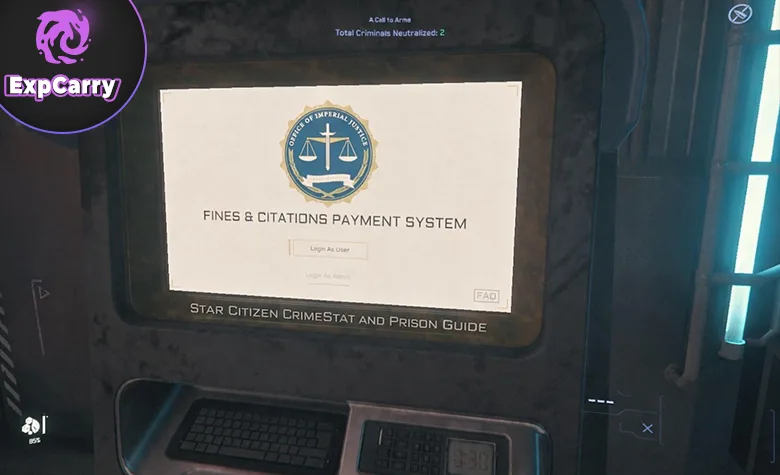
Open mobiGlas and review your Journal or legal information to see active offenses. Payable fines can be cleared at Fines and Citations terminals located at many lawful stations and Admin facilities.
Paying a fine is the best solution when:
- the terminal still offers payment;
- you only have misdemeanors or citations;
- you want to keep lawful mission access;
- you do not want to risk equipment, prison time or a Kareah operation.
Pay fines early. A small citation is cheaper than losing station access, being intercepted by security or turning a routine mistake into a felony record.
How to Surrender in Star Citizen
Surrender is the controlled way to accept arrest and begin serving the sentence instead of continuing a losing fight. Depending on the situation, players can surrender through the available legal terminal option or comply with security by stopping the ship and lowering its shields.
Surrender makes sense when:
- your fines cannot solve the record;
- you do not want to risk a Cryptokey run at Kareah;
- your ship or equipment is already expendable;
- the prison sentence is shorter than continuing to evade security;
- you plan to log off and let the sentence expire.
Do not continue attacking security after deciding to surrender. Additional crimes can increase the sentence and make the reset slower.
Explore services related to this guide, selected from our Star Citizen catalog.
View All Star Citizen Services


How to Remove CrimeStat Without Going to Prison
Payable misdemeanors can be removed through legal payment terminals. A felony-level CrimeStat must be erased by hacking the Advocacy database at Security Post Kareah, which orbits Cellin in Crusader space.
Security Post Kareah is currently the only active location used to hack away a serious CrimeStat. The station is restricted, defended by Crusader Security and can attract lawful players through missions that reward them for stopping criminal activity.
What you need for a Kareah CrimeStat hack
- a compatible Cryptokey;
- a ship capable of reaching and leaving Kareah;
- weapons, armor and medical supplies;
- enough time to complete the terminal interaction;
- a plan for security NPCs and player bounty hunters.
Insert the Cryptokey into the Advocacy terminal, start the hack and follow the terminal process until the criminal record is removed. The exact interaction can be interrupted by security, death or another player.
Kareah should be treated as a combat operation, not a quick administrative stop. Travelling there alone with valuable equipment is often less efficient than surrendering and reducing the sentence legally.
When You Are Sent to Klescher Prison
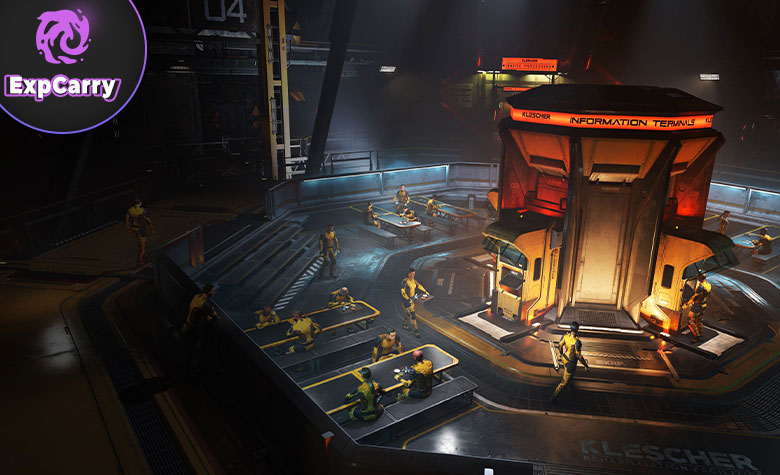
Klescher Rehabilitation Facility is the currently implemented prison in Star Citizen. It is located on Aberdeen, a moon of Hurston. Players with an arrestable criminal record can be sent there after being killed under lawful arrest conditions or after surrendering.
When imprisoned:
- your normal inventory becomes inaccessible;
- you receive prison clothing and basic mining equipment;
- a sentence timer is assigned based on your criminal record;
- you can wait, work for Merits or attempt an escape.
How the Klescher Sentence Timer Works
The sentence continues to count down while you are offline. For a short sentence, logging out and returning after the full term can be the most efficient option.
Alpha 4.8 known issue: the prison timer can reset if a player dies inside Klescher or logs out and returns before the sentence has fully expired. Until this is fixed, avoid unnecessary deaths and do not repeatedly reconnect during an active sentence.
The safest current choices are:
- remain in prison and reduce the timer through Merits;
- log out once and stay offline until the complete sentence should have expired;
- avoid escape attempts unless you accept the bug and failure risk.
What Are Prison Merits?
Merits are the internal currency used at Klescher. They can reduce prison time and can also be spent on basic supplies from prison vending machines.
One Merit currently represents approximately one second of sentence reduction. For example, 3,600 Merits can remove about one hour from the remaining sentence.
Merits can be earned through:
- hand-mining valuable minerals in the prison tunnels;
- selling mined material through the prison kiosk;
- completing Inmate Maintenance Opportunity contracts;
- receiving Merits transferred by another inmate.
Merit spending examples
| Item or use | Merit cost or value |
|---|---|
| Reduce sentence | 1 Merit ≈ 1 second |
| MedPen | 530 Merits |
| OxyPen | 520 Merits |
| Pyro RYT Multi-Tool | 730 Merits |
| Food and water | Low single-digit Merit cost |
Keep enough Merits for oxygen or medical supplies if you plan to work deep inside the mines. Spending every Merit immediately can leave you unable to complete the next run safely.
Fastest Legal Way Out of Klescher
The fastest legal route depends on the sentence length and current mission availability.
Option 1: Wait out the sentence
Best for short terms or when you are finished playing. The timer continues offline, but because of the Alpha 4.8 reset bug, remain offline until the full sentence should be complete.
Option 2: Complete maintenance missions
The Inmate Maintenance Opportunity contract appears intermittently and asks the player to reactivate an oxygen dispenser in the mining tunnels. It can award approximately 5,000 to 15,000 Merits, making it one of the fastest legal sentence-reduction methods when available.
The mission is not shareable, and deeper tunnel areas are not fully protected by an Armistice Zone. Other inmates can attack you.
Option 3: Mine for Merits
Use the provided multi-tool and mining attachment to collect minerals. Return the material to the prison kiosk and exchange it for Merits. Mining is slower than a strong maintenance reward but is repeatable and does not depend on mission availability.
How to Escape Klescher Prison
Klescher has an illegal escape route beginning through the ventilation system. Environmental markers guide the route: blue plants indicate the general direction, while yellow paint marks climbable surfaces.
An escape requires more than reaching the surface. You still need:
- transport from Aberdeen;
- outside support or access to a vehicle;
- a Cryptokey;
- a successful trip to Security Post Kareah;
- a completed CrimeStat hack before lawful forces arrest you again.
Escaping does not clear CrimeStat. It only removes you from the prison interior. Your criminal record remains active until it is hacked away.
Dying during the escape route can return you to prison and add approximately 30 minutes to the sentence. In Alpha 4.8, death may also trigger the known timer-reset issue.
When escape is worth it
Escape is reasonable when you know the route, have a pickup arranged and deliberately want outlaw gameplay. It is usually inefficient when the sentence is short, no ship is waiting outside or you do not already have a Kareah plan.
What Happens to Your Equipment?
Your regular equipment and assets are inaccessible while serving the prison sentence. After lawful release, they should be returned through the normal prison processing flow. After an escape, the broader legal recovery is not complete until the CrimeStat has been removed.
Do not carry expensive or irreplaceable equipment when deliberately attempting a high-risk Kareah hack or criminal mission chain.
Best CrimeStat Decision Tree
| Situation | Recommended action |
|---|---|
| Only payable fines | Pay them immediately |
| Low CrimeStat but no money | Use surrender if available instead of escalating |
| Felony record, strong gear and support | Prepare a Cryptokey operation at Security Post Kareah |
| Felony record, weak position or session nearly over | Surrender and serve the sentence |
| Short Klescher sentence | Wait offline until the full timer expires |
| Medium or long sentence | Prioritize maintenance missions, then mining |
| Escape route known and pickup prepared | Escape, then travel to Kareah and clear CrimeStat |
Common CrimeStat and Prison Mistakes
Ignoring small fines
Repeated minor offenses can become a felony problem. Pay manageable fines before losing lawful access.
Believing escape clears CrimeStat
It does not. You remain wanted and still need to hack the record at Kareah.
Going to Kareah without a Cryptokey
The Advocacy terminal requires a compatible Cryptokey. Reaching the station without one wastes the entire operation.
Logging back into Klescher too early
In Alpha 4.8, reconnecting before the sentence is complete may reset the timer.
Escaping without transport
Reaching Aberdeen's surface is only the first step. Without a pickup, ship or complete post-escape plan, the breakout has little value.
CrimeStat and Prison FAQ
Can CrimeStat be removed by paying a fine?
Payable misdemeanor offenses can be cleared through legal terminals. Felony-level CrimeStat normally requires prison or a hack at Security Post Kareah.
Where can CrimeStat be hacked?
Security Post Kareah, orbiting Cellin in Crusader space, is the current CrimeStat-hacking location.
Does prison time continue offline?
Yes. However, Alpha 4.8 has a known issue that can reset the timer if you reconnect before the term is complete.
What is the fastest way to reduce prison time?
Complete an Inmate Maintenance Opportunity mission when available. It can award 5,000 to 15,000 Merits. Mining is the repeatable alternative.
How much time does one Merit remove?
One Merit currently represents approximately one second of sentence reduction.
Does escaping remove the prison sentence?
You leave the facility illegally, but your CrimeStat remains. You must still reach Kareah and hack the record.
Final Recommendation
Use the cheapest clean solution available. Pay misdemeanors immediately. For felony CrimeStat, choose between surrender and Kareah based on sentence length, equipment value and available support. Inside Klescher, prioritize maintenance contracts, use mining as the repeatable fallback and avoid unnecessary deaths because of the current Alpha 4.8 timer-reset issue.
Escape only with a prepared pickup, Cryptokey and Kareah plan. Otherwise, legal sentence reduction is normally faster and safer.